Growth Manager Resume Examples: the lines they read
Build a Growth Manager Resume Around Tested Results
By Mustafa Tarabya, founder of CVBooster · Published · Updated
A growth manager resume example with acquisition, activation and retention metrics, experiment keywords, and a guide to writing growth experience.
Sample resumes for a growth manager
The same growth manager content laid out in three CVBooster templates, so you can see what the finished document looks like before you write a word.
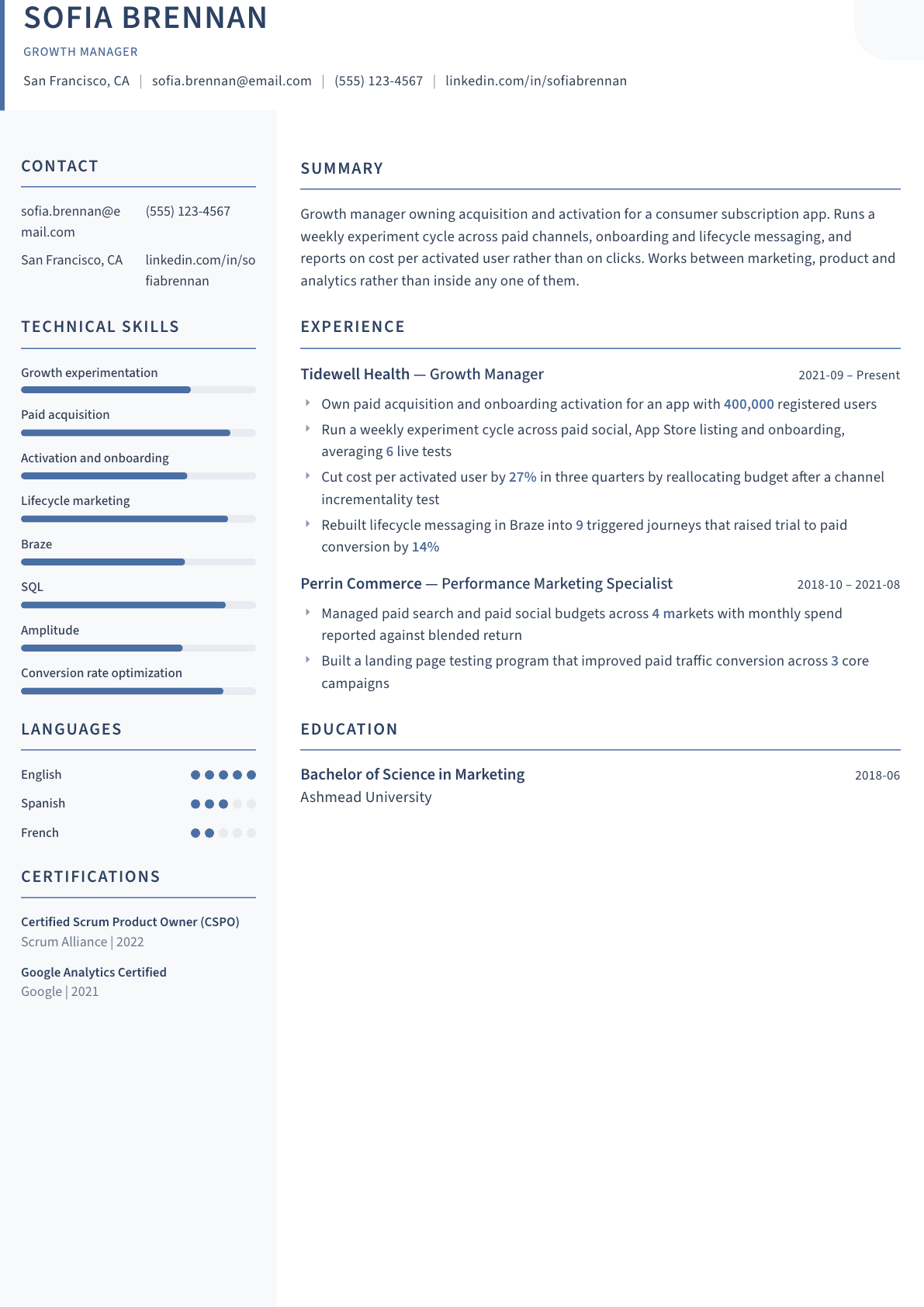
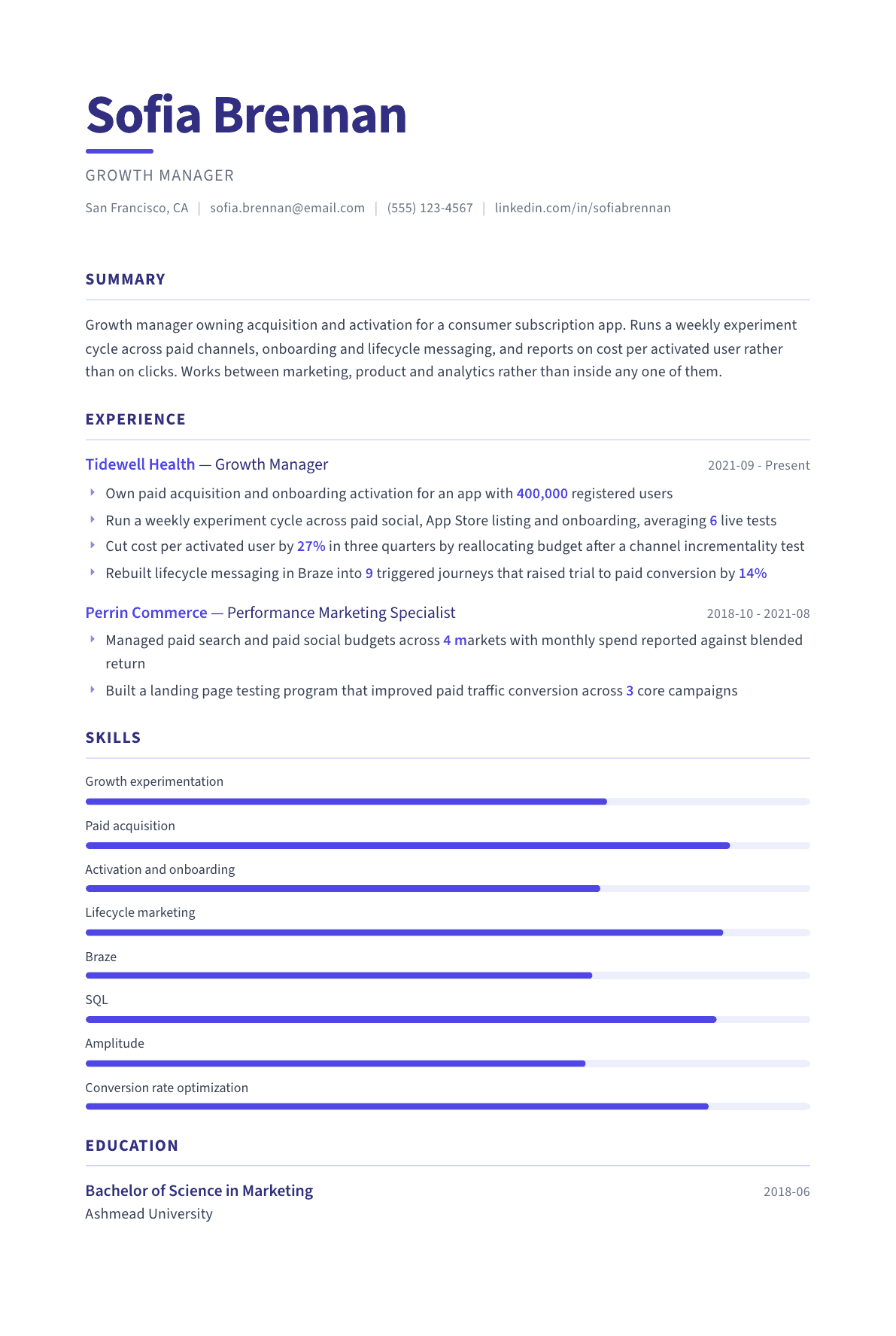
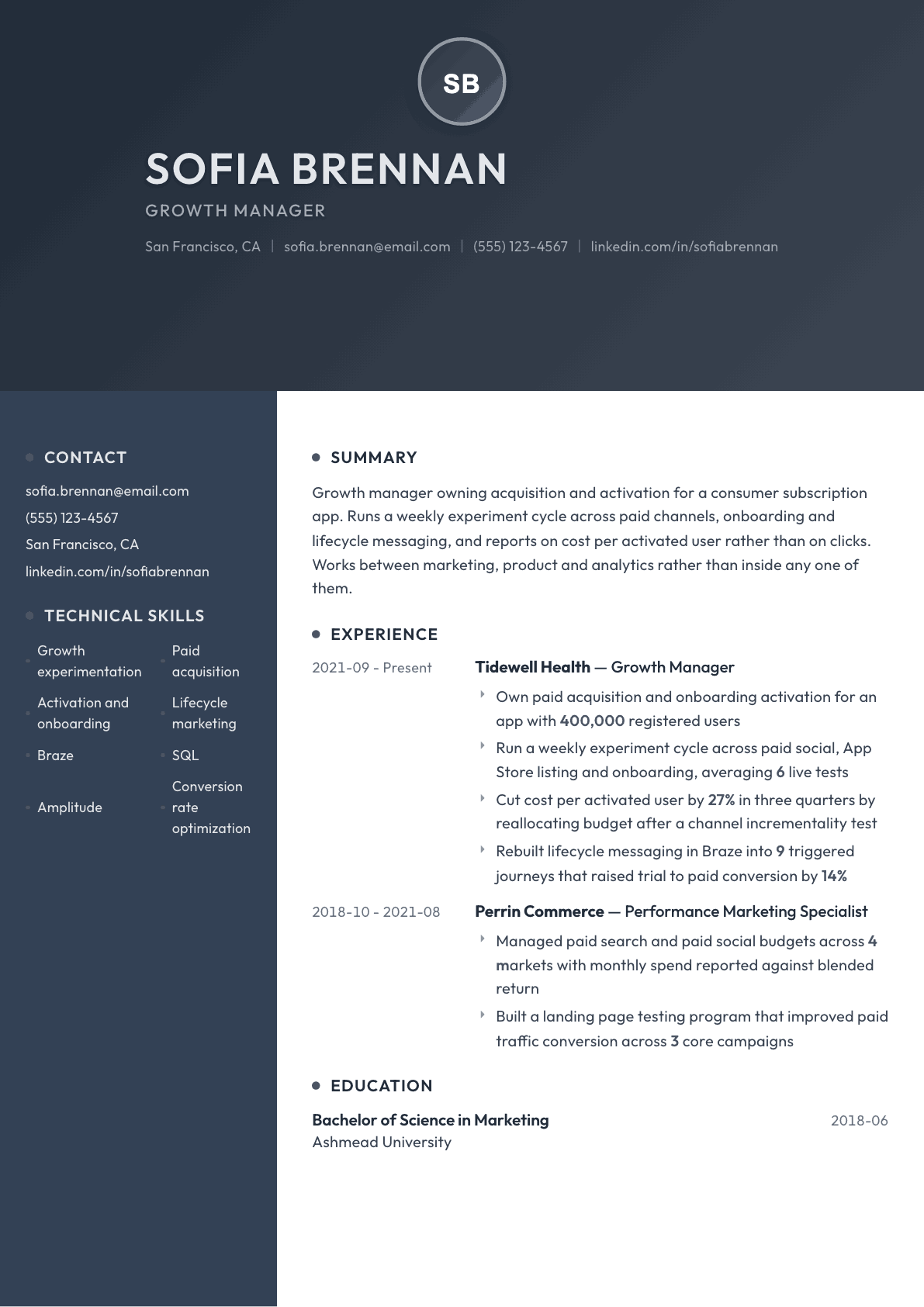
Example Growth Manager summary
Growth manager owning acquisition and activation for a consumer health subscription app with several hundred thousand registered users. Runs a weekly experiment cycle across paid channels, store listing and onboarding, and cut cost per activated user by more than a quarter after an incrementality test moved budget between channels. Rebuilt lifecycle journeys that lifted trial conversion. Seeking a growth lead role with team ownership.
Skills to list on a Growth Manager resume
- Growth experimentation
- Paid acquisition
- Activation and onboarding
- Retention and lifecycle marketing
- Conversion rate optimization
- A/B testing
- Funnel analysis
- Cohort analysis
- Attribution and incrementality testing
- Braze
- Amplitude
- SQL
- App store optimization
- Landing page testing
- Budget management
What actually gets this resume read
- State which part of the funnel you owned, because acquisition, activation and retention are hired for as separate jobs.
- Report the metric your budget was judged on, such as cost per activated user or payback period, not raw traffic.
- Describe your experiment cadence and the tests that failed, since honest test volume reads stronger than only winners.
- Show the channels and the messaging tools together, as growth roles sit between paid media and lifecycle automation.
- Include the analytics you run yourself, because most growth postings expect SQL and a product analytics platform.
- Name the collaboration model with product and engineering when your tests required code rather than campaign settings.
How to write a growth manager resume
Growth is a job title that means different things in different companies, and that ambiguity is the first problem your resume has to solve. In one business a growth manager runs paid acquisition. In another the same title owns onboarding activation and works inside a squad with engineers. A reader who cannot tell which one you were within a few lines will move on, because the two hires are not interchangeable.
The second problem is credibility. Growth attracts big claims, and hiring managers have learned to discount them. What survives scrutiny is method: the funnel stage you owned, the metric your budget or roadmap was judged on, the cadence at which you tested, and how you separated a real effect from a seasonal one. A candidate who talks about incrementality and inconclusive tests is more convincing than one with a page of round numbers.
This guide covers how to declare your funnel scope up front, how to write experiment work that a rigorous reader believes, which tools and metrics matter for acquisition compared with activation and retention, and the questions candidates ask when moving into growth from performance marketing or from product.
Format: declare your funnel scope in the first three lines
One page is enough for most growth careers. Immediately under your name, state the funnel stages you own and the business model you have worked in. Consumer subscription activation is a different craft from B2B pipeline generation, and the model determines which of your numbers a reader can even interpret.
Then add a scope line under each role: budget band if you carried one, the metric you were held to, the channels and surfaces you controlled, and whether you had engineering capacity. Growth roles without engineering support are campaign roles, and being clear about which you had prevents a mismatch later.
- Funnel scope: acquisition, activation, retention, monetization, or a named subset.
- Model: consumer subscription, marketplace, transactional ecommerce, B2B software.
- Resources: budget band, channels owned, engineering and design capacity.
Metrics: use the number your work was actually judged on
Traffic, impressions and click through rates are inputs, and a growth hiring manager treats them as such. Write the outcome metric instead: cost per activated user, payback period, trial to paid conversion, first week retention, contribution per new customer, or qualified pipeline per unit of spend. Those are the numbers a growth lead defends in a business review.
Always give the direction and the period. A conversion improvement over a quarter, with the channel mix noted, is believable. A single percentage with no timeframe reads as a headline pulled from a good week. Where absolute figures are sensitive, use relative change and a band for the spend level.
Name the seasonality or the confound where one existed. Saying that a lift held after adjusting for a seasonal peak is a small sentence that buys a lot of trust.
Experimentation: the cadence, the discipline, the failures
Growth is judged on the rate of learning as much as on the wins. State your cadence: how many tests were live in an average week, who reviewed the results, and where the backlog of ideas came from. A weekly cycle with a documented readout is a much stronger signal than a list of successful campaigns.
Show discipline. Sample size planning, holdout groups, guardrail metrics, and a rule for killing a test are the details that separate structured growth work from opportunistic changes. Include an incrementality test if you have run one, since geo holdouts and matched market tests are what let a company trust its acquisition numbers.
Mention what did not work. A candidate who says that two of five channels failed payback and were cut is describing the actual job, which is mostly reallocating away from things that do not work.
- Weekly test volume and the readout ritual.
- Design discipline: sample size, holdouts, guardrails, stopping rules.
- Channel decisions made after an incrementality or payback review.
Tools and technical depth: what you run yourself
Growth postings screen on a specific combination: an ad platform or app store surface, a lifecycle messaging tool, a product analytics platform, and enough query ability to check your own numbers. Name them individually, and say what depth you had in each, since running campaigns inside a platform and building the attribution model on top of it are different claims.
If you worked with engineers on tests that required code, say so and describe the working model. Growth engineers, a shared squad, or a queue with the product team all imply different levels of autonomy, and the difference matters to a hiring manager planning your first quarter.
Landing page and store listing work belongs here too. Page testing, checkout changes and app store listing experiments are concrete surfaces, and they are easy for a reader to picture.
- Acquisition surfaces: paid social, paid search, app store listing, affiliates, referrals.
- Lifecycle tools such as Braze or Customer.io and the journeys you built in them.
- Analysis: SQL, product analytics platform, attribution and payback modeling.
Growth Manager resume summary examples
From performance marketing
Performance marketing specialist with three years running paid search and paid social across four markets, reporting on blended return rather than channel clicks. Built a landing page testing program that improved paid traffic conversion on three core campaigns. Moving into a growth role covering acquisition and onboarding activation.
Owning acquisition and activation
Growth manager owning paid acquisition and onboarding activation for a consumer subscription app with several hundred thousand registered users. Runs six live tests in an average week and cut cost per activated user by 27% in three quarters after a channel incrementality test moved budget between paid social and store listing work.
Growth lead
Growth lead managing a team of four across acquisition, lifecycle and growth engineering for a subscription business. Built the payback model finance now uses to approve channel budgets, took trial to paid conversion up by 14% through onboarding and paywall changes, and set the experiment standard used across three squads.
Work experience bullets: before and after
Before: Managed paid acquisition campaigns.
After: Owned paid acquisition across paid social, search and the app store listing with a monthly budget in the low six figures, reporting weekly on cost per activated user rather than on cost per install.
The rewrite names the surfaces, the budget scale and the outcome metric the spend was judged against.
Before: Ran A/B tests to improve conversion.
After: Ran an average of six live tests each week across onboarding, paywall and store listing, setting sample size and guardrail metrics before launch and killing tests that breached a retention guardrail.
Cadence plus design discipline plus a stopping rule turns testing into a credible program.
Before: Reduced customer acquisition cost.
After: Cut cost per activated user by 27% over three quarters by running a geo holdout test that showed one channel was largely non incremental, then reallocating that budget to two channels with payback inside three months.
It shows the method behind the reduction, which is the part a growth lead will probe in an interview.
Before: Improved onboarding for new users.
After: Rebuilt onboarding with product and engineering, removing two steps and adding a value moment before account creation, which raised week one activation by 9% in a test held for four weeks.
The strong version names the change, the collaboration and the test duration behind the result.
Before: Set up email and push campaigns.
After: Rebuilt lifecycle messaging in Braze into nine triggered journeys covering trial, dormancy and win back, raising trial to paid conversion by 14% while holding unsubscribe rate flat.
Naming the tool, the journey structure and the guardrail shows control rather than campaign volume.
Hard skills
- Growth experimentation
- Paid acquisition across social and search
- App store optimization
- Activation and onboarding design
- Lifecycle and retention marketing
- Conversion rate optimization
- Incrementality and holdout testing
- Payback and contribution modeling
- Cohort and funnel analysis
- Braze and Customer.io
- Amplitude and Mixpanel
- SQL
Soft skills
- Comfort with being wrong quickly
- Prioritization across many small bets
- Working between marketing and product
- Clear reporting to finance
- Curiosity about user behavior
Certifications worth listing
- Google Ads Search Certification (Google)
- Google Analytics Certification (Google)
- Meta Certified Digital Marketing Associate (Meta)
Mistakes that cost growth manager candidates the interview
- Leaving the funnel scope unstated, so a reader cannot tell an acquisition hire from an activation hire.
- Reporting traffic and click through rates instead of the outcome metric the budget was judged on.
- Presenting percentage lifts with no timeframe, baseline or channel context.
- Claiming only wins, which tells an experienced growth lead the testing was not rigorous.
- Listing every marketing tool without saying what depth you had in any of them.
- Hiding whether you had engineering capacity, which decides what kind of growth work was even possible.
Growth Manager resume questions
What is the difference between a growth manager and a performance marketer?
A performance marketer optimizes media buying against a cost target. A growth manager works across the funnel, changing the product experience as well as the channels, and is usually measured on activation or retention rather than on media efficiency alone.
Which metrics should a growth manager put on a resume?
Cost per activated user, payback period, trial to paid conversion, first week retention and contribution per customer. Pick the ones your team actually reported, and always attach a period and the channel context so the number can be interpreted.
How do I show growth experience without a big budget?
Lead with product side work: onboarding changes, referral loops, lifecycle journeys, pricing page tests. Small budget experience is respected when the method is visible, and many growth teams care more about test discipline than about spend scale.
Do growth managers need SQL?
Increasingly yes. Most postings expect you to pull your own cohorts and check a result without waiting on an analyst. Basic joins, funnel logic and cohort construction cover the majority of day to day growth questions.
How do I move from product management into growth?
Highlight any work you did on activation, onboarding, pricing or referral mechanics, and any experiment you designed and read out yourself. Then add channel literacy, because the gap product managers usually have is on the acquisition side.
Related resume examples
- Digital Marketing Manager Resume example
- Product Manager Resume example
- Product Analyst Resume example
- Product Marketing Manager Resume example
- Franchise Manager Resume example
- Business Manager Resume example