Pharmaceutical Sales Representative Resume Examples
Pharmaceutical Sales Representative Resume Examples That Win Territories
By Mustafa Tarabya, founder of CVBooster · Published · Updated
Pharmaceutical sales rep resumes written out in full, with territory rankings, formulary access bullets, CRM keywords and a section-by-section guide.
Sample resumes for a pharmaceutical sales representative
The same pharmaceutical sales representative content laid out in three CVBooster templates, so you can see what the finished document looks like before you write a word.
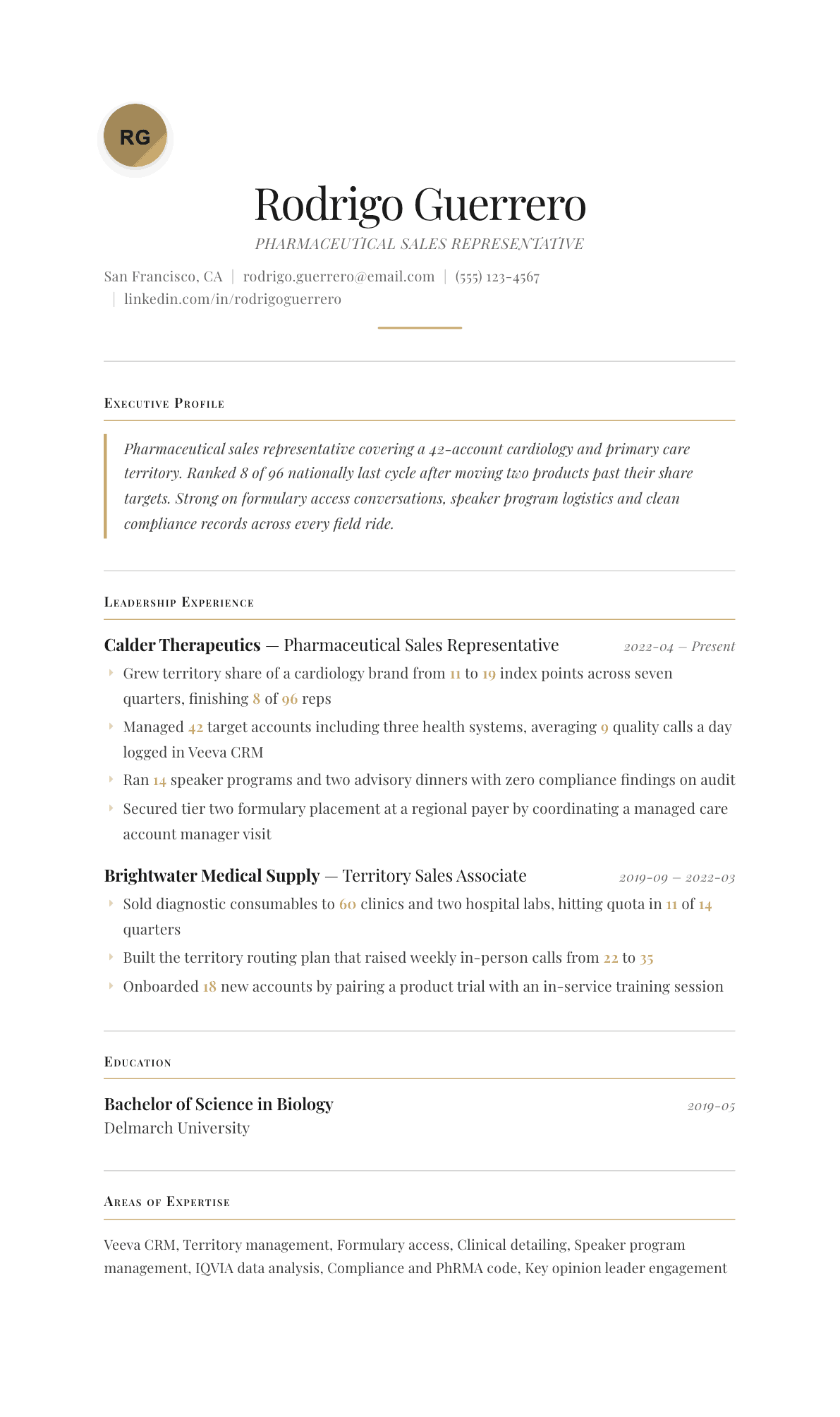
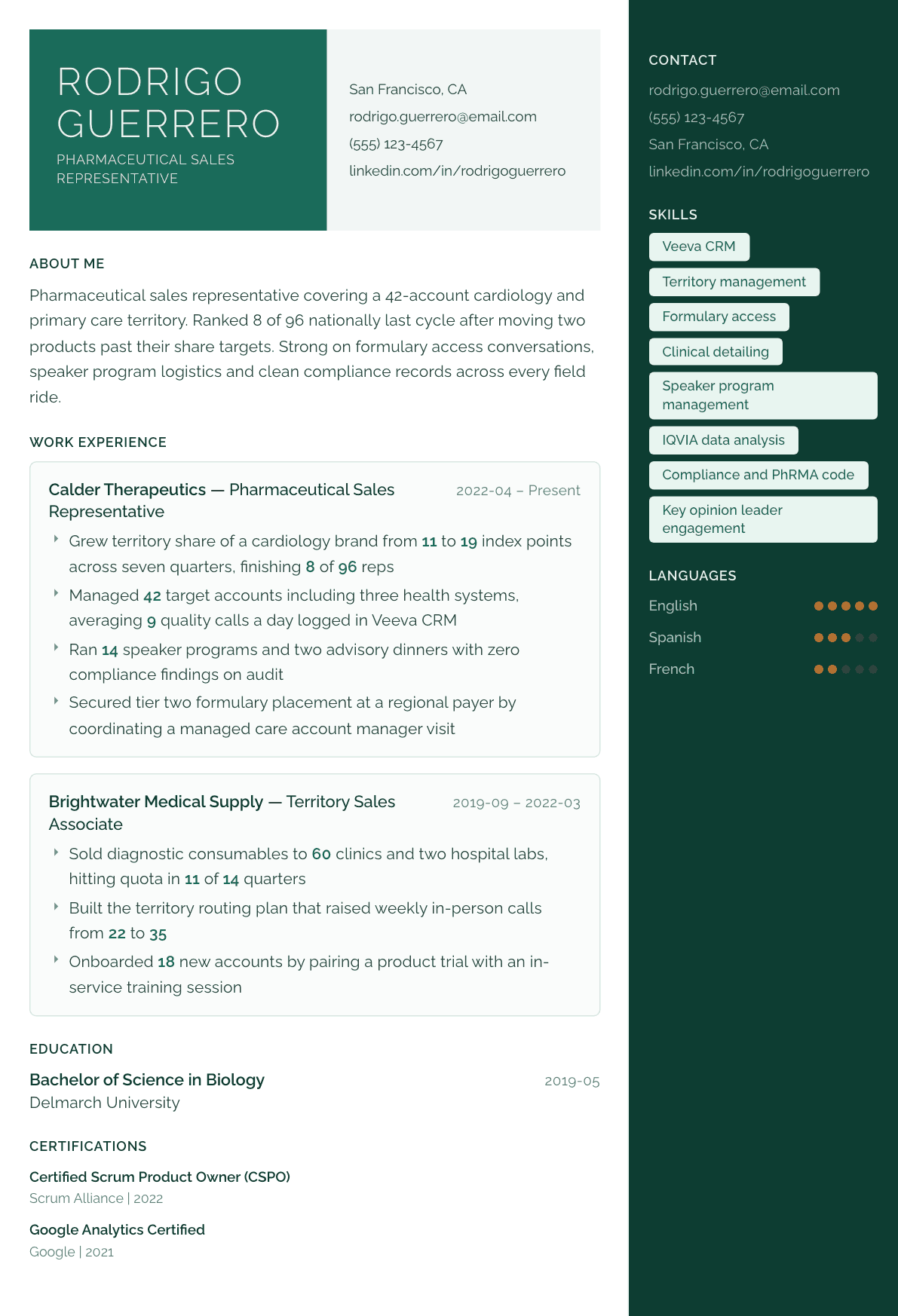
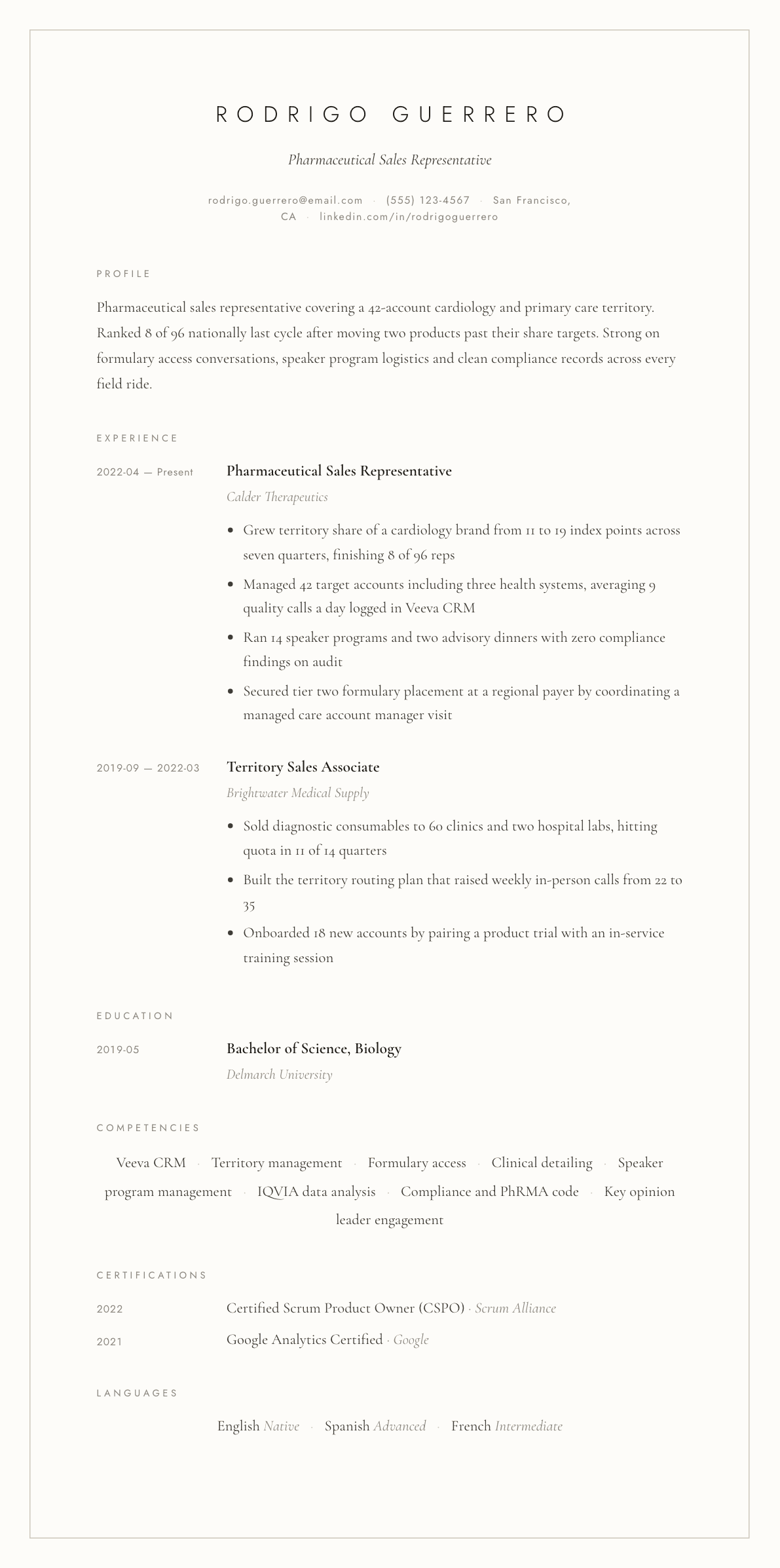
Example Pharmaceutical Sales Representative summary
Pharmaceutical sales representative with five years across cardiology and primary care, most recently ranked 8 of 96 after lifting brand share by eight index points. Runs a 42-account territory built around three health systems, logs nine quality calls a day in Veeva, and closed a tier two formulary win with the regional payer team. Clean compliance record on every field audit.
Skills to list on a Pharmaceutical Sales Representative resume
- Territory management
- Clinical detailing
- Formulary and payer access
- Veeva CRM
- IQVIA prescriber data
- Speaker program execution
- Key opinion leader relationships
- Managed care coordination
- Product launch execution
- Call planning and routing
- Sample accountability
- PhRMA code compliance
- Business plan writing
- Cross-functional field collaboration
What actually gets this resume read
- Lead every job with your national or regional rank and the number of representatives you were ranked against.
- Describe the territory in concrete terms: geography, account count, specialty mix and named health systems.
- Name the therapeutic area and the call point, because cardiology access looks nothing like dermatology access.
- Reference the data source you worked from, such as IQVIA or Symphony scripts, and the CRM you logged calls in.
- Include award names exactly as the company issued them: President Club, Rookie of the Year, Circle of Excellence.
- State your compliance record plainly, since one clean audit line reassures a hiring manager more than adjectives.
How to write a pharmaceutical sales representative resume
Pharmaceutical sales hiring is unusually numeric. A district manager who opens your resume is looking for four things in the first ten seconds: your rank, the size of the field force you were ranked inside, the therapeutic area you detailed, and whether your territory was built on offices, health systems or both. Everything else on the page is supporting evidence.
This creates a specific writing problem. Candidates coming from other sales roles describe relationships and effort, because that is what worked in their last industry. In pharma the reader is comparing you against representatives who wrote 7 of 112 at the top of a job and then explained how they got there. Without a rank or a share movement, your page has nothing to compare.
What follows is the section order a district manager expects, how to frame a territory, two pharmaceutical sales rep resumes written out from header to education, three example summaries from a first pharmaceutical role through to a senior specialty seat, rewritten bullets, and the questions candidates ask most when moving into or between pharmaceutical companies.
Format: two pages is normal, awards get their own block
Reverse chronological, clean single column, no graphics. Two pages is accepted here because rank history, award history and product launches all need space, and the reader expects a longer document than a retail or inside sales resume.
Create a distinct awards and rankings block near the top if you have more than two finishes worth naming. A district manager scanning fifty resumes will find that block, and it earns you the read of everything below it.
- Header: name, city and state, phone, email, and whether you will relocate.
- Order: summary, awards and rankings, professional experience, education, certifications and technical tools.
- Each job opens with a territory line before the bullets: geography, account count, call points, quota.
Summary: therapeutic area, territory scale, best finish
Four lines maximum. Name the therapeutic areas you have detailed, the call point mix, the years, and your strongest ranking. Cardiology and endocrinology detailing to specialists is a different job from primary care coverage of a wide office list, and the summary should settle which one you are.
If you are entering pharmaceutical sales from medical device, business to business or clinical practice, use the summary to name the bridge. A respiratory therapist moving to a respiratory portfolio should say so directly, because clinical credibility with the call point is the strongest thing that candidate owns.
Experience: territory line first, then share movement
Open each role with the territory itself: the geography, the number of target accounts, the specialty mix, the health systems included and the quota you carried. A reader cannot evaluate a growth number without knowing what it grew inside.
Then write bullets that follow the way the business is measured. Share or index movement across a stated period, total prescription volume against goal, quota attainment by cycle, new writer conversions, and formulary or pull-through wins are the four bullet types a district manager actually reads. Add one bullet on execution: speaker programs run, advisory boards supported, launches you carried into the territory.
Keep one line on compliance. A representative with a clean field audit record and disciplined sample accountability is easier to hire, and stating it plainly removes a question the interviewer would otherwise raise.
Access and data: the part that separates strong resumes
Payer access, health system contracting and pull-through are where pharmaceutical sales gets difficult, and most resumes skip them. If you coordinated a managed care account manager visit, worked a formulary review, navigated a closed system or built pull-through after a win, write it as its own bullet with the account type named.
Name your data sources and tools exactly: Veeva CRM, IQVIA or Symphony prescriber data, and whatever internal dashboard you used for targeting. Then say what you did with the data. Rebuilding a call plan by decile and lifting reach on high-decile writers is a real analytical bullet, and it is more convincing than the phrase data driven.
Education, certification and keywords
A life science degree helps but is not required, so lead with the degree you have and let the rank do the persuading. If you hold a Certified National Pharmaceutical Representative credential, list it with the issuing body rather than the acronym alone.
Postings recycle a stable vocabulary: territory management, clinical selling, share of voice, formulary access, key opinion leader engagement, launch execution, business planning, cross-functional collaboration. Use the ones that are true of you inside bullets where the evidence sits next to the phrase.
Pharmaceutical sales reps resumes: two examples written out
The two resumes below show the top of the page for a first pharmaceutical role and for an experienced specialty representative. The people, companies and products are invented. Notice that both open with a ranking or a quota result inside a named field force, because that is the comparison a district manager makes first.
- First role, header and summary: Kevin Tran, Pharmaceutical Sales Representative candidate, Phoenix, AZ. Business to business sales representative with three years selling medical office supplies to 140 physician practices, ranked 2 of 15 representatives in the region last year. Comfortable with call planning, sample accountability and CRM discipline.
- First role, experience: Territory Sales Representative, Desert Medical Supply. Territory: 140 primary care and specialty offices across the west valley. Bullets: grew territory revenue above plan in both full years; opened 22 new practice accounts; logged every call and follow up in Salesforce the same day.
- First role, education: BS in Biology; preparing for a pharmaceutical sales training certificate.
- Specialty rep, header and summary: Alyssa Grant, Specialty Pharmaceutical Sales Representative, rheumatology, Chicago, IL. Six years in immunology and rheumatology, finishing 4 of 61 in the national specialty field force last year. Calls on academic medical centers, community rheumatology groups and infusion centers.
- Specialty rep, experience: Specialty Representative, Northbrook Biologics. Territory: 9 health systems and 48 rheumatology offices. Bullets: grew new patient starts on a biologic in a contested class after securing formulary access at 2 health systems; coordinated with the market access manager on prior authorization support for 3 high volume offices; earned President's Club once.
- Specialty rep, education: BS in Health Sciences; Veeva CRM; compliant speaker program coordination.
Pharmaceutical Sales Representative resume summary examples
First pharmaceutical role
Medical device sales representative with three years selling diagnostic consumables to 60 clinics and two hospital labs, hitting quota in 11 of 14 quarters. Biology degree, comfortable in clinical conversations with physicians and lab directors, seeking a primary care pharmaceutical territory.
Five years, one portfolio
Pharmaceutical sales representative covering a 42-account cardiology and primary care territory, ranked 8 of 96 last cycle after moving brand share from 11 to 19 index points. Runs nine quality calls a day in Veeva, executed 14 speaker programs, clean on every field audit.
Specialty or institutional representative
Senior specialty representative with eleven years in oncology and immunology, covering four academic centers and a 12-hospital system. Two launches carried from pre-approval through first prescriptions, three President Club finishes, and a payer pull-through plan later adopted across the region.
Work experience bullets: before and after
Before: Built strong relationships with physicians in my territory.
After: Converted 17 new writers across 42 cardiology and primary care targets by pairing outcomes data with a same-week follow-up on every sampled office.
The rewrite counts the conversions and names the method, so relationship becomes a measurable sales result.
Before: Exceeded sales goals consistently.
After: Finished 8 of 96 representatives nationally and above goal in six of seven cycles, moving territory share from 11 to 19 index points.
A rank with the field size and a share movement gives the district manager the comparison she is actually looking for.
Before: Organized speaker programs and educational events.
After: Executed 14 speaker programs and two advisory dinners for cardiology key opinion leaders, with full attendance documentation and no compliance findings on audit.
Volume plus the compliance outcome shows both execution and the discipline the role is legally required to have.
Before: Worked with managed care to improve access.
After: Secured tier two formulary placement with a regional payer by coordinating a managed care account manager visit, then built a pull-through plan across 9 high-volume offices.
Naming the access win and the pull-through that followed proves you understand what happens after the contract is signed.
Before: Used company data to plan my calls.
After: Rebuilt the call plan by prescriber decile using IQVIA data, raising reach on the top two deciles from 61% to 84% within two cycles.
The data source, the analytical step and the reach change turn a generic claim into evidence of targeting skill.
Hard skills
- Territory business planning
- Clinical detailing
- Veeva CRM
- IQVIA and Symphony prescriber data
- Formulary and payer access
- Pull-through execution
- Speaker program management
- Key opinion leader engagement
- Product launch execution
- Sample accountability
- Call plan and decile targeting
- Health system account navigation
Soft skills
- Scientific credibility
- Access persistence
- Cross-functional partnership
- Coachability on field rides
- Route discipline
- Objection handling with clinicians
Certifications worth listing
- Certified National Pharmaceutical Representative (CNPR) (National Association of Pharmaceutical Sales Representatives)
Mistakes that cost pharmaceutical sales representative candidates the interview
- Reporting attainment without the field size, so a rank of 8 could mean 8 of 12 or 8 of 400.
- Leaving the territory undefined, which hides whether you covered rural offices or four academic medical centers.
- Describing relationships instead of writer conversions, share movement and quota attainment by cycle.
- Skipping payer access and pull-through entirely, the part of the job that separates a senior representative.
- Listing every product ever carried with no therapeutic area grouping, so the reader cannot place your expertise.
- Burying award names in paragraph text rather than giving rankings their own block near the top.
Pharmaceutical Sales Representative resume questions
How do I break into pharmaceutical sales from another industry?
Translate your current results into rank, quota attainment and account counts, then make the clinical bridge explicit. Experience selling into clinics, labs or hospitals matters more than the product, and any science coursework or clinical background belongs high on the page.
What if my company never gave us national rankings?
Use whatever comparison existed: district or region placement, percent to goal by cycle, or growth against the district average. State the basis clearly so the reader knows the scope, since an honest district rank reads better than a vague growth claim.
Should I name the specific drugs I detailed?
Name the therapeutic area and the product class rather than listing every brand. A reader hiring for a cardiology portfolio wants to see cardiology detailing and the call point, and a long brand list without grouping makes your expertise harder to place.
How long should a pharmaceutical sales resume be?
Two pages is standard once you have several cycles of ranking history, launches and award finishes. Keep the first page carrying the summary, awards block and current territory, because that is what a district manager reads before deciding to continue.
Does a layoff or a portfolio divestiture hurt my resume?
Not if you label it. Write divestiture, portfolio consolidation or restructuring next to the end date, since these are routine in the industry and every hiring manager has seen them. An unexplained gap invites more doubt than the actual reason.