Sales Director Resume Examples: the lines they read
Sales Director Resume and Director of Sales CV Sample
By Mustafa Tarabya, founder of CVBooster · Published · Updated
Sales director resume example and a director of sales CV sample built on team scope, annual number, forecast discipline and executive recruiter keywords.
Sample resumes for a sales director
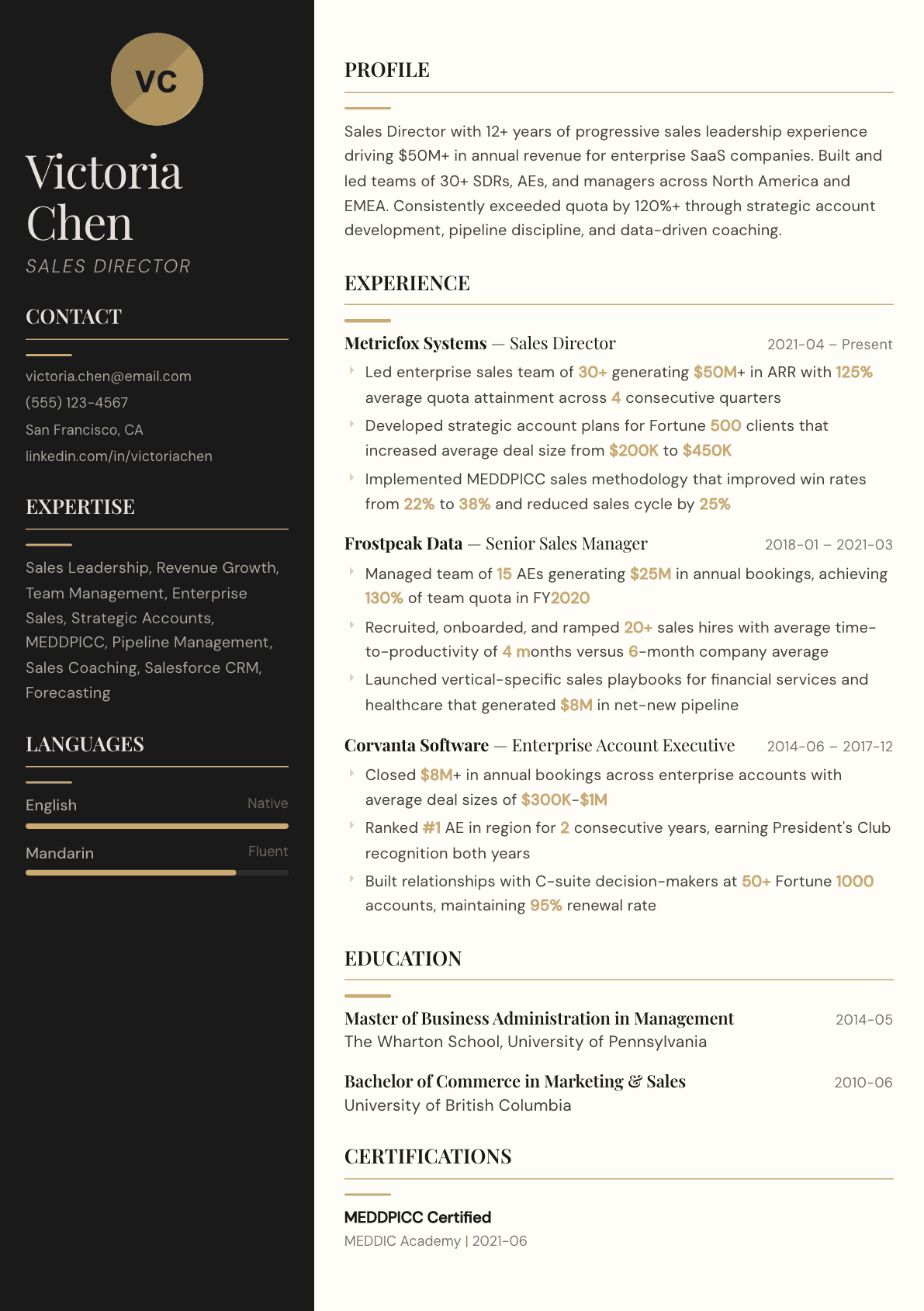
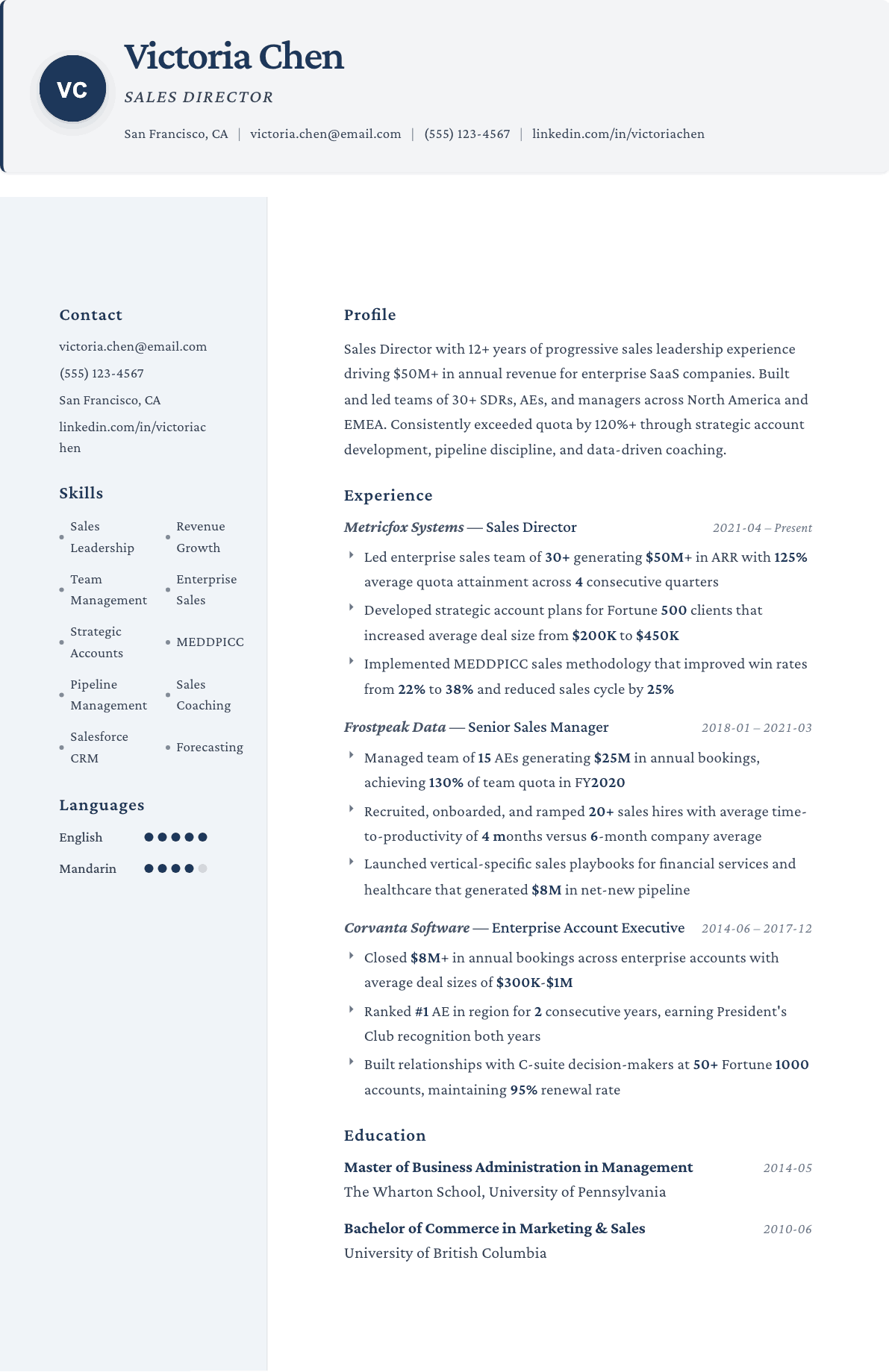
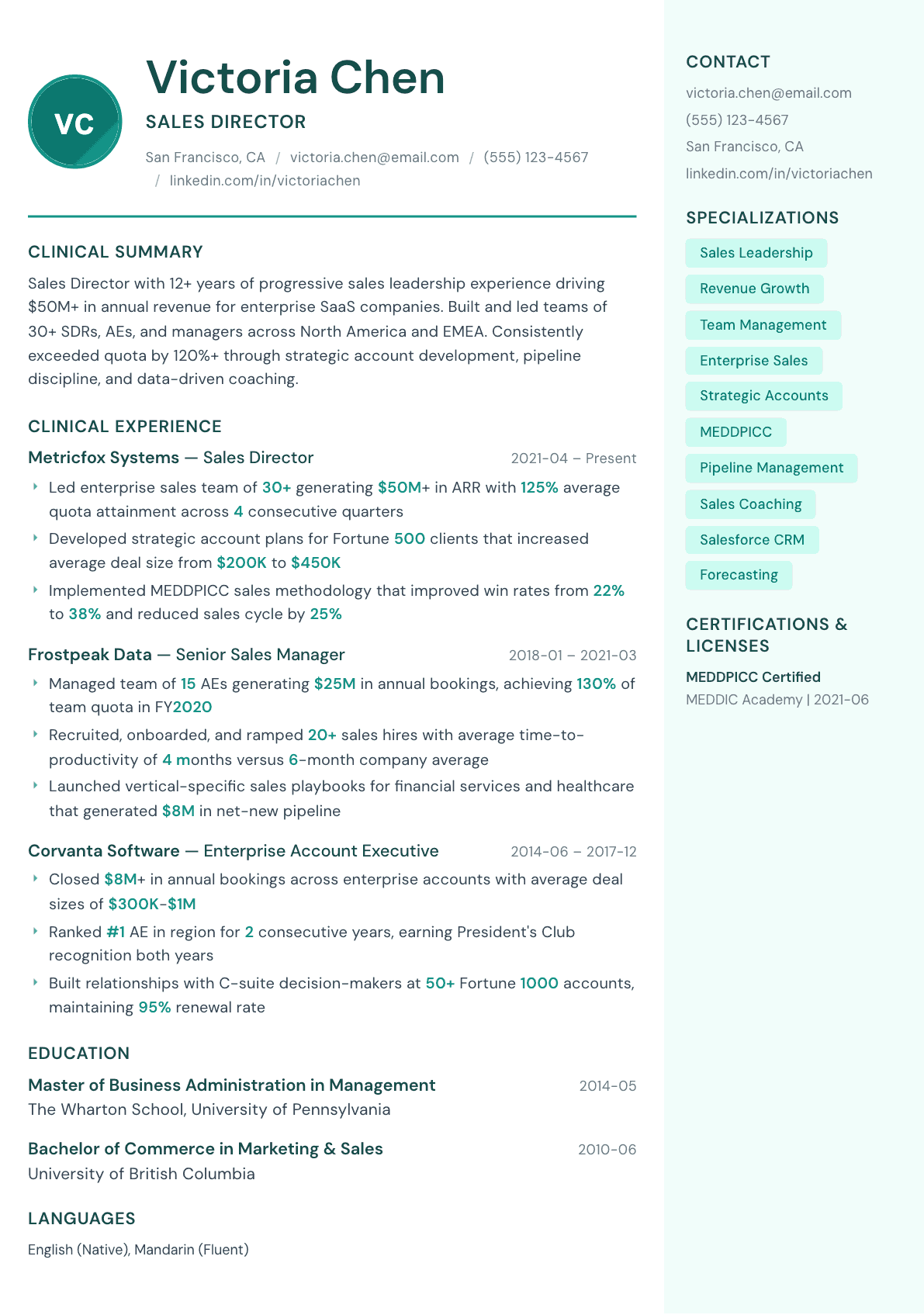
The same sales director content laid out in three CVBooster templates, so you can see what the finished document looks like before you write a word.
Example Sales Director summary
Sales Director with 12 years of experience scaling enterprise SaaS sales teams to $50M+ in annual revenue. Built and led 30-person teams at Metricfox Systems and Frostpeak Data with 125% average quota attainment. Works in MEDDPICC, strategic account development, and coaching against pipeline data. Targeting a VP Sales role at a growth-stage software company.
Skills to list on a Sales Director resume
- Sales Leadership
- Revenue Growth
- Team Management
- Enterprise Sales
- Strategic Account Management
- MEDDPICC
- Sales Coaching
- Pipeline Management
- Forecasting
- Salesforce CRM
- Hiring & Onboarding
- Quota Planning
- Cross-Functional Leadership
- Executive Selling
What actually gets this resume read
- Lead with revenue numbers: total revenue managed, quota attainment percentage, and YoY growth delivered.
- Showcase team building: team sizes managed, hiring velocity, ramp time improvements, and attrition rates.
- Highlight sales methodology expertise: MEDDPICC, Challenger, Sandler, SPIN, or Command of the Message.
- Include strategic account development: average deal size growth, enterprise client wins, and expansion revenue.
- Demonstrate pipeline discipline: forecast accuracy, pipeline coverage ratios, and deal velocity improvements.
- Mention President's Club, Chairman's Club, or other sales awards to validate consistent performance.
How to write a sales director resume
A sales director resume is read by a chief revenue officer, a founder or an executive recruiter, and all three are asking the same question: can this person own a number they cannot personally close? At this level the evidence is organizational. How large was the team, how was it structured, what was the annual number, did the organization hit it, and what did you change about how selling was done.
The most common failure is a resume that reads like a promoted account executive: deal stories, personal quota history and a few lines about leading a team. A director is hired for building the machine. Segmentation, hiring plan, ramp time, methodology, forecast discipline, compensation design, and the handoffs between marketing, sales development, closing and customer success are the substance of the role.
This guide covers the layout executives expect, how to write a summary around organizational scope, how to write bullets about systems and people rather than individual deals, which operating and planning skills to name, how a director of sales CV differs when you apply in the UK, Europe or the Middle East, and the questions directors ask when they move between company stages or into a first vice president seat.
Format: two pages, organizational scope first
Two pages, single column, no graphics. Open every leadership role with a scope line covering the annual number owned, the team size and structure, the segments and geographies covered, and the stage of the company. Company stage matters more than candidates think: running a team at an established employer with an inbound engine is a different job from building a first outbound motion at a young company, and executives filter on that distinction.
Add a short results block near the top giving plan attainment by year across your leadership roles. Consistency over several years is the single most persuasive pattern on a director resume, and it is hard for a reader to reconstruct from bullets.
- Header: name, city and state, phone, email, professional profile link.
- Order: summary, leadership results, leadership experience with scope lines, earlier selling roles, education.
- Scope line: number owned, headcount by function, segments, geography, company stage.
- Name the reporting line, since reporting to a founder is a different mandate from reporting to a vice president.
Summary: number, headcount, structure, outcome
The first two lines must carry the number owned, the headcount and structure, and the outcome. A director leading a team of account executives, sales development representatives and two managers against an eight figure annual number in enterprise software has described a role an executive can size immediately. Language about being a visionary revenue leader who builds high performing teams is filler that every competing resume already contains.
Then name what you are known for building. Some directors are hired to scale a motion that works, some to fix a team that is missing, some to open a new segment or region. Say which of those you have done, because search firms and founders hire against exactly that distinction.
Experience: the machine, not the deals
Write bullets about the operating system you installed. A qualification methodology adopted across the team and what it did to win rate. A stage definition and inspection cadence and what it did to forecast accuracy. A segmentation change that moved coverage toward higher value accounts. A ramp program that shortened time to first close for new hires. These are the artifacts a director leaves behind, and they are the reason a company pays for the role.
People results deserve their own bullets: how many managers you developed, how many representatives you hired against plan, what your ramp time looked like, what voluntary attrition was, and how many internal promotions came out of your organization. A director who cannot show a hiring and development record is asking to be judged only on one year of revenue.
Include the cross functional work. Directors negotiate with marketing over lead quality and volume, with product over roadmap commitments made in deals, with finance over quota and compensation design, and with customer success over renewal ownership. Naming one specific negotiation and its outcome shows executive range that pure sales bullets never demonstrate.
- Number owned and attainment by year, with the plan growth rate each year.
- Team structure: closers, sales development, managers, and any overlay functions.
- Hiring: roles filled against plan, ramp time to first close, attrition and promotions.
- Process: methodology, forecast cadence, stage definitions, territory and quota design.
- Cross functional: lead service level agreements with marketing, compensation design with finance.
Operating rhythm, analytics and compensation
Describe the operating rhythm you ran: weekly forecast calls, monthly business reviews, quarterly territory and quota reviews, pipeline generation targets by role, and the dashboards you held the team to. Executives read cadence as evidence of control, because a director who cannot describe their weekly rhythm usually cannot describe why a quarter missed either.
Name the analytics and the systems: the customer relationship platform, the forecasting layer, the conversation intelligence tool, the enablement platform, and the compensation and quota systems. If you designed or changed a commission plan, say what behavior you were trying to move and whether it moved, since compensation design is one of the clearest markers of a director who has operated rather than only managed.
Keywords an executive recruiter scans for
Revenue leadership, annual recurring revenue growth, quota attainment, team scaling, sales methodology, forecast accuracy, pipeline coverage, segmentation, territory and quota design, compensation planning, ramp time, attrition, manager development, go to market alignment, and business review cadence. Attach each to a result, because at director level a recruiter is screening for scope and an executive is screening for mechanism.
Director of sales resume sample
A director of sales resume sample teaches more than a list of tips, so here is one complete page for a director running a mid-market software team. The person is invented. The order is what matters: scope, number, structure, then what changed because you were there.
If the posting asks for a director of sales CV, the content stays the same and three things change. A CV outside the US often opens with a short personal profile and may run to two full pages without anyone minding; it states the countries and currencies of the number you owned; and it lists languages near the top when the territory crosses borders. Leave out photographs, date of birth and marital status unless the country you are applying in clearly expects them.
Profile: Renata Okafor, Director of Sales. Leads 34 sellers in three teams, mid-market, enterprise and sales development, against an annual new business number set by the board. Rebuilt territory design and the forecast cadence, and the team has hit plan in each of the last three years.
- Current role, Director of Sales, Fieldnote Software, four years: owns new business across North America with 34 sellers, four first-line managers and one sales operations analyst.
- Split one generalist team into mid-market and enterprise pods with separate quotas, which shortened the average enterprise cycle by five weeks.
- Cut new account executive ramp from nine months to six with a written onboarding plan, call certification and a shadowing schedule.
- Introduced a weekly forecast call with commit, best case and pipeline categories, and the quarter-end call has landed close to the final number for eight straight quarters.
- Hired 19 sellers and two managers; both managers were promoted from inside the team.
- Previous role, Regional Sales Manager, Corvane Systems, three years: led eight account executives in the central region and finished first of five regions twice.
- Earlier role: Senior Account Executive, Corvane Systems, three years, President's Club twice.
- Education and tools: Bachelor of Business Administration. MEDDICC qualification, Salesforce, Gong and Clari for forecasting.
Sales Director resume summary examples
First director seat
Sales manager stepping into a director role after four years leading a team of eight account executives and two sales development representatives against a seven figure annual number. Delivered plan in three of four years, built the ramp program now used across the sales organization, and promoted two representatives into management.
Sales director
Sales Director owning an eight figure annual number in enterprise software, leading 22 people across closing, sales development and two frontline managers in North America. Delivered plan for three consecutive years, rolled out a qualification methodology that lifted win rate, and cut new hire ramp time by a full quarter.
Multi-region director
Senior sales director with twelve years of leadership across North America and Europe, most recently 40 people and four managers against a nine figure annual number. Opened a new European region from two representatives to a full team, redesigned territories and quota, and kept voluntary attrition below the organization average.
Work experience bullets: before and after
Before: Led a large sales team and grew revenue year over year.
After: Owned an eight figure annual number with 22 people across closing, sales development and two frontline managers, delivering 118%, 106% and 121% of plan in three consecutive years.
Headcount by function, the number owned and attainment for each year replace a growth claim with an operating record.
Before: Implemented a new sales methodology across the team.
After: Rolled out MEDDPICC with mandatory stage exit criteria and weekly deal inspection, lifting win rate on qualified opportunities from 24% to 35% within three quarters.
Naming the methodology, the enforcement mechanism and the win rate change shows the rollout actually landed.
Before: Hired and onboarded new sales representatives.
After: Filled fourteen of fifteen planned roles across two years and rebuilt onboarding into a structured 30, 60 and 90 day plan that brought median time to first close down by a full quarter.
Hiring against plan plus a ramp outcome demonstrates the two things an executive checks when scaling a team.
Before: Improved forecast accuracy and pipeline management.
After: Replaced subjective stage calls with documented exit criteria and a weekly commit review, holding quarterly forecast within a narrow band of actual bookings for eight straight quarters.
The mechanism and the run of quarters make the accuracy claim something the reader can question and verify.
Before: Worked closely with marketing and product teams.
After: Negotiated a lead service level agreement with marketing covering volume, qualification criteria and response time, then held a joint weekly review that cut disputed lead rejections to near zero.
A named agreement and a joint review show real cross functional operating work rather than general cooperation.
Hard skills
- Revenue planning and forecasting
- Sales methodology rollout
- Territory and quota design
- Compensation plan design
- Hiring and ramp programs
- Manager development
- Pipeline coverage analysis
- Segmentation and coverage models
- Business review cadence
- Salesforce and forecasting tools
- Enablement program ownership
- Go to market alignment with marketing
Soft skills
- Executive communication
- Accountability without fear
- Judgment on people decisions
- Calm in a missed quarter
- Persuasion across functions
- Long range planning
Certifications worth listing
- Certified Sales Leadership Professional (CSLP) (Sales Management Association)
- Salesforce Certified Administrator (Salesforce)
- Project Management Professional (PMP) (Project Management Institute)
Mistakes that cost sales director candidates the interview
- Filling the page with personal deal stories, which signals a strong seller rather than a leader who can build an organization.
- Giving revenue with no headcount or structure, so an executive cannot tell whether you led six people or sixty.
- Skipping the hiring and attrition record, which is half of what a director is accountable for.
- Naming a methodology without the enforcement mechanism, since a rollout with no inspection cadence rarely survives a quarter.
- Leaving out company stage, when scaling a working motion and building a first one are different jobs with the same title.
- Presenting only the years that went well, which invites an executive to assume the rest went badly.
- Ignoring the cross functional half of the role: lead quality, product commitments, compensation and renewal ownership.
Sales Director resume questions
How is a sales director resume different from a sales manager resume?
A manager resume is about a team hitting its number. A director resume is about the system that makes teams hit numbers: segmentation, hiring plans, ramp, methodology, forecast discipline and compensation. If your page could belong to either, an executive will assume you are still operating at the manager level.
Should I include my earlier quota carrying roles?
Yes, but compress them to two or three lines each. They establish that you have carried a bag and closed real deals, which matters for credibility with the team, but they should not occupy space that belongs to leadership scope and operating results.
How do I show impact when the company missed its overall plan?
Give your own segment or region against its plan and name the wider context honestly, such as a market contraction or a product transition that hit the whole organization. Executives are more concerned with whether you can diagnose a miss accurately than with whether you have an unbroken record.
What changes in a director of sales CV compared with a resume?
Very little of the substance. A director of sales CV for roles outside the US usually opens with a short profile, can run to two full pages, names the countries and currencies of the number you owned and lists languages near the top. Mention compensation plan design there as one bullet: what you changed and what it did to attainment or attrition.
Does the size of the company I led matter to an executive recruiter?
It matters because motion and stage rarely transfer cleanly. Leading a team inside an established organization with mature demand generation is different from building the first outbound engine at a young company. State the stage plainly so a recruiter matches you against the right search instead of screening you out for ambiguity.