Territory Manager Resume Examples: the lines they read
Build a Territory Manager Resume That Covers Every Corner
By Mustafa Tarabya, founder of CVBooster · Published · Updated
Create a field-driven territory manager resume with geographic sales expertise, route optimization, and account growth strategies that field sales organizations seek.
Sample resumes for a territory manager
The same territory manager content laid out in three CVBooster templates, so you can see what the finished document looks like before you write a word.
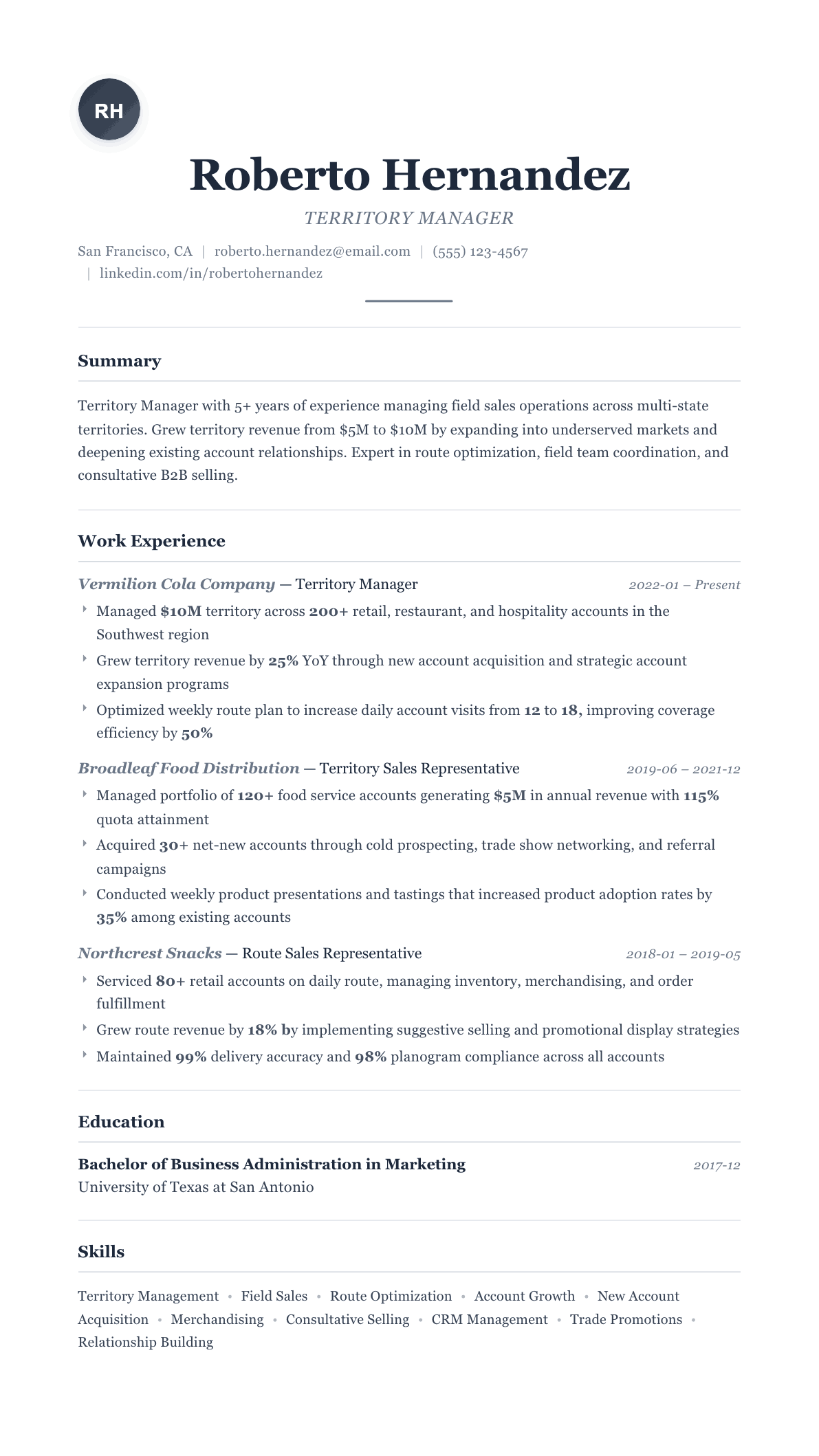
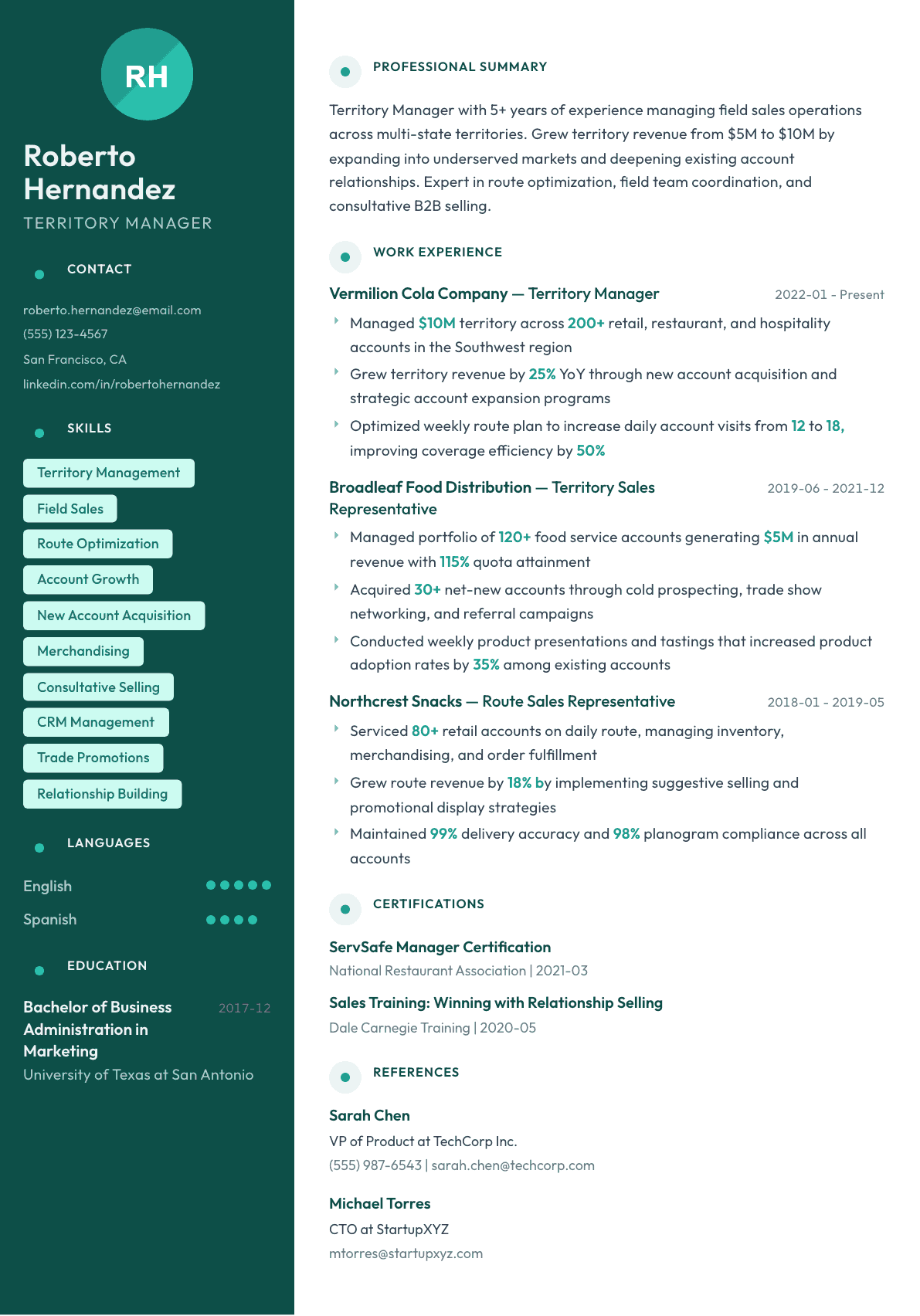
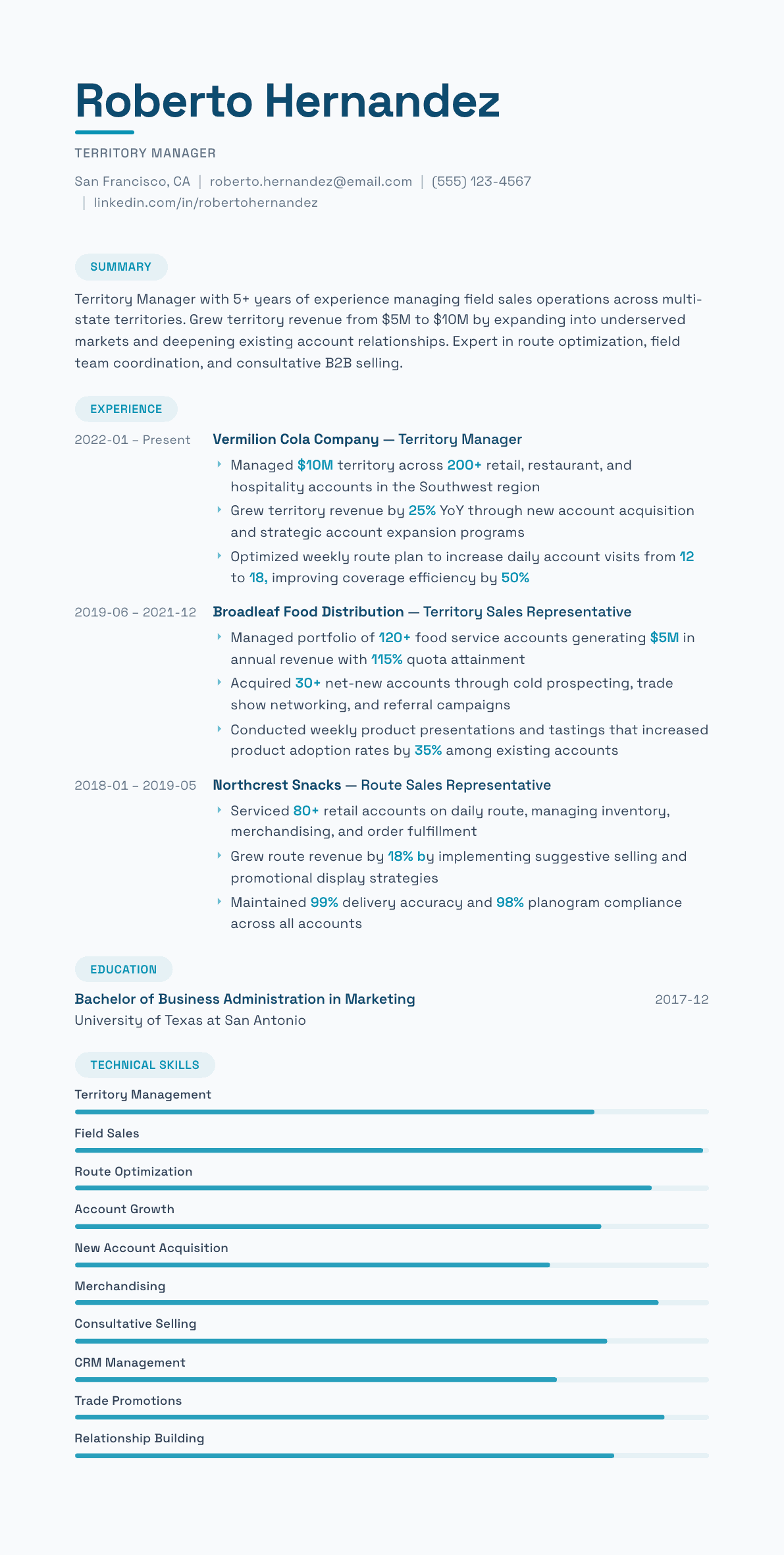
Example Territory Manager summary
Territory Manager with 5 years in field sales, growing a Southwest territory from $5M to $10M in annual revenue. Covers 200+ retail, restaurant, and hospitality accounts at Vermilion Cola Company and lifted daily account visits from 12 to 18 through route redesign. Strong in consultative B2B selling and new account acquisition.
Skills to list on a Territory Manager resume
- Territory Management
- Field Sales
- Route Optimization
- Account Growth
- New Account Acquisition
- Merchandising
- Consultative Selling
- CRM Management
- Trade Promotions
- Inventory Management
- Relationship Building
- Market Analysis
- Presentation Skills
What actually gets this resume read
- Define your territory clearly: geographic scope, number of accounts, and revenue size.
- Quantify growth: territory revenue increase, new accounts acquired, and market share gained.
- Highlight route optimization and time management skills that maximize field productivity.
- Showcase consultative selling: how you understand account needs and propose tailored solutions.
- Include merchandising and in-store execution skills that demonstrate full-cycle field sales capability.
How to write a territory manager resume
A territory manager is hired to own a map. The person reading your resume, usually a regional or district sales director, wants to know the shape of the ground you have covered: how many accounts, spread over what geography, in which channel, and what happened to the revenue while it was yours. Territory work is field work, and a resume that reads like an office sales role misses the point of the job.
The second thing that reader checks is call cadence. Field selling lives on route planning, visit frequency, and the discipline to show up at the same accounts on schedule while still prospecting new ones. Candidates who describe only closing and never describe coverage look like they will let the back half of the territory rot.
This guide walks through the territory manager resume in the order a field director reads it, with summaries for a route seller moving up through a multistate manager, before-and-after bullets, and the questions field reps ask when they put a map on paper.
Format: define the territory before anything else
One page unless you have managed several regions across a long career. Reverse chronological, plain layout, no map graphics, since parsers drop images and the same information reads better as a line of text.
Directly under each job title, write a territory definition line: geography, account count, channel, and revenue carried. Something like "Southwest region, 200 retail, restaurant and hospitality accounts, 10M annual" gives the reader the whole picture before the first bullet.
- Header: name, the metro area you are based in, phone, email, and whether you hold a clean driving record.
- Order: summary, territory scope, experience, product and channel expertise, education.
- Note overnight travel percentage and whether the territory was driven or flown, because that shapes the fit.
Summary: the map, the channel, the growth
Three or four lines. Say which states or metros you have covered, the channel you sell through, the number of accounts you carried, and what the revenue did on your watch. Field directors hire on growth inside an existing book far more than on raw closing volume.
If you are stepping up from a route or merchandising job, say that, then lead with the account count and the growth you produced on that route. Field organizations promote from the van regularly, and the numbers you already have are the evidence they use.
Experience: coverage, growth, and the accounts you opened
Open each role with the territory scope and what happened to revenue over the period. Then cover the two halves of the job separately: growing existing accounts through assortment, promotion and display, and adding net-new accounts through cold calls, trade shows and referrals. A territory manager who shows only one half looks like a farmer or only a hunter, and most field jobs need both.
Show your call cadence explicitly. Accounts visited per week, the route plan you built, how you segmented accounts by size so the top ones got more frequent visits. This is the operational habit a district manager most needs to see.
Include the work that surrounds the sale in the field: planogram compliance, inventory counts and returns, distributor and broker coordination, product training for account staff, and resolving delivery or credit issues. These bullets show the reader you can hold a territory rather than just call on it.
Products, channels and systems
Name the category you have sold and the channel it moved through. Food service, convenience and grocery, medical and dental offices, building supply dealers, automotive aftermarket, industrial distribution and hospitality all read very differently to a hiring director, and category familiarity often decides the shortlist.
List the systems you used in the field: the CRM on your phone, the order entry system, the route planning tool, and any retail execution app used for photos and audits. Salesforce, HubSpot, SAP order entry and route planning software all appear in these postings, and a candidate who names them saves a training week.
Keywords a field sales screen looks for
The phrases that recur are territory management, field sales, account growth, new account acquisition, route planning, call cadence, merchandising, planogram compliance, trade promotion, distributor relations, product training and quota attainment. Use the posting words once in the summary and again in a bullet that carries a number. Keep the phrasing natural, because a district manager who reads the file next can tell padding from experience immediately.
Territory Manager resume summary examples
Route seller moving up
Route sales professional serving 80 retail accounts daily across two counties, growing route revenue 18% through suggestive selling and promotional displays while holding 98% planogram compliance. Ready to take a defined outside territory with new account acquisition responsibility.
Five years in the field
Territory Manager covering 120 food service accounts across a two-state territory worth 5M, at 115% of quota. Added 30 net-new accounts through cold prospecting and trade show work, and lifted product adoption among existing accounts through in-store tastings and staff training.
Multistate territory manager
Senior Territory Manager running a 10M multistate book of 200 retail, restaurant and hospitality accounts. Grew revenue 25% year over year, raised daily account visits from twelve to eighteen through a redesigned route plan, and mentored two junior reps into their own territories.
Work experience bullets: before and after
Before: Managed a sales territory and grew revenue.
After: Owned a 10M Southwest territory of 200 retail, restaurant and hospitality accounts, growing revenue 25% year over year through assortment expansion and new account acquisition.
The revenue, the account count, the channel mix and the growth lever tell a field director exactly what kind of ground you can hold.
Before: Visited customers regularly to maintain relationships.
After: Rebuilt the weekly route into three tiers by account volume, raising daily visits from twelve to eighteen and giving top accounts a call every two weeks instead of monthly.
Coverage discipline becomes visible when you name the segmentation and the visit frequency it produced.
Before: Brought in new business for the company.
After: Opened 30 net-new food service accounts in one year through cold calls on the route, two regional trade shows, and a referral program run through existing operators.
Naming the three prospecting channels shows a method rather than luck, and the count sets the pace you can be expected to keep.
Before: Handled merchandising and product displays in stores.
After: Held 98% planogram compliance across 80 accounts and placed 40 promotional end caps per quarter, lifting sell-through on featured items during promotion windows.
Compliance rate and display volume are the retail execution measures a consumer goods manager tracks weekly.
Before: Worked with distributors on orders and deliveries.
After: Coordinated weekly with two distributor partners on order accuracy and fill rate, resolving delivery exceptions the same day and holding 99% on-time delivery for the territory.
The distributor half of field selling is invisible until you name the cadence, the failure mode and the service level.
Hard skills
- Territory planning and route design
- New account acquisition
- Account growth and assortment expansion
- Consultative field selling
- Merchandising and planogram compliance
- Trade promotion execution
- Distributor and broker management
- Order entry and inventory management
- CRM management in the field
- Trade show and tasting events
- Product training for account staff
- Quota and forecast reporting
Soft skills
- Working alone without supervision
- Building rapport with store operators
- Problem solving on the account floor
- Time management across a driving day
- Persistence through repeat cold calls
Certifications worth listing
- Certified Professional Sales Person (CPSP) (National Association of Sales Professionals)
- Certified Sales Executive (CSE) (Sales and Marketing Executives International)
- Salesforce Certified Administrator (Salesforce)
- ServSafe Food Handler (National Restaurant Association)
Mistakes that cost territory manager candidates the interview
- Never defining the territory, which leaves the reader unable to tell a dense city route from a five-state driving region.
- Reporting growth as a percentage with no revenue base, so a small increase on a tiny book looks the same as real expansion.
- Showing only new account wins and nothing about holding and growing the existing book, which is most of the job.
- Leaving out call cadence and route planning, the operational habits a district manager checks before anything else.
- Omitting the channel and product category, when category familiarity is often what puts a resume on the shortlist.
- Forgetting the travel picture: overnight nights per month, whether the territory is driven or flown, and the driving record.
Territory Manager resume questions
How do I describe my territory if the boundaries changed several times?
Show the territory as it was at its largest and note the change in one clause, such as an expansion from one state to three after a realignment. Directors realign constantly and read a candidate who absorbed a change without a revenue dip as a strength.
Does a territory manager resume need a driving record or license mention?
Include a clean driving record line when the posting mentions a company vehicle or heavy driving, which most field roles do. It removes a screening question early and matters more here than in an office sales role.
How much should I say about merchandising work?
Give it real space in consumer goods, beverage and grocery channels, where planogram compliance, display placement and sell-through are tracked as closely as revenue. In industrial or medical territories, replace it with product demonstrations and technical support.
What if my territory shrank because accounts were reassigned?
Say so plainly and report performance on the book you actually held. Reassignments are routine in field organizations, and a rep who explains a revenue drop with a specific structural cause reads as honest rather than as a decline.
Should I list the accounts by name?
Name the largest chains or operators only when they are public knowledge and the relationship is a real selling point. Otherwise describe the account type and size, since customer lists can be confidential and a hiring director cares more about the profile than the logos.