Security Guard Resume Examples: the lines they read
Security Guard Resume: Skills and a Complete Sample for Security Jobs
By Mustafa Tarabya, founder of CVBooster · Published · Updated
Security guard resume example with the security job skills to list for each post, a complete sample, license block, patrol and incident report bullets.
Sample resumes for a security guard
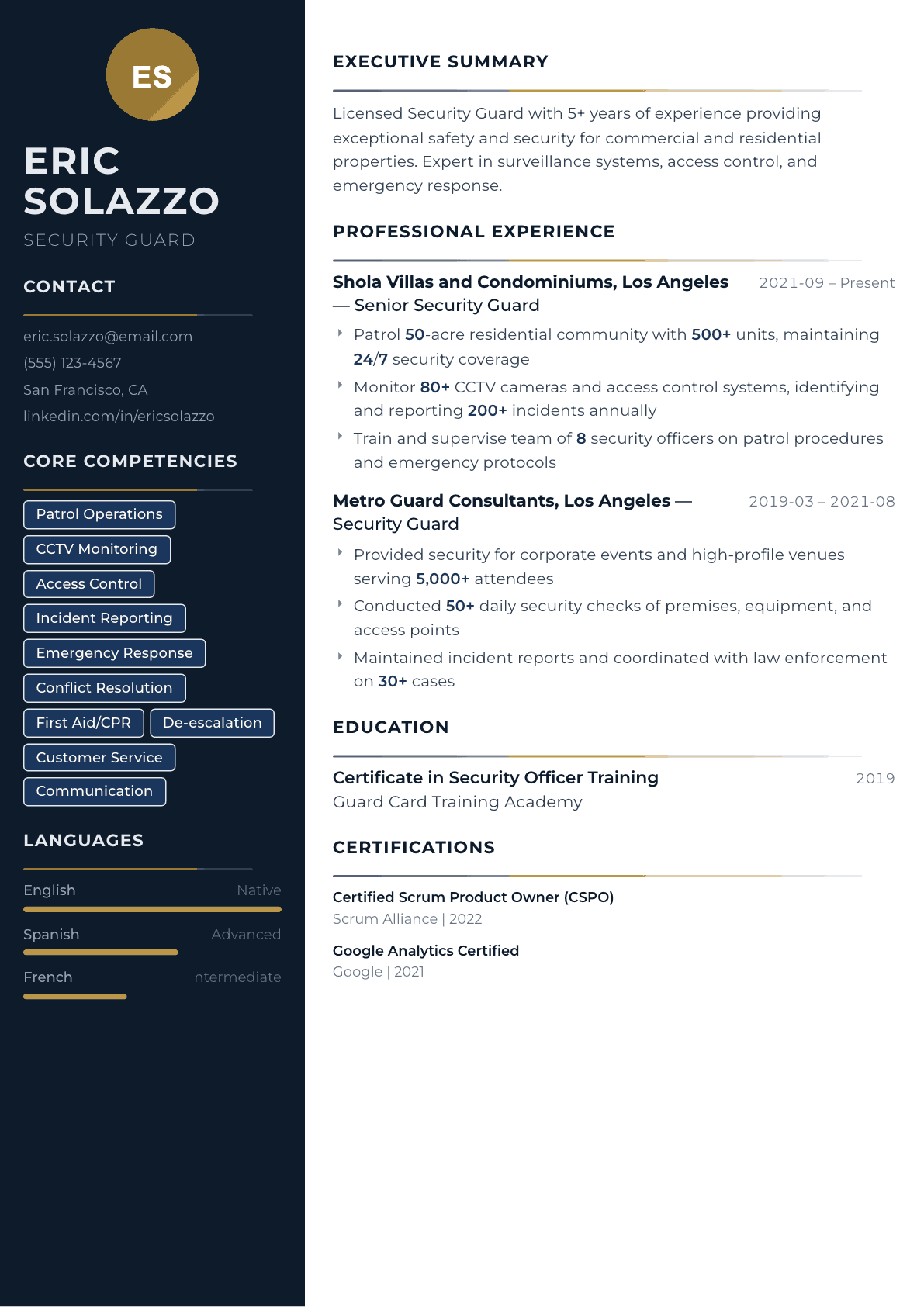
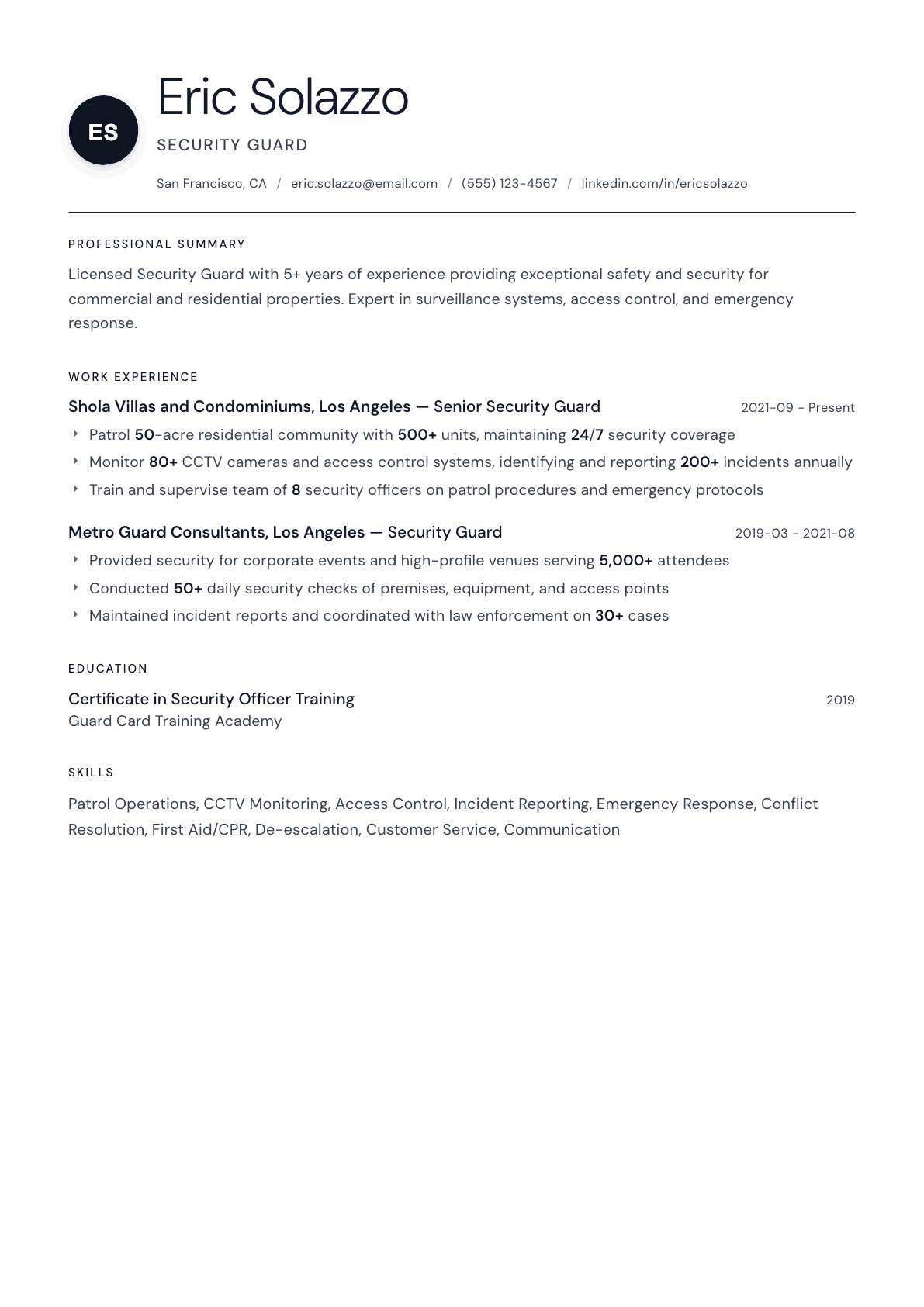
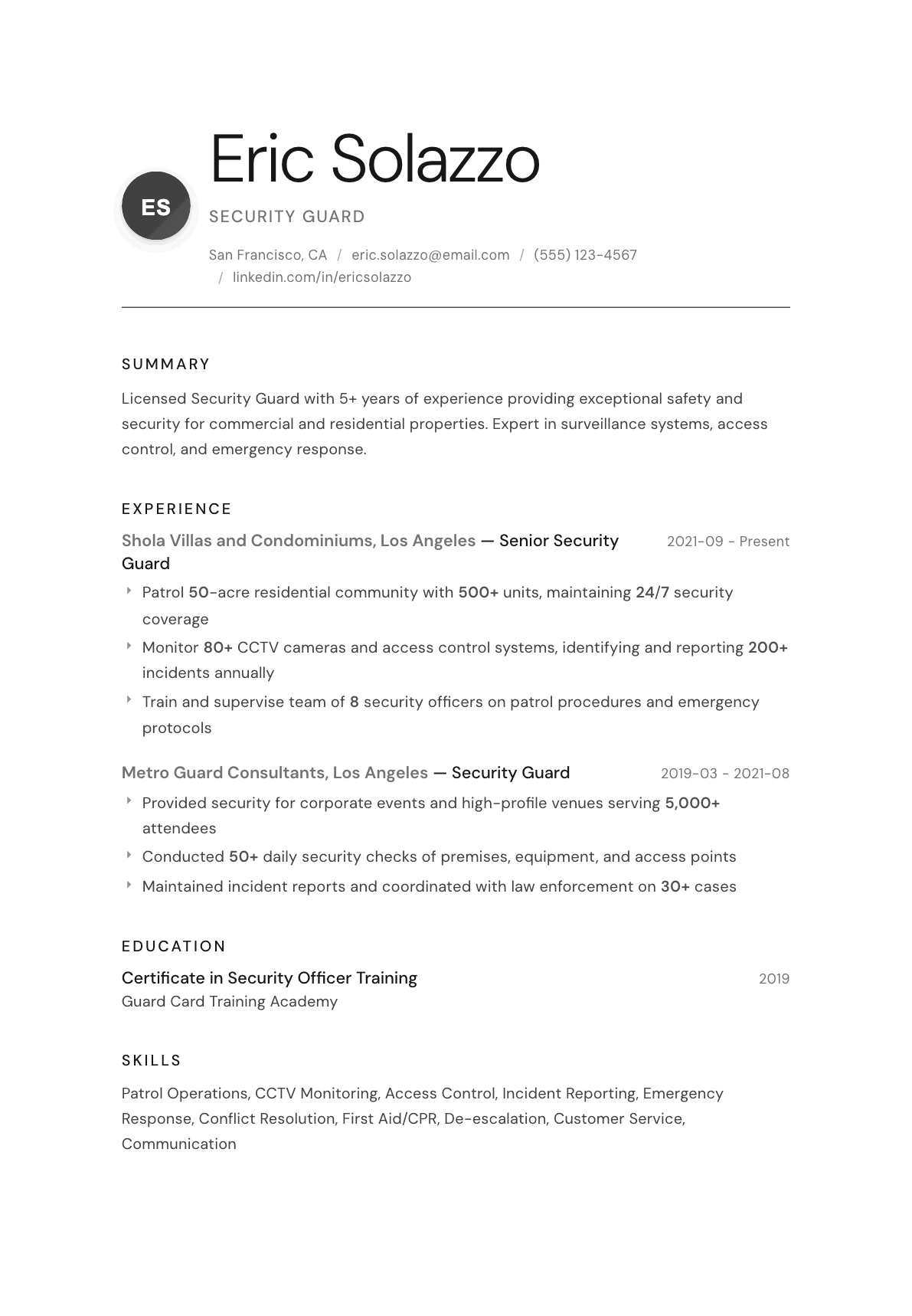
The same security guard content laid out in three CVBooster templates, so you can see what the finished document looks like before you write a word.
Example Security Guard summary
Licensed security officer, 5 years, currently senior on a 50-acre residential site with 500 units, 80 cameras and a team of eight officers to supervise. Logs and reports around 200 incidents a year, works events for crowds of 5,000, and coordinates with police on cases that go further.
Skills to list on a Security Guard resume
- Patrol Operations
- CCTV Monitoring
- Access Control
- Incident Reporting
- Emergency Response
- Conflict Resolution
- First Aid/CPR
- De-escalation
- Customer Service
- Communication
What actually gets this resume read
- List your guard card, firearms permits, and relevant certifications.
- Highlight property sizes and types you've secured.
- Include technology experience (CCTV, access control, alarm systems).
- Show training and supervisory experience.
- Mention emergency response and conflict resolution skills.
How to write a security guard resume
Security guard hiring moves fast, and it moves on paperwork. The account manager or site supervisor reading your resume is usually filling a post that starts next week, and their first pass is looking for a current guard card, the right endorsements, availability for the shift pattern, and reliability. A resume that answers those four things in the first six lines gets a call the same day.
The second thing that reader checks is site fit. A hospital lobby, a construction yard, a data center, a distribution warehouse, a retail center, a high-rise residential building and a nightclub each need different temperaments and different training. Naming the post types you have worked lets a supervisor place you on a site where you will last, and turnover is the biggest problem they have.
This guide covers the resume structure that works for security officer roles, the security guard resume skills to list for each type of post, a complete resume for security jobs from header to training with four post variations, three summaries from an unlicensed applicant through a site supervisor, before-and-after bullets, and the questions guards ask when their work sounds routine on paper.
Format: one page, licensing block up top
One page, always. Reverse chronological, plain layout, no graphics, and clear month and year dates, because contract security companies run background checks and any unexplained gap slows the file down.
Directly under the header, put a licensing and availability block: your guard card or state security license with the state, any armed permit, first aid and CPR certification, driver license class, and the shifts you can work. Overnight and weekend availability is a genuine advantage in this field and should be stated rather than assumed.
- Header: name, city, phone, email, and license status in plain words.
- Order: summary, licenses and certifications, security experience, related experience, education.
- Add languages spoken, which matters on lobbies, campuses and healthcare posts.
Summary: post types, site size, shift pattern
Three short lines. Say how long you have worked security, the post types you have covered, the size and kind of property, and whether you were armed or unarmed. A supervisor reading fifty applications wants to know in one glance whether you have stood a hospital lobby or a construction gate.
If you have no security experience yet, use the summary to show the transferable half. Customer-facing work under pressure, military or corrections service, warehouse or transport work with a clean attendance record, and a current guard card together make a very placeable candidate.
Experience: the post, the property, the log
Under each job, describe the property before the duties: a hospital campus, a distribution center with three gates, a residential high-rise with several hundred units, a corporate office with badge access. Property type and size do more to place you than any adjective.
Then show the work in concrete terms. Foot and vehicle patrols per shift, access control and visitor processing volume, alarm response, camera monitoring across a stated number of feeds, and the daily activity log and incident reports you wrote. Report writing matters more than most guards realize, because incident reports get read by insurers, attorneys and clients.
Include the customer service half honestly. Most security posts are mainly service work: directions, escorts to vehicles, lockouts, deliveries, and calming an upset visitor. Officers who show de-escalation and courtesy get placed on the better sites and get supervisory looks sooner.
If you have supervised, say so with specifics: officers on your shift, post orders you wrote or enforced, scheduling and callouts you covered, and the training you gave new officers on the site.
Systems, equipment and training
Name the systems you have operated: the video management system, the access control and badging platform, alarm panels, guard tour verification systems, visitor management software, and the incident reporting tool. Contract companies rotate officers between sites, and an officer who already knows the platforms needs less site training.
List training precisely: state guard card course hours, first aid and CPR, automated external defibrillator use, fire safety director or fire warden training, crowd management, defensive tactics, verbal de-escalation, and any armed qualification with its requalification schedule.
Security guard resume skills: what to list and where to prove it
The security job skills a supervisor scans for are patrol, access control, visitor screening, CCTV monitoring, alarm response, incident report writing, emergency and evacuation procedures, de-escalation, radio procedure, first aid and post order compliance. List eight to ten in a short skills block under the summary, using the words from the posting, then prove the most important four inside your experience bullets with the site and the detail attached.
Match the skills to the post. A plain list works for every application, but the order should change with the site, because a hospital, a store and a warehouse gate each hire for different strengths. Keep the tone plain, since a site supervisor is looking for a dependable officer rather than an impressive writer.
- Hospital or healthcare post: visitor management, de-escalation with distressed visitors, emergency department support, infant protection and code response procedures.
- Retail and loss prevention: CCTV monitoring, theft deterrence, opening and closing checks, apprehension policy knowledge and incident reports for police.
- Corporate lobby or high rise: access control and badging, front desk customer service, fire safety and evacuation, and visitor logs.
- Warehouse, plant or gate post: vehicle and driver checks, seal inspection, perimeter patrol, alarm response and guard tour systems.
- Events and venues: crowd management, bag checks, ID verification, radio teamwork and emergency exits.
Sample resumes for security jobs: one complete sample and four post variations
A resume for security work follows the same order whether the posting says security guard, security officer, patrol officer or loss prevention: license block, a summary with post types and shifts, then each site as its own entry. The sample below is invented. Keep the order and replace every detail with your own license, sites and training. The four variation lines at the end show how only the summary changes for a retail, corporate, construction or event post.
Check your state licensing board for the exact name of your registration and the training hours it requires, and write it the way the board does. Supervisors check it before they read anything else.
- Header and license block: Daniel Brooks, Security Officer. State guard registration current, with the license number kept ready for the application form; CPR and first aid certified; available for nights, weekends and holidays; own transportation.
- Summary: Unarmed security officer with three years on contract posts covering a hospital lobby, a distribution warehouse and a residential high rise. Runs access control and patrol rounds, writes clear incident reports and stays calm with upset visitors.
- Experience: Security Officer, a contract security company, three years. Staffs the main entrance of a hospital on night shift, checks visitor identification and issues badges, completes hourly interior and parking lot patrols logged on a guard tour system, and writes the shift report for the day supervisor.
- Earlier site: Warehouse gate post. Checks trucks and drivers in and out against the dock schedule, inspects seals, monitors cameras and alarms, and calls emergency services when needed.
- Training and skills: de-escalation training, report writing, CCTV and access control systems, radio procedures, fire safety and evacuation, and basic first aid.
- Retail variation, summary line: Loss prevention officer for a two level shopping center, watching floor and camera feeds, handling shoplifting stops under store policy and working with local police on reports.
- Corporate variation, summary line: Concierge security officer at a downtown office tower, issuing visitor badges, running the lobby desk on weekdays and leading fire drills with building management.
- Construction variation, summary line: Site security officer for a mixed use build, covering gate control for deliveries, night patrols of equipment yards and daily checks of fencing and lighting.
- Event variation, summary line: Event security staff for concerts and sports games, running bag checks, crowd flow at entry gates and radio contact with the control room.
Security Guard resume summary examples
New guard card holder
Newly licensed security officer with a current guard card and first aid and CPR certification, coming from four years in customer-facing retail with a perfect attendance record. Available for overnight and weekend shifts, comfortable writing clear reports, and looking for a lobby or access control post.
Four years on post
Unarmed security officer with four years across a hospital campus and a distribution center: foot and vehicle patrols, badge access control, camera monitoring across 40 feeds, and alarm response. Writes detailed daily activity logs and incident reports, and trained in verbal de-escalation.
Site supervisor
Security site supervisor leading eight officers across three shifts at a corporate campus. Owns post orders, scheduling and callout coverage, trains new officers on access control and reporting, and serves as the client contact for incidents and life safety drills. Armed licensed with current requalification.
Work experience bullets: before and after
Before: Patrolled the property and watched for suspicious activity.
After: Ran six foot patrols and two vehicle patrols per overnight shift across a distribution center with three gates, checking seals, doors and lighting at each verified tour point.
Patrol counts, the property layout and the tour checkpoints show a documented routine instead of general vigilance.
Before: Monitored security cameras.
After: Monitored 40 camera feeds from the control room, dispatched officers to alarm activations, and pulled and preserved video clips for client incident files.
Feed count, dispatch responsibility and evidence handling make camera work a skill rather than a seat.
Before: Checked visitors in at the front desk.
After: Processed around 200 visitors a day through badge issue and identification verification, and escorted contractors to restricted areas under the site access policy.
Volume and the escort policy show the pace of the post and that you worked inside written procedures.
Before: Wrote reports about incidents.
After: Wrote daily activity logs and detailed incident reports covering trespass, medical response and property damage, several of which were used by the client in insurance claims.
Naming the incident types and the downstream use proves the reports were accurate enough to rely on.
Before: Dealt with difficult people on site.
After: De-escalated confrontations with trespassers and upset visitors using verbal techniques from site training, resolving nearly all without a police call or a use of force.
The named technique and the outcome are exactly what a supervisor screens for, since force incidents create liability.
Hard skills
- Foot and vehicle patrol
- Access control and badge systems
- Visitor management and screening
- CCTV and video management monitoring
- Alarm panel and alarm response
- Guard tour verification systems
- Incident and daily activity reporting
- Emergency and evacuation procedures
- First aid, CPR and defibrillator use
- Fire safety and life safety systems
- Radio communication and dispatch
- Post order compliance
Soft skills
- Verbal de-escalation
- Reliability and punctuality on shift
- Courtesy with tenants and visitors
- Alertness through overnight hours
- Clear factual writing
Certifications worth listing
- State Security Guard License or Guard Card (State licensing authority)
- First Aid, CPR and AED (American Red Cross)
- Basic Life Support (BLS) (American Heart Association)
- Certified Protection Officer (CPO) (International Foundation for Protection Officers)
- Physical Security Professional (PSP) (ASIS International)
Mistakes that cost security guard candidates the interview
- Leaving the guard card status and expiry off the page, which is the first item a contract company checks.
- Not naming shift availability, when overnight and weekend coverage is what most open posts actually need.
- Describing patrols without the property, so a supervisor cannot tell a small office lobby from a large industrial site.
- Skipping the report writing entirely, when incident reports are read by clients, insurers and sometimes attorneys.
- Ignoring the customer service part of the post, which is most of the day on lobby, campus and residential sites.
- Leaving date gaps unexplained, which slows the background check every security employer runs.
Security Guard resume questions
Do I need a guard card before applying for security jobs?
In most states you need a security license before standing a post, though some employers hire conditionally and put you through the course. Say clearly on the resume whether you hold it, have applied, or are enrolled, since that determines how fast you can start.
How do I write a security guard resume with no security experience?
Lead with reliability and people skills from whatever job you have had: attendance record, cash handling, working alone at night, handling upset customers. Add the guard card and first aid training, and state your shift availability plainly, which many applicants forget to do.
Should I mention armed experience?
Yes if you hold an armed license, and include the state, the permit type and your requalification schedule. Armed posts pay more and are harder to fill, so making the status obvious in the credentials block moves your resume toward those openings.
What skills should I put on a security guard resume?
Patrol, access control, visitor screening, CCTV monitoring, alarm response, incident report writing, emergency procedures, de-escalation, radio procedure and first aid, in the posting wording. Add the systems you know and your training, and prove the main skills in your experience bullets. Describe incidents by type, never by name or client.
What should sample resumes for security jobs include?
A license block at the top with your guard registration, CPR and first aid, and availability; a short summary naming the post types and shifts you work; then each site with the patrols, access control, reports and systems you handle. A short skills section for CCTV, access control, radio and de-escalation training helps supervisors and applicant tracking software find you.
Related resume examples
- Police Officer Resume example
- Military Resume example
- Loss Prevention Resume example
- Alarm Technician Resume example
- Bouncer Resume example
- Executive Protection Agent Resume example