Police Officer Resume Examples: the lines they read
Write a Law Enforcement Resume That Clears Background Screening
By Mustafa Tarabya, founder of CVBooster · Published · Updated
Police officer resume examples with academy detail, patrol assignments, report writing evidence and the keywords background investigators look for.
Sample resumes for a police officer
The same police officer content laid out in three CVBooster templates, so you can see what the finished document looks like before you write a word.
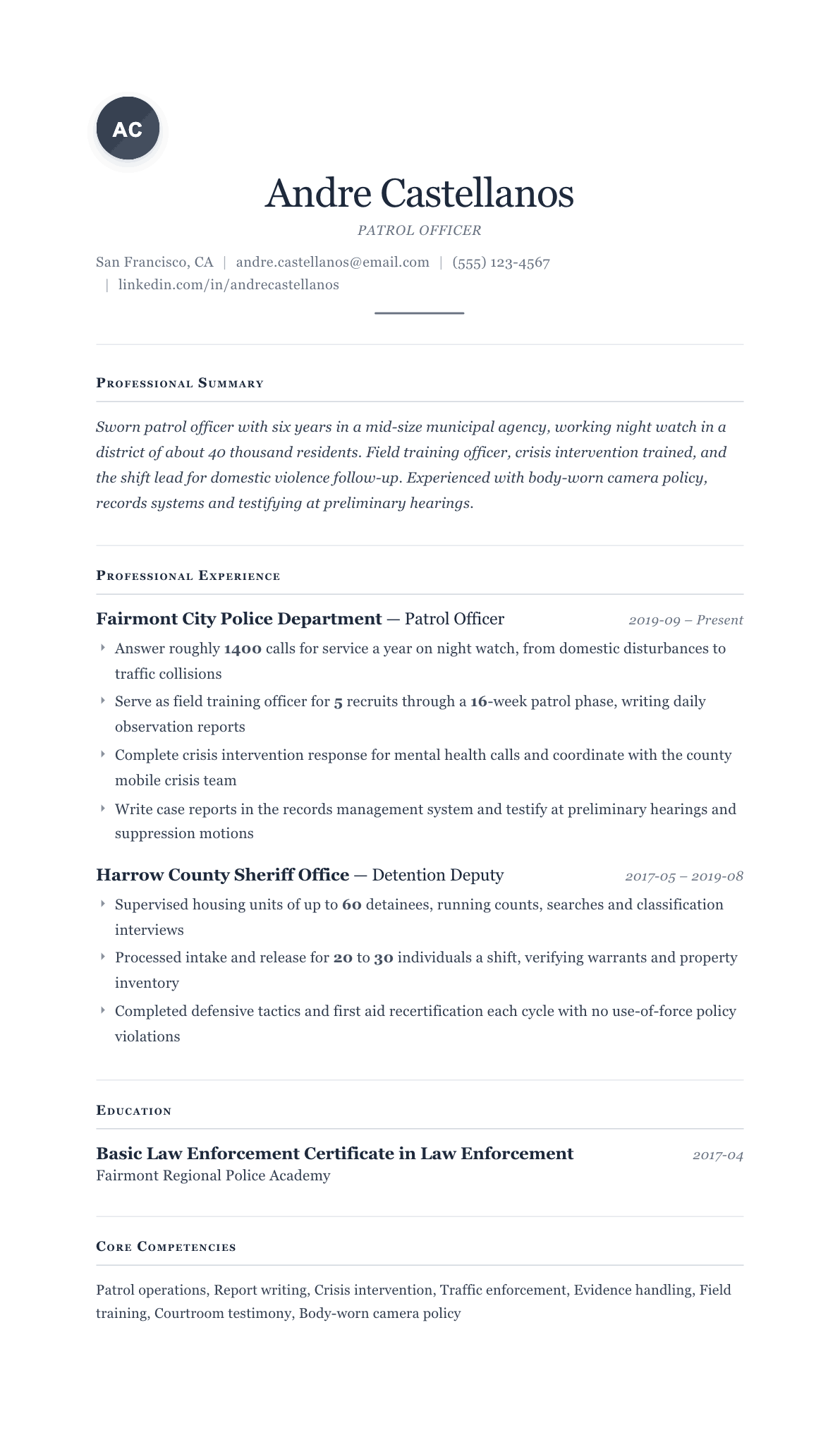
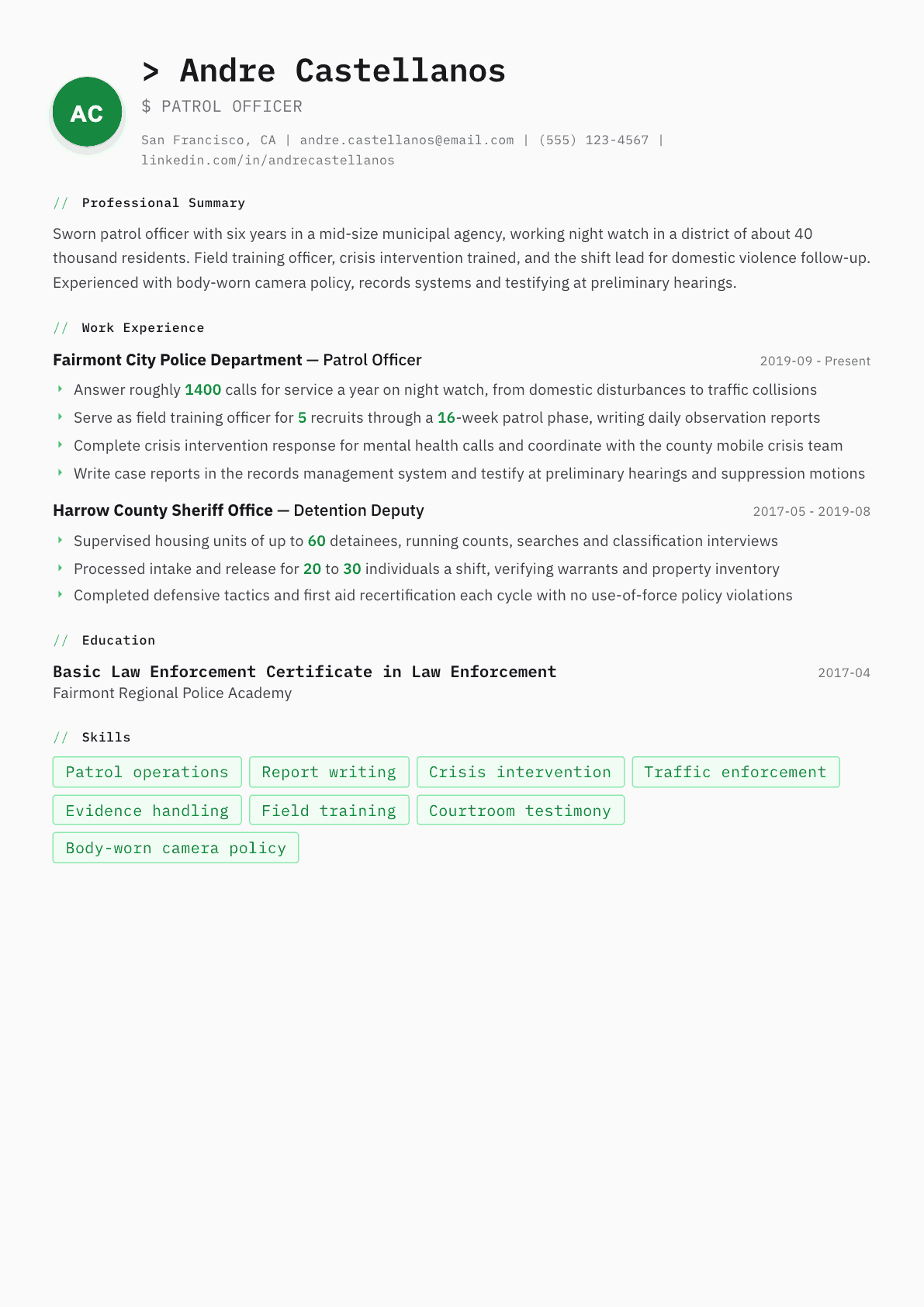
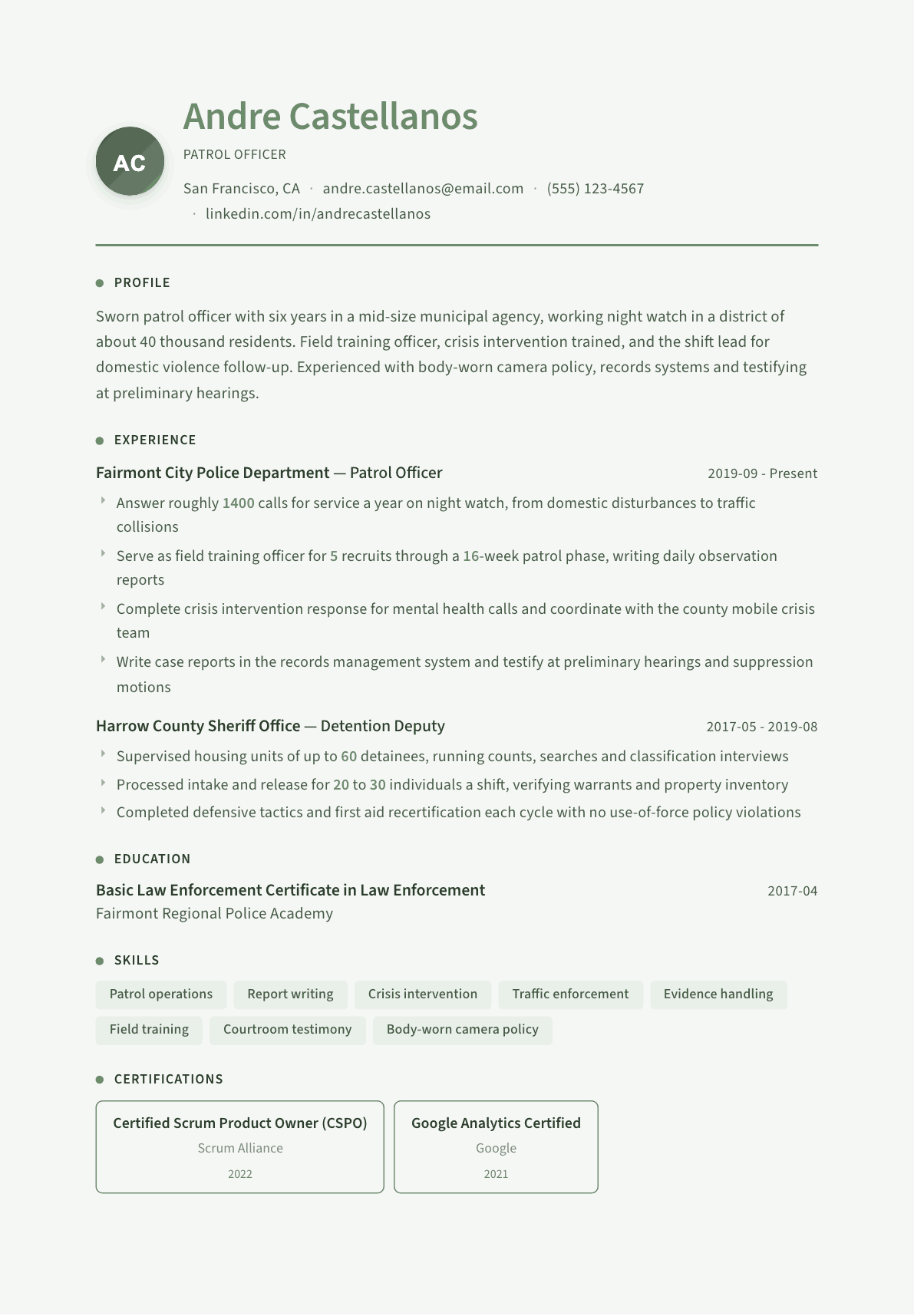
Example Police Officer summary
Sworn police officer with six years on night watch patrol in a mid-size municipal agency, answering about 1400 calls for service a year. Field training officer for five recruits, crisis intervention trained, and relied on for domestic violence follow-up and clean case reports that hold up in court. Seeking a detective bureau assignment.
Skills to list on a Police Officer resume
- Patrol operations
- Calls for service response
- Report writing
- Criminal investigation basics
- Traffic enforcement and collision investigation
- Crisis intervention
- De-escalation
- Evidence collection and chain of custody
- Field training officer duties
- Courtroom testimony
- Records management systems
- Body-worn camera policy
- Community policing
- Defensive tactics
- Firearms qualification
What actually gets this resume read
- Put your academy, certification status and any state peace officer certification number where a screener finds it fast.
- Name the assignment and the beat, because night watch patrol reads differently from a school resource or traffic post.
- Give call volume per year, since that is how a hiring sergeant judges the pace you are used to.
- Show report writing and courtroom testimony directly, because prosecutors depend on officers who document cleanly.
- List specialized training such as crisis intervention, drug recognition or field training officer, each with the hours.
- Keep the resume honest and verifiable, since a background investigator will call every employer and check every date.
How to write a police officer resume
A police officer resume travels a longer road than most. It passes a civil service clerk checking minimum qualifications, a hiring sergeant deciding who gets an interview slot, and eventually a background investigator who will call every employer, verify every date and read the page next to your personal history statement. Anything vague or inflated becomes a problem months later, so accuracy is not a style preference here, it is the whole game.
Within that constraint, the page still has to sell. A hiring sergeant is looking for call volume, the assignments you have held, evidence you can write a report a prosecutor can use, and specialized training that saves the agency money. Officers who list only duties, with no beat, no volume and no training hours, read as interchangeable.
This guide sets out the sections in the order a law enforcement hiring panel reads them, what to quantify and what to leave alone, a law enforcement resume example laid out section by section, three example summaries covering an academy graduate, a working patrol officer and an officer moving toward a specialty, before and after bullets, and the questions officers ask when they apply laterally or leave for the private sector.
Format: certification block, then assignments, then training hours
Open with a certification block: your academy, graduation status, state peace officer certification and number, firearms qualification currency, and driver license class. Civil service screening is a checklist exercise, and the checklist is exactly those fields.
Use reverse chronological order and plain formatting. Agency systems and background investigators both handle a single column better than a design layout, and an officer resume with icons and skill meters reads as unserious to a panel that spends its day in general orders and case files.
- Certification block: academy attended, peace officer certification and number, firearms qualification date.
- Assignment history by watch and district, since night watch patrol reads differently from a school or traffic post.
- Training log with course names and hours, including crisis intervention and field training officer school.
- Court history: the levels you have testified at, from preliminary hearings to jury trials.
Summary: agency size, watch, call volume, specialty
Three lines. Give years sworn, the size or type of agency, the watch and district you work, your annual call volume, and the one thing the agency uses you for. Field training officer, crisis intervention responder, evidence technician and traffic collision investigator are all worth naming in the first block.
If you are applying laterally, state it and name what transfers: certification reciprocity status, the records system you have used, and the call types your new agency handles most. Panels prefer candidates who have clearly read the posting over candidates who send a general page.
Experience: calls, reports and the work between them
Lead each role with the agency, the assignment, the watch and the district population. Then write bullets around the work a sergeant actually tracks: calls for service handled, self-initiated activity, reports written, arrests and citations, collision investigations, and the follow-up you carried after the initial response.
Report writing deserves its own bullet because it is the product an officer delivers. Name the records management system, the volume, and any feedback loop such as reports returned for correction or a prosecutor who relied on your documentation. A clean, complete report is the difference between a case that charges and one that dies.
Add the parts of the job that are not calls: field training recruits, community meetings, school visits, warrant service, court appearances and details worked. Those show a panel you contribute beyond the radio, which is what promotion boards later look for.
Training, conduct and what not to put on the page
List training by course and hours with the delivering body. Crisis intervention, de-escalation, standardized field sobriety testing, drug recognition, defensive tactics instructor and field training officer school all carry weight because they let an agency staff a need without paying for a new course.
Leave out anything you cannot document or would not want read aloud. Do not list confidential case details, do not name suspects or victims, do not quantify use-of-force events as achievements, and never describe an internal matter. A background investigator reads discretion as a job skill, and it is.
- Course name, hours and the academy or association that delivered it.
- Instructor certifications you hold, since they cut agency training cost immediately.
- Commendations and awards with the year they were issued and who issued them.
- Languages spoken at a working level, which many agencies compensate directly.
Keywords a law enforcement posting repeats
The phrasing is consistent across agencies: calls for service, patrol operations, report writing, probable cause, chain of custody, de-escalation, crisis intervention, traffic enforcement, collision investigation, field training officer, community policing, body-worn camera, courtroom testimony. Mirror the wording of the posting where it is true of you.
Add the systems you have worked in: the records management system, the computer aided dispatch platform, the body-worn camera evidence system and the state criminal information network. Systems familiarity shortens a lateral officer orientation, and hiring sergeants know it.
Law enforcement resume example, top to bottom
Here is the order a hiring sergeant and a background investigator both expect, filled in for a patrol officer six years in who is applying laterally. Use the example as a template for your own order, then replace every line with dates and figures you can document.
Keep every date exact to the month. The investigator will lay this page next to your personal history statement, and two dates that disagree cost more than a thin bullet ever will.
- Header: Marcus Bell, state peace officer certification and number, city and state, phone, email.
- Summary: Patrol officer with six years at a mid-size municipal department, working nights in a high-call district. Field training officer for three recruits, certified in crisis intervention, with reports routinely accepted by the district attorney without rework.
- Certifications and training: state certification, academy and graduation date, then specialized courses with hours, such as crisis intervention, defensive tactics instructor or accident reconstruction.
- Experience: agency, assignment and dates, then four bullets on call volume, report quality, the specialty or collateral duty you hold, and community or training work.
- Education and military service: degree or college credits, then service branch, dates and discharge type if it applies.
Police Officer resume summary examples
Academy graduate
Recent police academy graduate with state peace officer certification, 800 academy hours and a background in emergency medical response. Trained in report writing, de-escalation and standardized field sobriety testing, physically qualified, and seeking a patrol position with a structured field training program.
Six years on patrol
Patrol officer with six years on night watch in a mid-size municipal agency, handling about 1400 calls for service a year. Field training officer for five recruits, crisis intervention trained, and relied on for domestic violence follow-up and case reports that survive suppression motions.
Senior officer moving to a specialty
Senior patrol officer with eleven years sworn, three of them as a collision reconstruction responder and defensive tactics instructor. Handles high-priority calls across two districts, mentors newer officers on scene management, and is pursuing an investigative assignment in property crimes.
Work experience bullets: before and after
Before: Patrolled assigned areas and responded to calls.
After: Answered roughly 1400 calls for service a year on night watch in a district of 40 thousand residents, from domestic disturbances to injury collisions.
Call volume, watch and district size give a hiring sergeant the pace and environment you already work in.
Before: Wrote police reports.
After: Wrote case reports in the records management system for every incident, with reports rarely returned for correction and used directly at preliminary hearings.
The system, the return rate and the courtroom use turn paperwork into evidence of a usable product.
Before: Trained new officers.
After: Served as field training officer for 5 recruits through a 16-week patrol phase, writing daily observation reports and running scenario debriefs after each shift.
The recruit count, phase length and documentation show a structured training role, not informal help.
Before: Handled mental health related calls.
After: Responded to mental health calls using crisis intervention training and coordinated with the county mobile crisis team on voluntary transports rather than custodial outcomes.
Naming the training and the partner agency shows a de-escalation pathway a panel can picture.
Before: Testified in court when needed.
After: Testified at preliminary hearings and suppression motions, preparing case files with the prosecutor and reviewing body-worn camera footage before each appearance.
The hearing types and the preparation routine prove court readiness rather than attendance.
Hard skills
- Patrol operations
- Calls for service response
- Report writing
- Probable cause and arrest procedure
- Traffic enforcement
- Collision investigation
- Crisis intervention and de-escalation
- Evidence collection and chain of custody
- Field training officer duties
- Courtroom testimony
- Records management and dispatch systems
- Body-worn camera policy
Soft skills
- Composure under threat
- Verbal de-escalation
- Community trust building
- Discretion with sensitive information
- Teamwork on scene
- Written clarity
Certifications worth listing
- Crisis Intervention Team (CIT) Training (CIT International)
- Standardized Field Sobriety Testing (SFST) (National Highway Traffic Safety Administration)
- Drug Recognition Expert (DRE) (International Association of Chiefs of Police)
- Emergency Medical Responder (National Registry of Emergency Medical Technicians)
- Basic Life Support (BLS) (American Heart Association)
Mistakes that cost police officer candidates the interview
- Writing duty statements copied from a general order instead of the assignments, volume and training that are yours.
- Leaving off the peace officer certification and academy, which stalls a civil service screening immediately.
- Including confidential case detail or naming people involved in incidents you worked.
- Presenting use-of-force events as accomplishments rather than leaving them out of a resume entirely.
- Overstating dates or titles that a background investigator will verify with a phone call.
- Omitting the records and camera systems you have used, which is the fastest signal of a low orientation cost.
Police Officer resume questions
How long should a law enforcement resume be?
One page for an academy graduate or an officer with a few years. Two pages once you carry training hours, instructor certifications, multiple assignments and a court history, since a panel reads all of that as evidence of range.
Should I include arrest and citation numbers?
Include call volume and self-initiated activity, and be careful with arrest counts, since agencies differ on whether numbers read as productive or as quota driven. Never present an arrest total as a performance target you chased.
What matters most on a lateral application?
Certification reciprocity status, years of independent patrol, the records and dispatch systems you have used, your training hours and a clean disciplinary history. State reciprocity plainly, because a panel will not research your state on your behalf.
How do I write this resume for a private sector job?
Translate the work rather than the titles. Investigations become fact finding and documentation, patrol becomes risk assessment and incident response, and court testimony becomes presenting evidence under scrutiny. Keep the credential block, but drop the tactical language.
Do commendations belong on a police resume?
Yes, briefly. Give the award, the issuing authority and the year, without a narrative of the incident. Two or three lines of recognition tell a panel your agency valued your work, while a long story reads as self-promotion.
Related resume examples
- Security Guard Resume example
- Private Investigator Resume example
- Police Detective Resume example
- Sheriff Deputy Resume example
- Military Police Resume example
- Criminal Justice Graduate Resume example