Portfolio Manager Resume Examples: the lines they read
Create a Portfolio Manager Resume That Outperforms the Market
By Mustafa Tarabya, founder of CVBooster · Published · Updated
Build a portfolio manager resume demonstrating investment performance, risk management, and AUM growth with alpha generation metrics and client relationship expertise.
Sample resumes for a portfolio manager
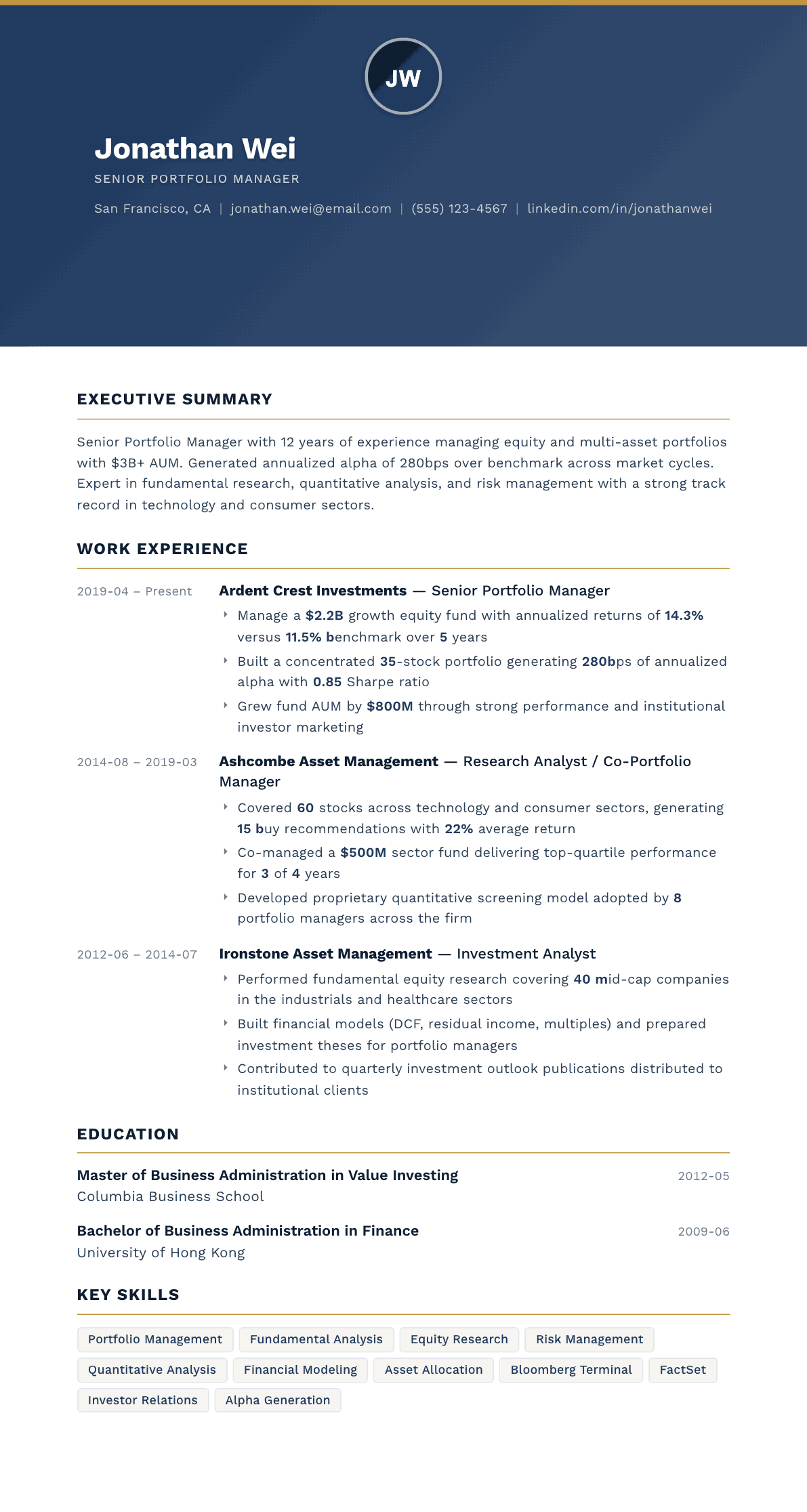
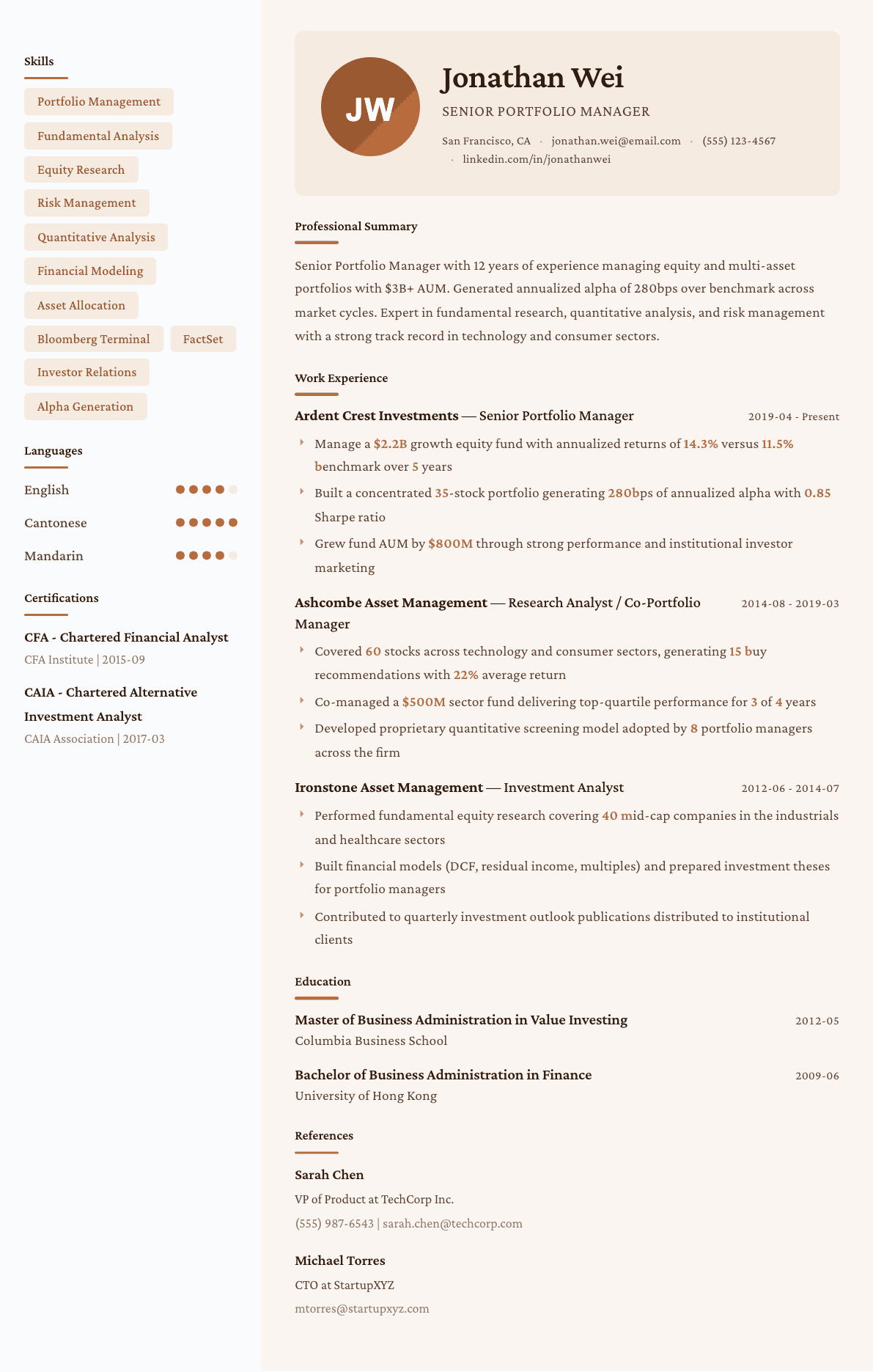
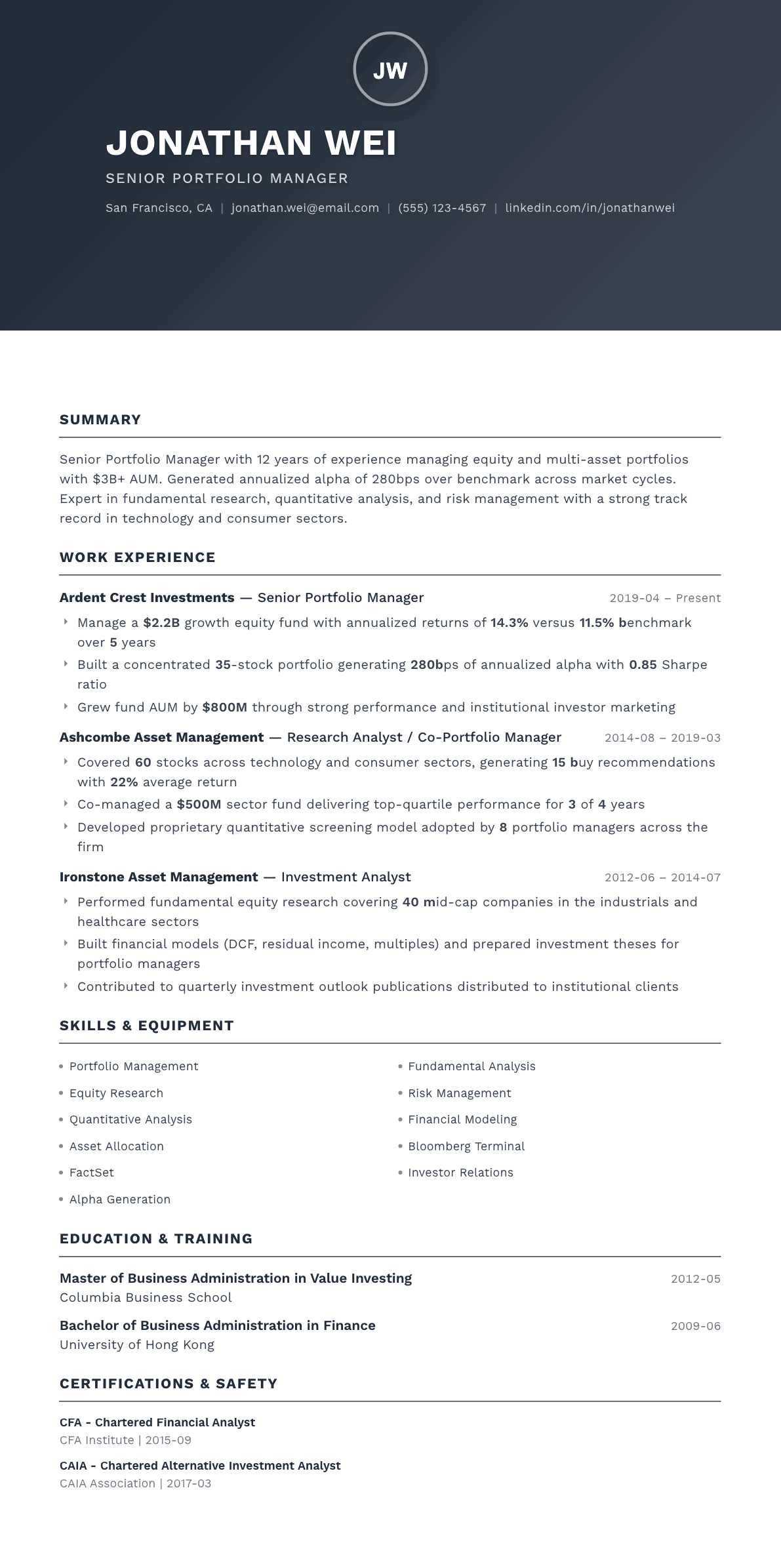
The same portfolio manager content laid out in three CVBooster templates, so you can see what the finished document looks like before you write a word.
Example Portfolio Manager summary
CFA and Senior Portfolio Manager with 12 years of experience managing $3B+ AUM across equity and multi-asset strategies. Generated 280bps annualized alpha with a 0.85 Sharpe ratio. Expert in fundamental research, quantitative screening, and risk management. Seeking a Head of Equities or CIO role to lead investment strategy at a premier asset management firm.
Skills to list on a Portfolio Manager resume
- Portfolio Management
- Fundamental Analysis
- Equity Research
- Risk Management
- Quantitative Analysis
- Financial Modeling
- Asset Allocation
- Bloomberg Terminal
- FactSet
- Morningstar Direct
- Investor Relations
- Performance Attribution
- Sector Analysis
What actually gets this resume read
- Lead with AUM, returns versus benchmark, and alpha generation metrics.
- Highlight investment philosophy: value, growth, quantitative, macro.
- Show Sharpe ratio, information ratio, and other risk-adjusted performance measures.
- Include specific sectors and asset classes where you have expertise.
- Demonstrate AUM growth through both performance and client development.
- CFA designation is virtually required; display it next to your name.
How to write a portfolio manager resume
Portfolio manager resumes are read by people who allocate capital for a living, which means they are read skeptically. The reader assumes that any track record on a page has been framed to look better than it was, so the resume that works is the one that anticipates the skeptic: what the mandate was, what the benchmark was, over what period, and what the risk taken to get there looked like. A return without those four things is not information.
The second question is what your edge is and whether it survives a change of firm. A manager whose results came from a proprietary data set, a specific relationship with a research desk, or a market regime that has ended is a different hire from one who runs a repeatable process: an idea funnel, a sizing rule, a risk budget, a sell discipline. Say which process you run, because the interview is going to test it in detail.
This guide covers how to present a track record honestly, the section order allocators expect, three summaries from analyst to lead manager, before and after bullets, and the compliance limits on what you may claim.
Format: strategy and mandate first, then the record, then the process
Two pages is normal for a portfolio manager and expected once you have managed multiple strategies. Open with the mandate rather than a personal statement: asset class, strategy, benchmark, assets under management, vehicle type, and whether you had sole discretion, shared it on a team, or ran a sleeve within a larger book.
Keep the formatting institutional. This is a document that may end up in front of an investment committee or a consultant, so plain typography, clean date columns and no graphics. A performance chart on a resume looks like marketing and invites the compliance question you do not want.
- Header: name, designation such as CFA charterholder, city, phone, email.
- Order: mandate summary, investment experience with track record context, process and risk framework, education and designations.
- Analysts moving up put coverage universe and stock or credit recommendations where the record would sit.
The track record: mandate, benchmark, period, risk
State performance the way an allocator evaluates it: against the stated benchmark, gross or net specified, over a defined period that includes at least one drawdown, and with a risk measure attached. Information ratio, tracking error, maximum drawdown, volatility and the hit rate on positions say more about a process than a single annualized figure. Reporting only the good years is the fastest way to lose the reader.
Be exact about attribution of responsibility. If you ran a sleeve inside a larger portfolio, say the sleeve size and who owned the top level allocation. If the record was produced by a team of three, say three. Allocators check these claims through references and prior colleagues, and an inflated attribution ends candidacies.
Where a strategy was closed, wound down or transferred, say why in one plain clause. Strategies close for capacity, for firm strategy and for performance, and readers will assume the worst if you leave a gap.
Process: the funnel, the sizing, the sell discipline
Describe how an idea becomes a position. The universe and how you screen it, the research you do yourself versus what you consume, the valuation framework you apply, the position sizing rule, the correlation and factor exposures you manage against, and what makes you sell. A portfolio manager who cannot articulate a sell discipline in writing is treated as someone who has never had to.
Then the risk framework: the limits you ran under, how exposures were monitored, what happened when a limit was breached, and how you handled liquidity in stressed markets. Include the operating side that senior seats carry, such as sitting on the investment committee, presenting to trustees, working with the risk and compliance functions, and handling due diligence meetings with consultants and clients.
Research depth: name the coverage and the tooling
Show the analytical substance underneath the portfolio. The sectors, regions or credit tiers you cover personally, the number of names you follow closely, the modeling you build yourself, and the primary research you do such as channel checks, management meetings, plant visits or expert calls. Quantitative managers should instead describe the signal families, the backtesting environment, the treatment of transaction costs and the guardrails against overfitting.
Name the tools as an institutional user would: Bloomberg, FactSet, Aladdin, Refinitiv, MSCI Barra or Axioma for risk, Morningstar Direct for peer analysis, Python and R for research work, and the order management and execution systems you have used. These names also carry the ATS keywords that consultant and asset manager screens look for.
Designations, compliance and the language allocators use
The CFA charter is close to standard for fundamental and multi asset seats, the CAIA is the recognized mark on the alternatives side, and the FRM fits risk oriented roles. List each with its issuing body, and say if you are a charterholder rather than a candidate, because the distinction is enforced.
Write performance claims as if a compliance officer will review them, because for a registered firm one usually does. Avoid implying that past results predict future ones, avoid cherry picked periods, and be prepared to support any figure you print with the underlying records. The safest and most persuasive approach is to give the mandate, the benchmark, the period and the risk measures and let the reader draw the conclusion.
Portfolio Manager resume summary examples
Analyst moving to the desk
Equity research analyst with four years covering 28 industrials and materials names for a long only manager, building the models behind the sector sleeve and presenting nine buy recommendations to the investment committee. CFA charterholder. Seeking an associate portfolio manager seat with sleeve responsibility.
Sleeve manager
Portfolio manager running a 400 million small cap value sleeve against a broad small cap benchmark, with sole discretion over roughly 60 positions and a defined sizing and sell framework. Six year record including two drawdown periods, with tracking error managed inside the stated mandate limits. CFA charterholder.
Lead portfolio manager
Lead portfolio manager for a 2.1 billion multi asset strategy across institutional separate accounts and a mutual fund, with a team of four analysts and two associate managers. Chairs the investment committee, presents to trustees and consultants, and owns the risk budget and manager selection process.
Work experience bullets: before and after
Before: Managed a portfolio and outperformed the benchmark.
After: Managed a 400 million small cap value sleeve against its stated benchmark over six years including two drawdowns, running tracking error inside the mandate limit with roughly 60 positions.
Mandate, size, period, risk and position count let a reader evaluate the record instead of trusting an adjective.
Before: Conducted fundamental research on companies.
After: Covered 28 industrials and materials names personally: built the operating models, ran channel checks with distributors, and met management at least twice a year on every core holding.
Coverage count and primary research methods separate an analyst who does the work from one who reads the sell side.
Before: Responsible for risk management of the portfolio.
After: Ran the portfolio inside defined sector, position and liquidity limits, reviewed factor exposures weekly in a third party risk system, and documented the response to every limit breach for the investment committee.
Naming the limits, the cadence and the breach process shows a real risk framework rather than a stated intention.
Before: Presented to clients and consultants.
After: Presented the strategy in 30 or more due diligence meetings a year with consultants and institutional clients, and led the operational due diligence responses alongside compliance during two mandate wins.
Meeting volume and the mandate outcome demonstrate the client facing half of a senior portfolio manager job.
Before: Improved the investment process.
After: Introduced a written sell discipline tied to thesis breakage and valuation triggers, and a post mortem file on every exited position, which the team now reviews quarterly.
A named process change with an artifact the team still uses is evidence of investment leadership.
Hard skills
- Portfolio construction and position sizing
- Fundamental equity and credit analysis
- Valuation modeling
- Performance attribution
- Risk budgeting and factor exposure management
- Asset allocation
- Manager selection and due diligence
- Bloomberg and FactSet
- Aladdin or comparable risk systems
- MSCI Barra or Axioma factor models
- Python and R for research
- Investment committee reporting
Soft skills
- Holding a thesis under pressure
- Changing your mind on new evidence
- Written investment argument
- Mentoring analysts
- Client and trustee communication
- Decision discipline in a drawdown
Certifications worth listing
- Chartered Financial Analyst (CFA) (CFA Institute)
- Chartered Alternative Investment Analyst (CAIA) (CAIA Association)
- Financial Risk Manager (FRM) (Global Association of Risk Professionals)
- Certificate in Investment Performance Measurement (CIPM) (CFA Institute)
- Series 65 Uniform Investment Adviser Law Examination (FINRA (North American Securities Administrators Association exam))
Mistakes that cost portfolio manager candidates the interview
- Quoting a return with no benchmark, period or risk measure attached, which an allocator reads as an unsupported marketing claim.
- Taking credit for a team record. References are called and attribution is checked, and an overstatement here is not recoverable.
- Selecting the favorable window. A record that excludes the drawdown tells the reader you would present the same way to clients.
- Describing the philosophy in adjectives such as disciplined and research driven without ever stating the sizing rule or the sell trigger.
- Leaving out why a strategy closed or a fund was wound down, so the reader supplies the least generous explanation.
- Adding a performance chart or logos to the page, which turns a professional document into a pitch and raises a compliance flag.
Portfolio Manager resume questions
How should I present performance on a portfolio manager resume?
Give the mandate, benchmark, period, whether figures are gross or net, and at least one risk measure such as tracking error or maximum drawdown. Include a full market cycle where you have one, and be ready to support every figure with records.
What if I managed a sleeve rather than the whole fund?
Say exactly that, with the sleeve size and who owned the top level allocation. Sleeve management is respected experience, and describing it accurately is far safer than a phrasing that implies discretion you did not hold.
Is the CFA required to become a portfolio manager?
It is not a legal requirement, but it is close to standard in traditional asset management and many institutional postings screen for it. Quantitative and alternatives seats weigh a relevant graduate degree or the CAIA more heavily.
How do I move from analyst to portfolio manager on paper?
Show decisions rather than coverage. Recommendations you made, how they were sized when adopted, the outcomes including the ones that went against you, and any sleeve or paper portfolio you ran under a defined framework.
How long should a portfolio manager resume be?
Two pages for most managers, and that is expected rather than penalized, because the mandate history, process description and risk framework simply do not compress. Keep any third page for a separate track record appendix if a firm asks for one.
Related resume examples
- Investment Banker Resume example
- Financial Planner Resume example
- Wealth Manager Resume example
- Investment Analyst Resume example
- Equity Research Analyst Resume example
- Financial Advisor Resume example