Equity Research Analyst Resume Examples: free ATS score
Craft an Equity Research Analyst Resume Sell Side Desks Respect
By Mustafa Tarabya, founder of CVBooster · Published · Updated
Equity research analyst resume examples covering coverage lists, initiations, modeling depth, and the keywords sell side and buy side screeners look for.
Sample resumes for a equity research analyst
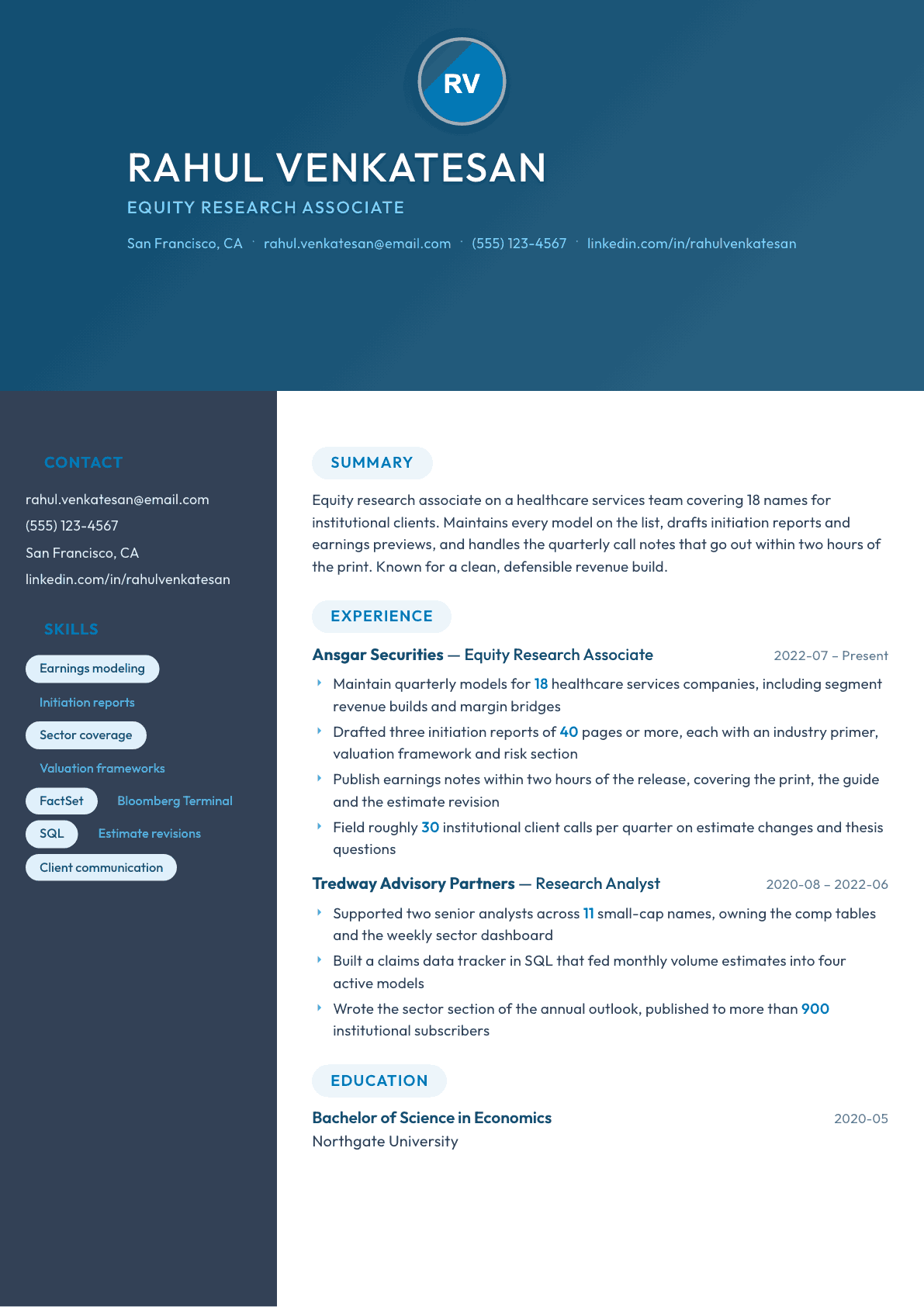
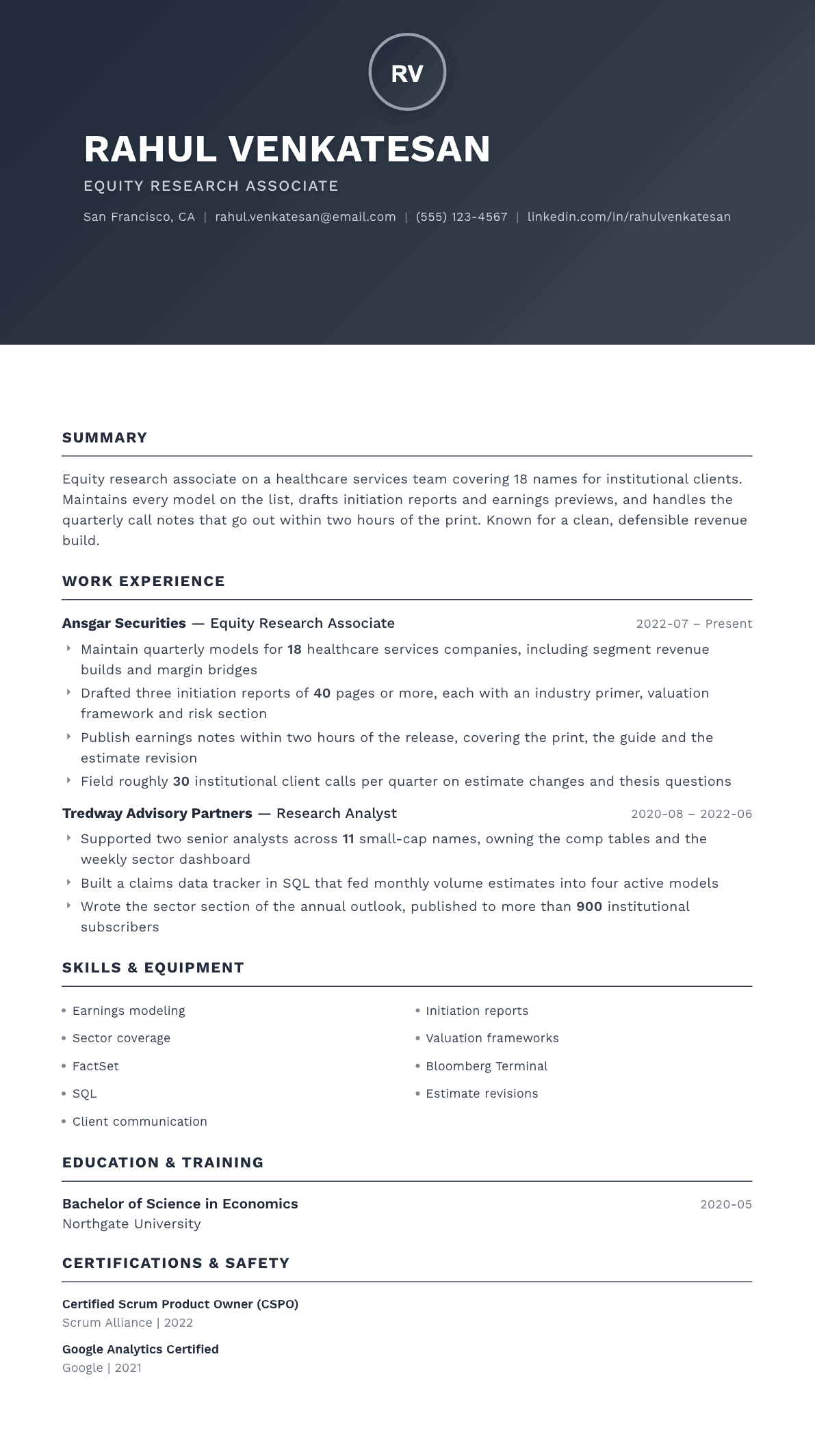
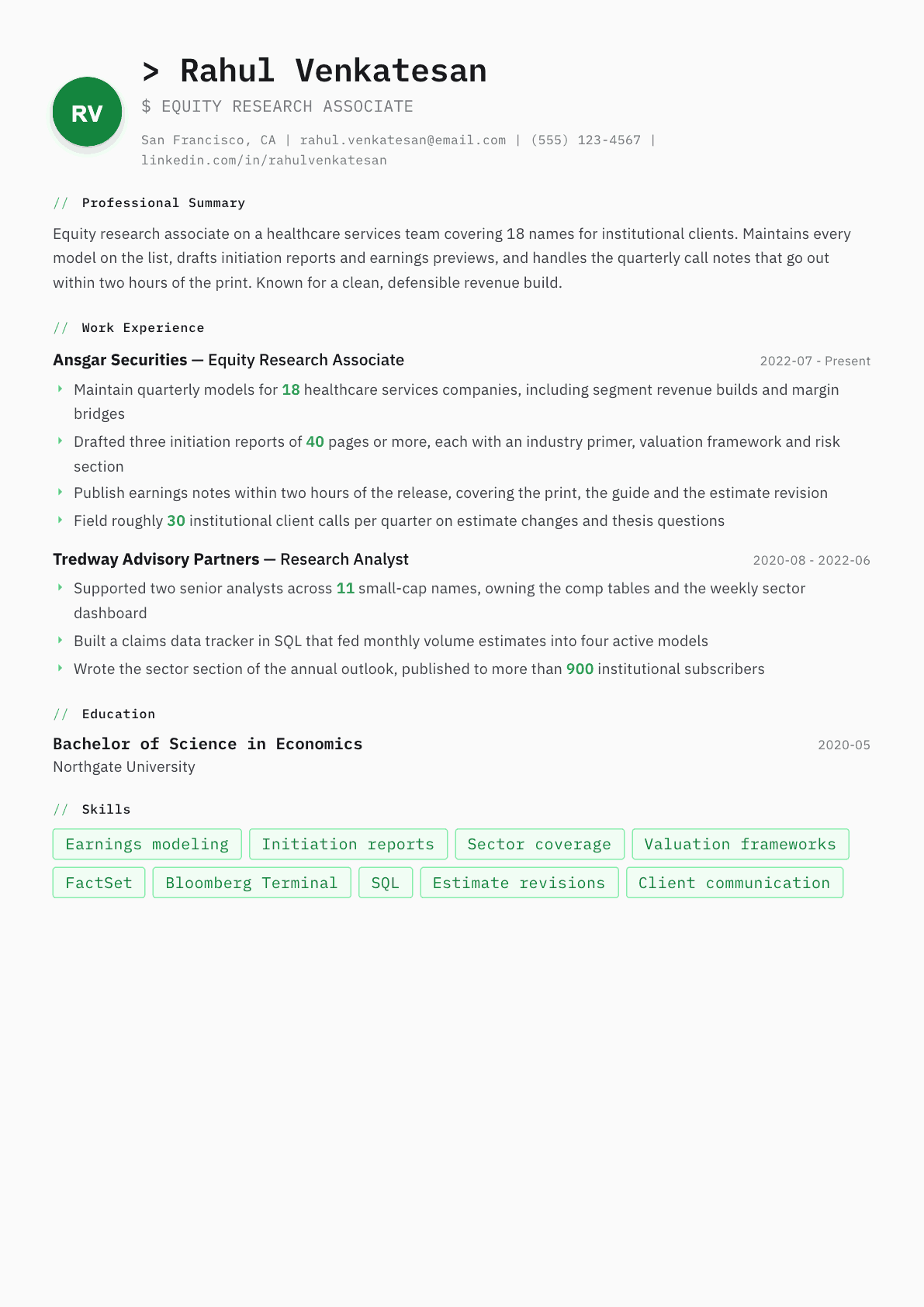
The same equity research analyst content laid out in three CVBooster templates, so you can see what the finished document looks like before you write a word.
Example Equity Research Analyst summary
Equity research associate covering 18 healthcare services names for institutional clients. Owns every model on the list, drafts initiations and earnings previews, and publishes the reaction note within two hours of the print. Uses claims data in SQL to build independent volume estimates rather than following company guidance. CFA Level II candidate seeking an analyst seat with published ratings and a named coverage universe.
Skills to list on a Equity Research Analyst resume
- Earnings models
- Revenue build
- Initiation reports
- Earnings previews
- DCF valuation
- Comparable company analysis
- Estimate revisions
- Sector research
- Alternative data
- FactSet
- Bloomberg Terminal
- Capital IQ
- SQL
- Client communication
- Industry primers
What actually gets this resume read
- Lead with the sector and the number of names covered, because coverage is how research desks size a candidate.
- Count your published work: initiations, earnings notes, industry primers and the page depth of each.
- Show model ownership by describing the revenue build, not by writing the phrase financial modeling alone.
- Mention client-facing work, since sell side research is a sales job dressed as an analytical one.
- Note any alternative data you use, such as claims files, web traffic or scanner data, and the tool you query it with.
- Keep the resume to one page and put the coverage list in the summary, not in a separate block at the bottom.
How to write a equity research analyst resume
Equity research hires on published work. The senior analyst reading your resume is asking how many names you can maintain without breaking, whether your model survives an earnings print, and whether you can write a note a client will read on a busy morning. Everything else on the page is secondary to that.
The role also carries a commercial half that candidates routinely leave out. Sell side research is paid through client interaction: calls, marketing days, conference panels and bespoke work for accounts. A resume that shows only modeling makes a supervisory analyst wonder whether you have ever spoken to a portfolio manager.
What follows is the structure research desks expect, how to present a coverage universe, how to describe an earnings model so it reads as yours, and the mistakes that get associate resumes filtered out before a first call.
Format: one page and completely plain
A research resume is one page with no graphics, no rating bars and no color. The convention is unglamorous on purpose, because the product of this job is written argument and the page is a sample of your judgment about what matters.
Keep the coverage universe inside the summary and the first role rather than in a standalone block, so the reader meets it in context. Education sits near the top for associates and drops below experience once you have a published rating.
- Order: summary, experience, education, technical skills, licenses and certifications.
- Give each employer a scope line: the sector, the market capitalization band and the client base.
- Include registration status, since publishing requires it and compliance verifies it.
Summary: sector, name count, publication record
Open with the sector and the number of names, then the products you publish, then one distinguishing method. An associate who writes I support a senior analyst has said nothing. An associate who writes maintain quarterly models for 18 healthcare services names and publish the reaction note within two hours of the print has described a job.
If you are moving from the buy side or from a corporate finance seat, name the modeling depth you bring and the sector knowledge you already hold, then say plainly which sector you want to cover.
Experience: the model, the note, the client
Structure each role around three outputs. The model, described by its build rather than its existence. The published work, counted by type: initiations, previews, reaction notes, industry primers and thematic pieces. The client work, counted by calls, marketing days and bespoke requests.
Earnings season is the load test of this job, so say what your turnaround is. Publishing within two hours of a release, or having the model updated before the call ends, is a concrete claim a research director recognizes.
Do not write assisted with research. Say which sections of the initiation you drafted, which comp tables you own and which parts of the estimate you set.
- Name any alternative data you use and the tool you query it with.
- State how estimates are built: volume and price, same store trends, cohort retention, backlog conversion.
- Mention the supervisory review process if you have taken a note through it.
Technical skills, licenses and credentials
List terminals and databases separately from methods. FactSet, Bloomberg, Capital IQ, Visible Alpha and the internal estimate system on one side, discounted cash flow, sum of the parts, multiple based valuation and scenario work on the other. Add SQL or Python only if you genuinely build with them.
Registration matters here in a way it does not in most finance seats. Publishing research generally requires the research analyst examinations alongside the general securities registration, so state exactly which you hold and which are in progress.
Keywords a research screen matches on
The recurring vocabulary is narrow: coverage universe, initiation, earnings preview, estimate revision, price target, valuation methodology, channel checks, sector primer and institutional client marketing. Use the true ones inside bullets where the evidence sits beside them.
Sector language matters as much as the finance language. A healthcare services screen matches on reimbursement, utilization and payer mix, while an industrials screen matches on backlog, book to bill and input cost pass through.
Equity Research Analyst resume summary examples
First research associate seat
Economics graduate with an internship on a small-cap research desk, where I owned the comp tables and the weekly sector dashboard for 11 names. Built a claims data tracker in SQL that fed monthly volume estimates. Passed CFA Level I and the securities industry essentials examination.
Three years as an associate
Equity research associate covering 18 healthcare services names for institutional clients. Maintains every quarterly model with segment revenue builds and margin bridges, drafted three initiations of 40 pages or more, and publishes the reaction note within two hours of the print. Fields roughly 30 client calls a quarter.
Publishing analyst
Publishing analyst with a rated coverage list of 22 industrials names and a differentiated view on input cost pass through that has driven two upgrades. Runs the sector primer and the annual outlook, hosts management marketing days, and mentors two associates on model architecture and note structure.
Work experience bullets: before and after
Before: Helped cover companies in the healthcare sector.
After: Maintain quarterly earnings models for 18 healthcare services companies, including facility level volume builds, payer mix assumptions and a margin bridge for each segment.
It replaces helped with a countable universe and a description only the model owner could write.
Before: Wrote research reports for clients.
After: Drafted three initiation reports of 40 pages or more, each with an industry primer, a valuation framework and a risk section, plus weekly earnings previews across the coverage list.
Counting the publications by type and depth shows a real output record rather than a claim of writing.
Before: Updated models after earnings.
After: Publish the earnings reaction note within two hours of the release, covering the print, the revised guide and the estimate change, with the model updated before the call ends.
Turnaround under earnings pressure is the specific competence a research director is hiring for.
Before: Interacted with institutional clients.
After: Field roughly 30 institutional client calls per quarter on estimate revisions and thesis questions, and prepared the materials for two management marketing days.
It makes the commercial half of the job visible and countable instead of implied.
Before: Used alternative data in the research process.
After: Built a claims data tracker in SQL that produced independent monthly volume estimates for four names, which flagged a slowdown ahead of company guidance.
The bullet now shows an original data process and the analytical edge it produced.
Hard skills
- Quarterly earnings models
- Segment revenue builds
- Initiation reports
- Earnings previews and reaction notes
- Estimate revisions
- Discounted cash flow and multiple based valuation
- Sum of the parts analysis
- Channel checks and expert calls
- Alternative data analysis
- FactSet and Bloomberg
- Capital IQ
- SQL
- Industry primers
Soft skills
- Concise written argument
- Client communication
- Working accurately under earnings deadlines
- Question design for management calls
- Attention to disclosure detail
- Mentoring junior associates
Certifications worth listing
- Chartered Financial Analyst (CFA Institute)
- Series 86 and 87 Research Analyst Examinations (FINRA)
- Securities Industry Essentials Examination (FINRA)
- Series 7 General Securities Representative (FINRA)
Mistakes that cost equity research analyst candidates the interview
- Hiding the coverage universe, which is the single number a research director looks for first.
- Writing supported the senior analyst with no statement of which sections and models were yours.
- Leaving out client interaction, which makes the commercial half of the job look absent.
- Describing valuation as a skill without saying which method you apply to which type of name.
- Adding charts or rating bars to a page that is meant to demonstrate restraint and clarity.
- Failing to state registration status when publishing research depends on it.
Equity Research Analyst resume questions
How do I get a research seat without an internship on a desk?
Write and circulate one full note on a name in the sector you want. A twelve page piece with a real model, a defensible target and a risk section demonstrates the actual job better than any coursework line, and desks do hire on the strength of a sample.
Do I need the Series 86 and 87 before applying?
No. Firms sponsor these examinations after you join, since sponsorship is a requirement to sit them. Mention that you understand the registration path and note any examinations you have already passed, such as the securities industry essentials.
How many names can one associate realistically maintain?
It varies with model complexity and reporting frequency, but a list in the mid teens to low twenties is common for a services or industrials associate. Claim the number you can update inside an earnings week without help, because that is what the number is being read as.
Should an equity research resume include a price target track record?
Only publishing analysts should reference ratings, and even then keep it brief and honest, describing the thesis and what happened. Associates should not imply ownership of a rating, because compliance records show exactly who published each note.
Is the CFA necessary for equity research?
It is not mandatory, but the charter is common enough on desks that it removes a question. Progress alone is useful on a resume, since it signals the valuation and accounting groundwork the job assumes you already have.
Related resume examples
- Financial Analyst Resume example
- Portfolio Manager Resume example
- Investment Analyst Resume example
- Investment Banking Analyst Resume example
- Finance Intern Resume example
- Investment Banker Resume example