Investment Banker Resume Examples: the lines they read
Build an Investment Banker Resume That Lands Top-Tier Offers
By Mustafa Tarabya, founder of CVBooster · Published · Updated
Create an investment banker resume with deal experience, financial modeling expertise, and the polished formatting that bulge-bracket banks expect.
Sample resumes for a investment banker
The same investment banker content laid out in three CVBooster templates, so you can see what the finished document looks like before you write a word.
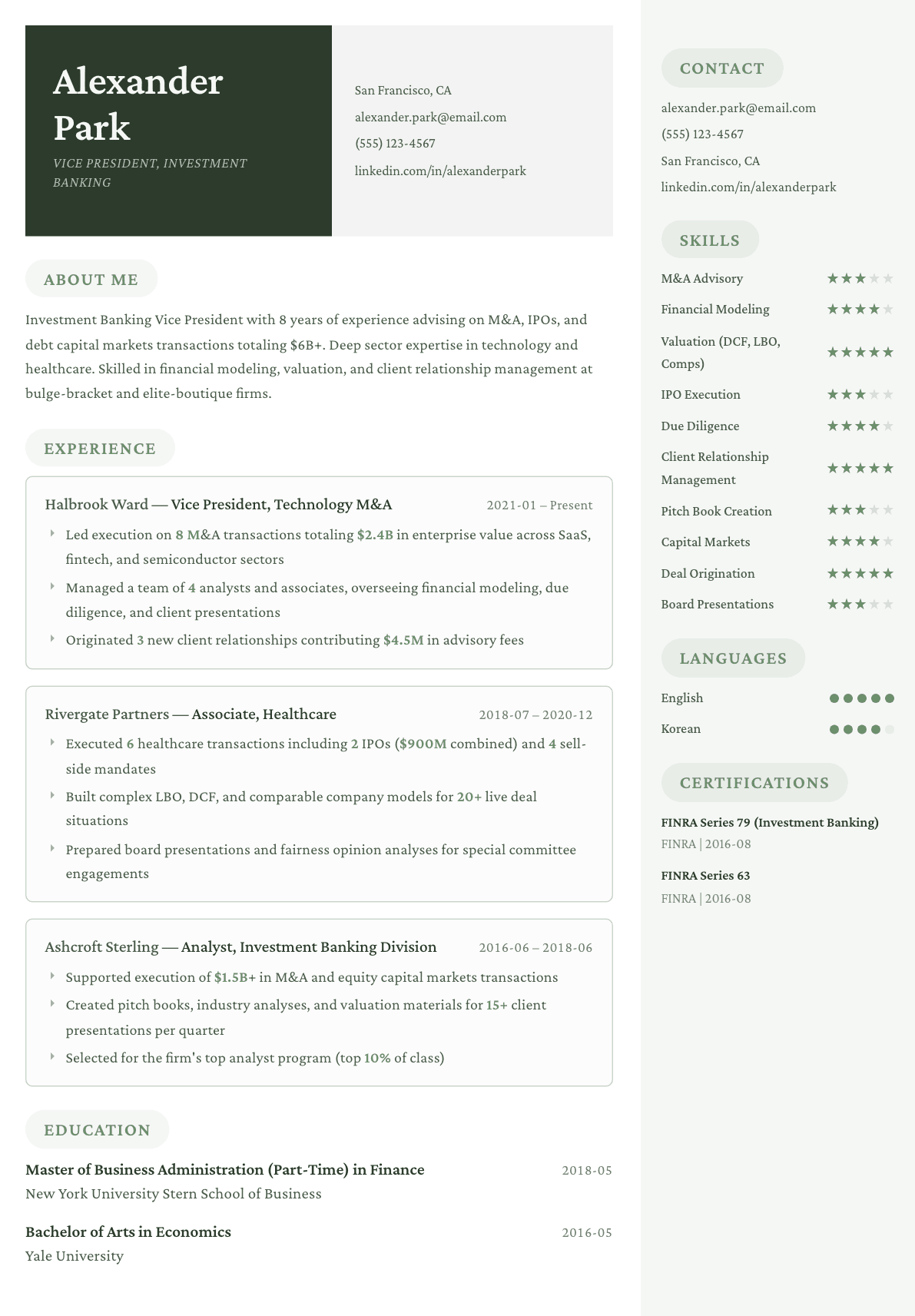
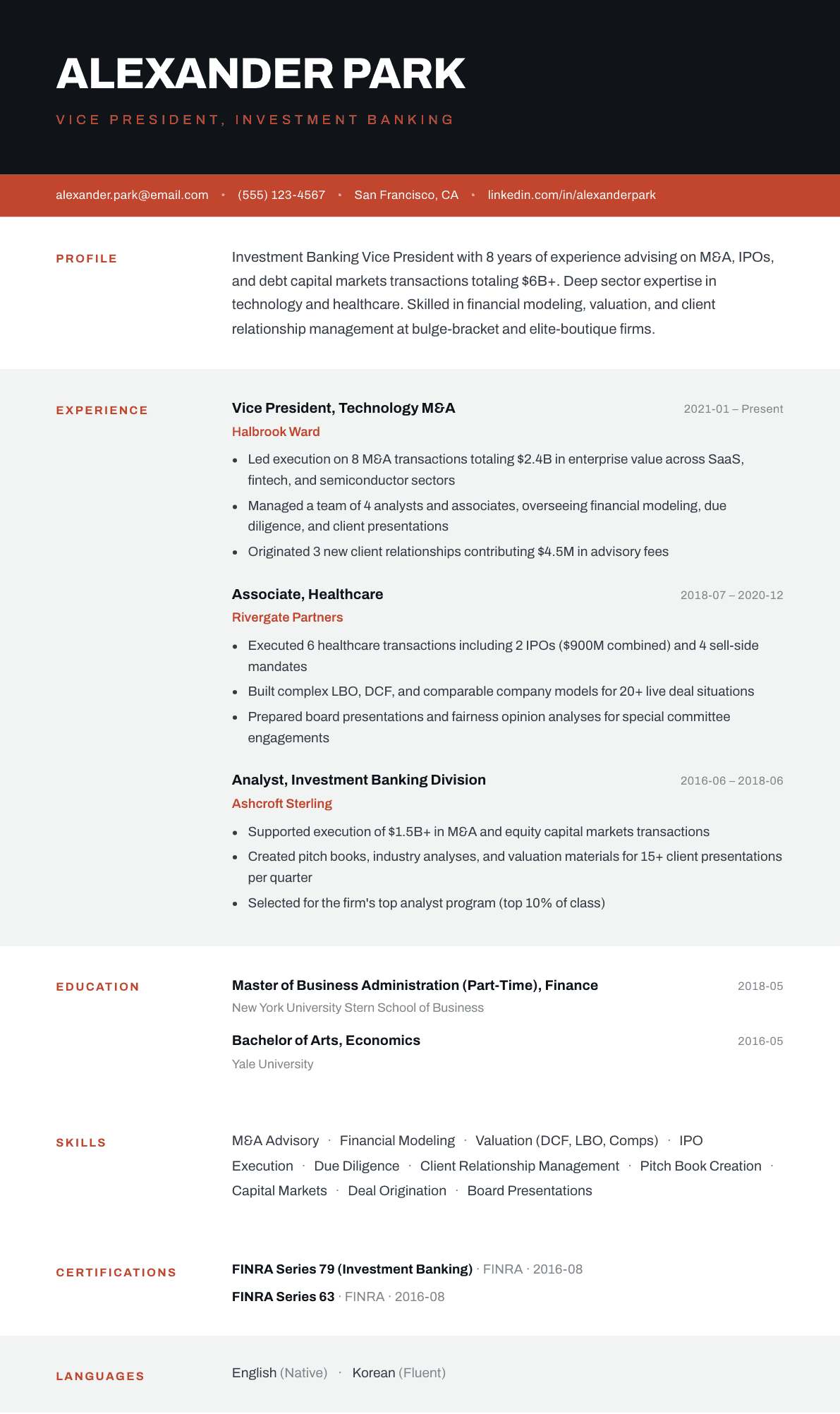
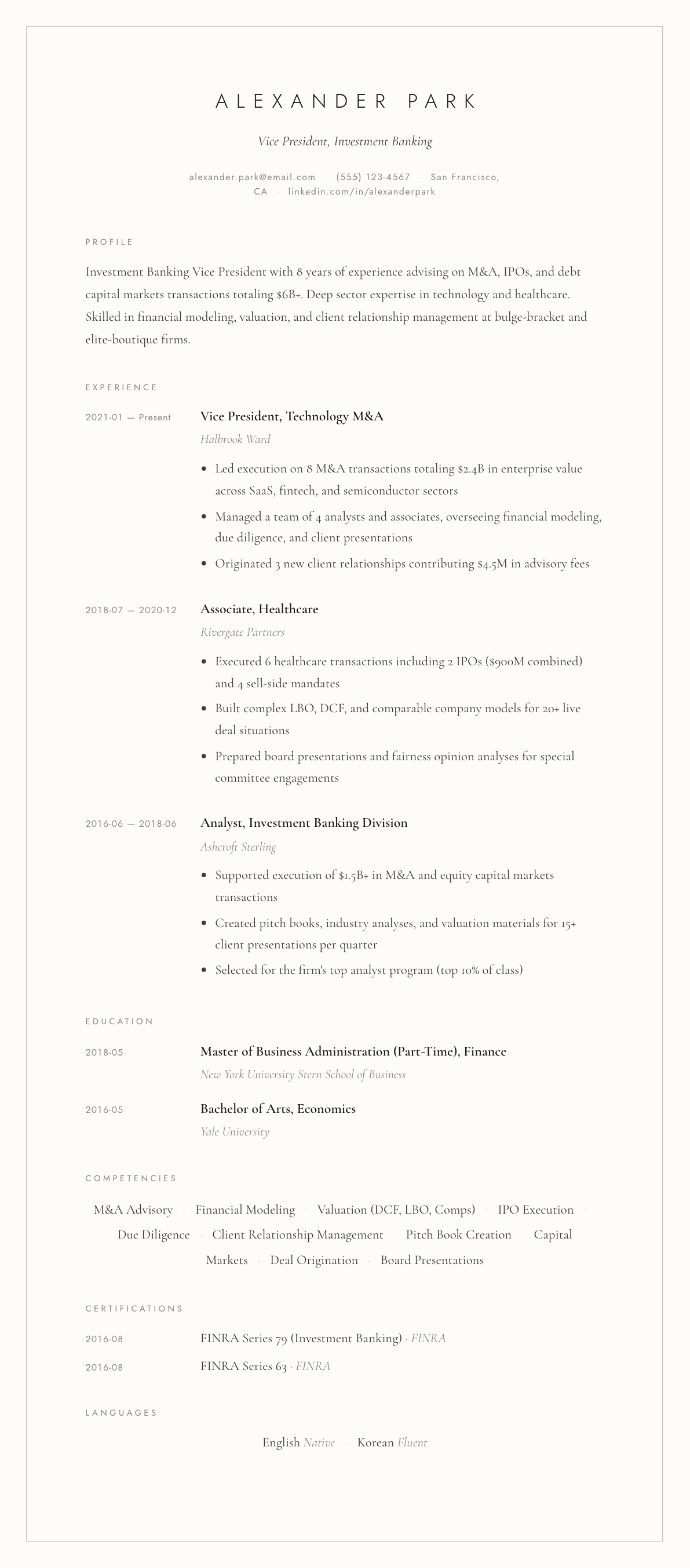
Example Investment Banker summary
Investment Banking Vice President with 8 years executing $6B+ in M&A, IPO and capital markets transactions across technology and healthcare. Expert in financial modeling, valuation, and client advisory. Seeking a Director or MD-track role at a leading investment bank or advisory firm.
Skills to list on a Investment Banker resume
- M&A Advisory
- Financial Modeling
- DCF Valuation
- LBO Modeling
- Comparable Company Analysis
- IPO Execution
- Due Diligence
- Pitch Book Creation
- Capital Markets
- Deal Origination
- Client Management
- Board Presentations
- Fairness Opinions
What actually gets this resume read
- List specific deal experience with transaction sizes, sectors, and your role in execution.
- Highlight financial modeling skills: DCF, LBO, merger models, comparable company analysis.
- Show progression from analyst to associate to VP with increasing deal responsibility.
- Include origination and client development metrics alongside execution experience.
- Keep formatting ultra-clean and conservative; investment banks expect polished documents.
- Name the sectors where you have deep expertise (TMT, healthcare, industrials, etc.).
How to write a investment banker resume
Investment banking is one of the few fields where resume format is close to standardized, and deviating from it costs you. Recruiting teams and staffers read hundreds of files in a sitting, always in the same order: school and grades, prior bank and group, transaction list, then modeling. If your file does not present those in the expected shape, the reader assumes you have not been around the industry, which for a banker is the worst possible first impression.
The content that decides the outcome is the deal list. Not the mandates the group worked on while you were in the seat, but the transactions where you did something identifiable: built the model, ran the diligence process, drafted the confidential information memorandum, managed the data room, wrote the fairness materials. Staffers hire for a specific product and sector need, so the list has to say announced or closed, buy side or sell side, sector, size and what you personally owned.
What follows is the layout banks expect, three summaries covering analyst, associate and vice president, before and after deal bullets, and the errors that get resumes cut in the first pass.
Format: one page, no exceptions below managing director
One page, plain serif or clean sans font, no color, no graphics, no summary block for juniors. The convention is education first for analysts and recent associates, professional experience first once you have two or more years at a bank, then a short skills and interests line at the bottom. Dates are right aligned, months included, and gaps are explained.
The interests line is not decoration. Interviewers use it to open a conversation, so make each entry specific enough to talk about for a minute and true enough to survive questioning. Vague entries such as reading and travel waste the one line where you are allowed to be a person.
- Header: name, phone, email, city. No photo, no objective statement.
- Order for juniors: education with degree, honors and test scores if strong, then experience, then skills and interests.
- Order at vice president and above: a short summary, experience with a deal list, then education.
The deal list: the single most read part of the file
Present transactions as a tight sub list under each role. Each line carries the target and acquirer descriptors if names are public, the sector, the size band, the product, and your role. Announced and closed deals may be named when they were publicly disclosed. Live or terminated processes stay anonymous: describe a mid market specialty chemicals sell side rather than the company.
Say what you did on each. Built the operating model and the leveraged buyout analysis. Ran the diligence tracker across seven workstreams. Drafted the management presentation and the confidential information memorandum. Managed the buyer outreach list and the data room. A staffer reading two identical size deals will pick the candidate whose list shows execution ownership rather than attendance.
Where a process died, say so and say why in three words: withdrawn, market conditions, terminated in diligence. Bankers respect a candidate who lists a broken process honestly, because everyone in the room has had one.
Modeling: name the analysis, not the software
Everyone claims financial modeling. The distinguishing detail is which analyses you have built from a blank sheet: a three statement operating model with working capital and debt schedules, a leveraged buyout with a full capital structure and returns waterfall, a merger model with accretion and dilution and purchase accounting, a discounted cash flow with a weighted average cost of capital build, a sum of the parts, or trading and transaction comparables you sourced yourself.
Add the data sources you have used, since juniors are judged on speed there too: Capital IQ, FactSet, Bloomberg, Dealogic, Refinitiv, and the filings themselves. If you have built anything reusable for the group, such as a comps template or an accretion model the team adopted, that is a strong differentiator and belongs in the experience section rather than skills.
Lateral moves, sector switches and non traditional paths
Coming from another bank, lead with the group and the product mix, since that is the shorthand the industry runs on: technology mergers and acquisitions, leveraged finance, financial sponsors coverage, restructuring, equity capital markets. Coming from a Big Four transaction services team, corporate development or a valuation practice, translate your work into deal language and name the live processes you supported.
For a sector switch, show sector fluency somewhere concrete: a model that reflects the sector economics, a diligence workstream specific to it, or coursework and a stock pitch if you are still early. Groups take lateral candidates on modeling ability plus evidence that you have thought about their sector rather than just applied to it.
Licenses, keywords and the details recruiters check
If you have worked at a registered broker dealer you will likely hold the Securities Industry Essentials examination plus Series 79 and Series 63. List them with the correct names. They do not win the job, but their absence prompts a question about whether your experience was really in banking.
Recruiter filters use the standard vocabulary: mergers and acquisitions, sell side, buy side, leveraged buyout, discounted cash flow, accretion dilution, due diligence, confidential information memorandum, capital markets, pitch materials, fairness opinion. Also proofread ruthlessly. A single formatting inconsistency or a mismatched date on a banking resume is read as a signal about the quality of your work product, and that judgment is not unfair given what the job involves.
Investment Banker resume summary examples
Analyst candidate
Finance and economics graduate with a summer analyst internship in an industrials coverage group, where I built the operating model for a live carve out and drafted two management presentations. Led the university investment fund industrials sleeve. Seeking a full time investment banking analyst seat.
Third year associate
Investment banking associate in technology mergers and acquisitions with four completed sell side processes and two buy side mandates in the last two years. Owns model builds, diligence coordination and buyer outreach, and supervises two analysts. Series 79 and 63 registered. Targeting a senior associate or vice president seat.
Vice president
Vice president in healthcare investment banking with eight years across mergers and acquisitions and equity capital markets, including nine announced transactions and two initial public offerings. Runs execution end to end, manages analyst and associate staffing, and has originated three new client relationships from a standing start.
Work experience bullets: before and after
Before: Worked on multiple M&A transactions.
After: Executed four sell side mergers and acquisitions processes in software, each in the 200 million to 900 million enterprise value range, owning the operating model and the buyer outreach tracker on all four.
Product, sector, size band and the specific workstreams you owned are what a staffer needs to place you.
Before: Built financial models for deal analysis.
After: Built a three statement model with a full debt schedule, a leveraged buyout with a returns waterfall across three sponsor cases, and the accretion and dilution analysis presented to the target board.
Naming the three analyses and where the output was presented proves you built rather than updated.
Before: Prepared pitch books and client materials.
After: Drafted the confidential information memorandum and management presentation for a founder owned distributor, and turned around a board level valuation update inside 48 hours before a competing bid deadline.
Naming the actual documents and the deadline pressure describes banking work rather than office tasks.
Before: Managed the due diligence process.
After: Ran diligence across seven workstreams and 40 buyer side questions per week, managing the virtual data room, the tracker and the weekly status call with counsel and the client finance team.
Volume and the named participants show real process management instead of a title.
Before: Trained and supervised junior team members.
After: Supervised two analysts across three live processes, reviewed every model and page before it left the team, and rebuilt the group comparable companies template that the desk now uses on every pitch.
Review responsibility and an artifact the group adopted are the two seniority signals associates are promoted on.
Hard skills
- Three statement operating models
- Leveraged buyout modeling
- Merger and accretion dilution analysis
- Discounted cash flow valuation
- Trading and transaction comparables
- Confidential information memorandum drafting
- Due diligence management
- Virtual data room administration
- Capital IQ and FactSet
- Bloomberg and Dealogic
- Fairness opinion support
- Equity and debt capital markets processes
Soft skills
- Working accurately at speed
- Client ready written communication
- Managing up to a demanding staffer
- Coordinating counsel and accountants
- Composure in a live negotiation
- Reviewing junior work product
Certifications worth listing
- Securities Industry Essentials (SIE) (FINRA)
- Series 79 Investment Banking Representative (FINRA)
- Series 63 Uniform Securities Agent State Law Examination (FINRA (North American Securities Administrators Association exam))
- Chartered Financial Analyst (CFA) (CFA Institute)
- Certified Public Accountant (CPA) (State Boards of Accountancy (AICPA Uniform CPA Exam))
Mistakes that cost investment banker candidates the interview
- Listing every deal the group touched. A staffer will ask what you did on any line, and one hollow answer discredits the rest of the list.
- Running past one page as an analyst or associate, which reads as inexperience before a word of content is judged.
- Naming a live or terminated process that was never publicly disclosed, which is a confidentiality problem, not a detail.
- Writing financial modeling as a skill with no evidence of building a leveraged buyout or merger model from a blank workbook.
- Using a template with columns, shading or icons. Banking resumes are deliberately plain and anything else marks you as an outsider.
- Leaving inconsistent date formats or a stray double space, since the reader treats the resume as a sample of your work product.
Investment Banker resume questions
Can I name the deals I worked on?
Name transactions that were publicly announced or closed, since the details are already in the market. Keep live processes, terminated mandates and anything undisclosed anonymous by describing sector, size band and product only.
Should an investment banking resume include a summary?
Not for analysts and junior associates, where the convention is to go straight to education or experience. From vice president upward a two or three line summary naming your product, sector and origination record is expected.
Do I need to put my grade point average on a banking resume?
Include it while you are within a few years of graduating and it is competitive, along with any honors and strong standardized test scores. Drop it once you have two or more years of deal experience that speaks for itself.
How do I move into investment banking from accounting or consulting?
Translate your work into deal language: the transaction services diligence you ran, the valuation models you built, the live processes you supported. Then show modeling ability directly, because the interview will test a leveraged buyout build regardless of your background.
What should go in the interests line at the bottom?
Three or four specific things you can genuinely discuss for a minute, such as a sport you compete in, an instrument, a book subject or a country you know well. Interviewers open with this line, so treat it as prepared conversation rather than filler.
Related resume examples
- Financial Analyst Resume example
- Portfolio Manager Resume example
- CFO Resume example
- Investment Banking Analyst Resume example
- Investment Analyst Resume example
- Private Equity Associate Resume example