Investment Analyst Resume Examples: the lines they read
Build an Investment Analyst Resume That Survives the Screen
By Mustafa Tarabya, founder of CVBooster · Published · Updated
Investment analyst resume examples with diligence bullets, valuation keywords, coverage details and a writing guide for buy side and asset management screens.
Sample resumes for a investment analyst
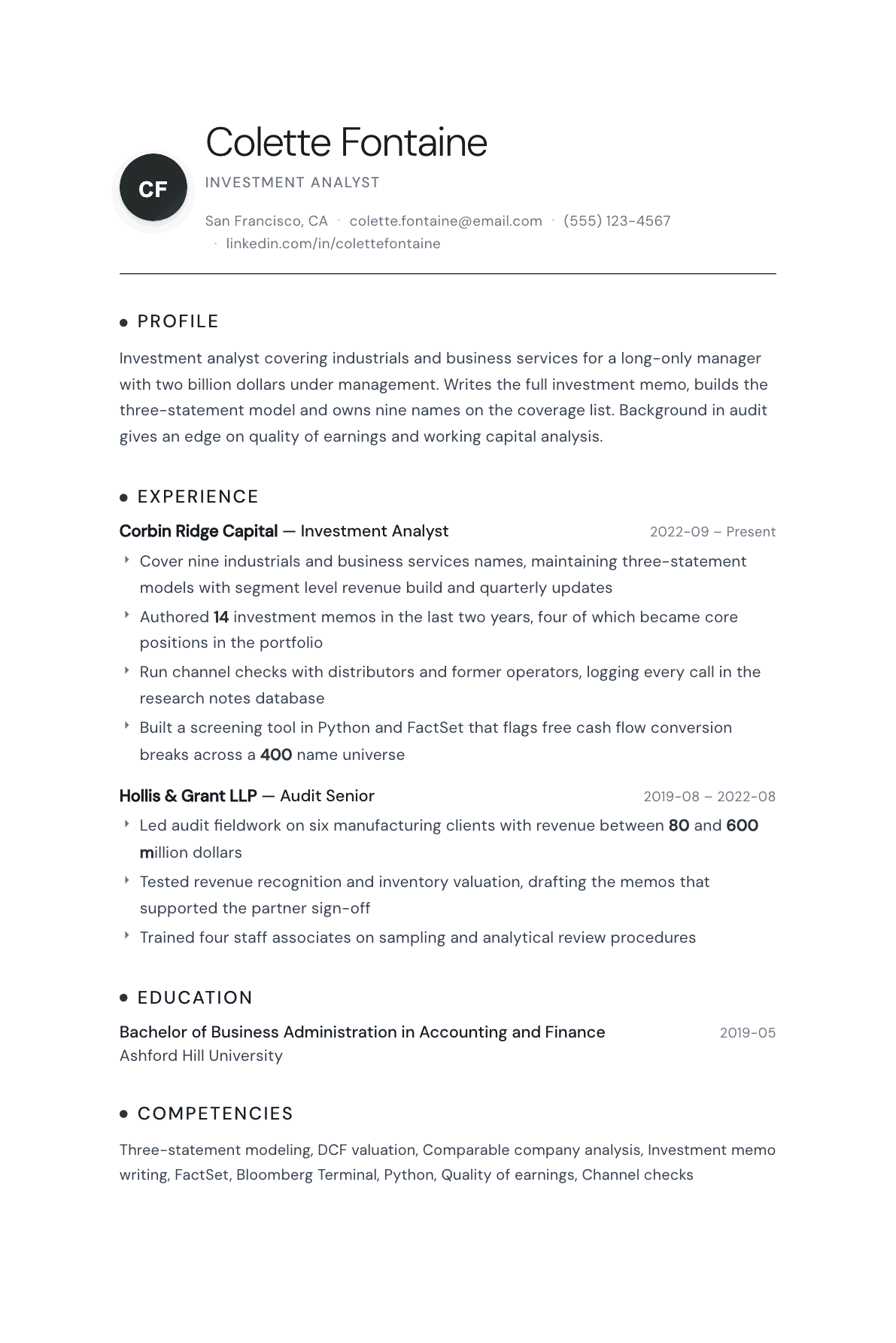
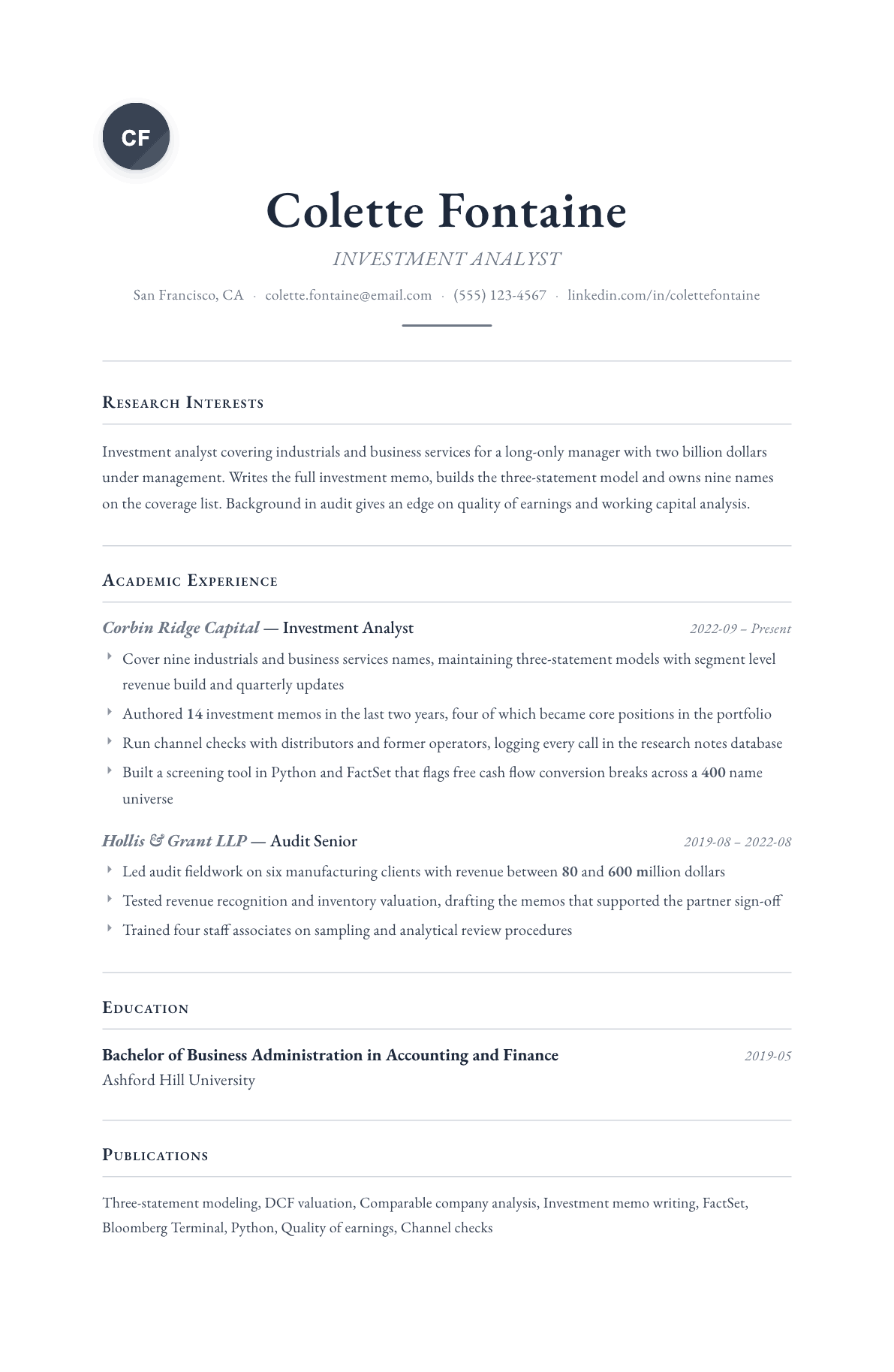
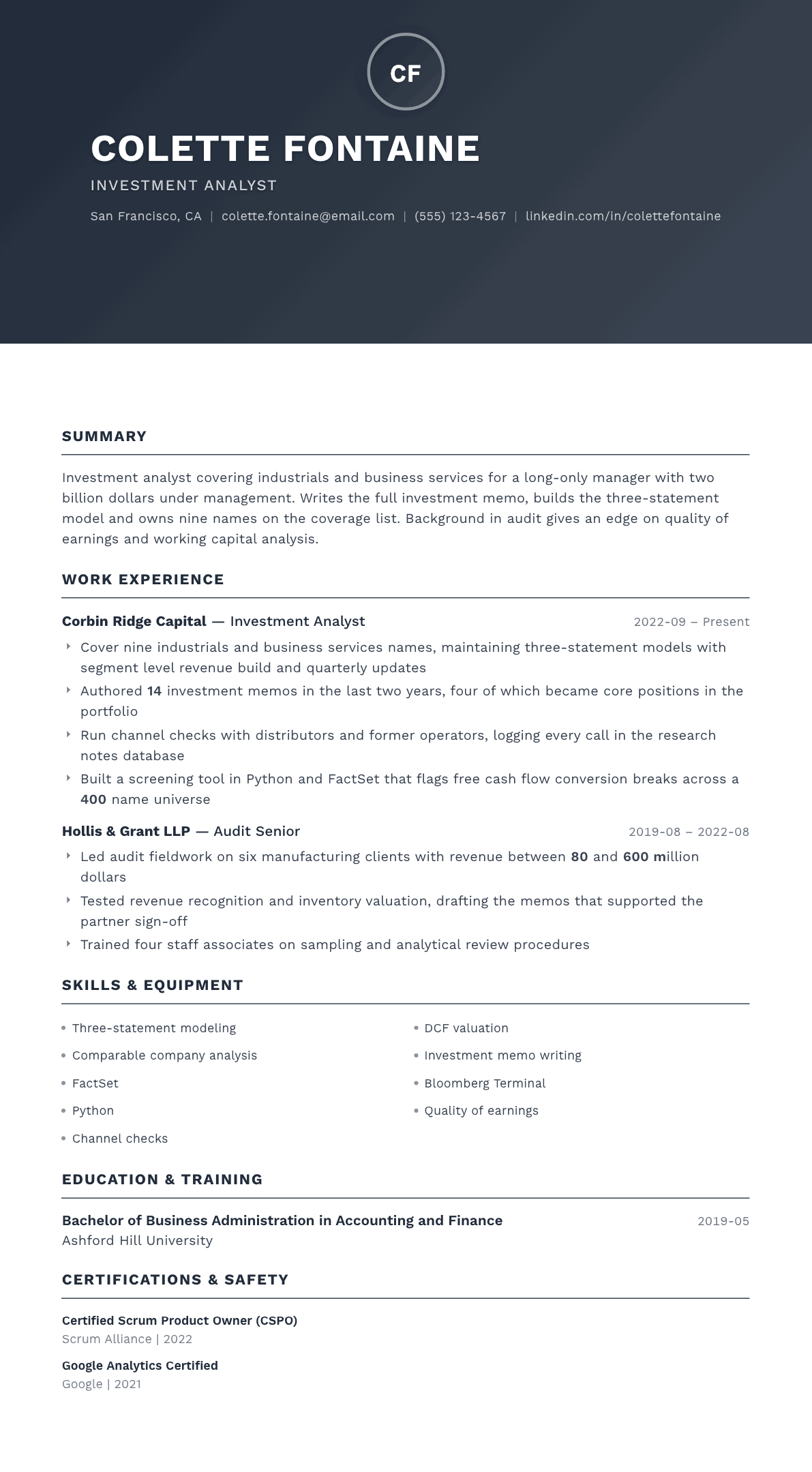
The same investment analyst content laid out in three CVBooster templates, so you can see what the finished document looks like before you write a word.
Example Investment Analyst summary
Investment analyst with three years on a long-only industrials desk, covering nine names and writing the memo behind every recommendation. Builds three-statement models with a segment level revenue build and tests management guidance against supplier and distributor calls. Prior audit training in revenue recognition and inventory sharpens the quality of earnings work. CFA Level II candidate seeking a generalist seat with wider mid-cap coverage.
Skills to list on a Investment Analyst resume
- Three-statement modeling
- DCF valuation
- Comparable company analysis
- Precedent transactions
- Investment memo writing
- Equity research
- Financial statement analysis
- Quality of earnings
- FactSet
- Bloomberg Terminal
- Capital IQ
- Python
- Portfolio monitoring
- Primary research
- Valuation modeling
What actually gets this resume read
- Say what you cover: the sector, the market capitalization band and the number of names you own on the list.
- Investment memos are the product of this job, so state how many you wrote and how many became positions.
- Name the data terminals honestly, since an interviewer will ask what you pull from FactSet against Bloomberg.
- Show your valuation range: discounted cash flow, sum of the parts, comparable companies, precedent transactions.
- Reference primary research such as expert calls, store checks or supplier conversations, not just filings work.
- Put CFA progress on the resume by level and status, and never imply a charter you have not been awarded.
How to write a investment analyst resume
An investment analyst resume is read by someone who will judge you on one question: can you form a view and defend it. Coverage, memos and models are the proof. The portfolio manager reading your page wants to know which sectors you have lived in, how many names you carried, and whether the recommendations you wrote actually entered a portfolio.
The screen before that is mechanical. A recruiter matches the strategy, the asset class and the terminals against the mandate, because a credit analyst at a private debt fund and a long-only equity analyst are not interchangeable even though both write investment analyst on a resume.
This guide sets out how to present coverage, how to describe model ownership without sounding generic, which credentials matter and how to write bullets that show original research instead of filings summarizing.
Format: one page, dense, no decoration
Buy side resumes are traditionally plain: one page, reverse chronological, a single serif or clean sans face, and no graphics. Skill bars and colored headers read as noise to a portfolio manager who reads forty of these before lunch.
Education stays near the top for anyone within five years of graduating, because the funnel into this profession is still school and program driven. After that, experience leads and education compresses to two lines.
- Header: name, city, phone, email, and CFA level and status if you are a candidate.
- Order: summary, experience, education, technical skills, certifications and interests.
- A short interests line is standard on the buy side and often starts the interview.
Summary: strategy, coverage, output
Name the strategy first, whether long-only, long short, credit, private markets or multi-asset. Then the sectors and the number of names you own. Then what you produce: memos, models, screens, monitoring. Three sentences carry more signal here than any list of adjectives.
If you are switching in from audit, consulting or banking, use the summary to name the transferable analytical edge rather than apologizing for the pivot. Audit training in revenue recognition is a genuine advantage when the question is whether earnings are real.
Experience: coverage, memos, and the research you did yourself
Give each role a scope line: the assets under management, the strategy and the universe. Then write bullets around four things. What you cover. What you built. What you wrote. What happened to it.
The strongest bullet an analyst can write is one where a recommendation was acted on. Say how many memos you authored and how many became positions, without claiming credit for the fund return, which nobody believes and every interviewer probes.
Show primary research explicitly. Expert network calls, conversations with former operators, distributor checks, site visits and channel work separate an analyst from someone reading transcripts. Name the count and the type.
- Model detail wins: segment revenue build, unit economics, working capital and capital expenditure schedules.
- Say which valuation methods you run and where each one is appropriate.
- If you built a screen or a tool, give the universe size and what it flags.
Technical skills and credentials
Split tools from methods. Tools are FactSet, Bloomberg, Capital IQ, Python, Excel and any research management system you log notes in. Methods are discounted cash flow, sum of the parts, comparable companies, precedent transactions and quality of earnings review.
For the CFA, write the level and the status exactly: passed Level II, candidate for Level III. Never write CFA after your name unless the charter has been awarded, because this is checked and the profession treats the misuse seriously.
Keywords the screen looks for
Postings repeat a narrow set of terms: coverage universe, investment thesis, three-statement model, valuation, due diligence, portfolio monitoring, financial statement analysis and idea generation. Use the ones that are true of you inside bullets rather than in a detached block.
Add the asset class vocabulary too, since screens for a credit seat filter on covenants, leverage and recovery, while an equity seat filters on multiples, margins and market share.
Investment Analyst resume summary examples
New to the buy side
Economics graduate with two internships in equity research and a student managed fund seat covering consumer staples. Built three-statement models for four names and presented two long theses to the investment committee. Passed CFA Level I. Seeking an analyst seat with generalist coverage and memo writing.
Three years covering a sector
Investment analyst covering nine industrials and business services names for a long-only manager with two billion dollars under management. Wrote 14 memos in two years, four of which became core positions. Runs channel checks with distributors and former operators, and screens a 400 name universe in Python for free cash flow conversion breaks.
Senior analyst
Senior investment analyst owning industrials and materials coverage, sizing positions with the portfolio manager and mentoring two juniors on model architecture. Rebuilt the sector monitoring framework around cash conversion and incremental returns on capital. CFA charterholder with prior audit experience in manufacturing revenue and inventory.
Work experience bullets: before and after
Before: Analyzed companies and made investment recommendations.
After: Cover nine industrials and business services names, publishing a full memo on each with a base and bear case and a downside supported by balance sheet capacity.
It fixes the coverage universe and shows the structure of the recommendation rather than asserting one existed.
Before: Built financial models in Excel.
After: Maintain three-statement models with segment level revenue builds, working capital schedules and a returns bridge that separates multiple change from earnings growth.
The detail proves the model is genuinely yours, because only a builder describes it at this level.
Before: Conducted due diligence on potential investments.
After: Ran 22 expert calls with distributors, former sales leaders and channel partners over the last year, logging each in the research notes database with a thesis implication.
It converts a vague diligence claim into countable primary research with a place the work is recorded.
Before: Used Bloomberg and FactSet for research.
After: Built a Python screen against FactSet fundamentals that flags free cash flow conversion breaks across a 400 name universe and surfaces candidates for deeper work each month.
Naming the output and the universe turns terminal access into an original process you created.
Before: Presented ideas to the investment team.
After: Pitched six names at the weekly investment meeting, four of which were sized into the portfolio and two of which were rejected on valuation after committee challenge.
Including the rejected pitches signals honesty and gives the interviewer something concrete to ask about.
Hard skills
- Three-statement modeling
- Discounted cash flow valuation
- Comparable company analysis
- Precedent transaction analysis
- Financial statement analysis
- Quality of earnings review
- Investment memo writing
- Portfolio monitoring
- Primary and channel research
- FactSet and Bloomberg
- Capital IQ
- Python for screening
- Sensitivity and scenario analysis
Soft skills
- Independent judgment
- Written argument
- Intellectual honesty
- Curiosity and question design
- Debate under challenge
- Time allocation across coverage
Certifications worth listing
- Chartered Financial Analyst (CFA Institute)
- Certificate in Investment Performance Measurement (CFA Institute)
- Chartered Alternative Investment Analyst (CAIA Association)
- Certified Public Accountant (State boards of accountancy)
Mistakes that cost investment analyst candidates the interview
- Claiming fund performance as a personal result, which every interviewer discounts immediately.
- Leaving out the coverage universe, so the reader cannot tell whether you carried three names or thirty.
- Writing CFA next to your name while still a candidate, which is treated as a serious misrepresentation.
- Describing models generically when the specifics of the build are the only proof of ownership.
- Listing every terminal and database without showing a single output you produced from them.
- Omitting failed or rejected ideas entirely, which makes the page read as marketing rather than analysis.
Investment Analyst resume questions
How many names should I claim to cover?
Claim only the ones whose models you maintain and whose earnings you would be comfortable discussing without notes. A tight list of eight defensible names reads far better than a padded list of thirty, because the interviewer will pick one at random.
Can I move into an investment analyst role from audit or consulting?
Yes, and it happens regularly. Lead with the analytical overlap: revenue recognition testing, working capital review, unit economics or market sizing. Then show self-directed investment work such as a written memo or a personal model to prove the interest is real.
Should I include a stock pitch on the resume?
Do not paste the thesis onto the page, but name the ideas you presented and be ready with a one page memo as a leave behind. Interviewers ask for a pitch in almost every process, so the resume should signal that one exists.
Does the interests line at the bottom really matter?
On the buy side it often does. Small teams hire people they will sit beside for years, and a specific interest gives the conversation somewhere to go. Keep it genuine and specific rather than listing reading and travel.
What separates an investment analyst resume from an equity research one?
Sell side research emphasizes published notes, initiations and client interaction, while a buy side page emphasizes memos, position outcomes and portfolio monitoring. Match the emphasis to the seat you want, even when the underlying work overlaps heavily.
Related resume examples
- Portfolio Manager Resume example
- Financial Analyst Resume example
- Equity Research Analyst Resume example
- Private Equity Associate Resume example
- Investment Banking Analyst Resume example
- Finance Intern Resume example