Wealth Manager Resume Examples: the lines they read
Build a Wealth Manager Resume That Attracts High-Net-Worth Clients
By Mustafa Tarabya, founder of CVBooster · Published · Updated
Create a wealth manager resume showcasing ultra-high-net-worth client advisory, multi-generational planning, and investment strategy with AUM and performance metrics.
Sample resumes for a wealth manager
The same wealth manager content laid out in three CVBooster templates, so you can see what the finished document looks like before you write a word.
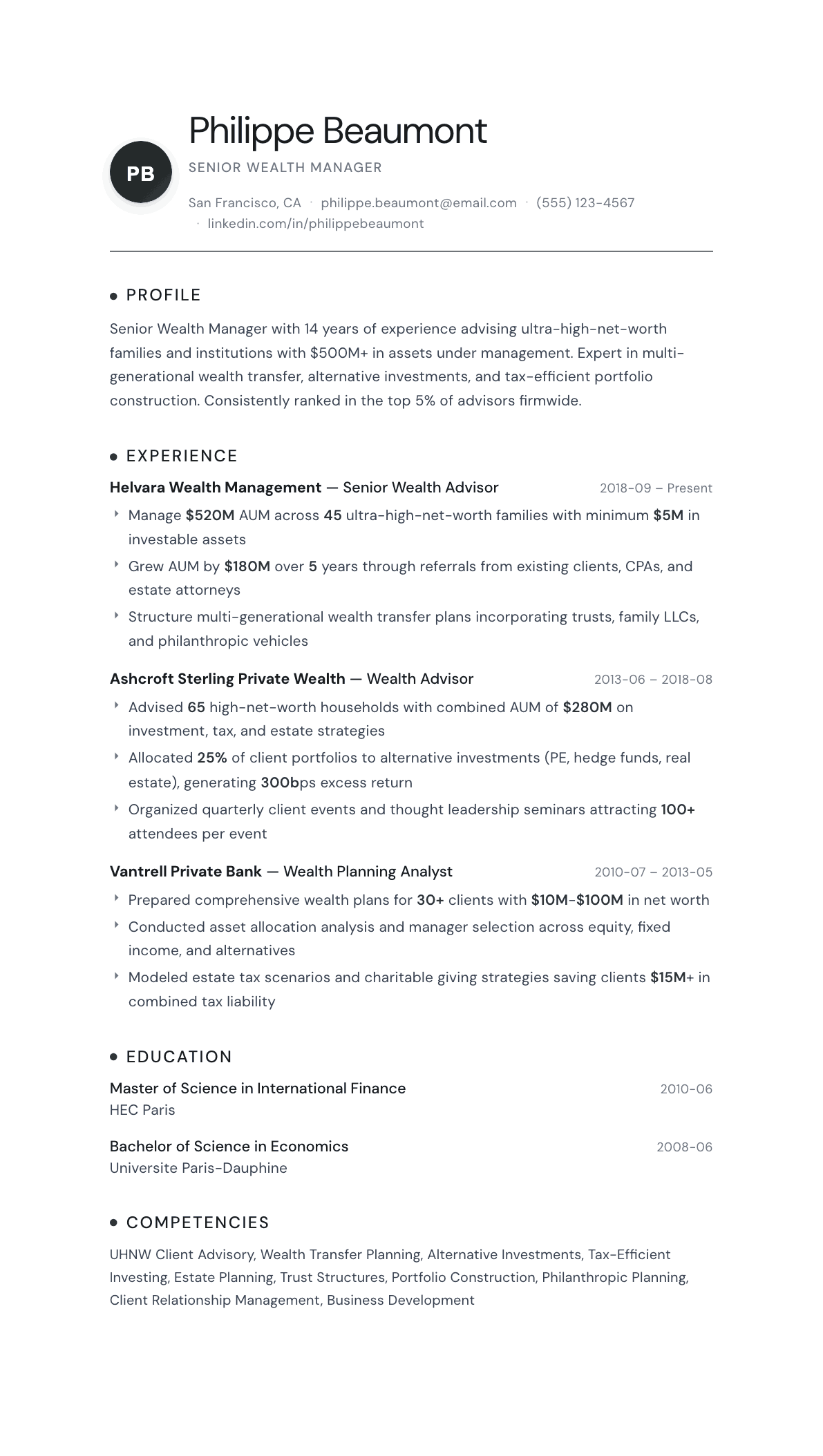
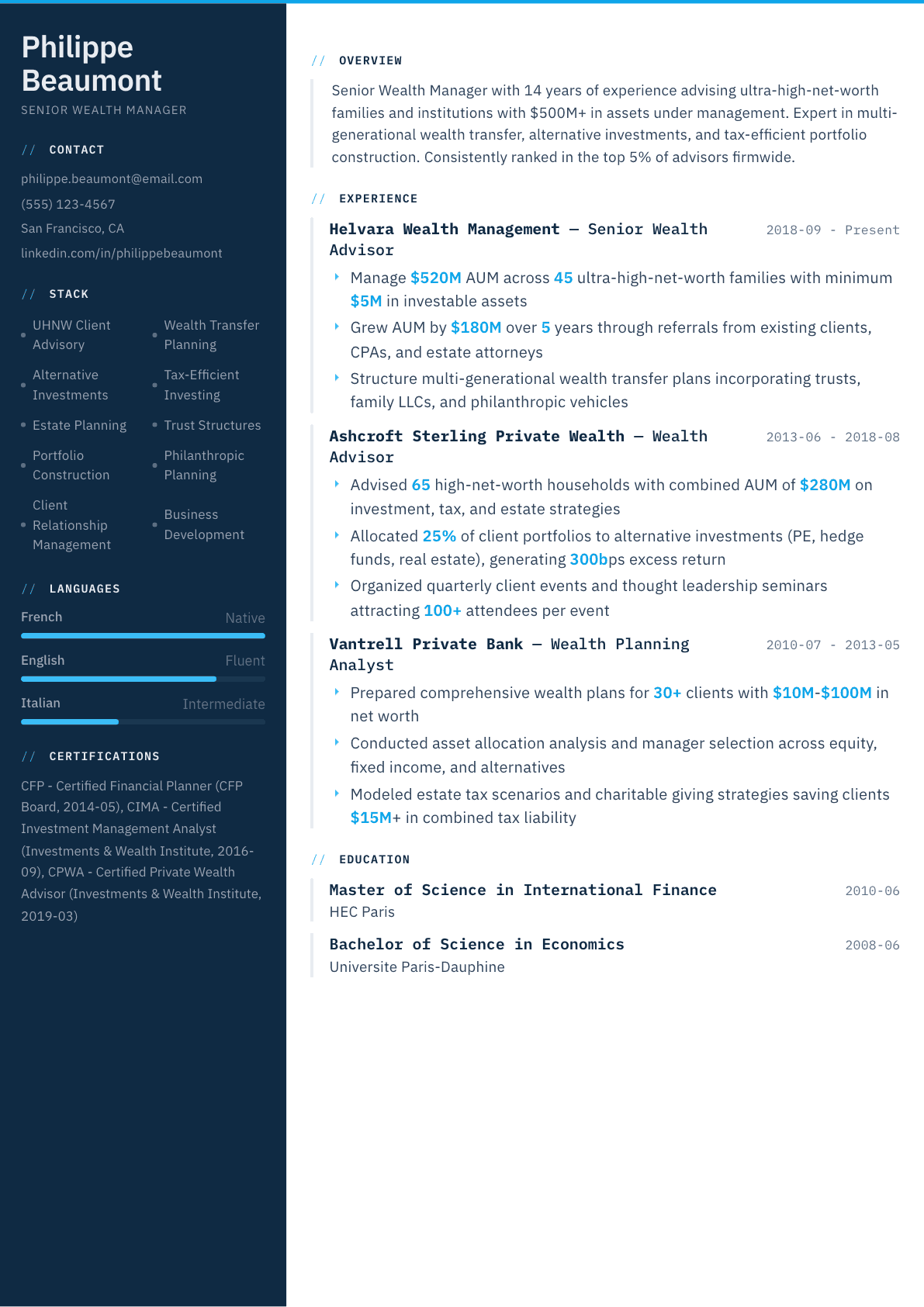
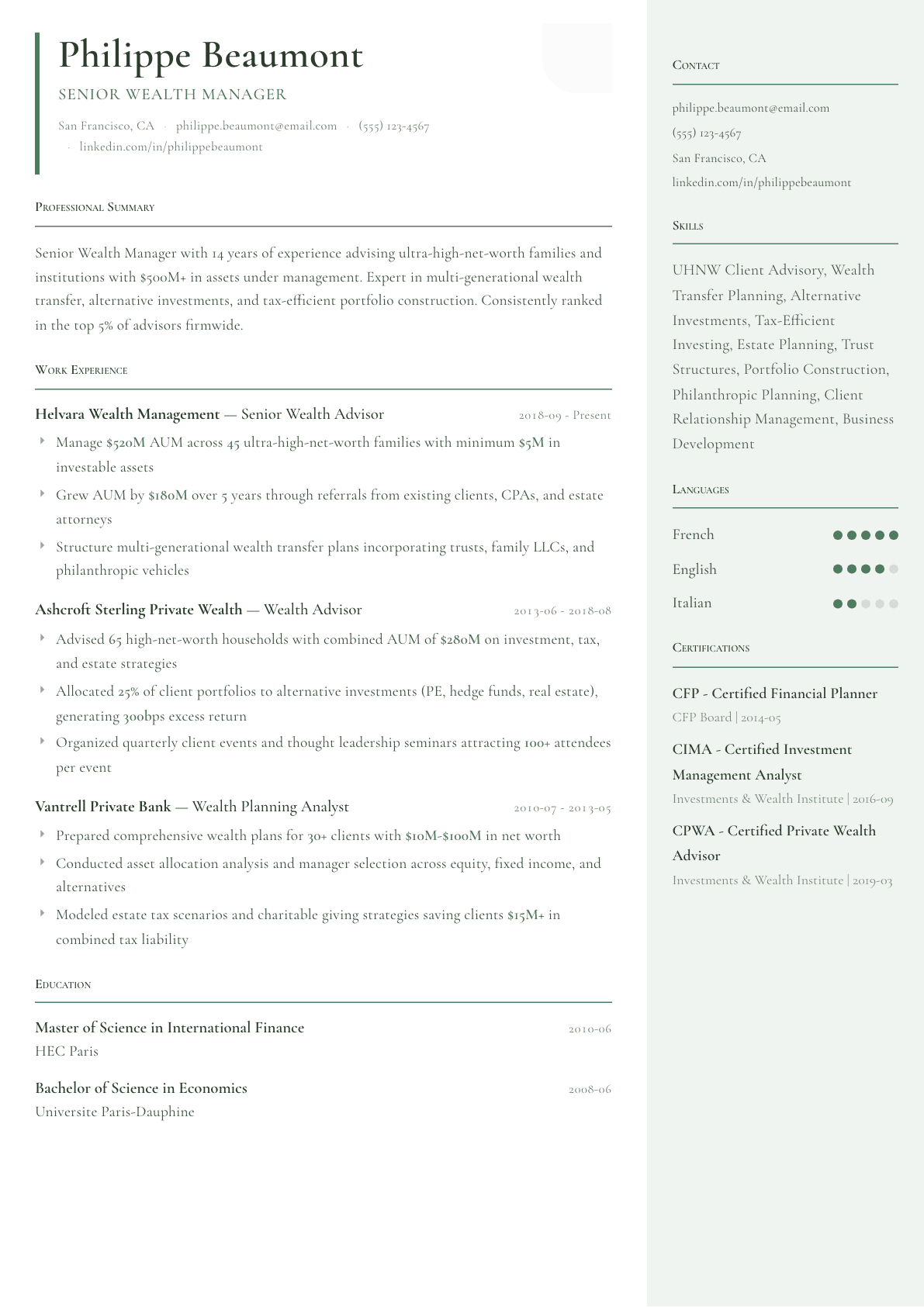
Example Wealth Manager summary
CPWA and CFP with 14 years of experience advising ultra-high-net-worth families with $500M+ AUM. Expert in multi-generational wealth transfer, alternative investments, and tax-efficient portfolio construction. Ranked in the top 5% of advisors firmwide. Seeking a Team Lead or Regional Director role to build and scale a premier wealth management practice.
Skills to list on a Wealth Manager resume
- UHNW Client Advisory
- Wealth Transfer Planning
- Alternative Investments
- Tax-Efficient Investing
- Estate Planning
- Trust Structures
- Portfolio Construction
- Philanthropic Planning
- Family Governance
- Client Development
- Manager Selection
- Risk Management
What actually gets this resume read
- Lead with total AUM, client count, and minimum account size to establish your market segment.
- Highlight multi-generational planning, trust structures, and philanthropic advisory.
- Show AUM growth through organic development and new client acquisition.
- Include alternative investment expertise: private equity, hedge funds, real estate, venture capital.
- CPWA, CFP, and CIMA credentials differentiate you; display them prominently.
- Demonstrate tax-efficient strategies and estate planning collaboration with legal and tax professionals.
How to write a wealth manager resume
Wealth management resumes are read by people who already know that assets under management is the headline number and that it can be presented in several flattering ways. So the reader goes looking for the qualifiers straight away: whose assets were they, how many relationships, what was the average household size, and did the assets come with you or come with the firm. A wealth manager with a smaller book of genuinely self sourced relationships is often the stronger hire.
The second read is about complexity. Advising a household with a portfolio and a retirement plan is one job. Advising a family with an operating business, concentrated founder stock, a family limited partnership, a private foundation and three generations who do not agree with each other is another. The vocabulary you use gives you away in either direction, so use the vocabulary that matches the work you have really done.
This guide covers the structure that fits private wealth, three summaries from a client associate to a senior relationship owner, before and after bullets, and the compliance boundaries around what a licensed advisor may put in writing.
Format: the book at the top, complexity underneath
Two pages is standard for an experienced wealth manager. Open with a book snapshot rather than a personal statement: assets under management or advisement, number of client relationships, average and typical household size, the client profile, and the channel you work in, whether that is a private bank, a wirehouse team, a multi family office, an independent registered investment advisor or a trust company.
Then say how much of the book you sourced. Firms distinguish sharply between an inherited book, a firm allocated book and one you built, and stating it plainly earns credibility rather than costing it. Everyone in the industry can tell the difference within one conversation anyway.
- Header: name, designation marks, city and state, phone, email.
- Order: book snapshot, summary, experience, planning and investment capabilities, licenses and designations, education.
- Client associates and analysts lead with the households supported and the deliverables they produce instead of a book.
Summary: client profile, complexity, and how you grow
Name the client type you serve well: business owners approaching a sale, senior corporate executives with equity compensation, physicians and surgical group partners, inherited wealth families across generations, professional athletes or entertainers, or foundations and endowments. Wealth management is a relationship trade and firms hire for a segment fit, not a generic advisor.
Then the complexity you handle in your own hands: liquidity events and pre transaction planning, concentrated stock and hedging or exchange strategies, trust structures and coordination with counsel, charitable vehicles including donor advised funds and private foundations, cross border families, private capital and direct investment allocations, and credit needs such as securities based lending. Finish with your growth engine: attorneys and certified public accountants, existing client introductions, an internal banking or lending partner, or a professional community you belong to.
Experience: the client work, the team, and the outcomes
Describe the actual advisory work rather than the service model brochure. The discovery process you run with a family, the wealth plan you produce and how often it is revisited, the investment policy statement you write and maintain, the asset location decisions across taxable and deferred accounts, tax loss harvesting and gain budgeting, the annual gifting cycle, beneficiary and titling reviews, and the family meeting you facilitate.
Show how you work with specialists, because at this level nobody works alone. Coordination with trust and estate counsel, tax advisors, insurance specialists, investment banking or business transition teams, and in house portfolio managers or research. Say what you own in that structure: the relationship, the plan, the allocation, the manager selection, or all of them.
Then the numbers a hiring firm will ask about: net new assets over a stated period, relationships added, retention across a market cycle, share of revenue that is fee based rather than transactional, and team production if you lead one. Present them without implying investment performance you delivered, since that is where compliance draws the line.
Investments and planning technology
Show your investment approach honestly. Whether you build portfolios directly, use a model or unified managed account platform, select external managers, or work with an in house chief investment office. Then the areas where a wealth manager earns fees beyond allocation: tax aware implementation, concentrated position management, alternatives due diligence and access, private credit and real assets, and liquidity planning around a known future event.
Name the platforms: the planning engine such as eMoney, MoneyGuidePro, RightCapital or NaviPlan, the reporting and portfolio system such as Addepar, Orion, Black Diamond or Tamarac, the customer relationship manager, and the custodians you have worked across. In the family office segment, Addepar experience specifically is worth its own mention because consolidated reporting across entities and illiquid holdings is a real skill.
Designations, registration and what compliance will not let you say
The CFP is the broad planning credential, the CPWA and CIMA are the recognized private wealth and investment consulting marks, the CFA carries weight where you manage portfolios directly, and the CTFA fits trust work. Use the marks correctly and state registrations accurately: the general securities and agent examinations, the investment adviser representative examination, and any state insurance licenses.
Then write as though the compliance department is the first reader, because at a registered firm it often is. No performance claims, no client names, no implication of guaranteed outcomes, no unsubstantiated ranking language. Describe what you do and the size and durability of the relationships you keep, and let the reader infer the quality of the advice.
Wealth Manager resume summary examples
Client associate
Client associate on a private bank team supporting three senior advisors and roughly 60 relationships, preparing wealth plans in eMoney, consolidated reporting in Addepar and quarterly review materials. Series 7 and 66 registered, and enrolled in the CFP program. Seeking an associate wealth manager seat.
Seven years in
Wealth manager with 210 million in assets under management across 48 relationships averaging four million, focused on business owners preparing for a sale. CFP professional handling pre transaction planning, charitable vehicles and concentrated stock strategies. Sourced most of the book through attorney and accountant introductions.
Senior relationship owner
Senior wealth manager holding CPWA and CFP, advising 32 ultra high net worth families with 640 million in assets under advisement, including operating businesses, private foundations and multigenerational trusts. Leads a team of four, chairs family meetings, and coordinates with counsel and tax advisors on every plan.
Work experience bullets: before and after
Before: Managed relationships with high net worth clients.
After: Advised 48 relationships averaging four million in investable assets, mostly business owners within five years of a liquidity event, owning the plan, the allocation and the annual review cycle for each.
Relationship count, average size, client type and what you personally owned describe a book rather than a job title.
Before: Grew assets under management significantly.
After: Added 85 million in net new assets over three years across 14 new relationships, sourced through two estate planning attorneys and introductions from existing clients rather than firm allocated leads.
Naming the sourcing channel tells a hiring firm whether the growth is portable and repeatable.
Before: Provided comprehensive wealth planning.
After: Built wealth plans covering liquidity event modeling, charitable structures, gifting to the next generation and trust funding, then updated each plan annually and after any material family change.
Listing the actual planning components and the refresh discipline shows depth that comprehensive alone cannot carry.
Before: Worked with attorneys and accountants on client matters.
After: Coordinated with estate counsel and the family tax advisor on grantor trust funding and an annual gifting program, and hosted a joint meeting each year so the family heard one consistent plan.
The named structures and the joint meeting show real coordination rather than occasional referral traffic.
Before: Handled clients with concentrated stock positions.
After: Managed concentrated founder stock for six clients through staged sale plans, charitable transfers ahead of a sale and, where suitable, exchange fund allocations, always with the family tax advisor at the table.
Naming the specific techniques and the suitability framing shows technical command with appropriate caution.
Hard skills
- Wealth planning for high net worth families
- Pre liquidity event planning
- Concentrated position strategies
- Trust structures and funding coordination
- Charitable vehicles and donor advised funds
- Tax aware portfolio implementation
- Asset location across account types
- Manager selection and alternatives due diligence
- Securities based lending and credit strategies
- Investment policy statement drafting
- Addepar and Orion reporting
- eMoney and MoneyGuidePro planning
Soft skills
- Building trust across generations
- Facilitating a difficult family conversation
- Discretion with sensitive family matters
- Listening before recommending
- Coordinating a team of outside professionals
- Steadiness through a market decline
Certifications worth listing
- Certified Private Wealth Advisor (CPWA) (Investments and Wealth Institute)
- Certified Investment Management Analyst (CIMA) (Investments and Wealth Institute)
- Certified Financial Planner (CFP) (Certified Financial Planner Board of Standards)
- Chartered Financial Analyst (CFA) (CFA Institute)
- Certified Trust and Fiduciary Advisor (CTFA) (American Bankers Association)
- Chartered Advisor in Philanthropy (CAP) (The American College of Financial Services)
Mistakes that cost wealth manager candidates the interview
- Giving assets under management with no relationship count, so the reader cannot tell whether you serve 20 families or 400 accounts.
- Staying silent on how the book was sourced, which a hiring firm reads as an inherited book you would rather not discuss.
- Borrowing family office vocabulary for work you have not done. Trust and foundation language is easy to test in an interview.
- Printing performance claims or firm rankings, which compliance treats as advertising and which stops the file before the hiring manager sees it.
- Describing the firm service model instead of your own work, leaving the reader unsure what you personally own in a client relationship.
- Naming clients or identifying details of a family situation, which signals exactly how you would treat your next employer relationships.
Wealth Manager resume questions
How should I present assets under management on a wealth manager resume?
Give the total with the relationship count and the average household size, say whether it is under management or advisement, and note how much you sourced yourself. Those qualifiers are what a hiring firm would ask for in the first call anyway.
What is the difference between a wealth manager and a financial planner resume?
A planner resume centers on planning process and household count. A wealth manager resume adds complexity and capital: trusts, business transitions, concentrated positions, alternatives, credit, and coordination with counsel and tax advisors across a family rather than an individual.
Which designation matters most in private wealth?
The CFP is the broad planning baseline, the CPWA and CIMA are the recognized private wealth marks, and the CFA matters where you manage portfolios directly. Pick the one that matches the seat you want and finish it rather than collecting several partly.
Can I say my clients outperformed the market?
No. Performance claims on a resume are advertising in a compliance sense, and they require substantiation and disclosure you cannot provide on one page. Show relationship retention, net new assets and the complexity you handle instead.
How do I move from a client associate role into an advisor seat?
Show the advisory work you already do: plans you build, review materials you prepare and present, client meetings you lead, and any relationships where you are the primary contact. Then add the credential and registration progress that removes the firm remaining objection.
Related resume examples
- Financial Planner Resume example
- Portfolio Manager Resume example
- Investment Banker Resume example
- Financial Advisor Resume example
- Banker Resume example
- Tax Consultant Resume example