Private Equity Associate Resume Examples: free ATS score
Write a Private Equity Associate Resume That Clears Headhunters
By Mustafa Tarabya, founder of CVBooster · Published · Updated
Private equity associate resume examples with deal sheet bullets, LBO modeling keywords, diligence detail and a guide to the headhunter screen.
Sample resumes for a private equity associate
The same private equity associate content laid out in three CVBooster templates, so you can see what the finished document looks like before you write a word.
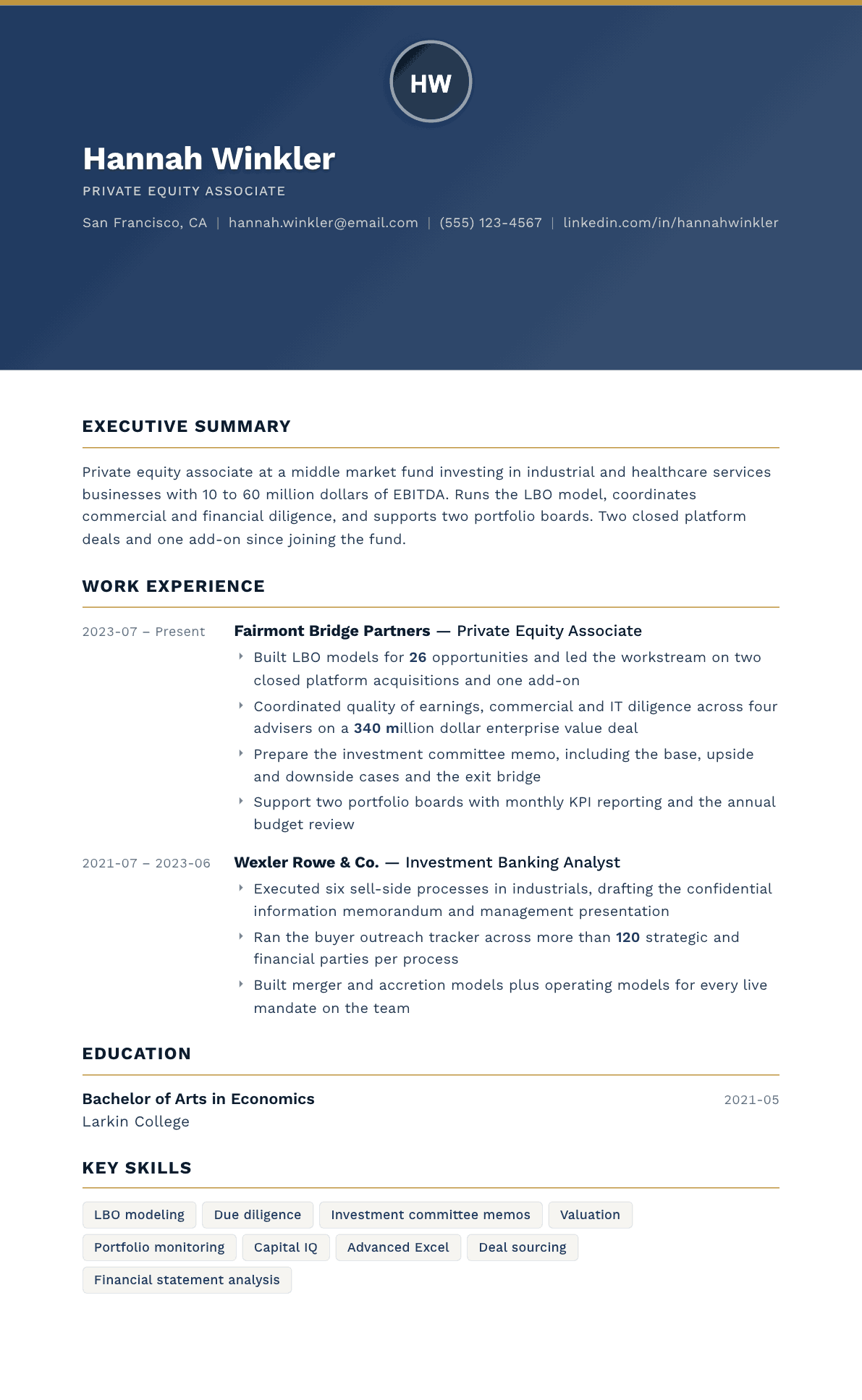
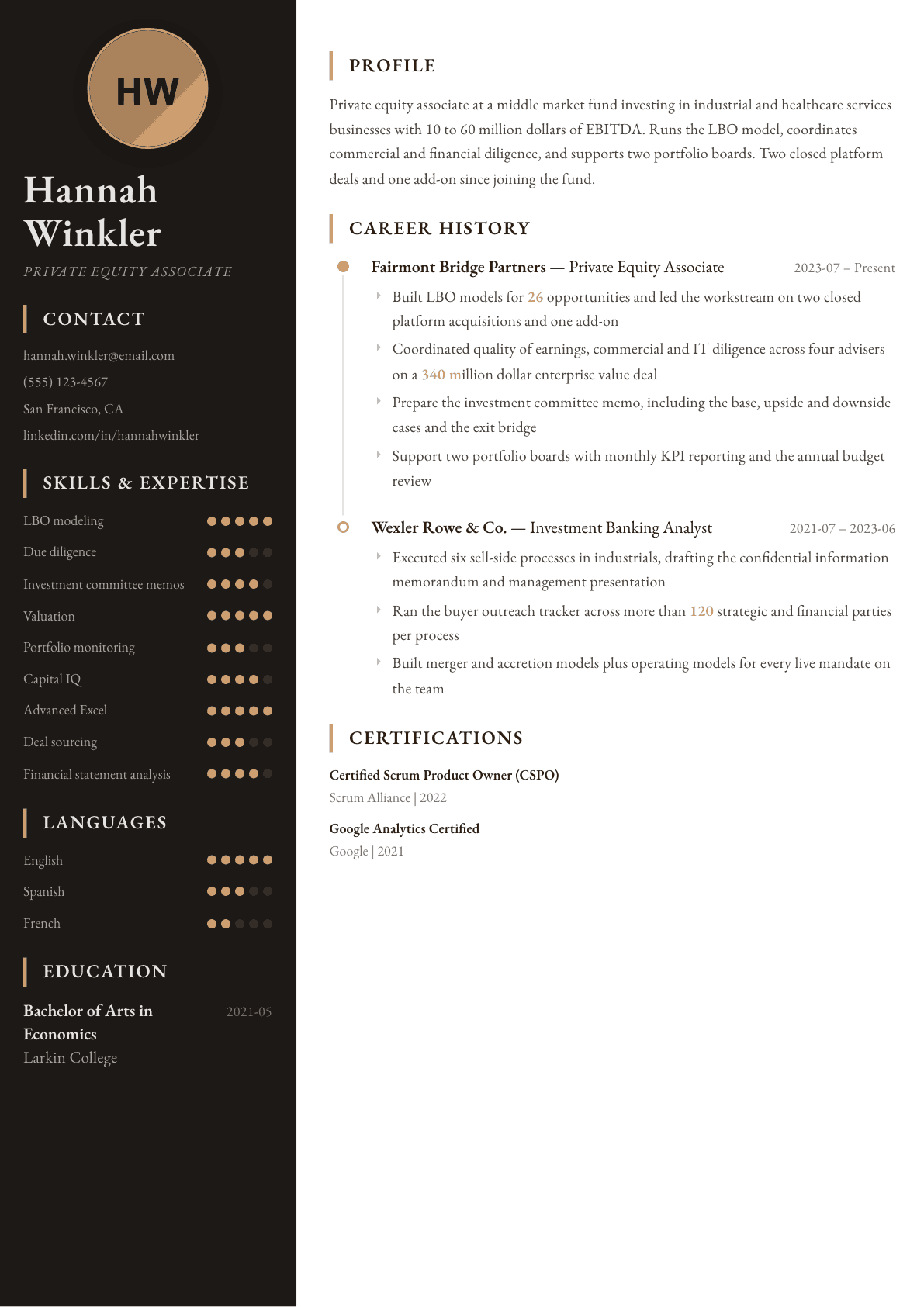
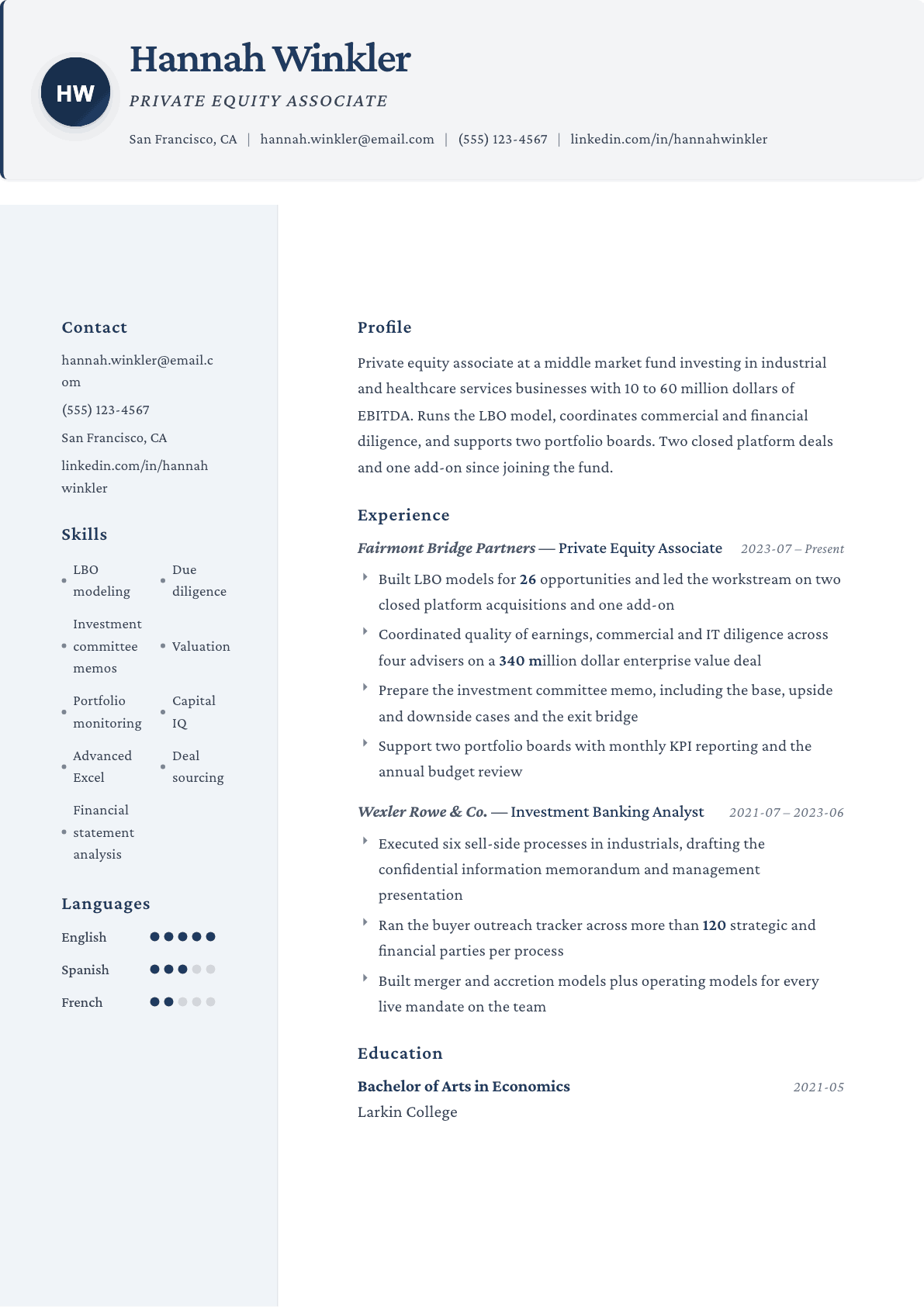
Example Private Equity Associate summary
Private equity associate at a middle market fund backing industrial and healthcare services companies with 10 to 60 million dollars of EBITDA. Two closed platforms and one add-on, with full ownership of the LBO model and the investment committee memo on each. Coordinates diligence across four advisory workstreams and supports two portfolio boards on monthly reporting. Prior industrials coverage in investment banking.
Skills to list on a Private Equity Associate resume
- LBO modeling
- Three-statement modeling
- Due diligence coordination
- Investment committee memos
- Valuation
- Deal sourcing
- Portfolio monitoring
- Add-on acquisitions
- Quality of earnings review
- Capital structure analysis
- Advanced Excel
- Capital IQ
- PitchBook
- Board reporting
What actually gets this resume read
- Give the fund a shape: strategy, check size, EBITDA range and sector focus, since headhunters filter on all four.
- Build a deal sheet with your role on each transaction, the enterprise value, the sector and whether it closed.
- Separate closed deals from live or dead processes, because an interviewer will ask and inflation is easy to catch.
- Describe the diligence you coordinated by workstream, naming quality of earnings, commercial, legal and technology.
- Show portfolio work, which is what distinguishes an associate who added value from one who only modeled.
- Keep it to one page with banking first, private equity second, and the deal sheet immediately under the experience.
How to write a private equity associate resume
A private equity associate resume passes through a headhunter before it reaches a fund, and the headhunter is filtering on four attributes: your banking group, your deal exposure, your modeling depth and your school. That is unfair but it is the mechanism, so the page has to answer all four inside the first eight lines.
Once a partner reads it, the question changes. They want to know what you actually did on each transaction, whether you can carry a diligence process without supervision, and whether you have ever sat in front of a management team that runs a real business. The deal sheet is where those answers live.
This guide covers the layout funds expect, how to build a deal sheet that survives questioning, how to describe leveraged buyout modeling credibly, and what to do when your background is consulting or operating rather than banking.
Format: one page, deal sheet directly under experience
Strictly one page. Reverse chronological with education at the top if you graduated within four years, which covers most associate candidates. No columns, no color, no photograph.
Put a deal sheet immediately under the experience section rather than mixing transactions into the bullets. A clean list of transactions with your role on each is the fastest way for a partner to see the shape of your exposure.
- Order: education, experience, deal sheet, technical skills, certifications and interests.
- Each deal line: target description, enterprise value, product or strategy, your role, status.
- Mark clearly which processes closed, which are live and which were abandoned.
Summary: fund shape and what you own
If you already sit at a fund, describe it the way another investor would: strategy, sector focus, check size and the earnings band of the businesses you buy. A line reading middle market buyout fund investing in industrial and healthcare services companies with 10 to 60 million dollars of EBITDA tells a reader more than the fund name alone.
Then say what you own. Model, memo, diligence coordination and portfolio support are the four workstreams of the seat, and claiming all four when you only run one is the fastest route to a bad interview.
The deal sheet: precise, honest, defensible
A deal sheet is the most examined part of the resume. For each transaction give an anonymized description if you cannot name the target, the enterprise value, the sector, the product and one line on what you personally did. Partners will pick a deal and ask you to walk through the thesis, the capital structure and why it did or did not clear the committee.
Separate closed transactions from live and dead ones, and never present a process you staffed for two weeks as a deal you led. Inflation is easy to detect because the follow up question is always about a detail only someone on the deal would hold.
- Give the sources and uses at a high level if the deal is public.
- Note which advisers you managed on each diligence workstream.
- Say whether you sat in management meetings or only supported from behind.
Experience bullets: modeling, diligence, portfolio
Model bullets should describe the build. Purchase price allocation, debt schedule with a revolver sweep, management incentive plan, and a returns bridge that separates deleveraging from multiple expansion and earnings growth. This is the language of someone who has built the model rather than opened one.
Diligence bullets should name the workstreams you coordinated: quality of earnings, commercial, legal, insurance, technology and environmental. Include how many advisers reported into you and how the findings changed the price or the structure.
Portfolio bullets are what distinguish a strong associate. Board reporting, a pricing project, an add-on pipeline, a budget review or a management dashboard all show you can create value after the close rather than only underwrite it.
Coming from consulting, accounting or operations
Consulting candidates should lead with commercial diligence, market sizing and operational improvement work, then prove modeling separately, because the standard objection is that the technical depth is missing. A transaction services background should lead with quality of earnings and working capital analysis, which funds pay heavily for.
In either case, name the deals you supported even when you were on the adviser side. Funds hire from advisory teams regularly, and the exposure counts as long as you describe your role accurately.
Private Equity Associate resume summary examples
Moving from banking
Investment banking analyst in industrials with six sell-side processes executed, seeking a middle market buyout seat. Built operating models, merger analyses and management presentations across every live mandate, and ran buyer outreach across more than 120 parties per process. Comfortable with leveraged buyout mechanics and debt schedule construction.
Second year associate
Private equity associate at a middle market fund backing industrial and healthcare services businesses with 10 to 60 million dollars of EBITDA. Two closed platforms and one add-on, with full ownership of the model and the investment committee memo on each. Coordinates four diligence workstreams and supports two portfolio boards on monthly reporting.
Senior associate
Senior associate leading deal execution end to end, from first management meeting through signing, with three closed platforms and five add-ons. Manages two associates on model and memo production, owns the add-on pipeline for a services platform, and sits in the monthly operating review with the portfolio company leadership team.
Work experience bullets: before and after
Before: Built LBO models for potential acquisitions.
After: Built leveraged buyout models for 26 opportunities, including purchase price allocation, a debt schedule with a revolver sweep, management incentive economics and a returns bridge separating deleveraging from multiple expansion.
The build detail proves ownership, because only someone who constructed the model describes its components.
Before: Assisted with due diligence on acquisitions.
After: Coordinated quality of earnings, commercial, insurance and technology diligence across four advisory firms on a 340 million dollar enterprise value platform, consolidating findings into the price adjustment schedule.
It names the workstreams, the number of advisers and the commercial result of the diligence work.
Before: Worked on investment committee materials.
After: Author the investment committee memo, including the market thesis, base, upside and downside cases, the exit bridge and the specific diligence findings that support each assumption.
Writing the memo is a very different claim from formatting it, and the components make that difference visible.
Before: Supported portfolio companies after closing.
After: Support two portfolio boards with monthly KPI reporting, the annual budget review and an add-on pipeline of 30 targets screened against the platform thesis.
Portfolio value creation becomes concrete, which is the work that separates a strong associate from a modeler.
Before: Sourced new investment opportunities.
After: Screened roughly 200 inbound teasers a year against the fund mandate and originated four proprietary conversations through direct outreach to founder owned businesses in the services sector.
It distinguishes intermediated flow from genuinely proprietary sourcing, which partners weigh very differently.
Hard skills
- Leveraged buyout modeling
- Three-statement modeling
- Debt schedule and capital structure analysis
- Returns bridge and exit analysis
- Quality of earnings review
- Commercial diligence coordination
- Investment committee memo writing
- Add-on acquisition screening
- Portfolio KPI reporting
- Capital IQ and PitchBook
- Advanced Excel
- Valuation and comparable analysis
Soft skills
- Adviser management
- Written argument under partner scrutiny
- Judgment about which diligence questions matter
- Direct communication with management teams
- Workload triage across live processes
- Discretion with confidential information
Certifications worth listing
- Chartered Financial Analyst (CFA Institute)
- Certified Public Accountant (State boards of accountancy)
- Chartered Alternative Investment Analyst (CAIA Association)
Mistakes that cost private equity associate candidates the interview
- Presenting a process you touched briefly as a deal you led, which unravels in the first walkthrough question.
- Omitting enterprise values and sectors from the deal sheet, leaving the reader unable to size your exposure.
- Describing the fund only by name, so a partner outside your network cannot tell what strategy you know.
- Writing built LBO models with no reference to the debt schedule, the sweep or the returns bridge.
- Leaving out portfolio work, which is the clearest evidence that you think past the close.
- Spilling onto a second page, which in this market reads as an inability to prioritize.
Private Equity Associate resume questions
Can I get a private equity associate seat without investment banking experience?
It is harder but it happens, most often from transaction services, strategy consulting or a corporate development team. Lead with diligence and modeling evidence, and expect a longer technical test, because the fund is underwriting a skill it usually assumes.
How should I describe a deal that never closed?
Describe it plainly as a live or abandoned process and say what you learned from the work. Funds care about reps, not only outcomes, and a candidate who can explain why a deal was dropped on diligence findings often interviews better than one who cannot.
Should I name the target companies on my deal sheet?
Name them only where the transaction is public. Otherwise use an anonymized description such as a regional facilities services platform with 25 million dollars of earnings, which gives the reader the shape without breaching confidentiality.
How much does the fund care about my school?
Headhunters weigh it heavily at the screening stage and partners weigh it much less once you are in the room. If your school is not on the usual list, compensate with a very precise deal sheet and a technical page that leaves no doubt about modeling depth.
Is a CFA useful for a private equity associate?
It is neutral to mildly positive. Funds value transaction reps and modeling speed above credentials, though the charter can help candidates coming from a non traditional background who need an external signal of technical grounding.
Related resume examples
- Investment Banker Resume example
- Portfolio Manager Resume example
- Investment Banking Analyst Resume example
- Acquisitions Analyst Resume example
- Investment Analyst Resume example
- Financial Analyst Resume example