Investment Banking Analyst Resume Examples: free score
Investment Banking Analyst Resume Sample That Deal Teams Notice
By Mustafa Tarabya, founder of CVBooster · Published · Updated
Investment banking analyst resume examples with transaction bullets, modeling keywords, deal experience formatting and a guide to the one page standard.
Sample resumes for a investment banking analyst
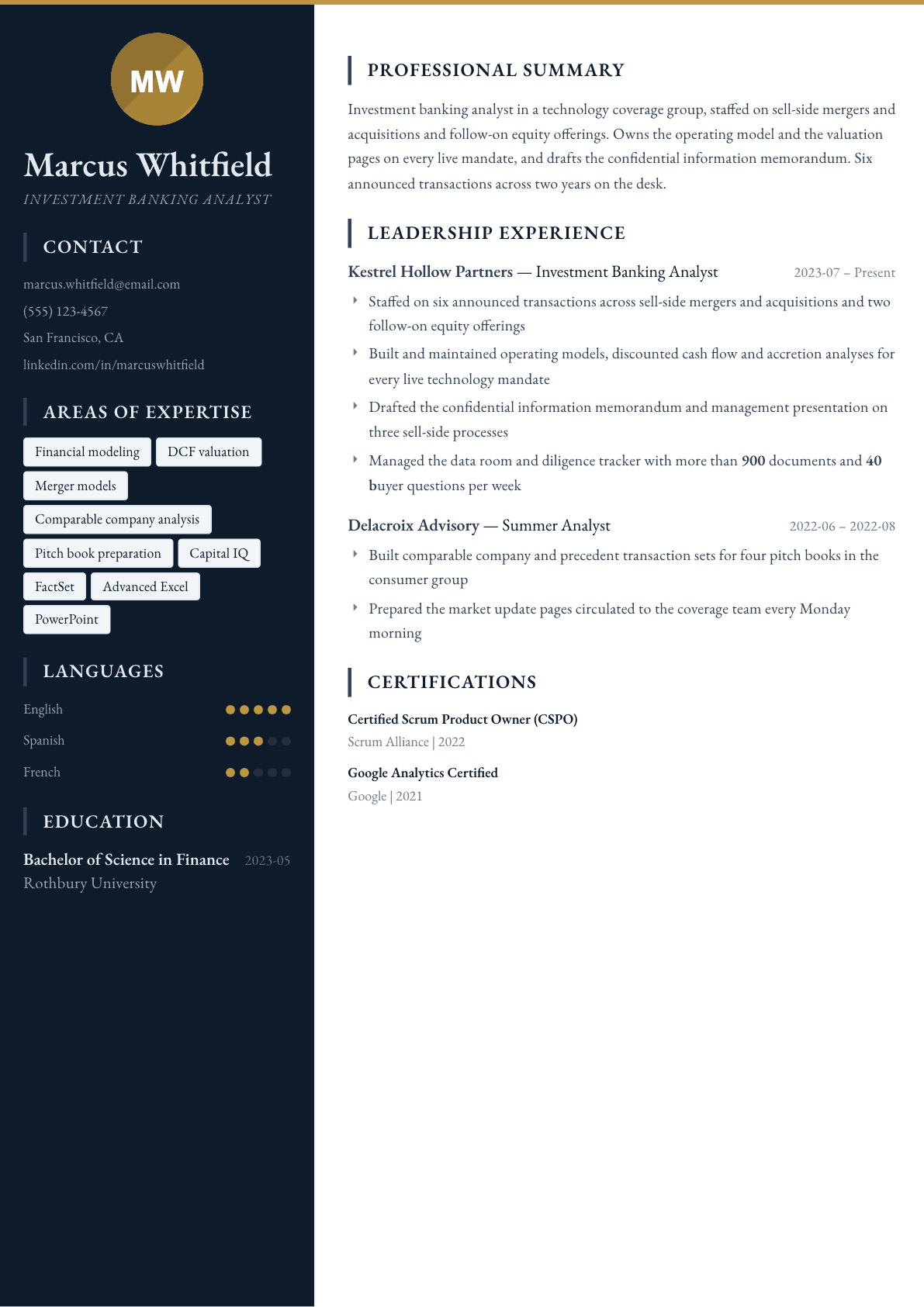
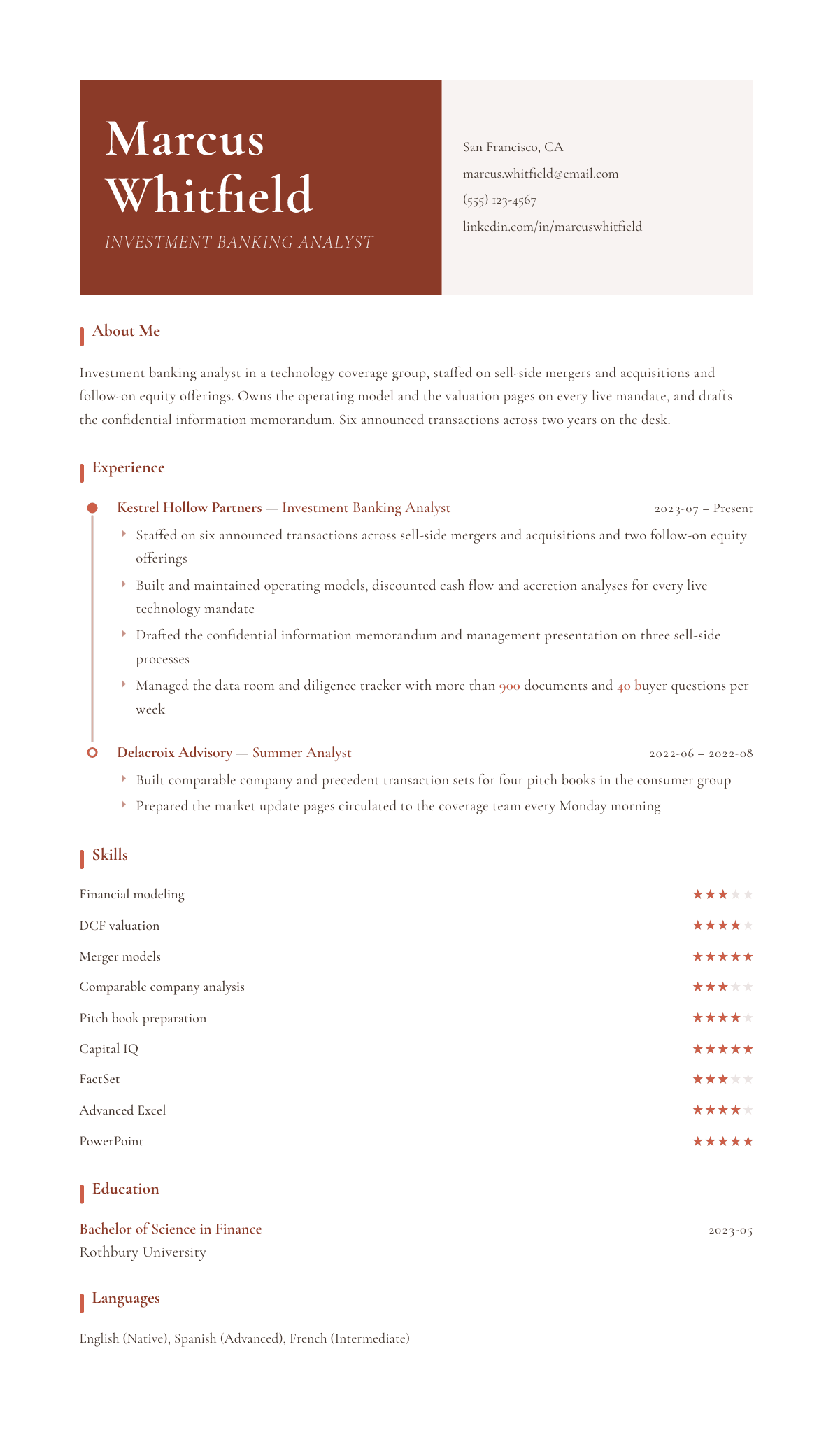
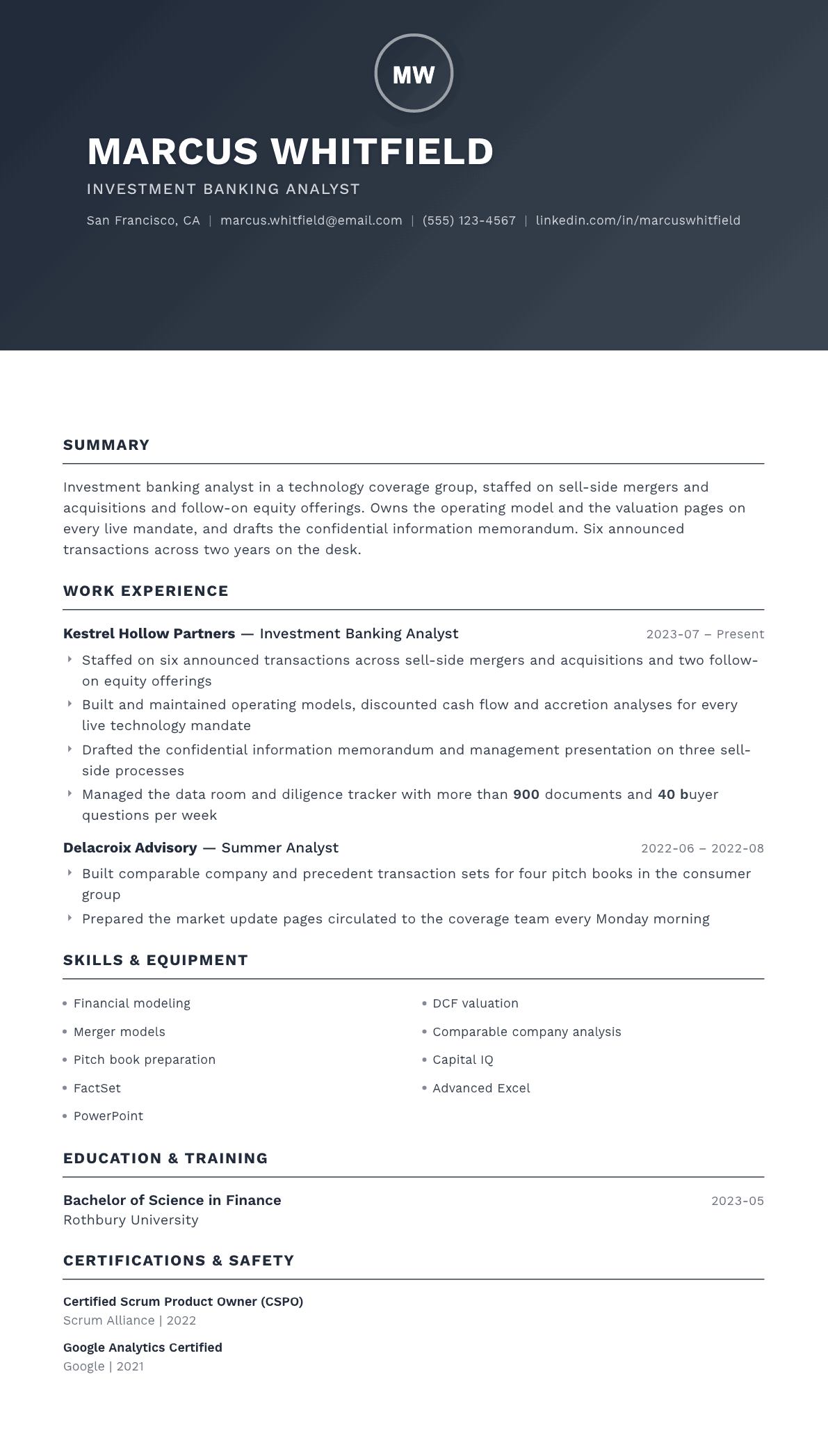
The same investment banking analyst content laid out in three CVBooster templates, so you can see what the finished document looks like before you write a word.
Example Investment Banking Analyst summary
Investment banking analyst in a technology coverage group with six announced transactions across sell-side mergers and acquisitions and follow-on equity offerings. Owns the operating model, the valuation pages and the confidential information memorandum on live mandates. Ran the diligence tracker and data room on three processes. Targeting a private equity or corporate development seat where the modeling work continues past the close.
Skills to list on a Investment Banking Analyst resume
- Three-statement modeling
- DCF valuation
- Merger and accretion analysis
- LBO modeling
- Comparable company analysis
- Precedent transactions
- Pitch book preparation
- Confidential information memorandum
- Due diligence support
- Capital IQ
- FactSet
- Bloomberg Terminal
- Advanced Excel
- PowerPoint
What actually gets this resume read
- Put the group on the page: technology, healthcare, industrials, financial sponsors or leveraged finance coverage.
- Format deals as a transaction list with your role, the product and whether the deal announced or closed.
- Never claim credit for the whole deal, since a banker will ask which pages and models were yours.
- Show product breadth across mergers and acquisitions, equity capital markets, debt financing and restructuring.
- Keep the resume to a single page with education first for analysts still within two years of graduation.
- Add the technical detail interviewers probe: accretion dilution, leveraged buyout mechanics and the debt schedule.
How to write a investment banking analyst resume
The investment banking analyst resume is the most standardized document in finance. Deviating from the expected format costs you more than it gains, because the reader is scanning hundreds of nearly identical pages and any variation reads as unfamiliarity with the industry rather than personality.
Within that rigid format, the differentiator is transaction detail. A vice president wants to see which products you have executed, which group you sat in, and what part of the process was yours. An analyst who can say they drafted the confidential information memorandum and ran the diligence tracker has described a real seat.
The sample resume for investment banking on this page follows that standard: education first, a transaction list by product and role, and a technical skills line that holds up in an interview. This guide covers the layout every group expects, how to write a transaction list, how to describe modeling so it survives a technical interview, and how a student with no banking internship can still build a credible page.
Format: one page, education first, no exceptions
One page, education at the top, experience below, then skills and interests. Analysts and recent graduates keep education first because the group is still reading school, major and academic results as a proxy. Times or a similar serif at ten or eleven point is the convention.
Dates right aligned, employer bolded, position underneath, city and state on the right. This is a template the industry has agreed on, and matching it lets the reader find what they need in five seconds.
- Header: name, phone, email and city on one or two centered lines.
- Education: school, degree, major, graduation date and relevant coursework or test results.
- Experience: three to five bullets per role, each starting with a past or present tense verb.
The transaction list: product, role, status
Once you have live deals, list them. Give the product, whether sell-side or buy-side mergers and acquisitions, an initial public offering, a follow-on offering, a debt financing or a restructuring. Give the sector and an approximate size. Then give your role in one clause.
Announced and closed transactions carry more weight than pitches, so keep them separate. Every banker who reads the list will ask you to walk through one deal from mandate to close, so only include transactions you can narrate without notes.
Experience bullets: the model, the book, the process
Modeling bullets should say what kind of model and what it drove. An operating model with a revenue build, a discounted cash flow with a weighted average cost of capital build, an accretion dilution analysis with synergy phasing, or a leveraged buyout with a full debt schedule. Naming the mechanics is what distinguishes a builder from a formatter.
Materials bullets should name the document. Confidential information memorandum, management presentation, board materials, fairness opinion support, lender presentation. Say which sections you drafted rather than claiming the whole book.
Process bullets show you can run the machinery. Data room administration, the buyer tracker, the diligence question log and the daily status call are unglamorous and are exactly what a vice president needs an analyst to carry without supervision.
- Give the number of parties contacted in an outreach process.
- Mention the size of the diligence question flow you managed per week.
- Note any direct client contact, which is uncommon and therefore worth stating.
Technical skills and what interviewers test
Keep the technical line short and true: Excel modeling, PowerPoint, Capital IQ, FactSet, Bloomberg and any language you genuinely use. Nobody is impressed by a long list, and each item is a legitimate interview question.
Assume the technical interview will cover the three statements linking, enterprise value against equity value, discounted cash flow mechanics, accretion dilution and the basics of a leveraged buyout. If a bullet on your page implies a skill, be ready for the question that follows it.
No banking internship yet
Build the page from three sources: a finance adjacent internship, a student investment fund or case competition, and self-directed modeling work. A boutique advisory internship, a valuation project or a search fund role all read as legitimate preparation.
Coursework and test results carry more weight in this recruiting funnel than almost any other, so include them. Add a clear interests line, because the coffee chat network that drives banking recruiting starts from something specific on that line.
Investment Banking Analyst resume summary examples
Incoming analyst
Finance graduate with a summer analyst internship in a consumer coverage group, where I built comparable company and precedent transaction sets for four pitch books and prepared the weekly market update. Led a student fund team through two long pitches. Seeking a full-time analyst seat in a coverage group.
Second year analyst
Investment banking analyst in technology coverage with six announced transactions across sell-side mergers and acquisitions and two follow-on equity offerings. Owns the operating model and valuation pages on every live mandate, drafted the confidential information memorandum on three processes, and manages the data room and diligence tracker.
Third year analyst moving up
Third year analyst executing across mergers and acquisitions, equity capital markets and leveraged finance in technology coverage. Trains two incoming analysts on model architecture and materials standards, runs the buyer outreach process end to end, and handles direct client contact on diligence follow ups.
Work experience bullets: before and after
Before: Worked on several M&A transactions.
After: Staffed on six announced transactions across sell-side mergers and acquisitions and two follow-on equity offerings in the technology coverage group.
Counting announced deals by product tells a vice president exactly what execution reps you have.
Before: Built valuation models.
After: Built and maintained operating models, discounted cash flow analyses with a weighted average cost of capital build, and accretion dilution models with synergy phasing for every live mandate.
Naming the mechanics signals real construction rather than updating an inherited template.
Before: Helped prepare marketing materials.
After: Drafted the business overview, industry and financial sections of the confidential information memorandum on three sell-side processes, plus the management presentation for each.
Identifying the specific sections you wrote is a claim you can defend, unlike credit for the whole document.
Before: Managed the data room.
After: Administered a data room of more than 900 documents and cleared roughly 40 buyer diligence questions per week against the deal team and client responses.
Volume converts routine process work into evidence you can carry a live process without supervision.
Before: Contacted potential buyers for the process.
After: Ran the buyer outreach tracker across more than 120 strategic and financial parties per process, logging non-disclosure agreement status and first round bid timing.
It shows the scale of the outreach and the specific mechanics of running a competitive process.
Hard skills
- Three-statement operating models
- Discounted cash flow valuation
- Comparable company analysis
- Precedent transaction analysis
- Merger and accretion dilution analysis
- Leveraged buyout modeling
- Confidential information memorandum drafting
- Pitch book preparation
- Data room and diligence management
- Capital IQ and FactSet
- Bloomberg Terminal
- Advanced Excel and PowerPoint
Soft skills
- Accuracy under deadline
- Attention to formatting standards
- Clear status communication
- Stamina across long processes
- Discretion
- Taking direction and reworking quickly
Certifications worth listing
- Securities Industry Essentials Examination (FINRA)
- Series 79 Investment Banking Representative (FINRA)
- Series 63 Uniform Securities Agent State Law Examination (FINRA)
- Chartered Financial Analyst (CFA Institute)
Mistakes that cost investment banking analyst candidates the interview
- Using a modern template with colors or icons, which signals that you have never seen a banking resume.
- Claiming credit for an entire transaction rather than the models and sections that were yours.
- Listing pitches beside announced deals without distinguishing between them.
- Writing financial modeling with no mechanics, which collapses under the first technical question.
- Dropping education below experience while still an analyst, when the group expects it at the top.
- Going to two pages, which no analyst level resume in this industry needs.
- Omitting the interests line, which is where most networking conversations begin.
Investment Banking Analyst resume questions
How many deals should be on an analyst resume?
List what you can discuss in depth, which for most second year analysts is between four and eight. Padding the list is counterproductive because a banker will pick one at random and expect a full walkthrough of the mandate, the process and the outcome.
What should a sample resume for investment banking include?
One page with education and GPA at the top, then experience with a short transaction list naming product, sector, size band and your role, then a skills line covering modeling, valuation and the tools you use, and a brief interests line. Do not wait for the Series 79; firms sponsor it after you start.
What should I put on the resume if my deals are confidential?
Describe the target generically by sector and approximate size, such as a mid-sized enterprise software business, and keep the product and your role explicit. Every banker reading it understands the confidentiality constraint and expects that phrasing.
How important is the interests line at the bottom?
More important than candidates expect. Banking recruiting runs on informational calls, and a specific interest gives the person on the other end an opening. Keep it concrete, and be prepared to talk about anything you list for several minutes.
Can I lateral into banking from accounting or corporate finance?
Yes, most often into leveraged finance, restructuring or a valuation group where your technical background maps directly. Rebuild the page to the banking format, lead with transaction adjacent work, and be ready to prove modeling speed in a timed test.
Related resume examples
- Investment Banker Resume example
- Financial Analyst Resume example
- Private Equity Associate Resume example
- Equity Research Analyst Resume example
- Investment Analyst Resume example
- Finance Intern Resume example