Real Estate Attorney Resume Examples: what gets the call
Write a Real Estate Attorney Resume That Closes Deals
By Mustafa Tarabya, founder of CVBooster · Published · Updated
Real estate attorney resume examples with title, leasing and closing keywords, and a guide to writing transactions and diligence work.
Sample resumes for a real estate attorney
The same real estate attorney content laid out in three CVBooster templates, so you can see what the finished document looks like before you write a word.
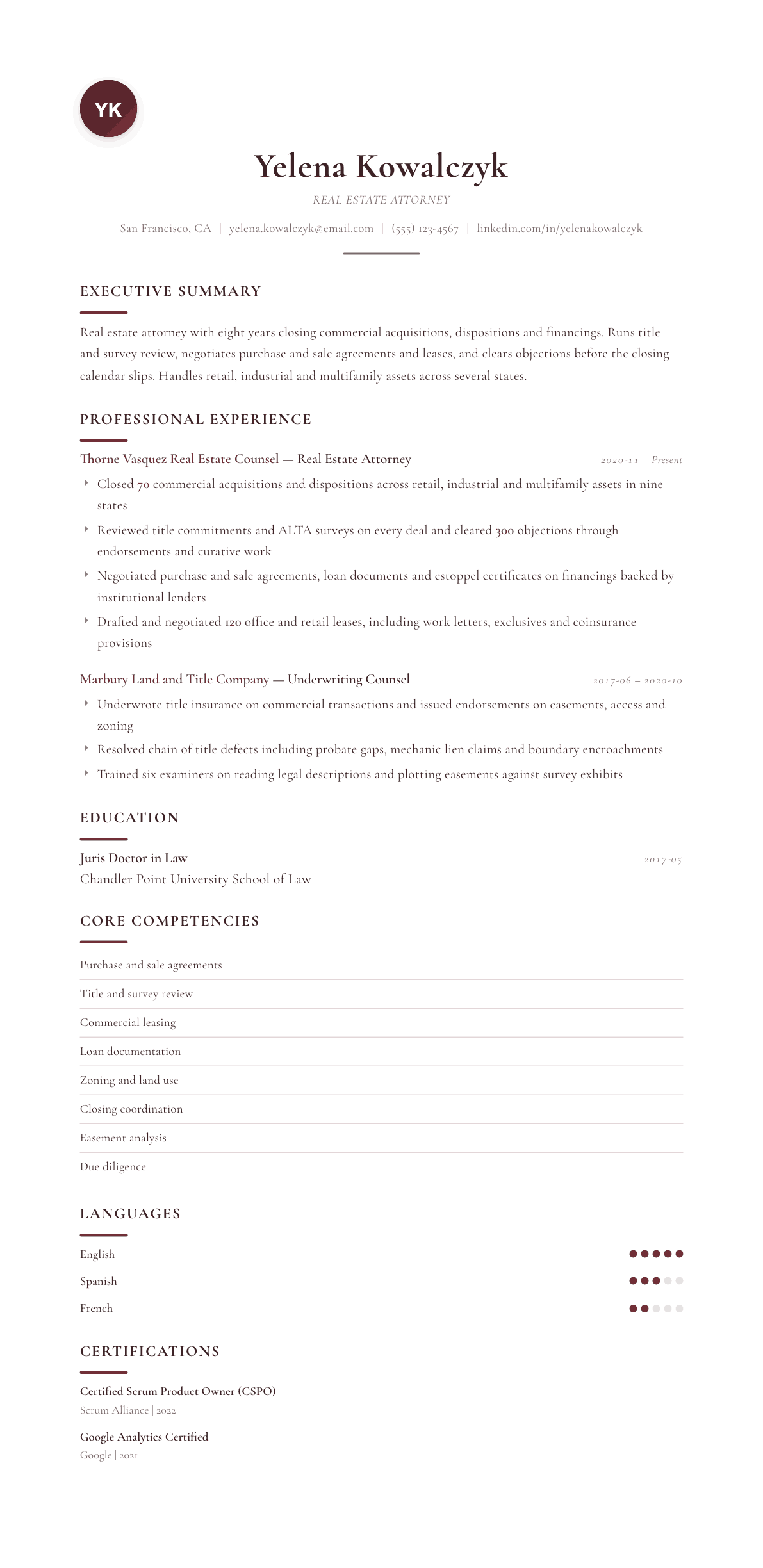
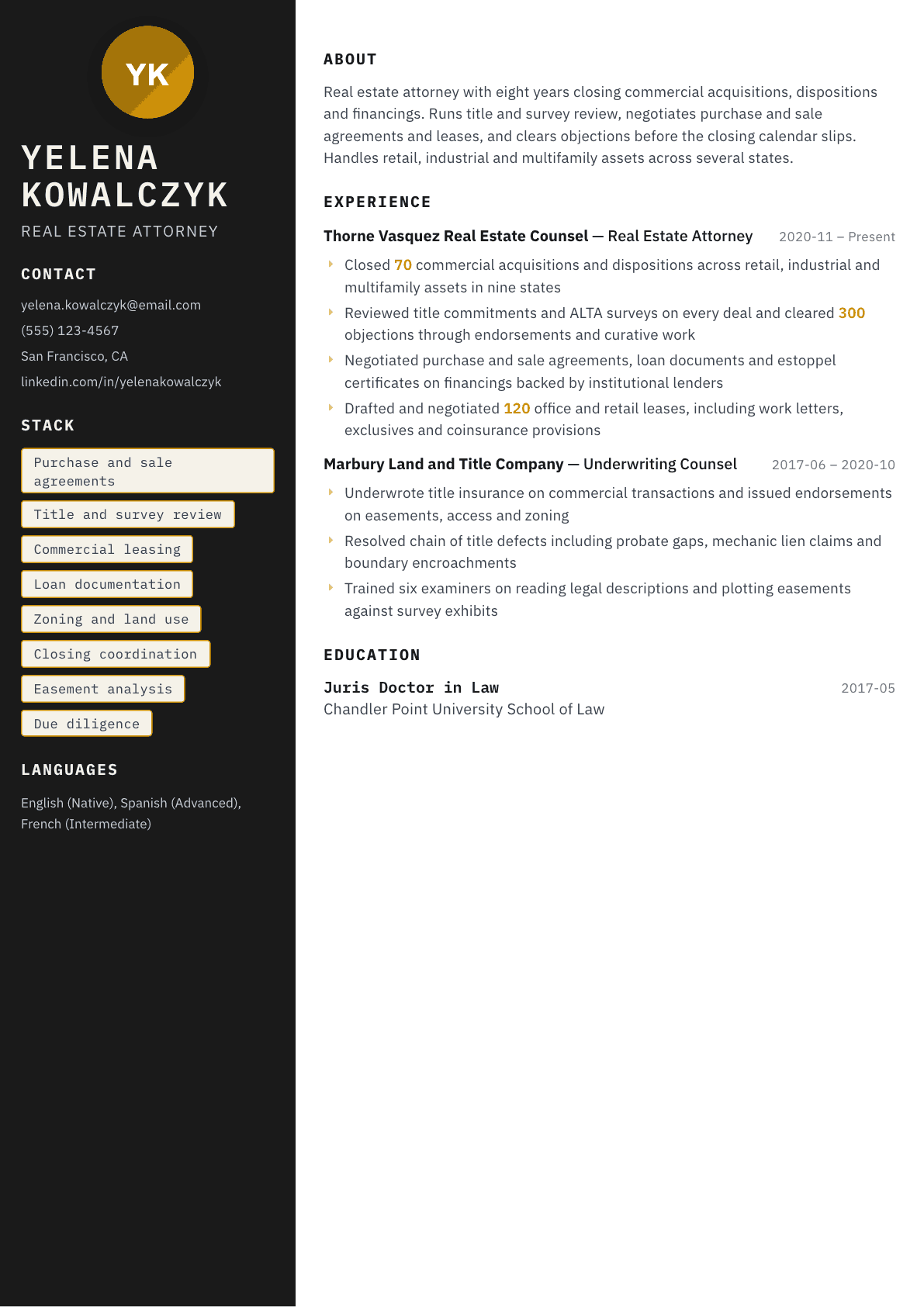
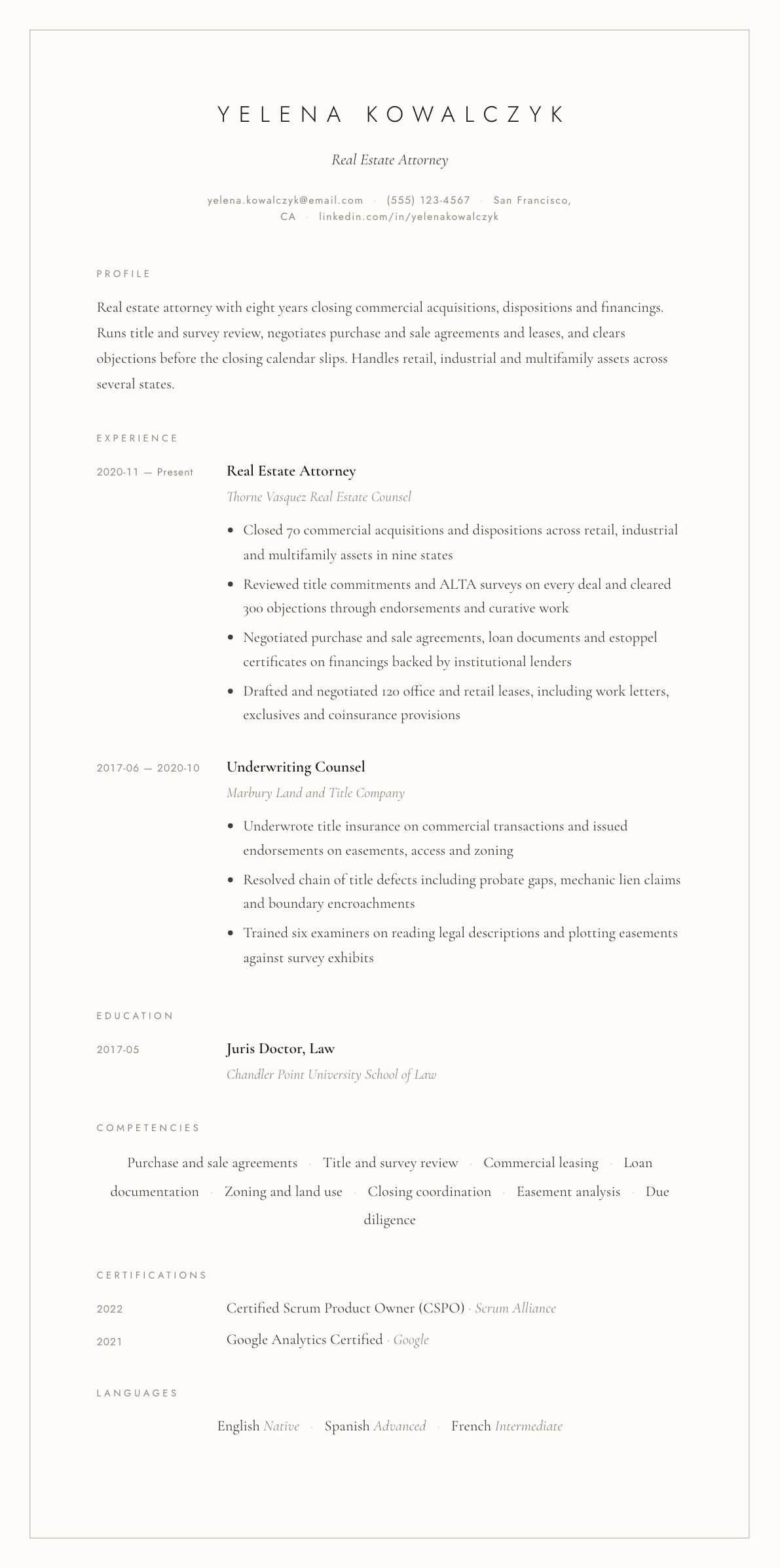
Example Real Estate Attorney summary
Real estate attorney with eight years closing commercial acquisitions, dispositions, leases and financings across retail, industrial and multifamily assets. Runs title and survey review personally, clears objections through endorsements and curative work, and keeps closings on calendar. Former title underwriting counsel, which brings a lender and insurer view to every deal on the diligence side.
Skills to list on a Real Estate Attorney resume
- Purchase and sale agreements
- Title commitment review
- ALTA survey review
- Curative title work
- Commercial leasing
- Lease abstracting
- Loan and mortgage documentation
- Easements and access rights
- Zoning and land use approvals
- Environmental diligence review
- Closing coordination
- Escrow instructions
- Entity formation for holdings
- Estoppel certificates
What actually gets this resume read
- Separate transactional volume by asset class and deal type so a firm sees whether you match its client mix.
- Say plainly that you handle title and survey review, because that work is the daily reality of the practice.
- Name the document types you draft: purchase and sale agreements, leases, easements, loan documents, estoppels.
- Give closing counts and deal sizes in ranges rather than naming clients bound by confidentiality provisions.
- Mention state specific practice such as attorney closing states, recording rules and local zoning approvals.
- Include title underwriting or lender side experience if you have it, since it signals a wider range to a hiring partner.
How to write a real estate attorney resume
A real estate attorney resume is read against a deal calendar. The partner or general counsel reviewing it has closings scheduled, and she is deciding whether you can take a file, order and read the title work, negotiate the agreement, clear the objections and get to the table without the date moving. Everything else is secondary to that question.
The practice splits along lines that matter for hiring. Commercial or residential. Buyer side, seller side or lender side. Transactional or land use. Attorney closing state or title company closing state. A resume that leaves those splits unstated makes a reader do work she has no reason to do when the next file in the stack states them plainly.
This guide covers how to present transactional volume by asset class, why title and survey work belongs near the top, how to write leasing and financing experience, and what to include if your background runs through a title company rather than a firm.
Open with the deal profile
Build a short block that says what kind of real estate lawyer you are: commercial or residential, the asset classes you have closed, the states where you have handled transactions, and whether your work has been buyer, seller, landlord, tenant or lender side. A reader can qualify you from that block before reaching your first employer.
Note the jurisdictions carefully. Recording practice, transfer taxes, closing customs and whether an attorney must attend closing vary by state, and a firm hiring across state lines needs to know where you have actually practiced.
- Asset classes: retail, industrial, multifamily, office, hospitality, land, mixed use.
- Deal types: acquisition, disposition, financing, leasing, development, joint venture.
- Sides of the table you have represented.
- States where you have closed, and any attorney closing states among them.
Title and survey work is the daily reality, so lead with it
The bulk of the practice is reading title commitments and surveys and turning what you find into objections, endorsements and curative work. Say that you do it yourself. An attorney who reviews the commitment personally, plots easements against the survey and writes the objection letter is describing the core competency of the field.
Then give the curative work by type: probate gaps in the chain, mechanic lien claims, unreleased mortgages, boundary encroachments, access and easement failures, tax and assessment issues. Naming the defects you have cleared demonstrates depth that a volume number alone cannot.
If you have title underwriting experience or have held agency authority, put it prominently. It signals that you understand what an underwriter will and will not insure, which shortens every negotiation over an objection.
Document drafting, by instrument
List the instruments you draft and negotiate rather than describing document preparation generally. Purchase and sale agreements, deeds, assignments, easements, declarations and restrictive covenants, reciprocal easement agreements, loan documents, guaranties, subordination agreements, estoppel certificates and closing statements.
Leasing deserves its own treatment because it is staffed separately at many firms. Give the lease volume and type, and mention the provisions you negotiate: work letters, operating expense pass through, exclusives, co tenancy, assignment and subletting, and surrender obligations.
Diligence, entitlements and the pieces around the deal
Show the diligence you supervise: environmental reports and reliance letters, zoning compliance and letters, certificates of occupancy, service contracts, tenant estoppels and rent rolls, and any entitlement or approval process you have walked a project through.
If you have handled land use work such as rezoning applications, variances, subdivision approvals or development agreements, separate it from pure transactional practice. Firms treat entitlements as a distinct skill and often hire for it specifically.
Closing execution, which is what a client remembers
Closings are a project management exercise as much as a legal one, and hiring partners value attorneys who run them cleanly. Describe how you manage the checklist, coordinate escrow and wiring instructions, chase signature pages, handle prorations and reconcile the settlement statement.
Mention the volume of closings you have completed and whether you handled multi property portfolios or simultaneous closings, since those introduce sequencing problems that a single asset deal never presents.
Real Estate Attorney resume summary examples
Junior transactional attorney
Real estate attorney in the second year of practice supporting commercial acquisitions and leasing. Reviews title commitments and surveys, drafts objection letters and estoppel certificates, and has assisted on 25 closings across retail and industrial assets. Admitted in one state and comfortable with recording requirements there.
Eight years in
Real estate attorney with eight years closing commercial acquisitions, dispositions and financings across retail, industrial and multifamily assets in nine states. Runs title and survey review personally, clears objections through endorsements and curative work, and negotiates purchase agreements, leases and loan documents to closing.
Practice group leader
Real estate practice leader with nineteen years handling portfolio acquisitions, development projects and joint ventures for institutional and family office clients. Sets deal structure with clients, supervises associates and paralegals across concurrent closings, and handles entitlement work for ground up development.
Work experience bullets: before and after
Before: Worked on commercial real estate transactions.
After: Closed 70 commercial acquisitions and dispositions across retail, industrial and multifamily assets in nine states, representing both buyers and sellers.
Volume, asset class, geography and side of the table are the four facts that qualify a candidate here.
Before: Reviewed title documents.
After: Reviewed title commitments and surveys on every deal and cleared 300 objections through endorsements, curative affidavits and releases of unrecorded interests.
Naming the curative mechanisms shows you resolve title problems rather than merely spotting them.
Before: Drafted and negotiated leases.
After: Drafted and negotiated 120 office and retail leases, including work letters, operating expense pass through, exclusives and assignment provisions.
Listing the negotiated provisions shows which parts of a lease you actually own.
Before: Helped clients get loans for properties.
After: Negotiated loan documents, guaranties and subordination agreements on financings backed by institutional lenders, coordinating estoppels and closing conditions.
Naming the instruments and the counterparty type places you on the lender facing side of the deal.
Before: Solved title problems on properties.
After: Resolved chain of title defects including probate gaps, mechanic lien claims and boundary encroachments, and trained six examiners on plotting easements against survey exhibits.
Specific defect types plus a training role show underwriting level depth, not a passing familiarity.
Hard skills
- Purchase and sale agreement drafting
- Title commitment review
- Survey review and easement plotting
- Curative title work
- Deed and conveyance drafting
- Commercial lease negotiation
- Loan and mortgage documentation
- Escrow and closing coordination
- Estoppel and subordination agreements
- Environmental diligence review
- Zoning and land use approvals
- Development and joint venture agreements
- Settlement statement review
- Entity formation for holdings
Soft skills
- Deal calendar management
- Negotiation across counterparties
- Client counseling on risk allocation
- Coordination with brokers and lenders
- Attention to recording detail
- Supervision of paralegals and examiners
Certifications worth listing
- State Bar Admission (State Bar Association)
- Title Insurance Producer License (State Department of Insurance)
- Board Certification in Real Estate Law (State Board of Legal Specialization)
- Certified Commercial Investment Member (CCIM) (CCIM Institute)
Mistakes that cost real estate attorney candidates the interview
- Not saying whether your work is commercial or residential, which is the first split a hiring partner makes.
- Treating title and survey review as background detail when it is the daily substance of the practice.
- Listing closings without asset class or deal type, so the volume cannot be compared to the firm client base.
- Omitting the states where you have closed, even though recording and closing customs differ across them.
- Describing document preparation generally instead of naming the instruments you draft and negotiate.
- Hiding title company or underwriting experience that would signal broader range to a firm.
Real Estate Attorney resume questions
Should a real estate attorney resume separate commercial from residential work?
Yes, and it should do so in the first two lines. The two practices differ in document complexity, client sophistication and volume, and a firm hiring for one will not read a resume that appears to be about the other.
How much detail should I give about title work?
Enough to prove you handle it yourself. Say that you review commitments and surveys, and list the defect types you have cleared such as probate gaps, mechanic liens, unreleased mortgages and access failures. That detail is the practice.
Is title company experience a disadvantage when applying to a firm?
It is usually an advantage, because underwriting experience teaches you what an insurer will accept and shortens objection negotiations. Present it as underwriting counsel or examiner work with the coverage decisions you made, not as administrative processing.
How should I handle deal size on the resume?
Use ranges rather than exact figures, and pair size with asset class so a reader understands the complexity level. Avoid naming clients bound by confidentiality provisions; describing them by type and portfolio size is specific enough.
Does land use experience belong on a transactional resume?
Keep it in a separate block rather than mixed into closings. Rezoning, variances, subdivision approvals and development agreements are staffed as a distinct capability, and separating them makes you a candidate for both kinds of opening.