Title Examiner Resume Examples: the lines they read
Write a Title Examiner Resume Underwriters Trust on Sight
By Mustafa Tarabya, founder of CVBooster · Published · Updated
Title examiner resume example with chain of title bullets, search software keywords and tips for commercial, residential and commitment work.
Sample resumes for a title examiner
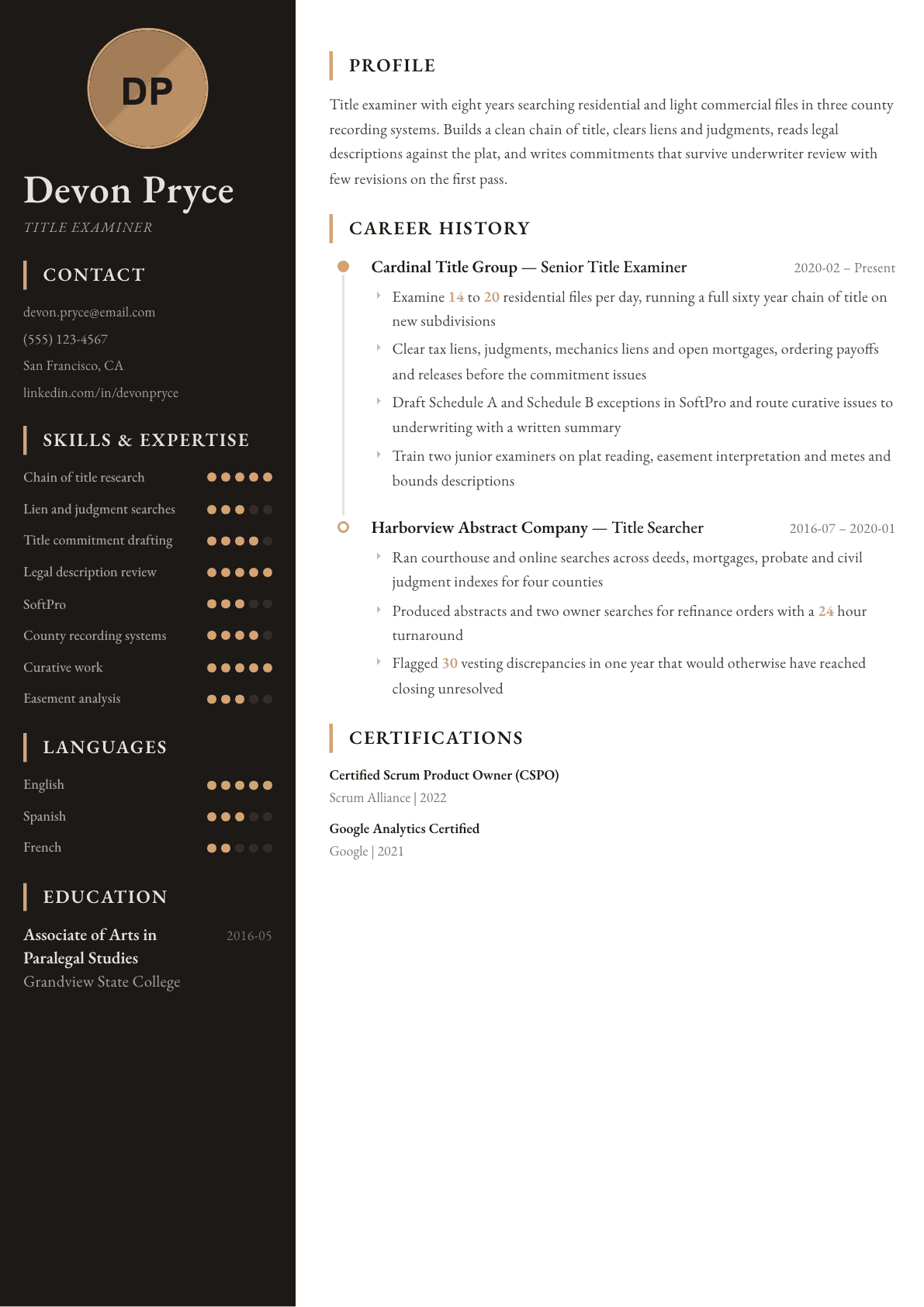
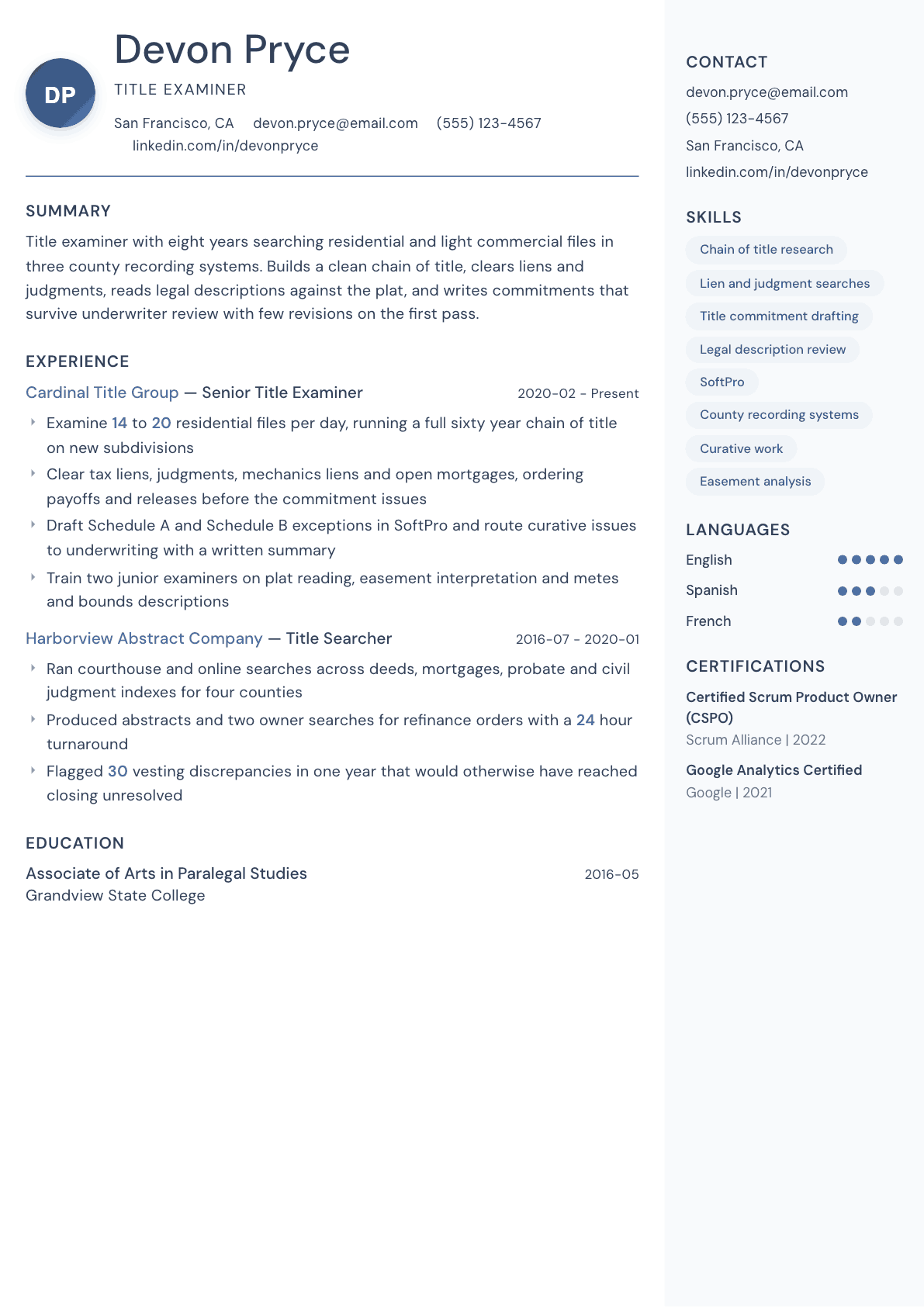
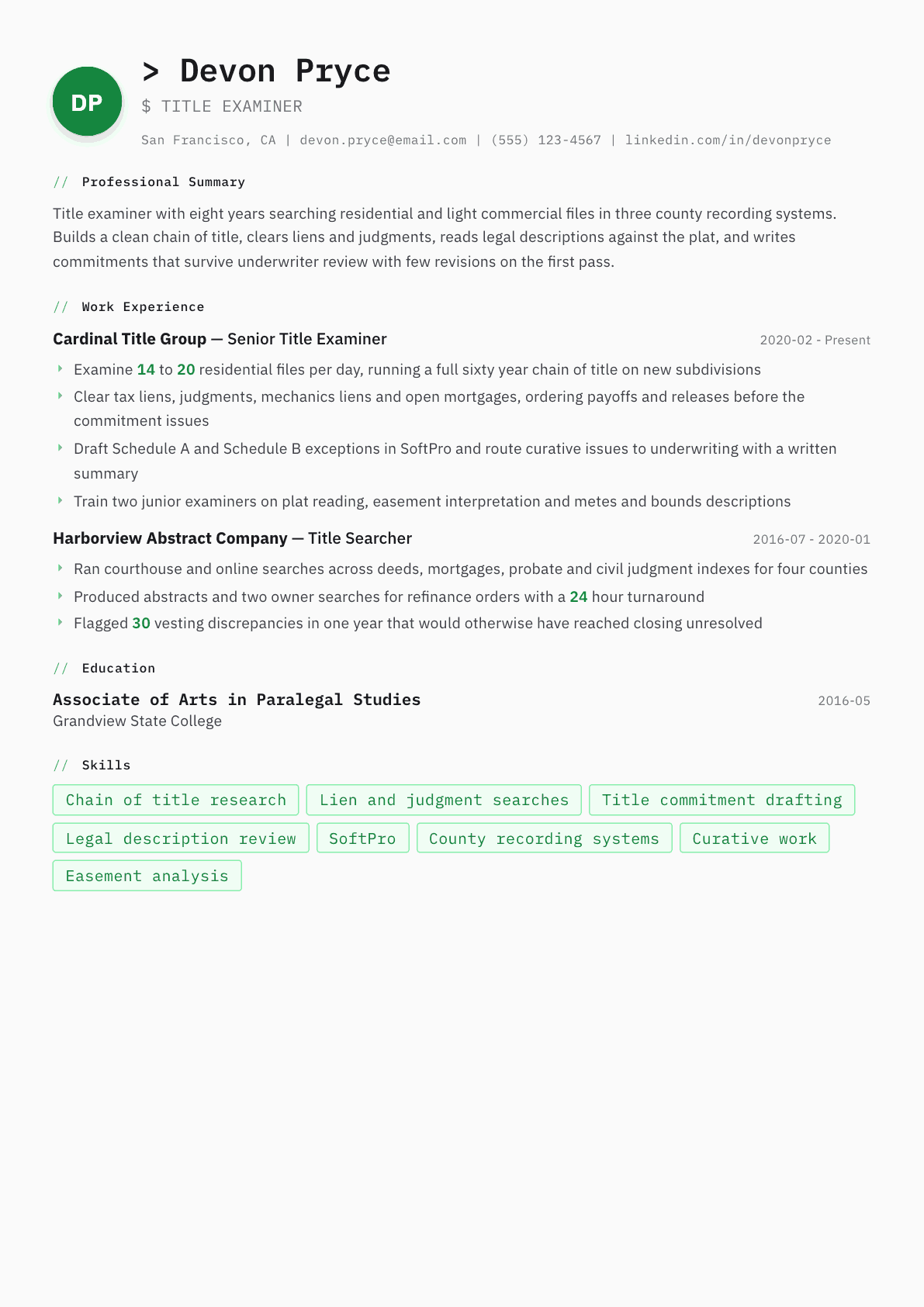
The same title examiner content laid out in three CVBooster templates, so you can see what the finished document looks like before you write a word.
Example Title Examiner summary
Title examiner with eight years across residential and light commercial orders in a multi county search area. Builds full chains of title, clears judgments and open mortgages before commitment, drafts Schedule B exceptions in SoftPro, and reads plats and metes and bounds descriptions without help. Seeking a commercial examination desk with a national underwriter.
Skills to list on a Title Examiner resume
- Chain of title
- Deed and mortgage research
- Judgment and lien searches
- Tax certificate review
- Title commitments
- Schedule B exceptions
- Curative title work
- Legal description interpretation
- Plat and survey reading
- Easements and restrictions
- Probate and estate records
- SoftPro and RamQuest
- Underwriter communication
- Escrow file coordination
What actually gets this resume read
- Say how many files you examine a day and whether they are residential, commercial or a mix of both.
- Name the title production software you work in, because employers filter examiner resumes on the platform first.
- List the counties or states whose recording systems you know, since local index quirks are the hard part of the job.
- Describe curative work in detail: the liens you cleared, the payoffs you ordered and the affidavits you drafted.
- Show your commitment writing by naming Schedule A and Schedule B exceptions rather than saying you prepared reports.
- Include search depth in years and any experience with plats, easements and metes and bounds descriptions.
How to write a title examiner resume
Title examiner resumes are read by production managers and underwriting counsel who already know how long a good search takes. They are not impressed by the phrase attention to detail, because every examiner claims it and the ones who lack it are discovered within a week. What they read for is search depth, county familiarity, curative ability and whether your commitments come back from underwriting with corrections.
A useful title examiner resume therefore reads almost like a production report: files per day, property types, the recording jurisdictions you know, the software you produce in, and the kinds of defects you have cleared without escalating.
This guide lays out how to structure that page, how to describe curative work so an underwriter can gauge your independence, and how to present a move between residential, commercial and national desks.
Format: production facts near the top
One page for under seven years, two after that. Under the header, put a short capability line: property types examined, states and counties covered, search depth in years, and the title production software you work in. Managers scan for the county list first because a strong examiner in an unfamiliar recording system is still a slow examiner for months.
Keep it plain. Title work is document work, and a resume with heavy design signals someone who has not spent long looking at a scanned deed book.
- Header: name, city and state, phone, email, and the states where you examine.
- Order: summary, coverage and systems, examination experience, education, licenses, skills.
- Searchers moving up to examiner should show any commitment drafting they have already done.
Summary: property type, volume, and the depth of your search
Name the property types, the daily file count and the search depth. Residential refinance at 18 files a day is a very different job from a commercial examination with a full run to sovereignty, and both belong to people who call themselves examiners.
Add the part of the file you own. Some examiners hand off every defect to a curative team; others order payoffs, chase releases and draft affidavits themselves. Say which you are, because that difference sets the level a manager is hiring for.
Experience: chain, defects, commitment
Structure each job around the three parts of an examination. Building the chain: which indexes you search, how far back, and whether you work from a plant, a county portal or the physical books. Finding the defects: liens, judgments, unreleased mortgages, tax delinquencies, probate gaps, boundary and easement problems. Writing the product: Schedule A vesting and legal description, Schedule B requirements and exceptions.
Quantify the throughput, then show the hard files. An examiner who has untangled a probate chain with an intestate death, a foreclosure with a defective assignment or a subdivision with a vacated easement should describe one of them, because that is the work that cannot be trained quickly.
Name the curative actions you took rather than saying you resolved issues. Ordered payoff statements, obtained releases, drafted an affidavit of identity, cleared a mechanics lien after the statutory period, confirmed a tax sale redemption.
Systems, plants and jurisdictions
List the production software by name, and separately the search sources: the title plant, the county recorder portals, the tax collector systems and any judgment or bankruptcy index you use. A hiring manager reads this to estimate your ramp time on her orders.
For every state, note whether it is an attorney closing state and whether you have worked with its particular conventions. Recording rules, dower and homestead requirements and tax lien priority differ enough that naming the states is a real qualification.
Skills and the terms the applicant system matches
Use the exact posting vocabulary: chain of title, two owner search, full search, current owner search, Schedule B exceptions, curative, legal description, metes and bounds, plat, easement, judgment lien, mechanics lien, tax certificate, commitment, policy production.
Leave out unrelated administrative software. The skills block on this resume should read like the index of an examination file.
Title Examiner resume summary examples
Searcher moving to examiner
Title searcher with 2 years running deed, mortgage and judgment indexes across 4 counties, producing current owner and two owner searches on refinance orders with 24 hour turnaround. Reads plats and legal descriptions, has drafted Schedule A vesting under supervision, and is ready for a full examiner desk.
Residential examiner
Residential title examiner handling 14 to 20 files a day with 60 year chains on new subdivisions. Clears tax liens, judgments and open mortgages before commitment, drafts Schedule B exceptions in title production software, and returns files to underwriting with few corrections on first review.
Commercial and lead examiner
Senior examiner with 11 years covering residential and commercial orders across 3 states, including multi parcel assemblages, ground leases and easement heavy industrial sites. Handles curative independently, trains junior examiners on plat reading and chain construction, and works directly with underwriting counsel on complex vesting.
Work experience bullets: before and after
Before: Searched public records for real estate transactions.
After: Ran full 60 year chains through deed, mortgage, probate, civil judgment and tax indexes for 4 counties, working from both the title plant and county recorder portals.
Naming the indexes, the depth and the sources shows exactly what kind of search you can be trusted to run.
Before: Found and fixed title problems.
After: Cleared unreleased mortgages, docketed judgments and delinquent tax liens by ordering payoffs and releases directly, escalating only vesting defects that required underwriting approval.
Listing the defect types and where you drew the escalation line tells a manager how much supervision you need.
Before: Prepared title commitments.
After: Drafted Schedule A vesting and legal descriptions and Schedule B requirements and exceptions on 16 files a day, with commitments returned from underwriting largely unchanged.
The product, the volume and the review outcome together evidence quality rather than asserting it.
Before: Worked on a difficult probate file.
After: Reconstructed a chain broken by an intestate death, confirming heirship through the probate docket and an affidavit of heirship before insuring the conveyance.
A specific defect and the steps taken to cure it demonstrate the judgment that separates examiners from searchers.
Before: Helped train new staff.
After: Trained 2 junior examiners on plat reading, metes and bounds interpretation and easement analysis, then reviewed their first 50 commitments before release.
Training becomes credible when the subject matter and the review volume are stated.
Hard skills
- Chain of title construction
- Deed and mortgage index research
- Judgment and lien searches
- Tax certificate and delinquency review
- Probate and heirship research
- Title commitment drafting
- Schedule B requirements and exceptions
- Curative title work
- Legal description and metes and bounds
- Plat and survey interpretation
- Easement and restriction analysis
- Title production software
- Foreclosure and bankruptcy review
Soft skills
- Sustained concentration
- Escalation judgment
- Written clarity for underwriters
- Consistency across high volume
- Comfort asking the recorder a question
Certifications worth listing
- National Title Professional (NTP) (American Land Title Association)
- Title Insurance Producer License (State department of insurance)
Mistakes that cost title examiner candidates the interview
- Writing that you examined titles without ever naming a property type, a file count or a search depth.
- Leaving the county and state coverage off, which hides the one thing that predicts how fast you will be productive.
- Saying you resolved issues rather than naming the liens, judgments and vesting defects you actually cured.
- Listing the production software but not the search sources, so a manager cannot tell plant work from portal work.
- Presenting searcher output as examiner output, which unravels quickly in a technical interview.
- Adding unrelated office software to a skills block that an underwriter reads as a professional index.
Title Examiner resume questions
How do I show search depth on a resume?
State the number of years your standard search runs and whether you also handle full runs to the patent or sovereignty. Depth requirements vary by state and product, and naming yours prevents an interview spent establishing the basics.
Does experience in one state transfer to another?
The method transfers and the local rules do not. Say which recording systems you know, then add that you have worked across multiple index structures, which is what convinces a manager you can learn a new county quickly.
Should I list every title production system I have touched?
List the ones you produced commitments in and mark the rest as familiar. Overstating platform experience is easy to test in the first week, and understating it costs you resume matches you would otherwise get.
How much detail can I give about specific properties?
Describe the defect and the cure, never the address or the parties. A file about an unreleased construction mortgage or a vacated easement is instructive without identifying anyone, and it reads as expertise rather than indiscretion.
What separates a commercial examiner resume from a residential one?
Commercial work brings multi parcel legal descriptions, ground leases, entity vesting with authority documents, survey exceptions and UCC filings. If you have handled any of those, say so explicitly, because the desks hire from different candidate pools.