Contract Specialist Resume Examples: what gets the call
Build a Contract Specialist Resume Around Volume and Cycle Time
By Mustafa Tarabya, founder of CVBooster · Published · Updated
Contract specialist resume example with redlining, renewal and contract lifecycle keywords, plus a writing guide for commercial contracting roles.
Sample resumes for a contract specialist
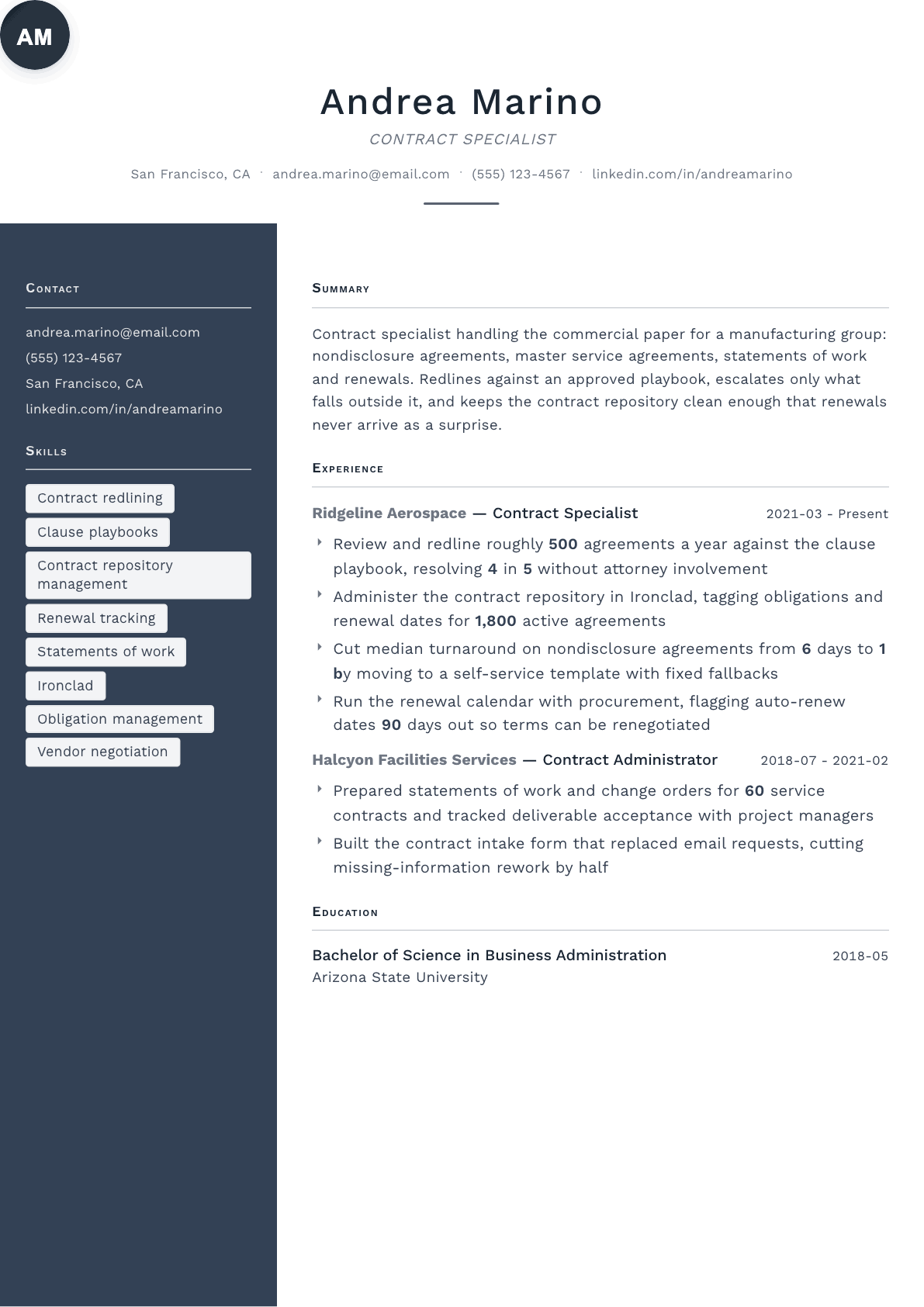
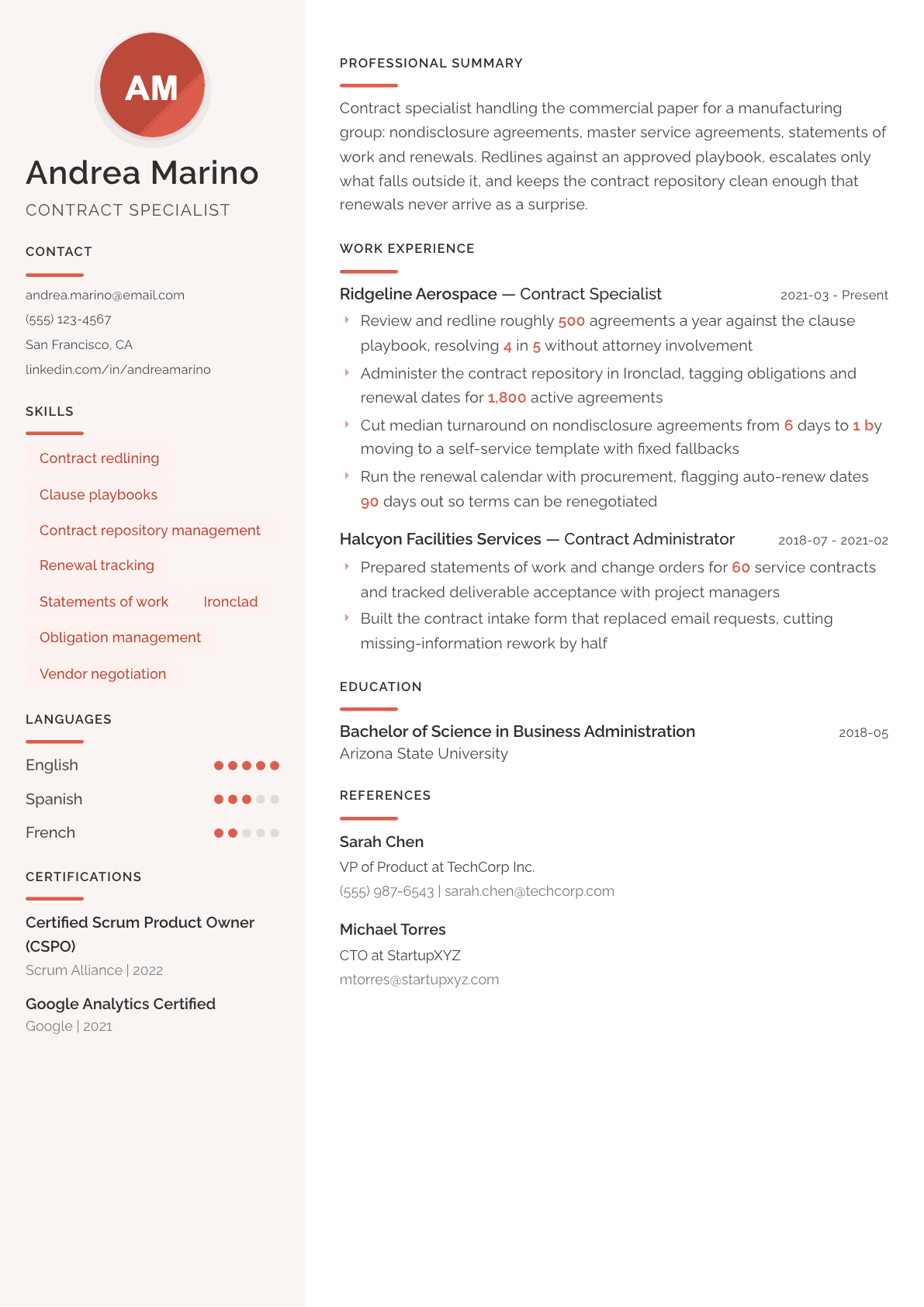
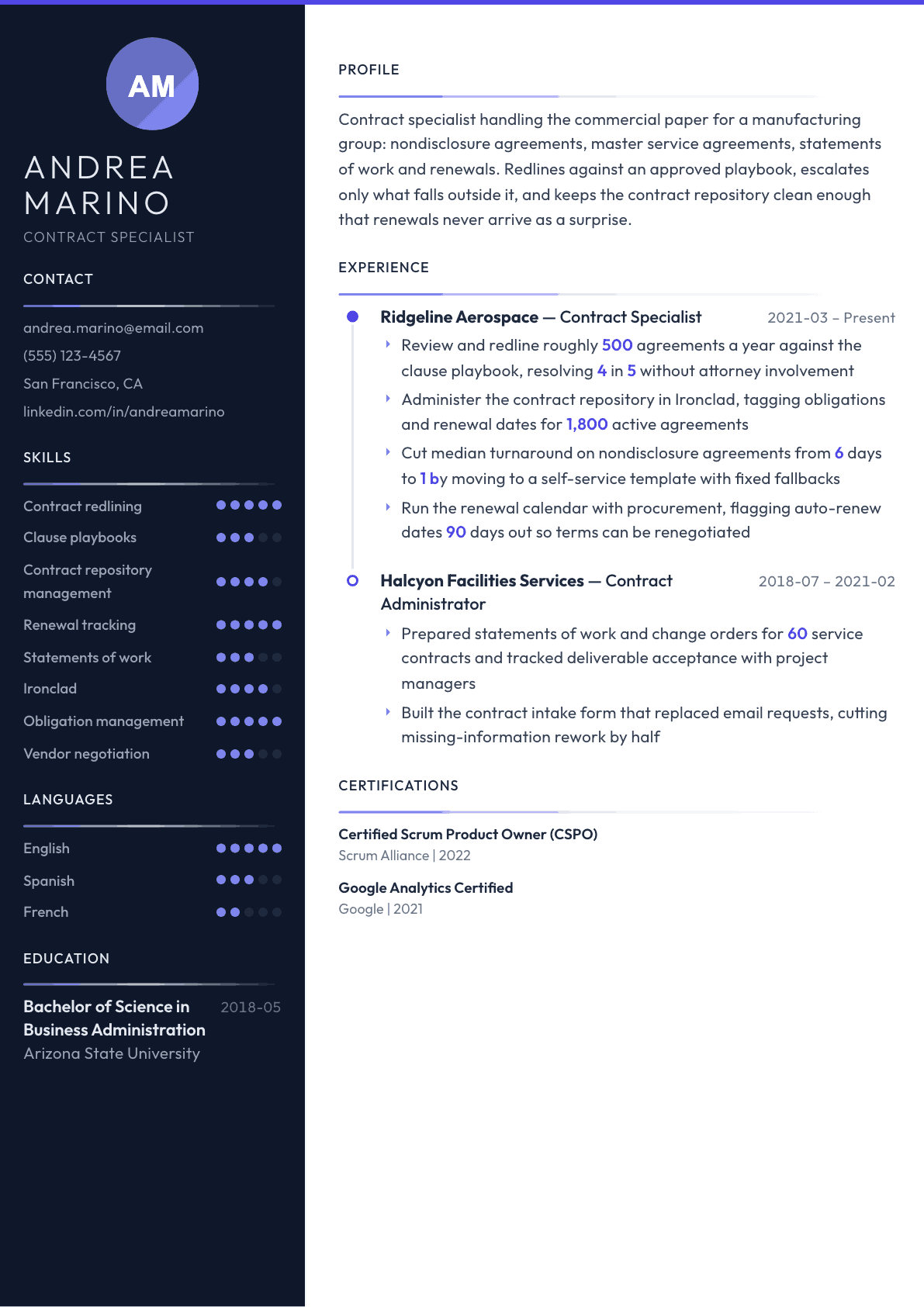
The same contract specialist content laid out in three CVBooster templates, so you can see what the finished document looks like before you write a word.
Example Contract Specialist summary
Contract specialist with six years owning commercial paper for a manufacturer, from nondisclosure agreements to master service agreements and renewals. Redlines against an approved playbook, closes most negotiations without escalation, and keeps a repository of active agreements tagged for obligations and renewal dates. Known for cutting turnaround without loosening a single risk position.
Skills to list on a Contract Specialist resume
- Contract drafting and redlining
- Nondisclosure agreements
- Master service agreements
- Statements of work
- Clause playbooks
- Contract lifecycle management
- Obligation tracking
- Renewal management
- Vendor negotiation
- Risk escalation
- Contract repository administration
- Change orders
- Procurement support
- Templates and fallback positions
What actually gets this resume read
- Give the annual contract volume and the agreement types, because that pair is how a contracts manager sizes a candidate.
- Report cycle time before and after your changes, since speed without added risk is the whole point of the role.
- State how much you resolve alone versus escalate, as autonomy inside a playbook is what separates specialist from administrator.
- Name the contract lifecycle system by name, because a team on one platform screens hard for that experience.
- Show obligation and renewal tracking, since missed auto-renewals are the failure every contracts leader has lived through.
- Keep procurement, sales and finance in the picture, because contract work is judged by how well those teams are served.
How to write a contract specialist resume
Every contracts team lives between two complaints. Sales says legal is slow. Legal says the business signs things it should not. A contract specialist is hired to make both complaints quieter, so the resume that wins is the one showing volume moving quickly without risk positions loosening.
That means the page has to carry numbers. Agreements reviewed a year. Median turnaround before and after you touched the process. The share you close inside the playbook versus the share you escalate. The size of the repository you keep clean. Without those, a contracts manager cannot distinguish you from a candidate who has only filed executed copies.
This guide walks through the structure a contracts hiring manager expects, gives summaries for an administrator moving up, a working specialist and a senior specialist, rewrites the bullets that hide real work behind soft verbs, and answers the questions that come up when the same title means procurement in one company and sales support in another.
Format: agreement types and volume near the top
Put a short contract profile under your summary: the agreement types you handle, the annual volume, and which side of the business you sit on. A contracts manager reading twenty resumes is sorting by exactly those three facts, and burying them in a third bullet of a second job means she never sees them.
Reverse chronological, single column, one page under seven years. Contract work is procedural and the resume should look procedural: clean headings, consistent tense, no decorative elements competing with the numbers.
- Header: name, city and state, phone, email, and any contract management credential.
- Contract profile: agreement types, annual volume, and the systems you work in.
- Then experience, skills, education and certifications.
Summary: what you sign off alone
The dividing line between a contract administrator and a contract specialist is authority. Say what you resolve without an attorney, what falls to legal, and what governs that split, usually a clause playbook with approved fallback positions. A candidate who states that boundary has already answered the interview question that decides the level of the offer.
Name the industry too. Aerospace, healthcare, construction and software carry different standard terms, and a specialist who already knows the flow-downs or the data terms of a sector arrives useful in week one.
Experience: volume, cycle time, escalation and obligations
Build every job around four measures. Volume, meaning how many agreements passed through you. Cycle time, meaning how long a standard agreement took and what you did to shorten it. Escalation, meaning the share that needed legal and why. Obligations, meaning what happens after signature: renewals, milestones, insurance certificates, deliverable acceptance, price adjustments.
The obligation side is where most resumes go quiet, and it is where contracts leaders have been burned. An auto-renewal that passed unnoticed, an expired certificate of insurance, a rate increase nobody challenged. A bullet showing that you track obligations and flag renewal dates in advance is worth more than three about drafting.
When you describe process improvement, always state what stayed the same. Cutting nondisclosure agreement turnaround by moving to a fixed template is only impressive if the fallback positions were preserved, so say that in the same sentence.
Systems: the repository is part of the job
Name the contract lifecycle platform you have used and what you did in it beyond storage: intake forms, approval routing, clause libraries, metadata tagging, reporting, integrations with the sales or procurement system. Teams running one platform screen hard for it, and teams about to migrate value anyone who has been through an implementation.
If your company runs on shared drives and email, say that honestly and describe the discipline you imposed instead: a numbering convention, an intake form, a tracked renewal calendar. Resourcefulness without tooling reads well as long as it is specific.
Keywords and the words that weaken a contracts resume
Postings reuse this vocabulary: redlining, master service agreement, statement of work, nondisclosure agreement, terms and conditions, indemnification, limitation of liability, contract lifecycle management, obligation tracking, renewal management, supplier agreements. Use the phrase the posting uses, then prove it in a bullet.
Cut the verbs that hide the work: assisted with, involved in, responsible for, supported the team. Replace each with the action you performed and the position you held in the negotiation.
Contract Specialist resume summary examples
Administrator moving up
Contract administrator with two years preparing statements of work, change orders and nondisclosure agreements for a services business. Maintains a repository of 600 active agreements, tracks deliverable acceptance with project managers, and redlines standard templates against the approved fallback positions before routing them to legal.
Working specialist
Contract specialist reviewing roughly 500 commercial agreements a year for a manufacturing group. Redlines against the clause playbook and closes 4 in 5 without attorney involvement, administers the contract repository and obligation tags, and runs a renewal calendar that flags auto-renew dates 90 days ahead of the deadline.
Senior specialist
Senior contract specialist with nine years across procurement and sales-side contracting, now setting the playbook other reviewers work from. Led a contract lifecycle platform rollout to 90 users, negotiates the highest-value supplier agreements directly, and reports contract cycle time and risk exceptions to the leadership team monthly.
Work experience bullets: before and after
Before: Reviewed and processed contracts for the business.
After: Reviewed and redlined roughly 500 agreements a year against the clause playbook, closing 4 in 5 without attorney involvement and escalating the rest with a written risk rationale.
Volume, autonomy and a documented escalation habit describe the level of the role instead of the task.
Before: Reduced contract turnaround times.
After: Cut median nondisclosure agreement turnaround from 6 days to 1 by moving to a self-service template with fixed fallback positions and a single approval step.
The mechanism and the preserved fallbacks show speed that a legal team would actually approve.
Before: Maintained the contract database.
After: Administered 1,800 active agreements in the contract lifecycle platform, tagging obligations, renewal dates and liability caps so any owner could pull their own terms without a request to legal.
The repository size and the self-service outcome make the maintenance work visible as a service.
Before: Tracked contract renewals.
After: Ran the renewal calendar with procurement, surfacing auto-renew dates 90 days out and creating a renegotiation window on 40 supplier agreements a year.
A lead time and a count turn passive tracking into commercial leverage the business can use.
Before: Worked with sales and procurement teams.
After: Built the contract intake form that replaced email requests, cutting rework from missing information by half and giving sales a single queue with a stated turnaround.
A named artifact and its effect prove partnership rather than proximity to other teams.
Hard skills
- Contract drafting and redlining
- Nondisclosure and master service agreements
- Statements of work and change orders
- Clause playbooks and fallback positions
- Contract lifecycle management platforms
- Obligation and milestone tracking
- Renewal and auto-renew management
- Supplier and vendor negotiation
- Risk identification and escalation
- Insurance and compliance certificate tracking
- Contract repository administration
- Intake and approval workflow design
- Contract reporting
- Template and library maintenance
Soft skills
- Negotiation without escalation
- Plain-language explanation of terms
- Holding a position under sales pressure
- Queue management
- Cross-functional coordination
- Consistency over long cycles
Certifications worth listing
- Certified Commercial Contracts Manager (CCCM) (National Contract Management Association)
- Certified Professional Contracts Manager (CPCM) (National Contract Management Association)
- Certified Professional in Supply Management (CPSM) (Institute for Supply Management)
Mistakes that cost contract specialist candidates the interview
- Describing contract work without a single volume figure, which leaves the reader unable to size your capacity.
- Claiming faster turnaround while saying nothing about the controls that remained in place.
- Ignoring post-signature obligations, the part of contracting that most often causes real losses.
- Listing clause names as if familiarity equals negotiation experience on those positions.
- Leaving out the contract platform, then competing against candidates who already know the one the team runs.
- Using the same bullet language for procurement-side and sales-side work when the two require different instincts.
Contract Specialist resume questions
What separates a contract specialist from a contract administrator?
Authority and judgment. An administrator prepares, routes and files. A specialist negotiates within an approved playbook, decides what needs legal review and owns the risk conversation with the business. Make that boundary explicit in your summary, because the title alone will not.
Do I need a paralegal or law background for contract work?
No. Many strong contract specialists come from procurement, project management or sales operations. What matters is that you can read a clause, explain its commercial effect and hold a position. A contract management credential helps close the credibility gap.
How do I show contract value without disclosing confidential figures?
Use ranges, counts or relative language instead of exact amounts. Describing a portfolio as several hundred active supplier agreements, or a negotiation as the largest in the category, communicates scale without breaching an obligation you are still bound by.
Should I list the clause types I negotiate?
List the ones you genuinely argue, such as limitation of liability, indemnification, data protection terms or termination for convenience. Keep the list short and expect questions on each, since an interviewer will ask which position you held and what fallback you accepted.
How do I present government contracting experience for a commercial role?
Translate it. Regulated clause discipline, flow-down management and audit-ready files are all strengths a commercial team wants. Name the transferable habits rather than the regulation numbers, which will mean little to a hiring manager on the commercial side.