Property Management Resume Examples: what gets the call
Build a Property Management Resume That Opens Doors
By Mustafa Tarabya, founder of CVBooster · Published · Updated
Create a property manager resume showcasing your portfolio management, tenant relations, and property maintenance oversight skills.
Sample resumes for a property management
The same property management content laid out in three CVBooster templates, so you can see what the finished document looks like before you write a word.
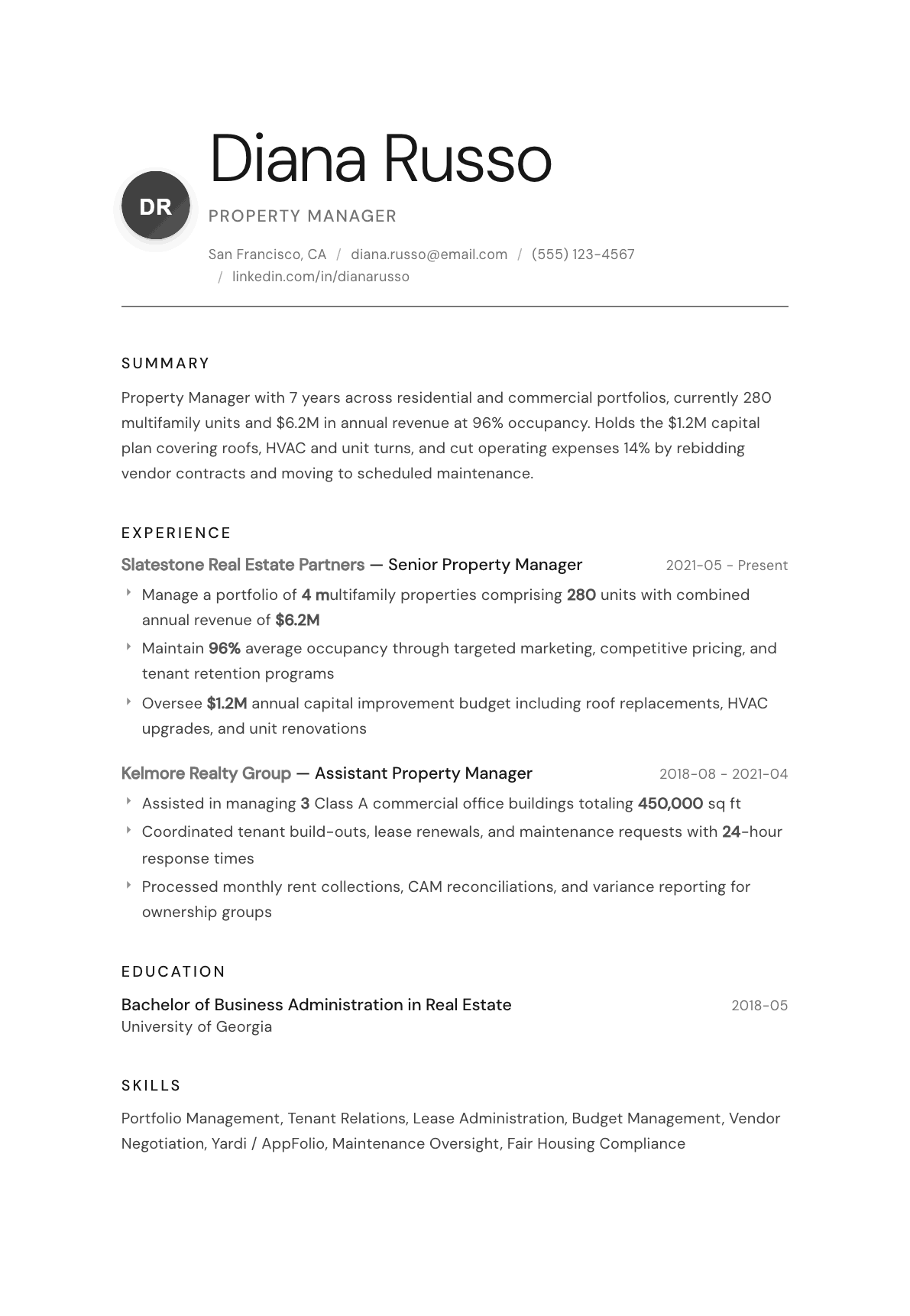
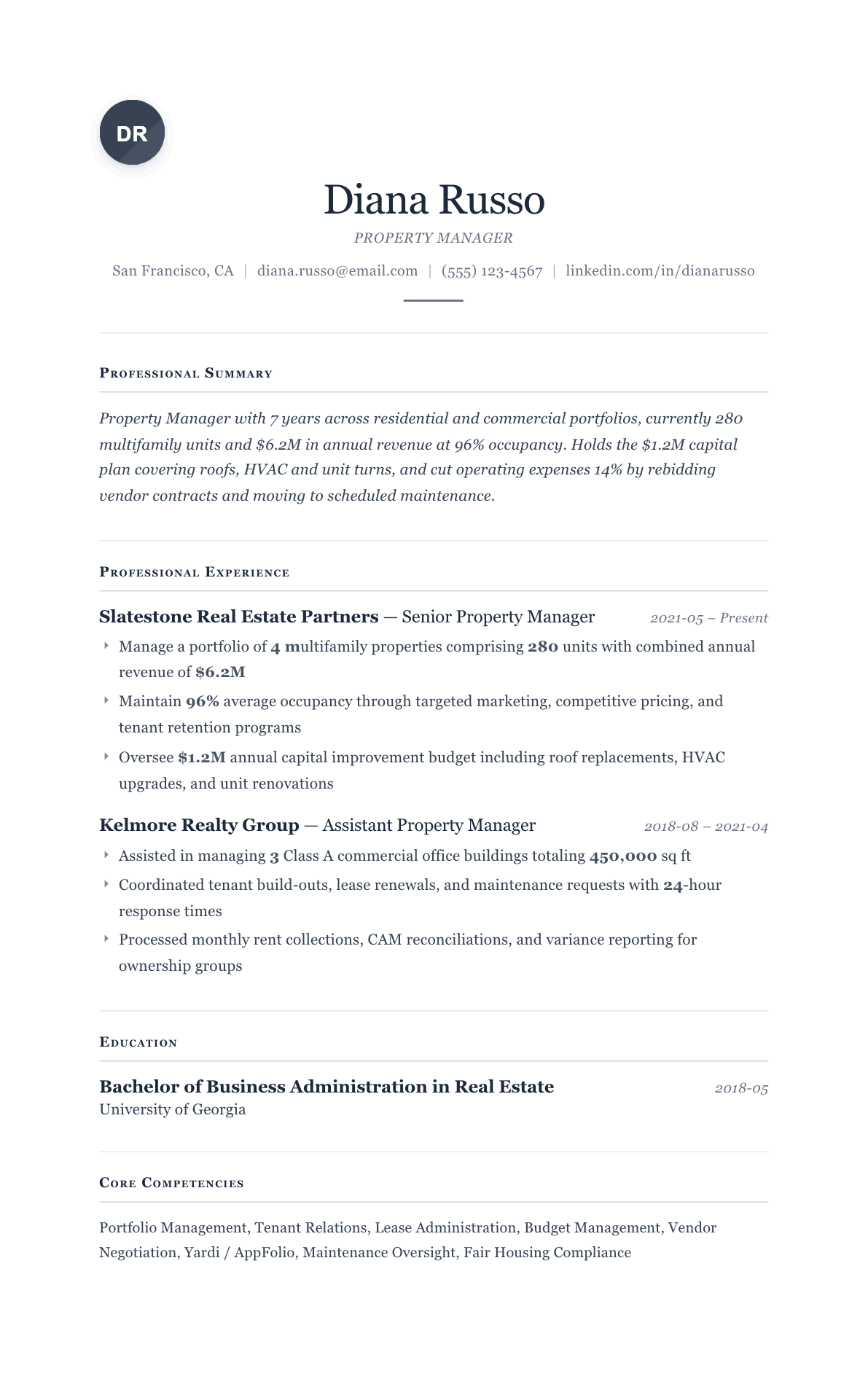
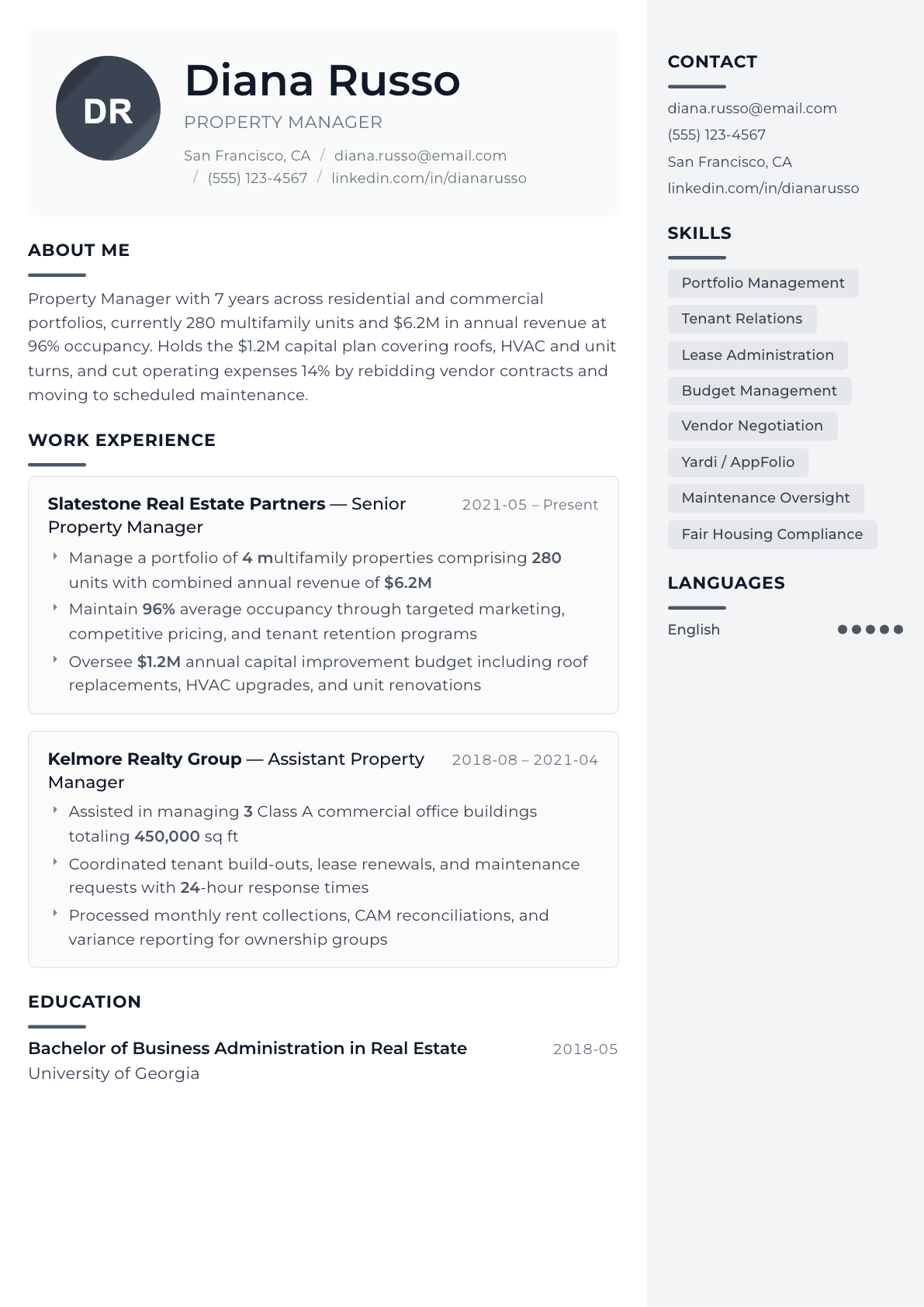
Example Property Management summary
Experienced Property Manager overseeing 350+ residential and commercial units valued at $45M. Strong track record of 96% occupancy, 14% cost reductions, and high tenant satisfaction across multifamily and office portfolios.
Skills to list on a Property Management resume
- Portfolio Management
- Tenant Relations
- Lease Administration
- Budget & Financial Reporting
- Vendor Management
- Yardi Voyager
- AppFolio
- Fair Housing Law
- Capital Improvements
- Maintenance Coordination
What actually gets this resume read
- Quantify your portfolio: number of units, square footage, and total asset value managed.
- Highlight occupancy rates, tenant retention, and rent collection percentages.
- Showcase budget management with specific cost savings or revenue improvements.
- Include property management software proficiency like Yardi, AppFolio, or RealPage.
How to write a property management resume
A property manager resume is judged on the size and type of the portfolio you have carried. The regional director reading it wants three facts in the first ten seconds: how many doors or how much rentable square footage you managed, whether the assets were multifamily, commercial office, retail or mixed use, and whether you owned the operating budget or only executed someone else's.
Everything after that is proof. Occupancy, renewal rate, delinquency, turn time, work order response, controllable expense variance and net operating income are the numbers an owner or an asset manager checks every month, so they are the numbers your bullets should carry. A resume that talks about tenant relations without a renewal percentage reads as an assistant's resume, whatever the title says.
This guide covers the section order property management firms expect in a property management resume, how to write the portfolio line, examples of property management resumes by asset type, three summaries for an assistant, a site manager and a portfolio or regional manager, before and after bullets, and the questions that come up when a leasing background is being turned into a management resume.
Format: portfolio first, then the operating record
Use reverse chronological order and keep it to one page under five years, two after that. Property management hiring is portfolio driven, so the reader needs to compare your assets to theirs. Put a one line portfolio descriptor directly under each job title before any bullets, and keep the layout single column so the applicant tracking systems used by the large operators parse the dates correctly.
If you have moved between asset classes, make that visible rather than hiding it. An owner staffing a Class A office tower cares whether your last three years were common area maintenance reconciliations and tenant build outs or unit turns and rent ready inspections. Those are different jobs sharing a title.
- Header: name, city and state, phone, email, and any active real estate license or salesperson license with its state.
- Section order: summary, portfolio snapshot or core competencies, experience, licenses and designations, education, systems.
- Under each job: asset type, door count or rentable square feet, number of sites, annual revenue scale, team size and reporting line.
The portfolio line every reader is looking for
Write it as a single descriptor: asset class, unit or square footage count, number of properties, ownership type and who you reported to. Something like garden style multifamily, four communities, two hundred eighty units, institutional owner, reporting to a regional manager tells a hiring director more than a paragraph of duties.
Ownership type matters more than most candidates realize. Managing for an institutional owner with monthly variance reporting and quarterly asset management calls is a different discipline than managing for a private owner who wants a phone call. Homeowner association and community association management is different again, because the client is a volunteer board and governing documents drive the decisions.
Experience: write the operating metrics, not the tasks
Lead each job with the results an owner reviews: average physical occupancy, economic occupancy, renewal conversion, delinquency as a share of billed rent, average days vacant on turn, and net operating income against budget. Then add the capital work you supervised by scope, not by adjective: roof replacement, HVAC changeout, parking lot resurfacing, unit renovation programs.
Two bullets should cover the parts of the job nobody sees from the outside. The first is vendor and contract work: bidding, service agreements, insurance certificate compliance, scope walks. The second is compliance: fair housing, local rent regulation, habitability inspections, lead and mold protocols, and for affordable portfolios the tax credit or subsidy program you operated under.
Cut the bullets that describe the job title. Collecting rent, responding to tenant requests and coordinating maintenance appear on every property manager resume ever written and steal room from the numbers that would separate yours.
Systems and licenses: the filter fields
Name the property management platform by product, because recruiters filter on it: Yardi Voyager, RealPage OneSite, AppFolio, Entrata, MRI or Buildium. Add the modules you actually worked in, such as accounts payable, budgeting, or the screening and renewal workflow, since a manager who only ran leasing screens in Yardi is not the same as one who built the annual budget in it.
Many states require a real estate broker or salesperson license to manage property for a third party, and community association managers are separately licensed or registered in several states. Put the license, the state and the status in its own line near the top. Designations from the Institute of Real Estate Management and the National Apartment Association are read as evidence of a career track rather than a job.
Keywords the screener is scanning for
Postings from the large operators are written from internal templates, so the same phrases repeat: lease administration, rent roll, delinquency management, capital improvement, preventive maintenance, variance reporting, resident retention, fair housing, common area maintenance reconciliation, budget preparation and net operating income. Use the exact phrase once in the summary or competency block and once inside a bullet where you can prove it.
Match the asset language to the posting. A commercial listing wants tenant improvement coordination, estoppel certificates and triple net recovery. A multifamily listing wants make ready, renewal conversion and resident events. Sending one version to both is how strong candidates get filtered out.
Examples of property management resumes by asset type
The same title reads differently depending on what you managed. Pick the version that matches the posting and lead with the facts that kind of owner checks first.
Whichever version you write, the property management resume still opens on the portfolio line. A reader who has to hunt for the door count or the square footage usually stops hunting.
- Conventional multifamily: door count, occupancy, renewal rate, delinquency, turn time, and the property management software you close the month in.
- Affordable and tax credit housing: program compliance, income certifications and recertifications, file audits passed, and your compliance credential.
- Commercial office and retail: rentable square footage, tenant count, CAM reconciliations, lease administration and the capital projects you ran.
- Student housing: bed count, the preleasing cycle, turn week logistics and the size of the seasonal team you hired.
- Third party management: how many owners you reported to, the monthly reporting package, and the budget variance explanations you wrote.
- Community associations: number of homes, board meetings run, reserve planning and the vendor contracts you managed.
Property Management resume summary examples
Assistant property manager
Assistant Property Manager with two years supporting a 240-unit garden style community: rent posting, delinquency follow-up, renewal outreach and make-ready scheduling in Yardi Voyager. Holds an active state salesperson license and completed the NAA leasing credential. Seeking a site manager role.
Site manager, five years in
Property Manager running a 310-unit Class B multifamily asset for an institutional owner, with a team of seven and full budget ownership. Held physical occupancy at 96% across two years, cut delinquency to under 1.5% of billed rent, and delivered a 180-unit interior renovation program on schedule.
Portfolio manager
Portfolio Property Manager overseeing nine mixed multifamily and neighborhood retail assets, roughly 900 units plus 210 thousand rentable square feet, through four site managers. Owns budgeting, capital planning and monthly variance reporting to ownership. Certified Property Manager with eleven years in third-party management.
Work experience bullets: before and after
Before: Responsible for day to day operations of an apartment community.
After: Ran daily operations for a 310-unit Class B community with a staff of seven, owning the operating budget, the rent roll and monthly variance reporting to an institutional owner.
Unit count, class, team size and reporting line let a regional director place you against the asset being hired for.
Before: Maintained high occupancy and good tenant relations.
After: Held physical occupancy at 96% and lifted renewal conversion from 48% to 61% by starting outreach 120 days out and pricing renewals against weekly market surveys.
Two owner-level metrics plus the method behind them replace a claim nobody can verify.
Before: Handled maintenance requests and vendor coordination.
After: Cut average work order completion from 4.1 days to 1.8 by rebuilding the on-call rotation, and rebid landscaping, pest and janitorial contracts across four sites at a lower annual controllable spend.
A before and after on response time plus the contract work shows operational control rather than message forwarding.
Before: Assisted with the annual budget.
After: Built the annual operating and capital budget for a nine-property portfolio, defended it in the ownership review, and closed the year within 2% of the controllable expense line.
Owning the build, the defense and the variance is the difference between a budget participant and a budget owner.
Before: Made sure the property followed all regulations.
After: Kept the portfolio audit ready on fair housing, habitability inspections and vendor insurance certificates, and passed two REAC inspections with no findings requiring a corrective plan.
Naming the specific compliance regimes and an audit outcome makes the claim checkable.
Hard skills
- Lease administration
- Rent roll and delinquency management
- Operating and capital budgeting
- Variance reporting
- Yardi Voyager
- RealPage OneSite
- AppFolio
- Entrata
- CAM reconciliation
- Vendor contracting and bid management
- Preventive maintenance programs
- Fair housing compliance
- Turnover and make-ready management
- Capital improvement oversight
Soft skills
- Owner communication
- Conflict de-escalation
- Negotiation with vendors
- Team supervision
- Prioritization across sites
- Written reporting discipline
Certifications worth listing
- Certified Property Manager (CPM) (Institute of Real Estate Management)
- Accredited Residential Manager (ARM) (Institute of Real Estate Management)
- Certified Apartment Manager (CAM) (National Apartment Association)
- Certified Apartment Portfolio Supervisor (CAPS) (National Apartment Association)
- Real Property Administrator (RPA) (BOMI International)
- Certified Manager of Community Associations (CMCA) (Community Association Managers International Certification Board)
- Association Management Specialist (AMS) (Community Associations Institute)
Mistakes that cost property management candidates the interview
- Leaving the door count and square footage off, which forces the reader to guess whether you managed a fourplex or a portfolio.
- Listing duties that every property manager performs instead of the occupancy, renewal and delinquency numbers an owner actually reviews.
- Naming the software as a single word when the posting filters on the platform and the module, such as budgeting inside Yardi Voyager.
- Hiding an asset class change, so a commercial hiring manager assumes your triple net and estoppel experience exists when it does not.
- Omitting the active real estate or community association license in states that require one to manage for a third party.
- Writing capital work as improved the property rather than the actual scope: roofs, HVAC, envelope, parking, interiors.
- Using a two column template with icons, which the large operator applicant systems frequently reorder and strip.
Property Management resume questions
Do I need a real estate license on a property manager resume?
Put it on when you hold one, because many states require a broker or salesperson license to manage property for a third party and several license or register community association managers separately. List the license type, the state and the current status near the top.
How do I show portfolio size if I managed several small properties?
Aggregate them and then break them out. Write the combined door count or square footage, the number of sites and the asset types on one line, then give the two largest or most relevant assets their own detail so the reader sees the range you handled.
What metrics should a property management resume include?
Physical and economic occupancy, renewal conversion, delinquency as a share of billed rent, average days to turn a unit, work order response time, and net operating income or controllable expense against budget. Pick the ones the posting emphasizes and prove them in bullets.
How do I move from leasing consultant to property manager?
Lead with the manager-adjacent work you already do: renewal pricing, delinquency calls, vendor scheduling, closing reports and covering the office. Add the credential that signals the track, then state the target role in the summary so the reader is not left guessing.
Should a commercial and a residential version of my resume be different?
Yes, and materially. Commercial readers want tenant improvement coordination, common area maintenance reconciliations, estoppels and lease abstraction. Residential readers want make-ready cycles, renewal conversion, resident retention and fair housing. Reorder the bullets and swap the summary for each posting.
Related resume examples
- Leasing Consultant Resume example
- Facilities Manager Resume example
- Real Estate Appraiser Resume example
- Commercial Property Manager Resume example
- Vacation Rental Manager Resume example
- Asset Manager Real Estate Resume example