Real Estate Developer Resume Examples: read this first
Build a Real Estate Developer Resume Around Entitlements and Delivery
By Mustafa Tarabya, founder of CVBooster · Published · Updated
Real estate developer resume example and guide covering entitlements, pro formas, construction draws, lease up and project delivery on schedule.
Sample resumes for a real estate developer
The same real estate developer content laid out in three CVBooster templates, so you can see what the finished document looks like before you write a word.
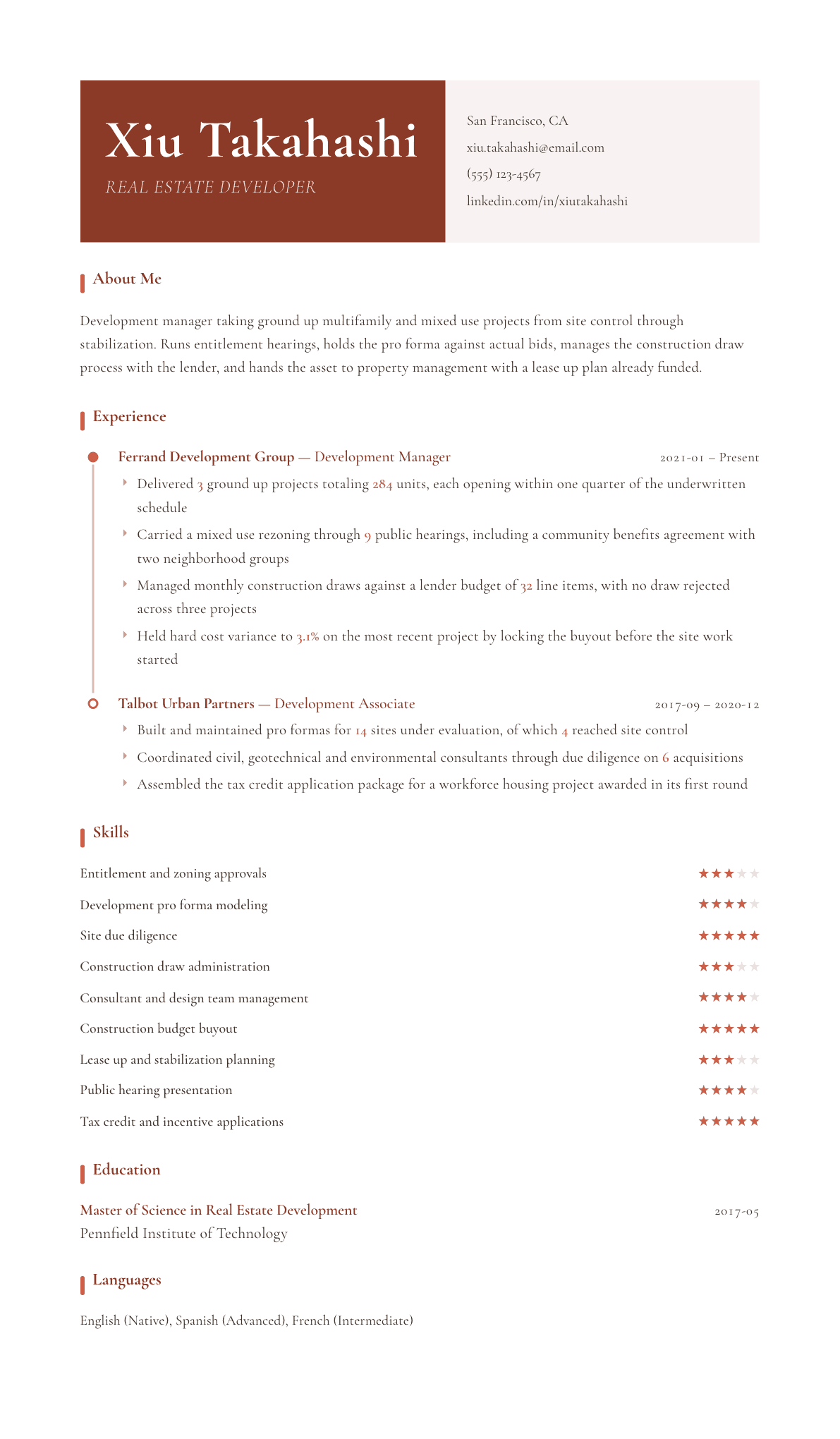
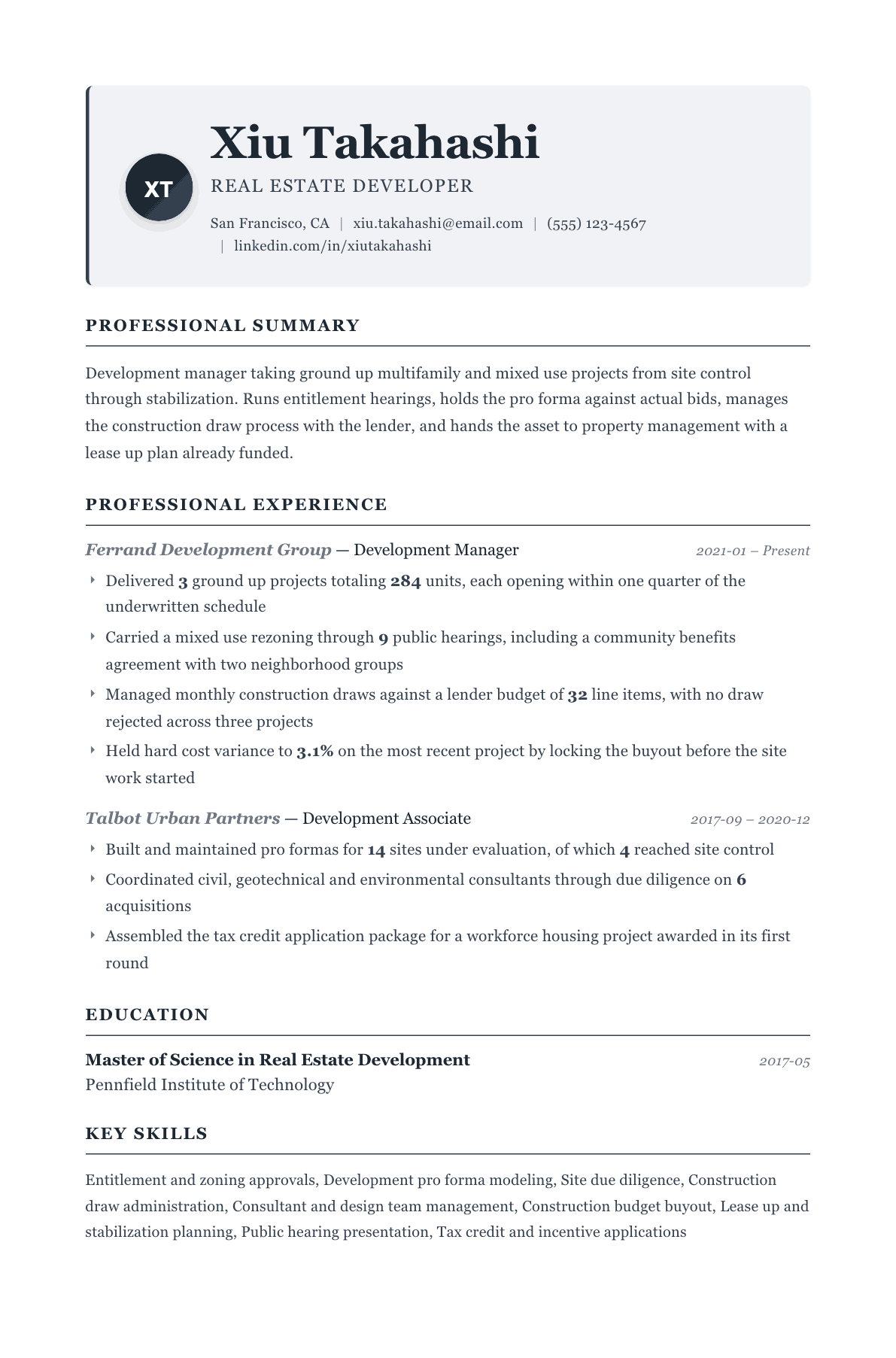
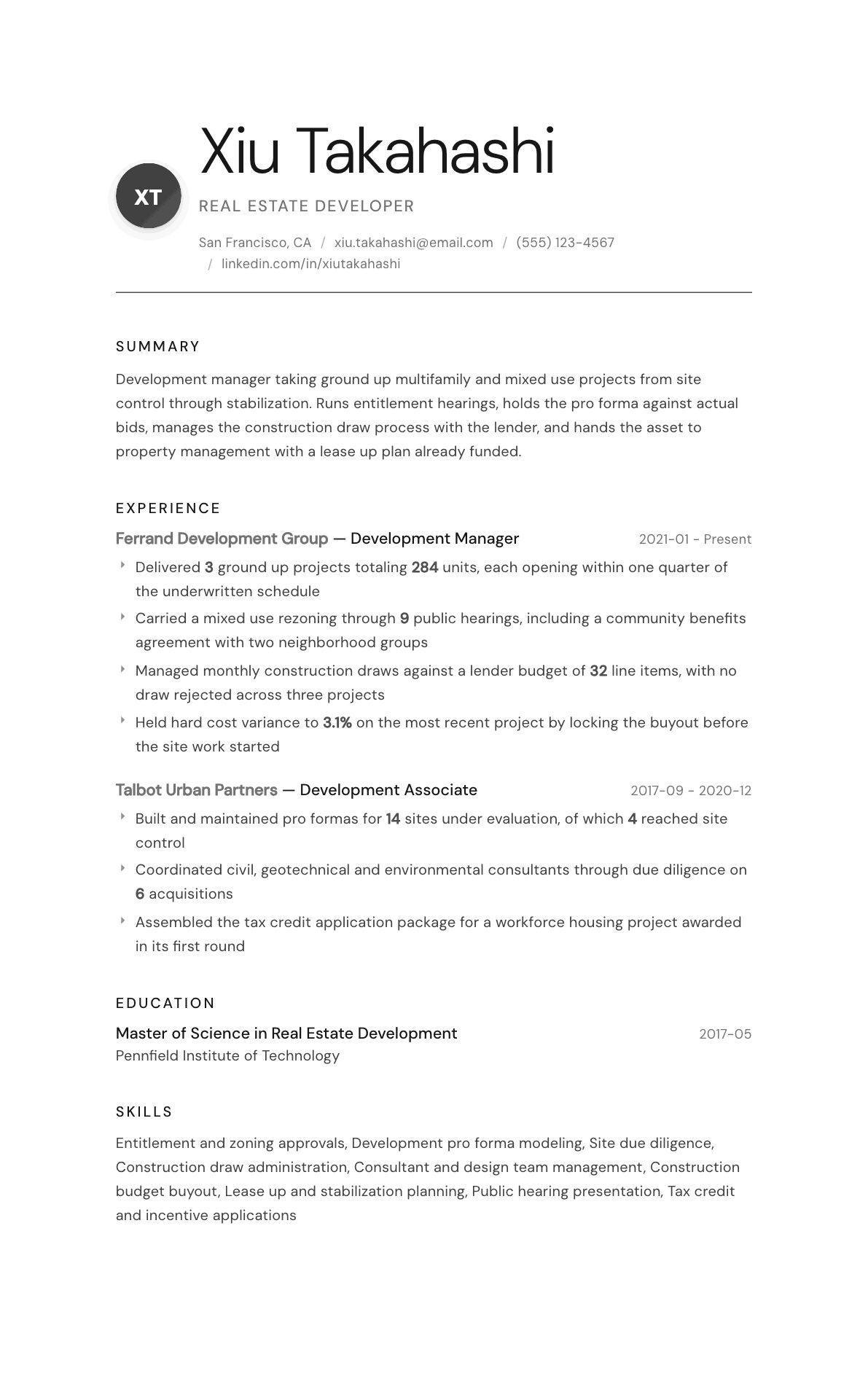
Example Real Estate Developer summary
Development manager delivering ground up multifamily and mixed use projects from site control through stabilization, most recently three projects totaling two hundred eighty-four units that each opened within a quarter of the underwritten schedule. Carries rezonings through public hearings and community negotiation, locks the construction buyout before site work, administers monthly lender draws without rejection, and hands finished assets to management with a funded lease up plan.
Skills to list on a Real Estate Developer resume
- Site selection and acquisition
- Zoning and entitlement strategy
- Public hearing testimony
- Development pro forma modeling
- Environmental and geotechnical due diligence
- Design team coordination
- Construction budget buyout
- Draw request administration
- Change order review
- Construction lender reporting
- Joint venture equity structures
- Tax credit applications
- Lease up and stabilization
- Municipal and community relations
- Project scheduling
What actually gets this resume read
- Lead with delivered projects in units or square footage, and say whether each opened on the underwritten schedule.
- Describe entitlements by the approvals won and the hearings attended, not by calling the process challenging.
- Show budget discipline as hard cost variance against the original number rather than as a claim of cost control.
- Name your capital structure experience: construction debt, joint venture equity, tax credits or public incentives.
- Say which phases you personally owned, because a developer who has never run a draw is a different hire.
- Add the handoff to operations, since a project is not done until lease up hits the underwritten pace.
How to write a real estate developer resume
Development hiring is a memory test about delivery. The principal reading your resume wants to know which projects you took across the finish line, whether they opened when the pro forma said they would, and how far the hard costs drifted from the number the equity committed against. Everything else on the page is context for those three facts.
The other question underneath is which phases you have actually owned. Site selection, entitlement, design management, buyout, draw administration and lease up are six different jobs that get bundled under one title. A real estate developer who has never run a draw or sat through a hostile hearing is a different hire from one who has, and a resume that blurs the two gets found out in the first interview.
This guide covers presenting delivered projects, writing entitlements as approvals rather than as effort, showing budget discipline with variance, and handling the projects that died in diligence. Three summaries, before and after bullets, and the questions development professionals ask when they move between merchant builders, institutional sponsors and public agencies.
Format: a project schedule, then phases owned, then the pro forma work
Two pages is acceptable and often correct here, because a project schedule earns its space. Give each delivered project a compact row: product type, units or square footage, the jurisdiction, your role, and whether it opened on the underwritten schedule. A principal reads that schedule before anything else and forms an opinion from it alone.
Underneath, list the phases you personally owned rather than the phases the project went through. Anyone can be near an entitlement. The resume should be clear about which hearings you presented at, which budgets you held, which draws you assembled and which lease up plans you wrote.
- Project schedule row: product type, unit or square foot count, jurisdiction, your role, delivery against schedule.
- Phases owned block: site control, entitlement, design management, buyout, draw administration, lease up.
- Capital experience named by type: construction debt, joint venture equity, tax credits, public incentives.
- A candidate coming from construction or architecture puts transferable phase ownership above the project schedule.
Summary: product, scale, jurisdictions and delivery record
Three lines. Product type and scale in units or square footage, the jurisdictions you have worked, the phases you carry, and one delivery fact. A developer who states that three projects totaling several hundred units each opened within a quarter of the underwritten schedule has made an argument. One who states a proven ability to deliver complex projects has repeated the job posting back at the reader.
Jurisdiction matters more than people expect. Entitlement knowledge is local, and a principal expanding into a new city is often buying relationships and process familiarity as much as skill. Name the municipalities, the review bodies and the approval types you have been through.
Entitlements: write the approvals, not the effort
Entitlement bullets should read like a record of approvals obtained. Rezonings, conditional use permits, variances, subdivision approvals, site plan approvals, historic review, environmental clearance. Give the number of public hearings, the opposition you faced and what you conceded to get to a vote. Concessions are the most interesting part, because they show judgment about what a project can afford to give.
Community work belongs here as a named process rather than as an adjective. Neighborhood meetings held, a community benefits agreement negotiated, a traffic or parking study commissioned in response to a specific objection. A principal reading that knows you will not surprise them with a council vote nobody prepared for.
Budget, draws and the numbers a construction lender watches
Give hard cost variance against the original underwritten number, and say what produced it. Locking the buyout before site work, a contingency policy, a change order approval threshold, or an early design freeze on the elements that drive cost. Variance with a mechanism behind it is the strongest line a developer can write, because it is the number the equity remembers.
Then the draw process. How many line items the lender budget carried, the monthly cycle, the inspector and title relationships, retainage handling and lien waiver collection. A draw rejected or delayed costs a project real money in interest and contractor goodwill, so a clean draw record is a credential in its own right.
Lease up, keywords and the handoff to operations
A project is not delivered until it performs. Say what you handed to property management: the lease up plan, the funded marketing budget, the model unit schedule, the absorption assumption and how the actual pace compared to it. Developers who track their own assets through stabilization are trusted with the next deal.
Postings for this role reuse a specific vocabulary: entitlements, site control, due diligence, pro forma, buyout, guaranteed maximum price, draw request, change order, certificate of occupancy, stabilization, absorption. Use the terms your target product uses, since a workforce housing developer and an industrial developer share the process but not the language around subsidy and tenant structure.
Real Estate Developer resume summary examples
Development associate
Development associate with a real estate development degree completed in 2017 and three years supporting site evaluation. Maintained pro formas for 14 sites under consideration, of which 4 reached site control, and coordinated civil, geotechnical and environmental consultants through diligence on 6 acquisitions.
Development manager
Development manager who delivered 3 ground up projects totaling 284 units, each opening within one quarter of the underwritten schedule. Carried a mixed use rezoning through 9 public hearings, held hard cost variance to 3.1% by locking buyout before site work, and administered monthly draws without a rejection.
Development director
Development director running a pipeline of 6 concurrent projects across two states with two development managers reporting in. Owns capital structuring with joint venture partners and construction lenders, presents at council and planning commission, and has delivered more than 900 units across multifamily and mixed use.
Work experience bullets: before and after
Before: Managed multiple real estate development projects from start to finish.
After: Delivered 3 ground up projects totaling 284 units across two jurisdictions, each opening within one quarter of the schedule underwritten at closing.
Project count, unit total and delivery against the underwritten schedule are the facts a principal checks first.
Before: Obtained necessary approvals from the city.
After: Carried a mixed use rezoning through 9 public hearings, negotiating a community benefits agreement with two neighborhood groups and conceding a reduced building height on the residential edge.
Approvals, hearing count and the concession made show how the vote was actually won.
Before: Kept construction costs under control.
After: Held hard cost variance to 3.1% against the underwritten budget by locking the subcontractor buyout before site work started and requiring written approval on any change order.
A variance figure paired with the two mechanisms behind it is verifiable where cost control alone is not.
Before: Handled the construction loan draws.
After: Assembled monthly draw packages against a 32 line item lender budget across three projects, coordinating inspector visits, lien waivers and title endorsements with no draw rejected.
The budget structure and a clean rejection record describe a process the lender relationship depends on.
Before: Worked on affordable housing funding applications.
After: Assembled the tax credit application for a workforce housing project, including the market study, site control evidence and local support letters, and the project was awarded in its first round.
The document set and the award outcome show competence in a process where most applications fail.
Hard skills
- Site selection and site control
- Zoning and entitlement strategy
- Public hearing presentation
- Development pro forma modeling
- Environmental and geotechnical due diligence
- Design team and consultant management
- Subcontractor buyout and budget control
- Draw request administration
- Change order and contingency management
- Joint venture and construction loan structuring
- Tax credit and incentive applications
- Lease up and stabilization planning
Soft skills
- Absorbing hostility at a neighborhood meeting without escalating it
- Holding a design team to a budget they consider unreasonable
- Deciding when a site should be dropped after money is already spent
- Keeping equity partners informed during a schedule slip
- Negotiating with a jurisdiction you will be back in next year
Certifications worth listing
- LEED Accredited Professional (Green Business Certification Inc.)
- Certified Commercial Investment Member (CCIM) (CCIM Institute)
- Housing Credit Certified Professional (HCCP) (National Association of Home Builders)
Mistakes that cost real estate developer candidates the interview
- Listing projects without saying whether they opened on the schedule the equity underwrote.
- Claiming an entitlement you attended rather than one you presented, which unravels the moment a principal asks about the hearing.
- Writing cost control as a virtue instead of giving hard cost variance against the original budget.
- Leaving jurisdictions off the page, when local process knowledge is a large part of what a developer is hired for.
- Stopping the story at certificate of occupancy and never mentioning lease up pace against the absorption assumption.
- Blurring the six phases of development so a reader cannot tell which ones you have personally owned.
Real Estate Developer resume questions
How do I show projects that never got built?
Give them their own short section for pursuits, with the phase reached and why the deal stopped: entitlement denial, a diligence finding, capital markets or a seller decision. Killed deals are normal in development, and diligence that saved money is a result worth claiming.
Can I move into development from construction management?
Yes, and buyout, draw administration and schedule control transfer directly. What you must add on the page is any exposure to the front end: pro forma work, site diligence, entitlement support or capital conversations, since that is the half the employer is testing for.
Should I include the capital stack details of my projects?
Name the structures and sources by type rather than attaching terms to a specific lender or partner. Construction debt, joint venture equity, mezzanine, tax credits and public incentives tell the reader what you can execute without breaching anyone's confidentiality.
How many projects should be on a development resume?
Every delivered project belongs in the schedule, since it is a record rather than a narrative. Reserve the detailed bullets for three or four that best match the product type and jurisdiction of the role you are applying for.
What if my role was narrow on large projects?
Say exactly what you owned and at what scale. Running draw administration on a large project is a real credential, and a precise narrow claim on a big deal is far more persuasive than a broad claim that a reference call will contradict.
Related resume examples
- Property Management Resume example
- Real Estate Appraiser Resume example
- Real Estate Investor Resume example
- Asset Manager Real Estate Resume example
- Regional Property Manager Resume example
- Real Estate Analyst Resume example