Medical Writer Resume Examples: the lines they read
Build a Medical Writer Resume That Shows Regulatory and Publication Range
By Mustafa Tarabya, founder of CVBooster · Published · Updated
A medical writer resume example with regulatory and publication document types, the keywords hiring teams scan for, and a full writing guide.
Sample resumes for a medical writer
The same medical writer content laid out in three CVBooster templates, so you can see what the finished document looks like before you write a word.
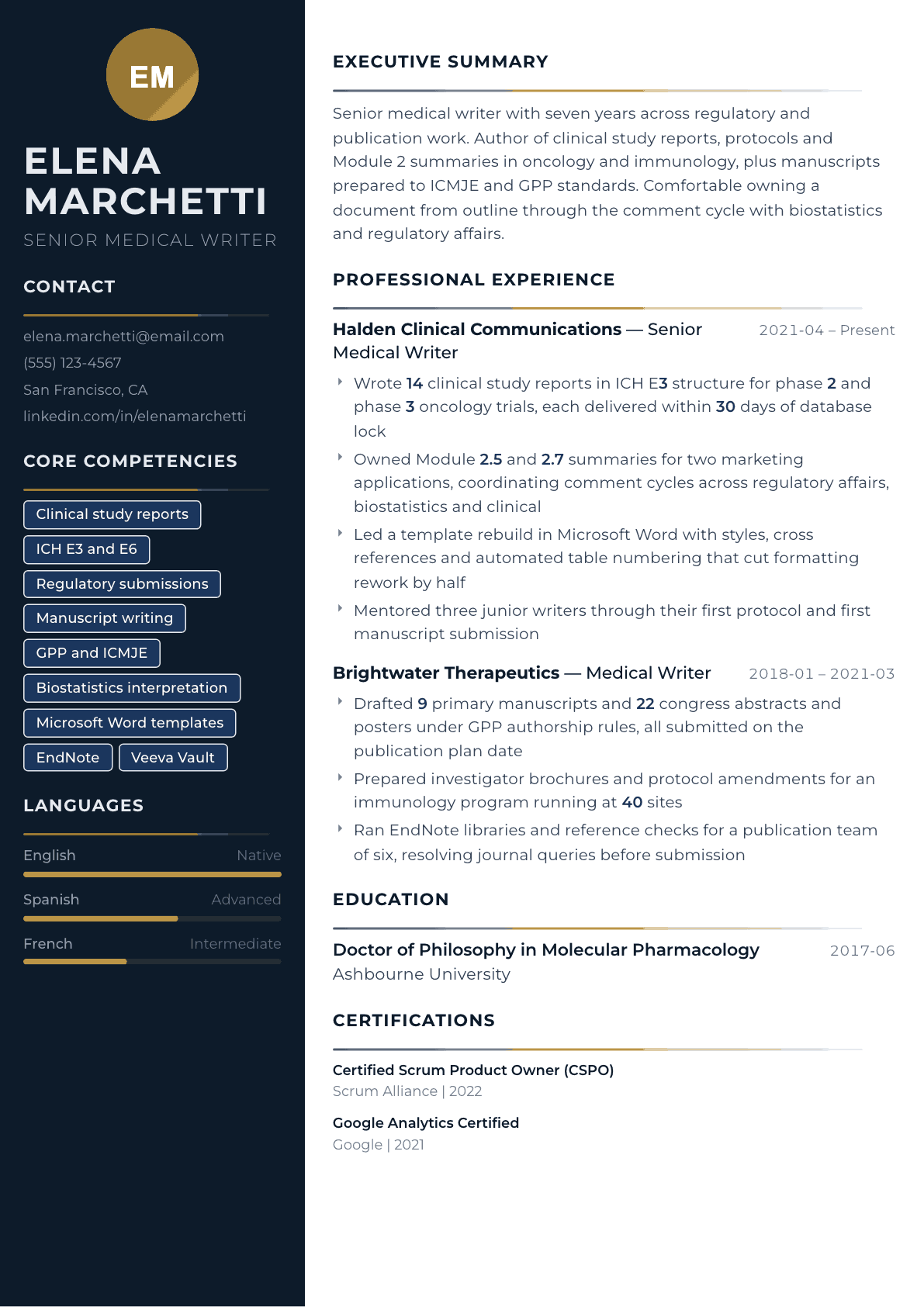
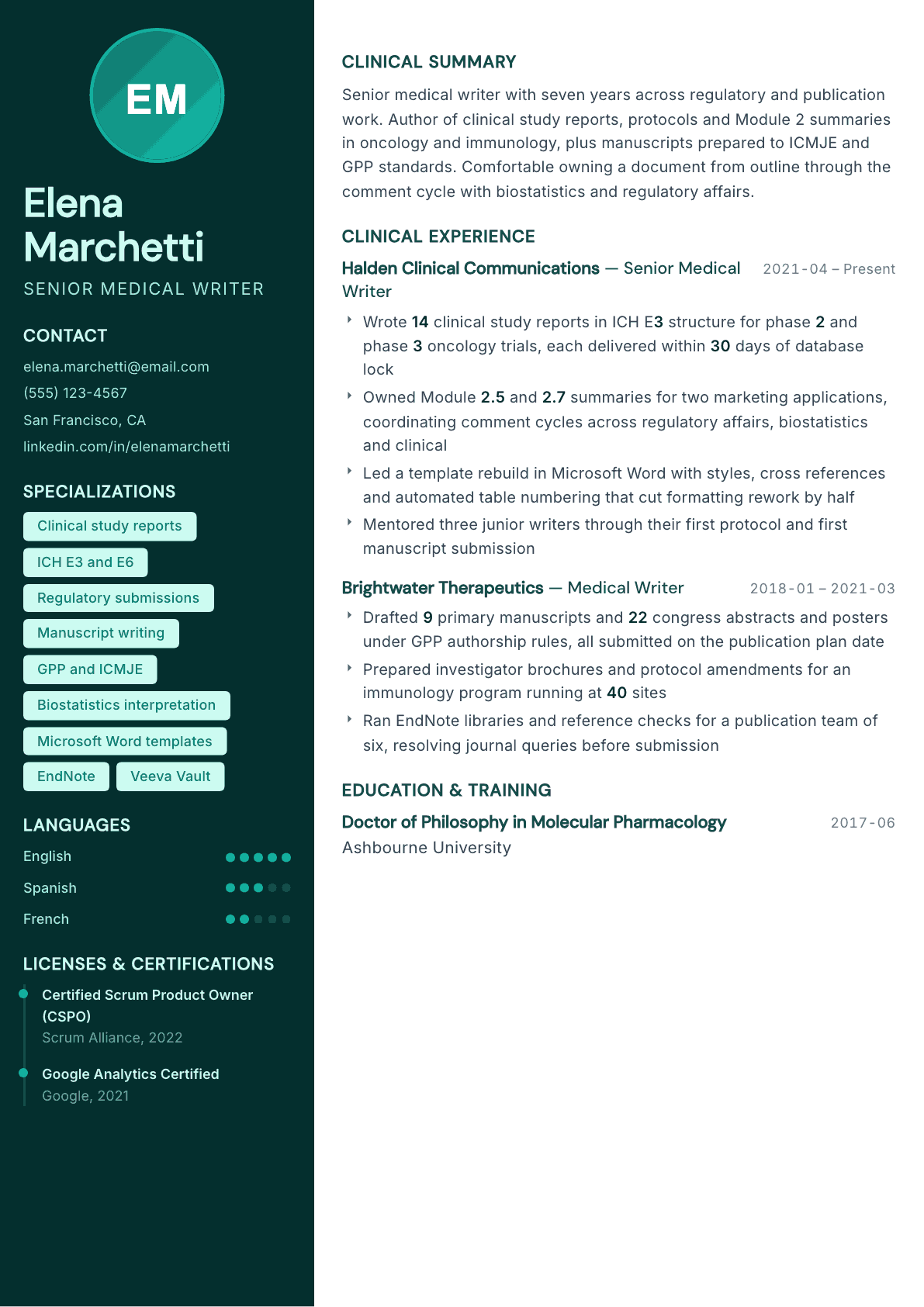
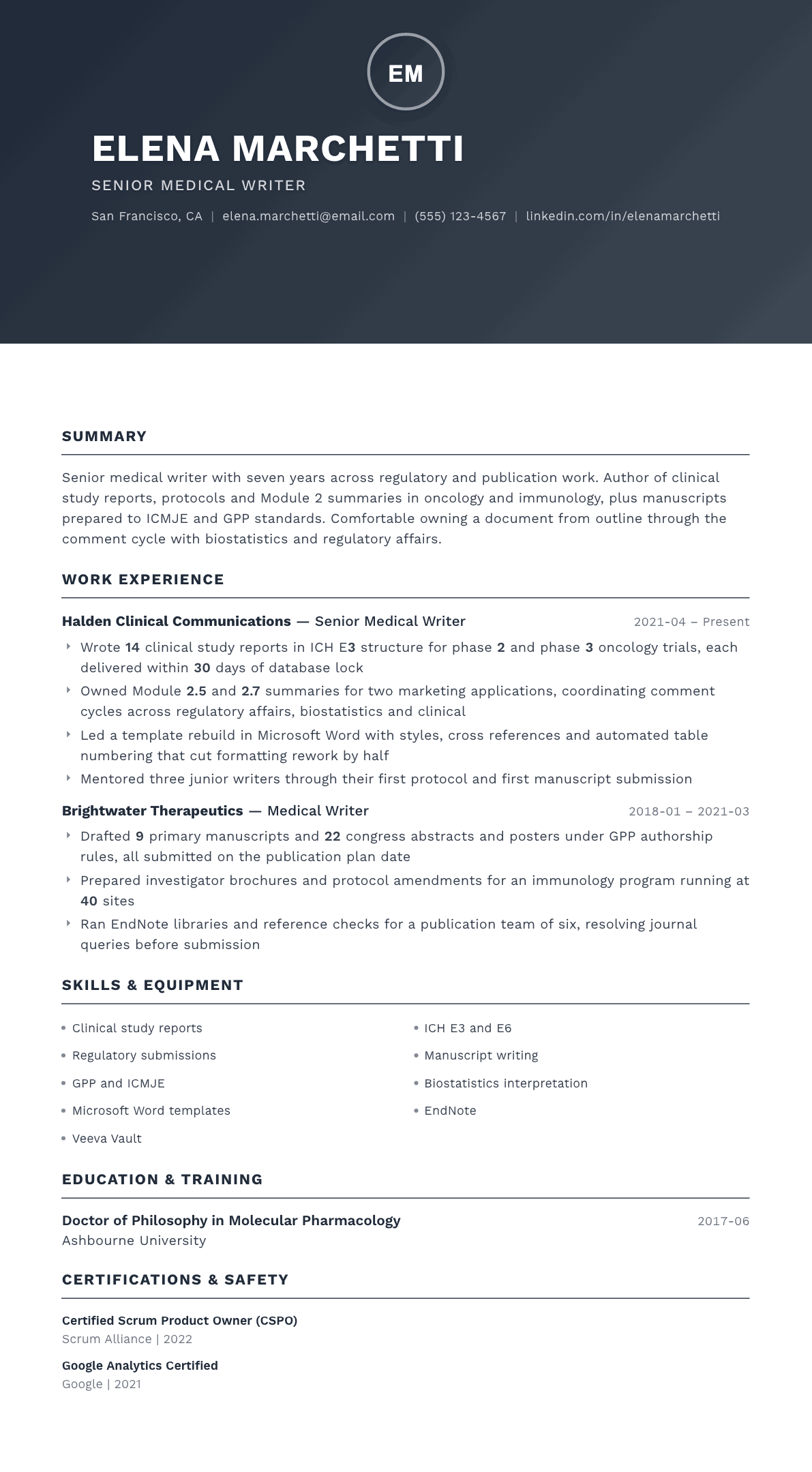
Example Medical Writer summary
Medical writer with six years of regulatory and publication experience in oncology and immunology. Author of clinical study reports, protocols and Common Technical Document summaries, plus peer reviewed manuscripts written to Good Publication Practice. Skilled at turning statistical output packages into accurate narrative and at running comment cycles across clinical, regulatory and biostatistics teams without slipping a submission date.
Skills to list on a Medical Writer resume
- Clinical study reports
- Study protocols
- Investigator brochures
- Common Technical Document summaries
- Manuscript writing
- Congress abstracts and posters
- Plain language summaries
- ICH E3
- ICH E6 GCP
- CONSORT
- Good Publication Practice
- ICMJE authorship criteria
- Biostatistics interpretation
- Veeva Vault
- EndNote
- Microsoft Word templates
- Document quality control
What actually gets this resume read
- Name the document types you have written, because regulatory writing and publication writing are hired as separate skill sets.
- State the therapeutic areas you know well, since oncology, immunology and rare disease teams recruit for prior exposure.
- Show that you can read a statistical output package and turn tables and figures into accurate narrative text.
- List the standards you write to by name: ICH E3, ICH E6, CONSORT, GPP and the ICMJE authorship criteria.
- Include the systems you have worked inside, such as Veeva Vault, EndNote, Datavision or a validated Word template suite.
- Give one line per role on how you handled comment cycles, because review management is the part hiring managers worry about.
How to write a medical writer resume
Medical writer is one job title covering two different hiring markets. Regulatory writing is judged on whether you can build a clinical study report from a statistical output package without misstating a single result, and whether you can hold a document through five review cycles and still hit the submission date. Publication writing is judged on whether you can turn a data set into a manuscript that survives peer review, and whether you understand who may be named an author and who may not.
A resume that blurs the two loses both. The regulatory hiring manager scans for document types, ICH structure and submission experience. The publications lead scans for journals, congresses, Good Publication Practice and the authorship rules. Neither of them wants a generic paragraph about strong written communication.
This guide covers the order those readers expect, three example summaries at different career stages, before and after bullets built from real document work, and the questions writers ask when moving from the bench or the clinic into the role.
Format: lead with a document inventory, not a duties list
Use reverse chronological order and keep the file to two pages once you have more than three years of experience. Directly under the summary, add a short block titled Document Experience that lists the deliverable types you have authored, with rough counts. That block is the fastest way for a screener to tell a protocol writer from an abstract writer.
If you have both regulatory and publication experience, group the block into two lines so the reader can see the split. A hiring team recruiting for a submission heavy quarter will read that split before they read your job history.
- Header: name, credentials, city and state, phone, email, and a link line only if you have a public author profile.
- Order: summary, document experience, therapeutic areas, professional experience, education, skills and systems.
- Writers moving in from research put education and publications above experience for the first two applications.
Summary: document types, therapeutic areas, and where you sit in the process
Three sentences. The first names your years and your split between regulatory and publication work. The second names the therapeutic areas where you know the endpoints and the vocabulary. The third names the part of the process you own, whether that is authoring from an outline, running the comment cycle, or quality controlling other writers.
Avoid claiming both regulatory and medical communications depth unless you can support both with documents. Reviewers who write for a living notice padding faster than anyone else in the hiring chain.
Experience: name the document, the standard, and the review cycle
Each bullet should carry a document type, a volume, and a constraint you worked inside. A clinical study report written in ICH E3 structure delivered within thirty days of database lock tells the reader far more than authored various regulatory documents. The same applies to publications: a primary manuscript prepared to journal specifications and submitted on the publication plan date shows you understand that timing is part of the work.
Show the review cycle explicitly. Comment reconciliation across clinical, biostatistics, regulatory affairs and pharmacovigilance is the part of the job that consumes the most hours and the part hiring managers most want evidence of. Say how many reviewers, how many rounds, and how you tracked resolution.
Cut anything that describes writing itself. Excellent attention to detail and strong grammar skills are assumed of anyone whose job title contains the word writer.
Standards, systems and statistics
Name the standards by their identifiers. ICH E3 for study reports, ICH E6 for good clinical practice, the Common Technical Document structure for submissions, CONSORT and its extensions for trial reporting, Good Publication Practice for industry sponsored publications, and the ICMJE criteria for authorship. These are the exact strings a keyword filter looks for.
List the systems where the work actually lives: a validated document management platform, a reference manager, a publication planning tool, and the version of Microsoft Word template suite you have used with styles, cross references and automated numbering. A writer who can repair a broken template saves a team days.
Say plainly what you can do with statistical output. Reading tables, listings and figures, checking narrative text against the shells, and querying a statistician about a discrepancy is a distinct skill and it should appear as one.
- Regulatory: protocols, amendments, investigator brochures, clinical study reports, Module 2 summaries, responses to health authority questions.
- Publications: primary and secondary manuscripts, congress abstracts, posters, oral presentation decks, plain language summaries.
- Quality: document quality control, style guide ownership, template maintenance, reference verification.
Keywords a screener is filtering on
Postings for this role are written from templates that repeat a narrow set of phrases: clinical study report, protocol, investigator brochure, common technical document, publication plan, comment resolution, therapeutic area, good clinical practice, and the name of the document management system. Use each exact phrase once in the document inventory and once inside a bullet where it is doing real work.
Add the therapeutic areas as separate terms. A team hiring for an oncology submission filters on oncology, then on the tumor types, then on whether you have handled a report with overall survival and progression free survival endpoints.
Medical Writer resume summary examples
First writing role after a PhD
Molecular pharmacology PhD moving into regulatory writing, with four peer reviewed publications as first author and a year of contract work drafting protocol synopses and congress abstracts. Trained in ICH E3 structure and good clinical practice, comfortable reading statistical output tables against a shell.
Five years in
Medical writer with five years split between regulatory and publications in immunology. Author of 11 clinical study reports, 6 protocols and 14 manuscripts, running comment cycles across clinical, biostatistics and regulatory affairs. Delivers reports within 30 days of database lock and works inside a validated document platform.
Lead writer
Lead medical writer with nine years in oncology submissions. Owned Module 2.5 and 2.7 summaries for two marketing applications, managed a team of four writers, and rebuilt the department template suite and style guide. Also chairs the quality control review that clears every document before it leaves the group.
Work experience bullets: before and after
Before: Wrote clinical documents for clinical trials.
After: Authored 14 clinical study reports in ICH E3 structure for phase 2 and phase 3 oncology trials, each delivered within 30 days of database lock.
The document type, the standard, the phase and the timing turn an unverifiable claim into a workload a manager can price.
Before: Managed the review process with stakeholders.
After: Ran three round comment cycles with 9 reviewers across clinical, biostatistics, regulatory affairs and pharmacovigilance, logging every resolution in the document management system.
Naming the reviewer functions and the number of rounds shows you have handled the part of the job that actually consumes the schedule.
Before: Helped with publications for the medical affairs team.
After: Drafted 9 primary manuscripts and 22 congress abstracts under Good Publication Practice, coordinating author review and confirming ICMJE criteria for every named author.
Publication work is judged on the standards you applied, and authorship compliance is the risk the reader is checking for.
Before: Used company templates and reference software.
After: Rebuilt the department Word template with styles, cross references and automated table numbering, and maintained shared reference libraries for a team of six writers.
Template and reference ownership is infrastructure work that saves a whole group time, so it deserves a bullet of its own.
Before: Worked with statisticians on trial results.
After: Checked narrative text against tables, listings and figures for every report, raising queries on inconsistent denominators and unreconciled adverse event counts before circulation.
The strong version demonstrates the exact quality behavior a regulatory writing lead needs to trust in a new hire.
Hard skills
- Clinical study reports
- Study protocols and amendments
- Investigator brochures
- Common Technical Document summaries
- Manuscript writing
- Congress abstracts and posters
- Plain language summaries
- ICH E3 and ICH E6
- CONSORT reporting
- Good Publication Practice
- ICMJE authorship criteria
- Statistical output interpretation
- Document quality control
- Reference management
Soft skills
- Comment cycle facilitation
- Working to a fixed submission date
- Scientific accuracy judgment
- Querying subject matter experts
- Mentoring junior writers
- Handling conflicting reviewer feedback
Certifications worth listing
- Medical Writer Certified (MWC) (American Medical Writers Association)
- Certified Medical Publication Professional (CMPP) (International Society for Medical Publication Professionals)
- Regulatory Affairs Certification (RAC) (Regulatory Affairs Professionals Society)
Mistakes that cost medical writer candidates the interview
- Writing a generic communications summary that never names a single document type, which reads as if you have written none of them.
- Mixing regulatory and publication experience into one undifferentiated list so neither hiring manager can find their evidence.
- Claiming therapeutic areas from a single small project, which collapses the moment an interviewer asks about the endpoints.
- Leaving out the review cycle entirely, when comment reconciliation is where most of the working hours go.
- Listing writing adjectives such as meticulous and detail oriented instead of the counts, standards and deadlines that prove them.
- Attaching a portfolio of confidential regulatory documents rather than offering a redacted writing sample on request.
Medical Writer resume questions
Do I need a PhD to become a medical writer?
No, though an advanced degree helps in regulatory and publication roles because you already read primary literature and statistical output comfortably. Nurses, pharmacists and clinical research coordinators move into the field regularly by leading with document work they have already produced.
How do I show writing samples without breaking confidentiality?
Never attach sponsor documents. Offer a redacted sample on request, point to published manuscripts or abstracts where you are a named author, or write a short mock protocol synopsis from a public trial registry entry specifically for applications.
Should a medical writer resume list every publication?
List first author and key publications on the resume and put the full list in a separate document. Give the journal, the year and your author position, since a publications lead reads author position as evidence of how much of the writing you owned.
What is the difference between regulatory writing and medical communications on a resume?
Regulatory writing is measured in clinical study reports, protocols and submission modules built to health authority structure. Medical communications is measured in manuscripts, congress materials and advisory board summaries built to journal and Good Publication Practice standards. Show which one you want.
How long should a medical writer resume be?
Two pages for most experienced writers, one page if you have under three years. Keep the document inventory and therapeutic areas on page one, since a screener often decides from the top third of the first page.