CEO Resume Examples: what a hiring manager reads first
Write an Executive CEO Resume That Earns a Board Conversation
By Mustafa Tarabya, founder of CVBooster · Published · Updated
An executive CEO resume guide with a chief executive sample, the growth and governance numbers directors read first, keywords, and advice on length.
Sample resumes for a ceo
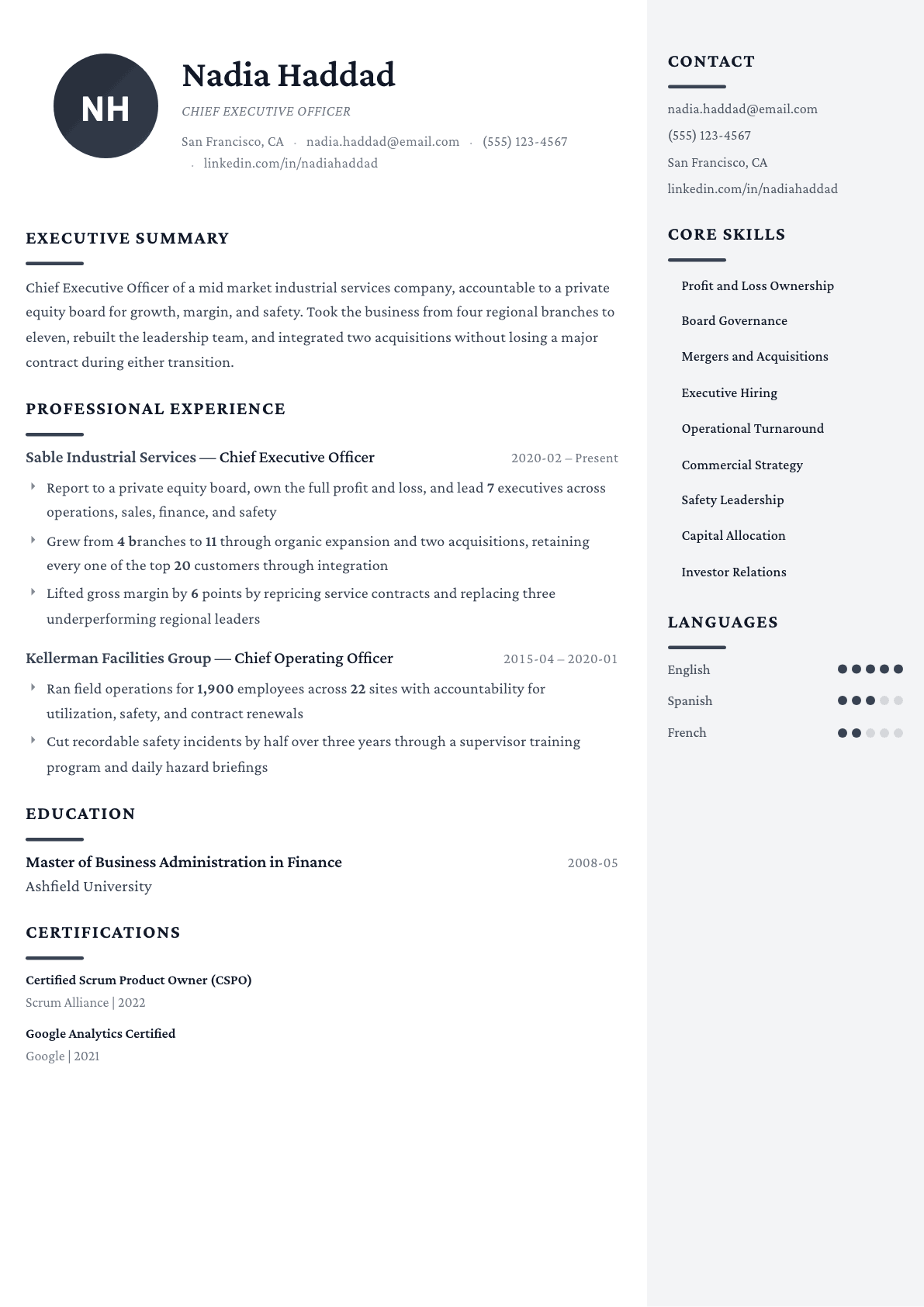
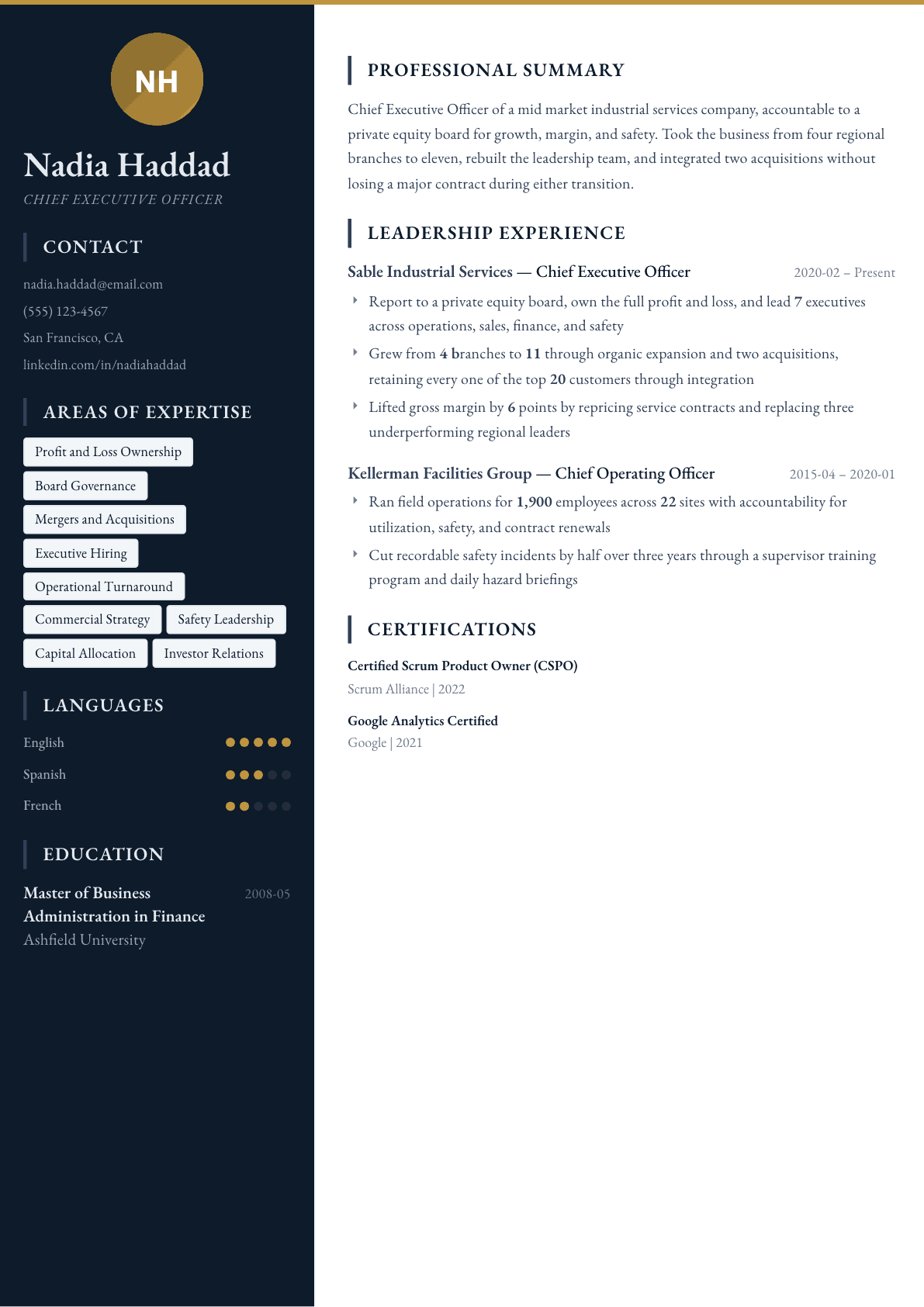
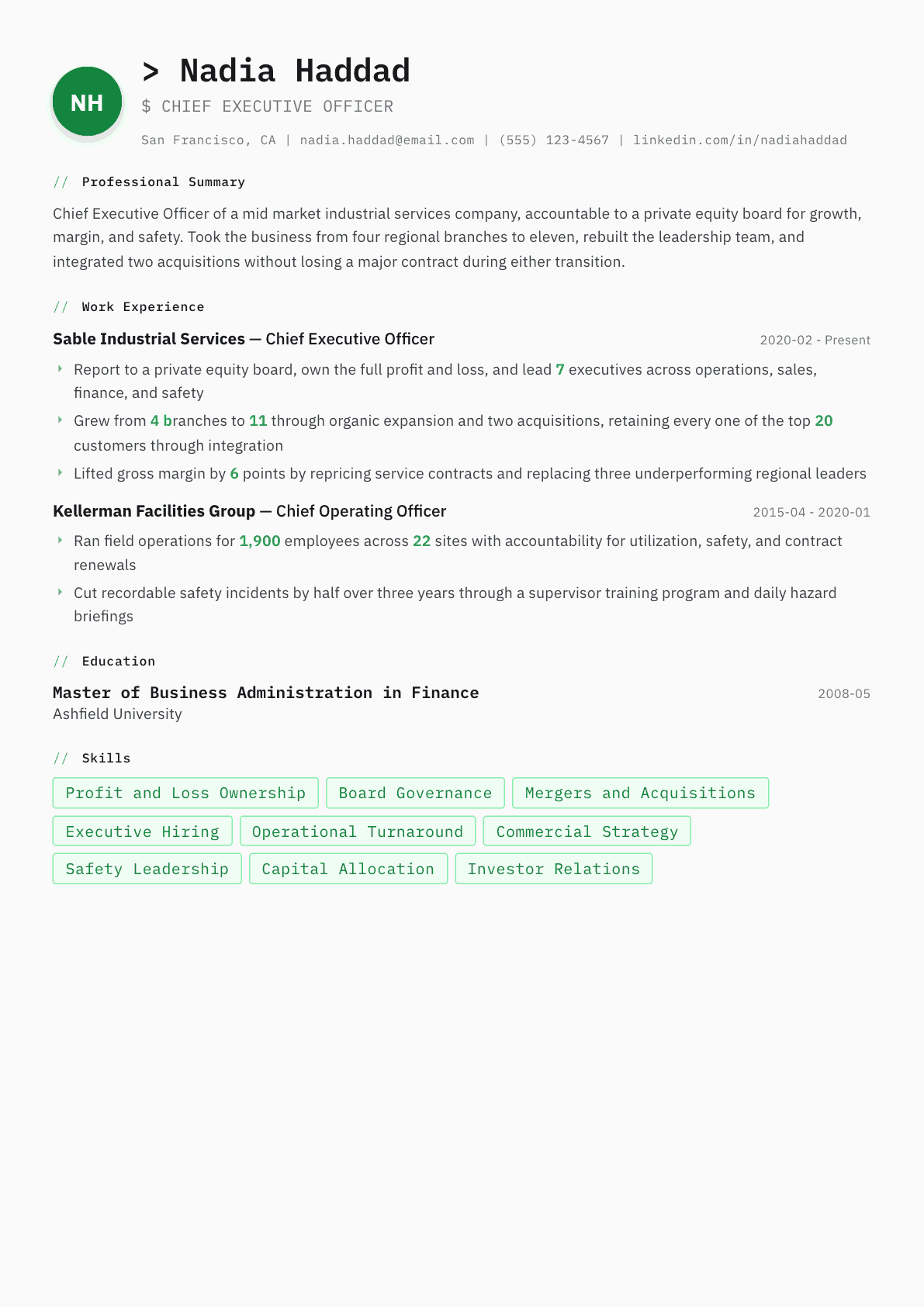
The same ceo content laid out in three CVBooster templates, so you can see what the finished document looks like before you write a word.
Example CEO summary
Chief Executive Officer with twenty years in industrial and facilities services, the last five running a private equity backed business through branch expansion and two acquisitions. Owns the full profit and loss, reports to a sponsor board, and rebuilt an executive team of seven. Lifted gross margin by repricing service contracts and halved recordable safety incidents across a large field workforce.
Skills to list on a CEO resume
- Profit and Loss Ownership
- Board Governance
- Corporate Strategy
- Mergers and Acquisitions
- Capital Allocation
- Executive Team Building
- Investor Relations
- Operational Turnaround
- Commercial Strategy
- Organizational Design
- Risk and Compliance Oversight
- Change Leadership
- Market Expansion
- Succession Planning
What actually gets this resume read
- State the size of the business you led in revenue scale, headcount, and site count so a director can place you in seconds.
- Name your reporting line, whether that is a founder board, a private equity sponsor, or a listed company board of directors.
- Show the capital decisions you made, including acquisitions, divestments, and the places where you deliberately chose not to invest.
- Give every executive hire and leadership change an outcome, because rebuilding a team is a central part of this job.
- Hold the resume to two pages and move the longer narrative into a separate board biography you attach when asked.
- Include a governance line covering audit, risk, and compliance exposure, since search committees screen that as hard as growth.
How to write a ceo resume
An executive CEO resume has an unusual audience. It is read by an executive search partner, then by a nomination committee or a private equity deal team, and finally by directors who have twenty minutes and three candidates. None of them are looking for a career history. They are looking for a pattern: what kind of situations you have run, what you did with capital, and whether the results held after you left.
The document also has to survive being summarized. A search partner will lift four or five lines out of it into a candidate report, so those lines have to work alone, without the paragraph around them. Anything that only makes sense in context will be cut, and what remains is what the board actually reads.
This guide covers how directors read the page, three summaries reflecting different routes into the top seat, before and after bullets that hold up in a reference check, the governance content committees expect, and the questions first time chief executives ask when they write this document.
Format: two pages, and a separate board biography
Two pages is the working limit. Directors are not reading a memoir, and a longer document competes with the candidate report the search firm writes about you. Keep a separate one page board biography in third person for committee packs, and keep the two documents consistent so nobody has to reconcile them.
Use a plain single column layout with a conservative typeface. Executive files are printed, forwarded, and pasted into other documents constantly, and anything with columns or graphics degrades badly on that journey.
- Header: name, city, phone, email, and a professional profile link.
- Order: executive profile, selected results, experience, board and governance roles, education.
- Add a short line naming your reporting relationship in each role: founder board, sponsor, or listed company board.
Profile: the situation you ran, in the reader's language
Open by naming the type of business and the situation. Growth, turnaround, integration after acquisition, professionalizing a founder led company, and preparing an exit are recognized categories, and directors sort candidates into them immediately. Say which one you have done and how many times.
Then give the scale in three numbers: revenue order of magnitude, headcount, and site or market count. Precision is less important than proportion, and a reader who cannot size your last business will assume it was smaller than it was.
Results: capital decisions, margin, and what held
Choose four or five results and make each one a full thought. A margin improvement is only credible when the reader knows what drove it, whether that was repricing, mix shift, procurement, or removing a loss making line. A growth number is only credible when it says whether it came from organic expansion or acquisition.
Include the decisions where you allocated capital, and the ones where you refused to. Closing a branch, walking away from an acquisition, and stopping a capital project are the choices directors probe hardest, because they reveal whether you can say no to your own management team.
Wherever you can, say that a result held. Two consecutive years of margin improvement is a different claim from one good year, and it is the difference between a leader who cut and a leader who changed how the business works.
Team and succession: the part references confirm
Directors ask referees about your executive team more than anything else. Show who you hired, which roles you rebuilt, and what changed in the function afterward. A chief executive who arrived to a weak commercial function and left a strong one has done something that outlasts a quarter.
Succession belongs on the page too. Naming internal leaders you developed into larger roles is a quiet signal that you were building an organization rather than a personal dependency, which is exactly what a committee is testing for.
Governance, risk, and safety
Give one block to governance. Name the board and committee structures you worked within, the audit and risk exposure you carried, and any regulatory or safety obligation that sat with you personally. In industrial, healthcare, and financial businesses this is not decoration, it is a screening criterion, and its absence is read as inexperience.
If you led through a serious incident, an investigation, or a regulatory review, include one line about it. Handling that well is a mark in your favor, and search partners tend to find out anyway.
Chief executive officer resume example, start to finish
A chief executive officer resume is easier to judge when you see a whole one, so here is a complete example for a sitting CEO of a mid sized company. The person and companies are invented; the order is what to copy, and it works as a chief executive resume template whether the first reader is a search partner or a director.
Profile: Daniel Okafor, Chief Executive Officer. CEO of a private equity backed specialty distribution business with about twelve hundred employees across nine branches, reporting to a board of seven. Took over a business losing share, refocused it on three customer segments, rebuilt the leadership team and led it through a sale to a strategic buyer.
- Current role, Chief Executive Officer, Corbel Supply, five years: full P&L, nine branches, seven direct reports and the relationship with the board and the lenders.
- Exited two unprofitable product lines and reinvested in the three segments with the strongest margins, with the board approving each step.
- Replaced four of seven executives, promoted two from inside, and left a named successor for every executive role.
- Led the sale process with the board and the bankers, from management presentation through diligence to closing.
- Previous role, President, Industrial Division, Harwick Group, six years: the largest division of a public company, with its own P&L and three plants.
- Board and governance: director of a regional hospital system and member of its audit committee.
- Education: MBA; BS in Mechanical Engineering.
CEO resume summary examples
First chief executive appointment
Operating leader stepping into a first chief executive role after four years as chief operating officer of a regional services business. Ran field operations for 1,900 employees across 22 sites, halved recordable safety incidents, and rebuilt three underperforming branch teams before taking the full profit and loss.
Sponsor backed mid market business
Chief Executive Officer of a private equity backed industrial services company, accountable to a sponsor board for growth, margin, and safety. Grew from four branches to eleven through organic expansion and two acquisitions, lifted gross margin by six points, and retained every top twenty customer through integration.
Group level and non executive experience
Chief Executive with twenty two years leading businesses through growth and turnaround in industrial and facilities services. Completed two sponsor exits, rebuilt executive teams in both companies, and now serves as a non executive director on the audit committee of a family owned manufacturer.
Work experience bullets: before and after
Before: Grew the business significantly during my tenure.
After: Grew from 4 branches to 11 through organic expansion and two acquisitions, retaining all of the top 20 customers through both integrations.
Separating organic from acquired growth and adding customer retention makes the number defensible in diligence.
Before: Improved profitability across the company.
After: Lifted gross margin by 6 points over two years by repricing legacy service contracts, exiting one loss making product line, and replacing three underperforming regional leaders.
Three named drivers show the reader how the margin moved instead of asking them to take it on faith.
Before: Built and led the senior leadership team.
After: Rebuilt an executive team of seven across operations, sales, finance, and safety, promoting two internal leaders and reducing executive turnover to zero over the following three years.
Internal promotion and retention prove the team was built rather than simply replaced.
Before: Focused on health and safety across the business.
After: Cut recordable safety incidents by half over three years through a supervisor training program, daily hazard briefings, and making site safety performance part of every branch manager review.
The mechanisms and the accountability change explain why the safety result was sustained.
Before: Reported to the board on company performance.
After: Reported monthly to a private equity board on trading, cash, and covenant headroom, and led the quarterly audit and risk session through two years of covenant pressure.
Naming what you reported on and the condition of the business shows the reader how you operate under scrutiny.
Hard skills
- Profit and loss ownership
- Corporate strategy
- Mergers, acquisitions and integration
- Capital allocation
- Commercial and pricing strategy
- Operational turnaround
- Investor and sponsor relations
- Board governance
- Risk and compliance oversight
- Organizational design
- Market and geographic expansion
- Succession planning
Soft skills
- Board level communication
- Executive team building
- Decisiveness under incomplete information
- Negotiation with counterparties
- Cultural change leadership
- Public and stakeholder representation
Certifications worth listing
- Chartered Director (Institute of Directors)
- NACD Directorship Certification (National Association of Corporate Directors)
Mistakes that cost ceo candidates the interview
- Writing four pages of history when directors read half of page one before deciding whether to continue.
- Giving growth and margin numbers with no driver attached, which collapses the moment a referee is asked about them.
- Omitting the reporting relationship, so a committee cannot tell whether you answered to a founder, a sponsor, or a listed board.
- Leaving out governance, audit, and safety exposure, which regulated sector committees treat as a hard requirement.
- Taking credit for results delivered mostly by a predecessor, which reference checking at this level exposes quickly.
- Describing culture and values with no observable change, when retention, promotion, and turnover numbers were available.
CEO resume questions
Is there a chief executive resume template I can follow?
Follow one order rather than one design: name and title, a short profile of the situations you ran, experience with capital decisions and results under each role, then board and governance, then education. Keep the layout plain, because a search partner will copy lines into a candidate report. The complete example on this page follows that order.
How long should a CEO resume be?
Two pages, with a separate one page board biography written in third person. Directors and search partners both work from summaries, so a longer document simply gets condensed by someone else rather than read in full.
How do I present a short tenure that ended badly?
State the dates plainly and give one factual line on the change in ownership, strategy, or board composition that ended it. Search partners see this constantly and a straightforward explanation is far less damaging than an unexplained twelve month gap.
Do I need board experience to become a chief executive?
It is not required for a first appointment, but exposure to a board helps considerably. Presenting to a board as a functional leader, sitting on a subsidiary board, or holding a non executive seat in a smaller organization all count and belong on the page.
What should a first time chief executive emphasize?
Emphasize full accountability rather than functional excellence. Directors want evidence that you have carried a whole result, made a capital decision, faced a board, and rebuilt a team, so lead with the moments where the outcome sat entirely with you.
Related resume examples
- Executive Resume example
- COO Resume example
- Managing Director Resume example
- General Manager Resume example
- Chief of Staff Resume example
- Executive Director Resume example