Financial Analyst Resume Examples: the lines they read
Financial Planning and Analysis Resume Examples for FP&A Analysts
By Mustafa Tarabya, founder of CVBooster · Published · Updated
Create a data-driven financial analyst resume with CVBooster. Feature your financial modeling expertise, analytical tools, and metrics that impress hiring managers.
Sample resumes for a financial analyst
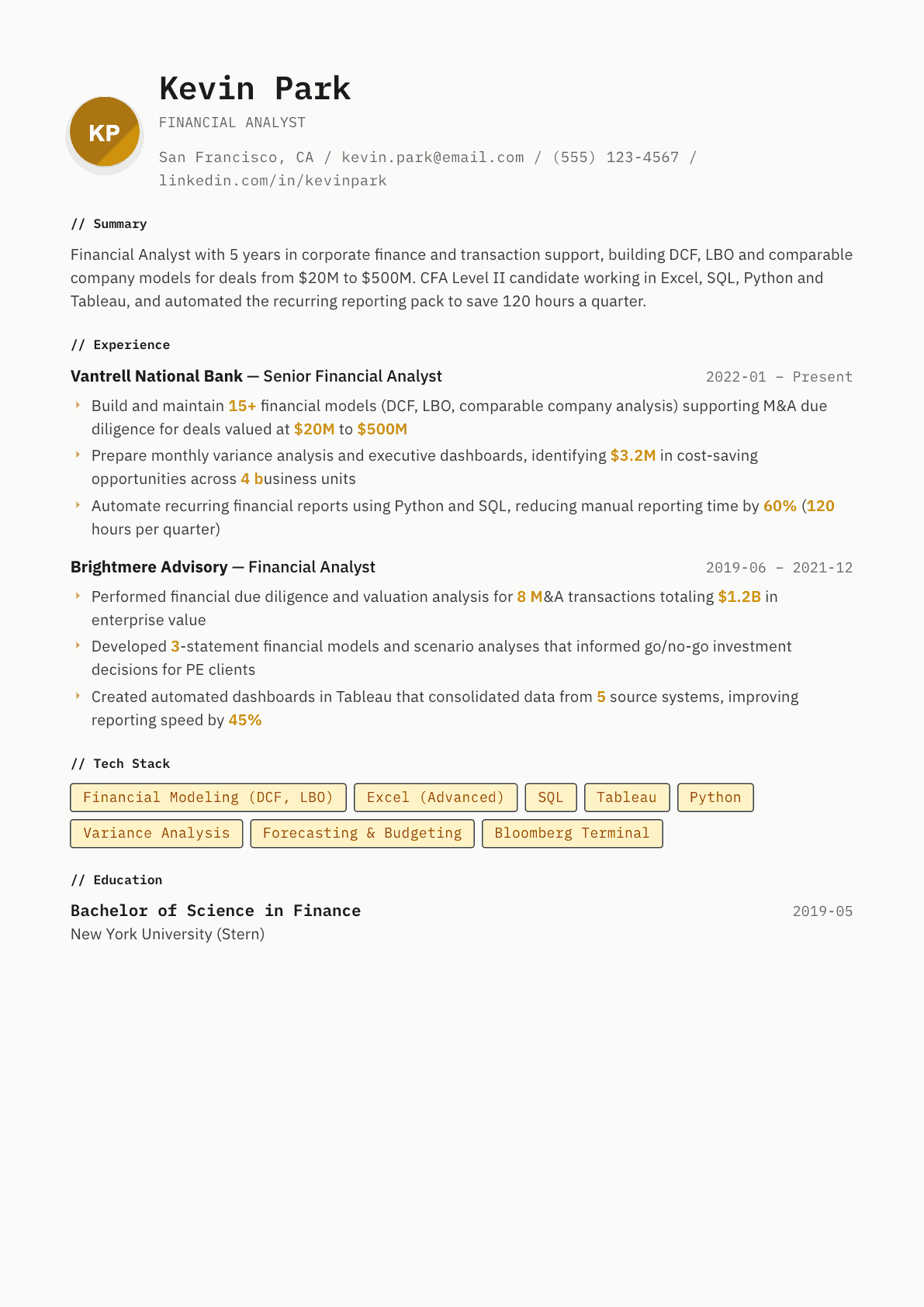
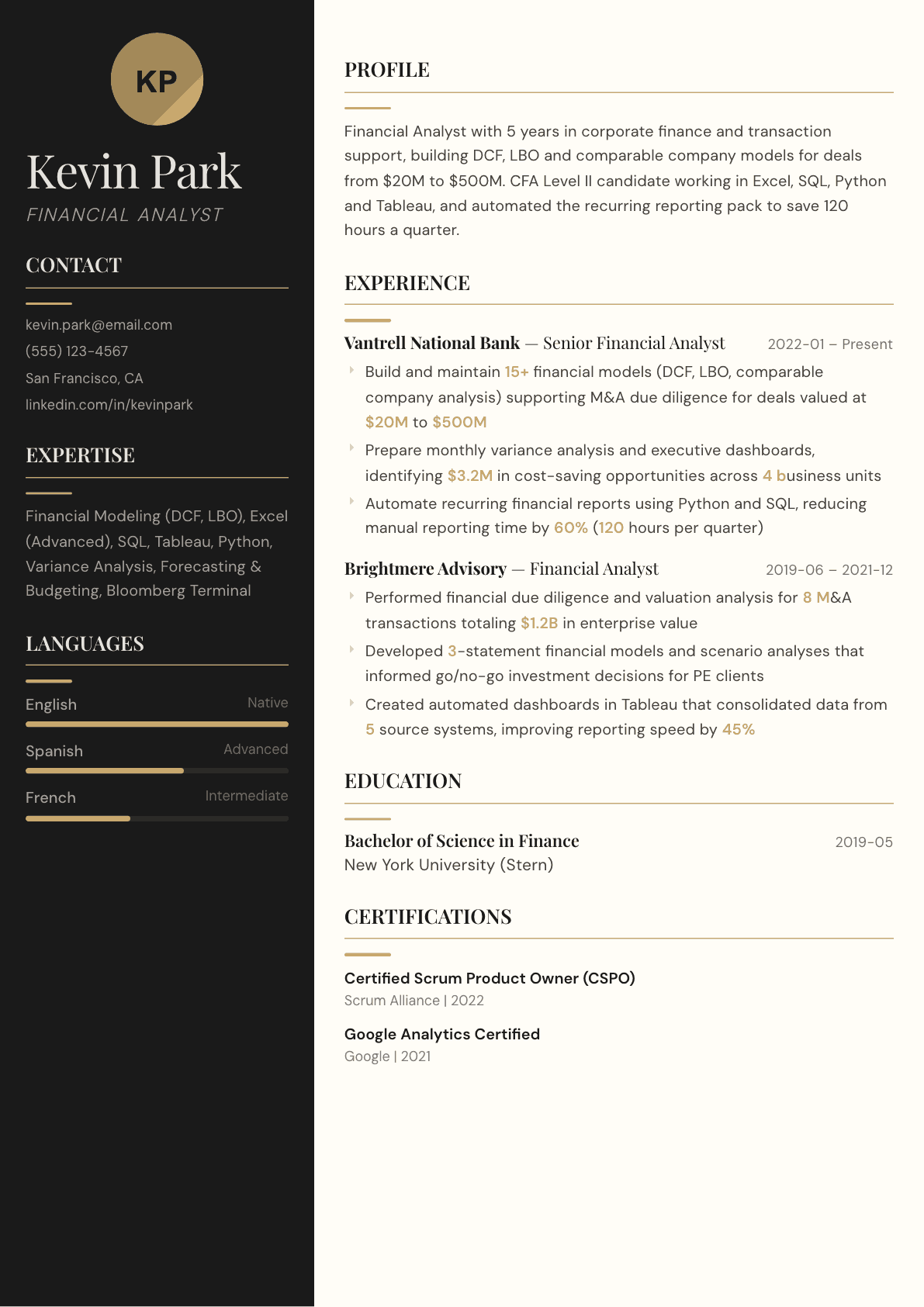
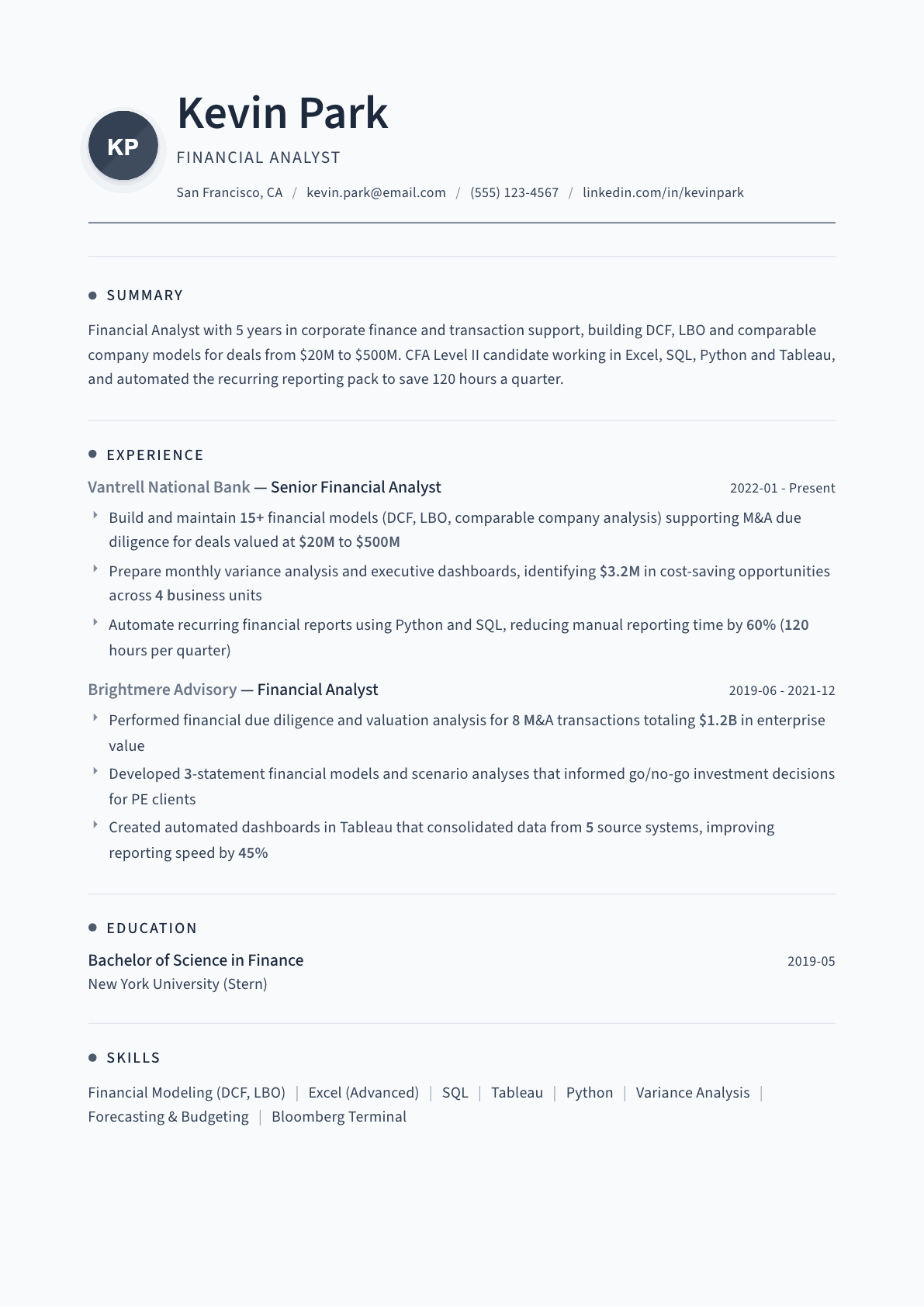
The same financial analyst content laid out in three CVBooster templates, so you can see what the finished document looks like before you write a word.
Example Financial Analyst summary
Analytical Financial Analyst with 5 years of experience building financial models and delivering strategic insights for $500M+ transactions. Proficient in Excel, SQL, Python, and Tableau with CFA Level II candidacy. Known for automating reporting workflows (saving 120+ hours/quarter) and identifying $3.2M in cost-saving opportunities through rigorous variance analysis.
Skills to list on a Financial Analyst resume
- Financial Modeling (DCF / LBO)
- Excel (Advanced / VBA)
- SQL
- Tableau
- Python (Pandas / NumPy)
- Power BI
- Variance Analysis
- Forecasting & Budgeting
- Bloomberg Terminal
- M&A Due Diligence
- Valuation Analysis
- Financial Reporting
What actually gets this resume read
- Highlight the dollar value of deals, budgets, or portfolios you analyzed to demonstrate scope and impact.
- List financial modeling techniques by name: DCF, LBO, comparable company analysis, 3-statement models, or scenario analysis.
- Showcase technical tools prominently: Excel (pivot tables, VLOOKUP, VBA macros), SQL, Python, Tableau, Power BI, or Bloomberg Terminal.
- Include CFA, CPA, or FRM certifications (or candidacy level) as they are major differentiators in finance roles.
- Quantify automation achievements: hours saved, reports streamlined, or manual processes eliminated.
- Demonstrate cross-functional influence by describing how your analysis informed executive decisions, capital allocation, or strategy.
How to write a financial analyst resume
Financial analyst is one of the widest job titles in corporate finance, which is exactly why the resume is hard to write. The same two words cover FP&A at a manufacturer, deal support in a corporate development team, buy-side coverage of a sector, and the person who rebuilds the monthly close deck. The hiring manager already knows which of those she needs. Her first job when your file opens is to work out which one you have been doing.
So the screen is short. She looks for the finance function you sat in, the size and type of the business, the models you own end to end, and whether your numbers ever changed a decision. Then she checks the tooling: how deep the Excel actually goes, whether you query the data yourself or wait for someone to send you an extract, and which ERP or planning system you have lived inside.
This guide covers section order, a complete financial planning and analysis resume sample written out line by line, three summaries at different career stages, before and after bullets that show what a hiring manager reads differently, and the mistakes that keep otherwise strong analysts at the bottom of the pile.
Format: one page until you have run a planning cycle end to end
Reverse chronological, one page for anyone under about seven years, two once you have owned a full annual planning cycle and a team. Finance readers are unusually intolerant of layout noise: no icons, no skill bars, no photo, and no two column body, because the corporate ATS parses columns badly and the reader assumes anyone who rates their own Excel at four stars out of five has not met a real model.
Give the technical stack its own short block rather than scattering tools through the bullets. A financial analyst resume is read partly as a tooling inventory, and the reader wants to find Excel depth, SQL, the ERP, the planning tool and the BI layer in one glance.
- Header: name, city and state, phone, email, and a credential line if you hold or are sitting the CFA or CPA.
- Order: summary, technical skills, experience, education, certifications.
- Students and career changers move education up and add a modeling coursework or case competition line.
Summary: which finance seat, what scale, what you own
Three sentences. Name the function (FP&A, corporate development, treasury support, equity research), the industry, the revenue or budget scale you supported, and the one thing you own that a replacement would have to be trained on. Scale matters because forecasting a subscription business with monthly cohorts is a different craft from forecasting a plant with raw material inputs.
A candidate moving from public accounting or consulting into an analyst seat should say the move plainly and point at the transferable half: audit gives you the statements cold, consulting gives you the model build and the executive deck. What neither gives you is ownership of a forecast that gets graded next quarter, so do not pretend otherwise.
Experience: the model, the cycle, and the decision it fed
Open each role with a context line: the company, what it does, the revenue or budget under your analysis, and who you supported. "Financial analyst supporting a four plant industrials segment, roughly 400 million in revenue, reporting to the segment controller" tells a reader more than any three bullets can.
Then write bullets around three things. First, what you built: three statement models, driver based forecasts, unit economics, cohort models, DCF or LBO, headcount plans. Second, the cycle you carried: month end close support, rolling forecast, annual operating plan, board reporting, capital requests. Third, the outcome: the variance you caught before it hit the quarter, the pricing change your margin analysis triggered, the capital request you killed.
Avoid the flat verbs that make every analyst resume identical. "Assisted with budgeting" and "prepared reports" survive on a resume only because nobody has asked what the budget was for or who read the report. Answer both in the bullet itself.
Financial planning and analysis resume sample: one FP&A role, written out
FP&A is the seat most people mean when they search for financial analyst resume examples, and it reads differently from deal work or research. The reader wants the planning cycle you carried, the business partner you sat next to, and the forecast you were graded on. Here is how one FP&A role looks on the page for an invented analyst, Dana Whitfield, four years in, so you can see the order and the density before you write your own.
Notice what is missing: no objective, no list of duties copied from the posting, no rating of Excel. Every line names a model, a cycle or a decision, and the context line does the work three vague bullets would otherwise try to do.
- Header: Dana Whitfield, Columbus, OH, phone, email, LinkedIn. CFA Level I passed.
- Summary: FP&A analyst for a mid sized packaging manufacturer. Owns the rolling forecast and monthly variance commentary for two plants, and partners with the operations director on capital requests.
- Technical skills: Excel (Power Query, scenario toggles), SQL, Oracle ERP, Adaptive Planning, Power BI.
- Role context line: Financial Analyst, FP&A, Northgate Packaging. Two plant segment, reporting to the segment controller, partnering with plant and operations leadership.
- Bullet: Rebuilt the plant cost forecast on volume, scrap and labor drivers, replacing a spreadsheet that was rolled forward by hand each month.
- Bullet: Wrote the monthly plan versus actual commentary for the segment and flagged a freight cost trend two months before it reached the quarter.
- Bullet: Built the business case model for a second packaging line, including the downside scenario the CFO asked to see before approving it.
- Education: BS in Finance, The Ohio State University.
Technical skills: be honest about Excel depth and say who writes the query
Everyone writes "advanced Excel", so the word has stopped carrying information. Replace it with the thing you actually do: index and match across a messy source file, dynamic arrays, Power Query transforms, a scenario toggle driven by a switch, a monthly file that rolls forward without breaking. If you have written VBA to automate a recurring pack, name that separately, because it is a different skill from modeling.
The other high signal item is data access. State whether you pull your own data from the warehouse in SQL or Python, and name the systems: the ERP (SAP, Oracle, NetSuite, Dynamics), the planning tool (Anaplan, Adaptive, Hyperion, Pigment), the BI layer (Tableau, Power BI, Looker), and the market data terminal if you used one. An analyst who can self serve is worth more than one who queues for extracts, and the reader will look for it.
Certifications and keywords the screen is scanning for
The CFA moves an investment oriented resume more than anything else you can put on it, and candidacy counts: state the level and that you passed it, not that you registered. The CPA carries weight in accounting adjacent FP&A, the FMVA is a reasonable early signal when you have no finance degree, and the FRM matters only if the job is risk.
Corporate postings recycle the same language: financial modeling, forecasting, variance analysis, budgeting, month end close, business partnering, KPI reporting, capital allocation, ad hoc analysis. Use the posting wording once in the skills block and once inside a bullet where it is demonstrated. Reciting the phrase list without an example is the fastest way to sound like a candidate who has only read the job description.
Financial Analyst resume summary examples
First analyst role
Finance graduate with two internships in corporate FP&A and equity research, comfortable building three statement and DCF models from filings. Wrote SQL against a retail sales warehouse for a capstone margin study and passed CFA Level I. Looking for a rotational analyst program in corporate finance.
Five years in
FP&A analyst supporting a 600 million revenue software segment: monthly close commentary, the rolling forecast, and the annual operating plan for a 180 person organization. Rebuilt the bookings to revenue bridge in Power Query and cut the close cycle by three days. CFA Level II candidate.
Lead analyst
Senior financial analyst and CFA charterholder, seven years across corporate development and FP&A. Owns the consolidated forecast for four business units, the board reporting pack, and the model behind two completed acquisitions. Manages two analysts and runs the Anaplan planning model the whole finance team plans in.
Work experience bullets: before and after
Before: Built financial models for the business.
After: Built and owned the driver based revenue model for a four segment portfolio, rebuilt quarterly from CRM pipeline and billing data, and used as the input to the board forecast.
Naming the model type, its data sources and where the output lands proves ownership rather than participation.
Before: Performed monthly variance analysis and reporting.
After: Ran monthly plan versus actual variance for a 90 million cost base, flagged a 1.4 million overrun in contractor spend in month two, and worked with the department head to reset the run rate before year end.
A variance bullet is only interesting when it names the thing you caught and what happened next.
Before: Automated reports using Excel and SQL.
After: Replaced a manual 14 tab reporting pack with a Power Query refresh over a SQL extract, cutting preparation from two days to under an hour each month.
The before and after of the process shows the size of the problem, which is what makes the automation impressive.
Before: Supported the annual budget process.
After: Coordinated the annual operating plan across 12 cost center owners: built the templates, ran the review sessions, and consolidated submissions into the CFO deck two weeks ahead of the board date.
Coordinating a planning cycle is a leadership signal, and it disappears entirely behind the word supported.
Before: Analyzed profitability and made recommendations.
After: Built a customer level contribution margin analysis that identified 30 accounts below breakeven after service costs, leading to a repricing that lifted segment gross margin by 2 points.
The unit of analysis and the decision it produced turn a generic claim into evidence of commercial judgment.
Hard skills
- Three statement modeling
- DCF and LBO valuation
- Driver based forecasting
- Variance and bridge analysis
- Annual operating plan
- Month end close support
- Excel (Power Query, dynamic arrays, VBA)
- SQL
- Python for analysis
- Power BI and Tableau
- Anaplan or Adaptive Planning
- ERP reporting (SAP, Oracle, NetSuite)
- Unit economics and cohort analysis
- Capital expenditure appraisal
Soft skills
- Business partnering with non finance managers
- Executive summary writing
- Pushing back on optimistic forecasts
- Working to a close calendar
- Attention to reconciliation detail
- Explaining a model to its users
Certifications worth listing
- Chartered Financial Analyst (CFA) (CFA Institute)
- Certified Public Accountant (CPA) (State Boards of Accountancy (AICPA Uniform CPA Exam))
- Certified Management Accountant (CMA) (Institute of Management Accountants)
- Financial Risk Manager (FRM) (Global Association of Risk Professionals)
- Financial Modeling and Valuation Analyst (FMVA) (Corporate Finance Institute)
Mistakes that cost financial analyst candidates the interview
- Writing "advanced Excel" and stopping there, when the reader wants to know whether you can rebuild a broken model or only fill one in.
- Listing tasks from the close calendar without ever naming the business you were closing: revenue scale, segment count and industry are the context every bullet depends on.
- Claiming credit for a decision you fed a number into. Say what your analysis showed and who acted on it, which is both more accurate and more convincing.
- Burying CFA progress at the bottom of an education block instead of putting the level next to your name where the recruiter filters.
- Using a designer template with skill rating bars, which reads as unserious to finance hiring managers and parses badly in corporate applicant tracking systems.
- Sending one resume to an FP&A role and a corporate development role. They read for different things, and the summary and first two bullets have to change.
Financial Analyst resume questions
Do I need the CFA to get a financial analyst job?
No for corporate FP&A, where the CPA or a strong modeling record matters more. It becomes close to expected on the investment side, in equity research and asset management. If you are sitting it, put the level you have passed next to your name.
How do I show modeling skills if my models are confidential?
Describe the structure rather than the numbers: what the model was for, the drivers it ran on, the scenarios it produced, who used the output and how often it was rebuilt. That is enough for a reader to judge, and none of it discloses anything.
What should a financial planning and analysis resume include?
A summary that names the FP&A seat and the business you plan for, a technical skills block above experience, a context line under every role, and bullets built around the forecast, the planning cycle and the decision your numbers fed. The written out sample on this page shows that order for one analyst.
How do I move from accounting into a financial analyst role?
Lead the summary with the move, then rewrite your bullets around analysis instead of process: the variance work, the reporting you built, the forecasting input you gave the business. Keep the technical accounting, because knowing the statements cold is a real advantage in FP&A.
What metrics belong on a financial analyst resume?
The scale you worked at (revenue, budget or portfolio size), the size of what you found or saved, forecast accuracy if you tracked it, cycle time you removed from a process, and the count of stakeholders or cost centers you coordinated. Skip metrics you cannot explain in an interview.
Related resume examples
- Accountant Resume example
- Business Analyst Resume example
- Data Scientist Resume example
- Revenue Analyst Resume example
- FP&A Analyst Resume example
- Economist Resume example