Surgeon Resume Examples: free score, then the gap list
Build a Surgeon Resume Around Case Volume and Operative Outcomes
By Mustafa Tarabya, founder of CVBooster · Published · Updated
A surgeon resume guide with case volume examples, board certification and privileging keywords, plus sample bullets for general and subspecialty practice.
Sample resumes for a surgeon
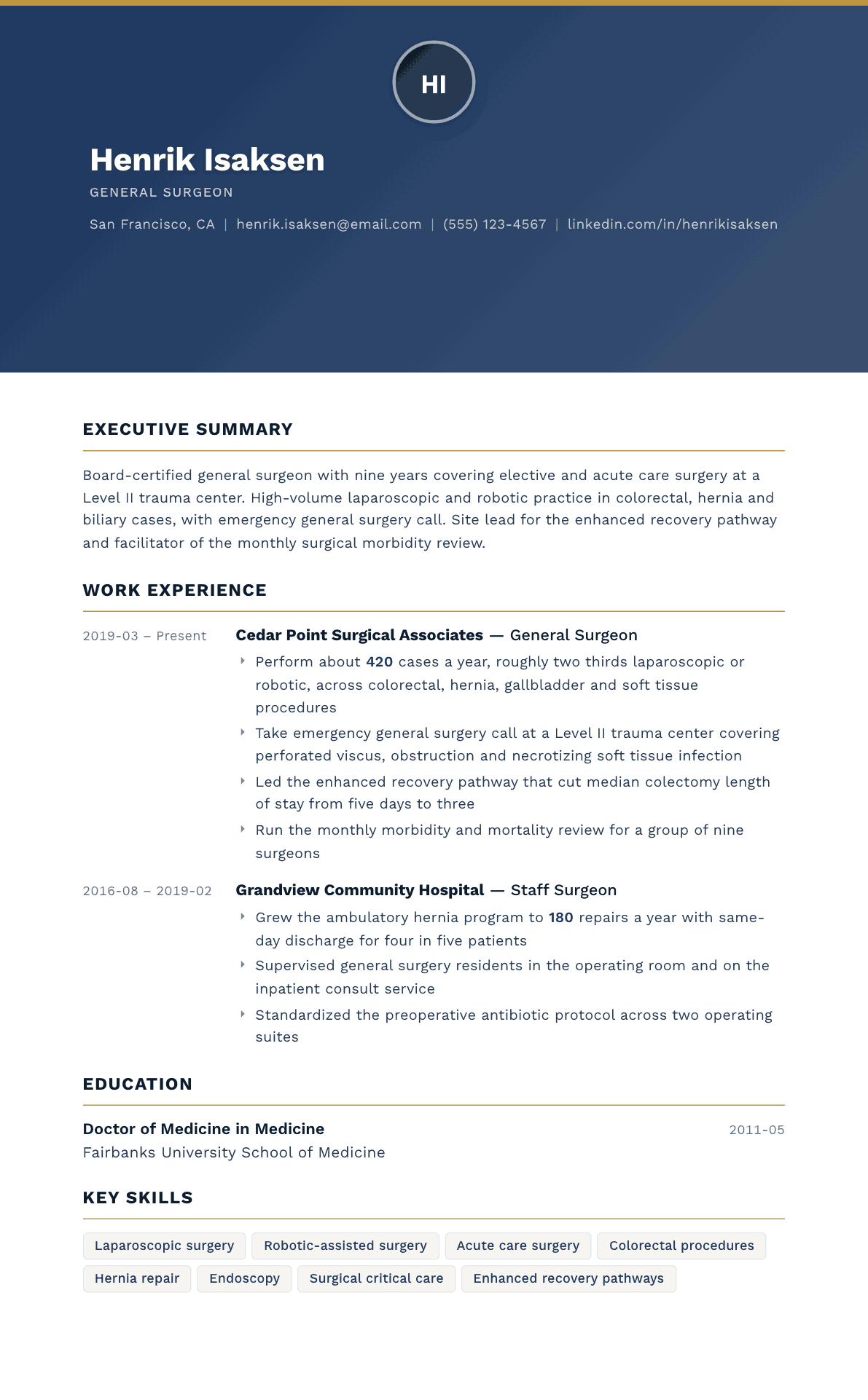
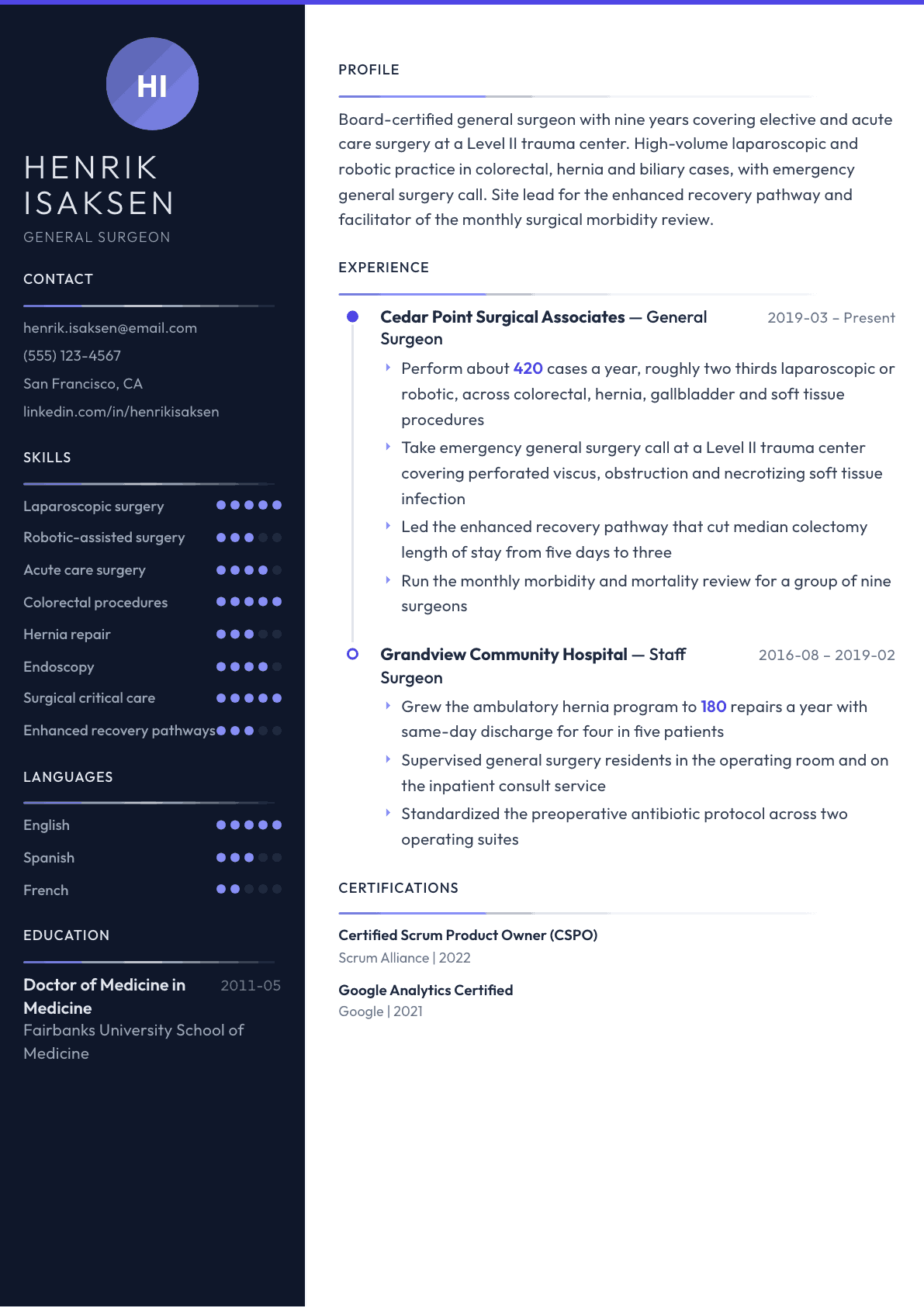
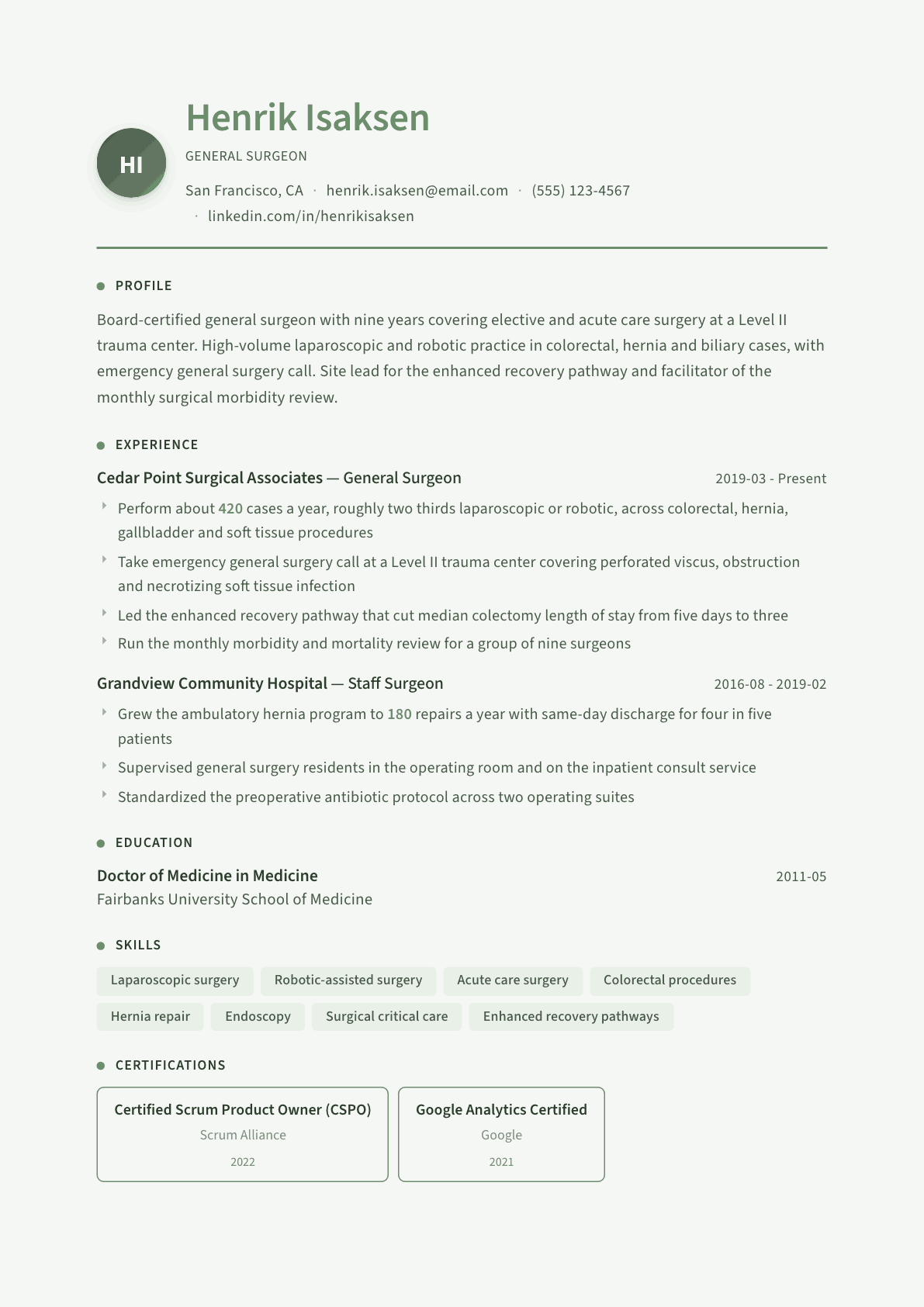
The same surgeon content laid out in three CVBooster templates, so you can see what the finished document looks like before you write a word.
Example Surgeon summary
Board-certified general surgeon with nine years in community and Level II trauma practice, performing about 420 cases a year with a strong laparoscopic and robotic mix across colorectal, hernia and biliary work. Built an ambulatory hernia program and led an enhanced recovery pathway that shortened colectomy stays by two days. Looking for a partnership track with dedicated robotic block time and acute care surgery call.
Skills to list on a Surgeon resume
- General surgery
- Laparoscopic surgery
- Robotic-assisted surgery
- Trauma surgery
- Acute care surgery
- Colorectal surgery
- Hernia repair
- Hepatobiliary procedures
- Endoscopy
- Surgical critical care
- Operating room leadership
- Enhanced recovery pathways
- Perioperative management
- Resident supervision
- Morbidity and mortality review
What actually gets this resume read
- Give annual case volume for every position and split it between open, laparoscopic and robotic approaches.
- List board certification, the states where you hold an active license, and the hospitals where you carry privileges.
- Name the trauma level and bed count of each facility, because surgical scope of practice varies enormously by site.
- Show outcome work: infection rates, readmissions, length of stay, or a care pathway you designed and then measured.
- Keep the detailed case log out of the resume and offer it as a separate document available on request.
- Include fellowship training, robotic platform certification and any proctoring you have done for newly hired surgeons.
How to write a surgeon resume
The person reading a surgeon resume is usually a department chair or a practice partner deciding whether you can fill a specific block on the operating room schedule. They want three answers quickly: what you operate on, how much of it you do in a year, and whether the credentialing office will have any trouble with your file.
That last point is underrated. A surgeon who leaves out board status, license states or a gap in the training timeline creates work for a medical staff office, and files that create work move slowly. A clean credentials block near the top prevents the delay.
This guide covers how to present operative volume honestly, how to describe scope at facilities of different trauma levels, where fellowship and technique certification belong, and how to write outcome bullets that survive a partner reading them with a skeptical eye.
Format: two pages, credentials block, no design flourishes
Reverse chronological, two pages for most practicing surgeons, three once fellowships, leadership roles and a publication record build up. Include every month of your training and practice timeline. Unexplained gaps in a surgical career invite questions in the credentialing process, so account for research years, military service or a leave in one short line.
Put a credentials block directly under the header: board certification and status, state licenses with expiration, controlled substance registration, current life support certifications, and the hospitals where you hold or have held privileges.
- Header: name and degree, city and state, phone, email.
- Credentials: board status, licenses, life support cards, active privileges.
- Then summary, practice history, fellowship and residency, education, technique certifications, selected publications.
Summary: subspecialty, annual volume, approach mix, call
Name the surgical specialty and any fellowship, then the setting and its trauma level, then a rounded annual case count with the split between open, laparoscopic and robotic work, then what call you take. Four facts, three or four lines. A chair comparing candidates is comparing exactly these.
If you are changing setting rather than specialty, say so directly. A surgeon leaving academic practice for a community group should point at breadth and independence, since the group has no fellows and no in-house backup at two in the morning.
Experience: facility scale first, then what you actually operate on
Open each position with the facility, its trauma designation, the bed count and the size of the surgical group. A general surgeon at a Level I center with residents does a very different job from a solo surgeon covering a critical access hospital, and only the facility line makes that visible.
Then give the case picture. Annual volume rounded to the nearest twenty-five is fine, followed by the procedure families that make up most of it and the share done minimally invasively. Where you have robotic experience, name the platform and say whether you were the primary console surgeon and whether you have proctored others.
Add the emergency work separately. Emergency general surgery call, trauma activations, and the kind of pathology you manage overnight tell a partner whether you can carry the unscheduled half of the practice, which is the half that burns groups out.
- Facility: trauma level, bed count, group size, resident coverage or none.
- Annual case volume rounded, with the open, laparoscopic and robotic split.
- Procedure families that dominate your list.
- Call structure and the acute pathology you handle without backup.
Outcomes and program work: what makes a partner, not just an operator
Every applicant operates. Fewer applicants have improved something measurable. Surgical site infection rates, readmissions, length of stay after a defined procedure, first case on-time starts, block utilization: these are the numbers a chair is accountable for, and a surgeon who has moved one of them is a different candidate.
Program building belongs here as well. Starting an ambulatory hernia service, launching a robotic program, standardizing a preoperative antibiotic protocol, or running the morbidity and mortality conference all show that you take responsibility for the department beyond your own list.
Keep the claims defensible. Write what you led, what changed, and over what period. A partner will ask about the number in the interview, so put nothing on the page you cannot walk through.
Skills, technique certification and keywords
A surgical skills section should read as an operative capability list, not a list of adjectives. Name the procedures, the platforms, the endoscopic work you perform, and the critical care management you provide postoperatively. Add the electronic record and any operating room scheduling or case log system you have used.
Technique certifications matter because credentialing committees ask for them. Fundamentals of laparoscopic surgery, energy device certification, trauma life support and robotic platform training are all things a medical staff office wants to see documented rather than described.
Surgeon resume summary examples
Finishing residency
General surgery chief resident, board eligible, with a logged case volume above 1,000 including 380 as primary surgeon in colorectal, hernia, biliary and trauma cases. Robotic console experience across 60 procedures. Seeking a community position with emergency general surgery call and senior partner mentorship in the first year.
Nine years in practice
Board-certified general surgeon performing about 420 cases a year at a Level II trauma center, two thirds laparoscopic or robotic across colorectal, hernia, gallbladder and soft tissue work. Led an enhanced recovery pathway that shortened median colectomy stays from five days to three.
Section chief
Section chief of general surgery with eighteen years of practice, responsible for block allocation, credentialing review and quality for eleven surgeons across two campuses. Maintains a personal volume near 300 cases a year, launched the robotic program, and reduced surgical site infections after colorectal resection.
Work experience bullets: before and after
Before: Performed a high volume of general surgery cases.
After: Performed about 420 cases a year, roughly two thirds laparoscopic or robotic, across colorectal resection, hernia repair, cholecystectomy and soft tissue procedures.
The rounded count, the approach split and the procedure families let a chair picture your list instead of guessing at it.
Before: Took emergency call.
After: Covered emergency general surgery call at a Level II trauma center on a one-in-four rotation, managing perforated viscus, bowel obstruction and necrotizing soft tissue infection without in-house subspecialty backup.
Naming the rotation, the trauma level and the pathology shows the autonomy the group is actually buying.
Before: Improved patient outcomes after colorectal surgery.
After: Led the enhanced recovery pathway for colorectal resection, moving median length of stay from five days to three across two years and 190 cases.
A named pathway with a before and after figure and a denominator is defensible in an interview; an outcome claim alone is not.
Before: Helped start the robotic program.
After: Launched the robotic surgery program, wrote the credentialing criteria, proctored four surgeons to independent console privileges and grew the service to 160 cases a year.
Program building is shown through the credentialing work and the proctoring, which is what a chair needs from a senior hire.
Before: Taught residents in the operating room.
After: Supervised general surgery residents through 200 teaching cases a year and rebuilt the junior resident skills curriculum around laparoscopic simulation before floor rotations.
Teaching volume plus a curriculum change turns a routine duty into evidence of educational leadership.
Hard skills
- Open and laparoscopic general surgery
- Robotic-assisted procedures
- Colorectal resection
- Hernia repair, open and minimally invasive
- Hepatobiliary and pancreatic procedures
- Trauma and acute care surgery
- Diagnostic and therapeutic endoscopy
- Surgical critical care
- Ultrasound-guided procedures
- Perioperative and enhanced recovery management
- Operating room block scheduling
- Credentialing and privileging review
- Morbidity and mortality analysis
Soft skills
- Intraoperative decision making
- Consent and expectation setting
- Operating room team leadership
- Handoff to critical care
- Resident and fellow teaching
- Referral relationship building
Certifications worth listing
- General Surgery Certification (American Board of Surgery)
- Surgical Critical Care Subspecialty Certification (American Board of Surgery)
- Fundamentals of Laparoscopic Surgery (FLS) (Society of American Gastrointestinal and Endoscopic Surgeons)
- Fundamental Use of Surgical Energy (FUSE) (Society of American Gastrointestinal and Endoscopic Surgeons)
- Advanced Trauma Life Support (ATLS) (American College of Surgeons)
- Advanced Cardiovascular Life Support (ACLS) (American Heart Association)
Mistakes that cost surgeon candidates the interview
- Writing a surgeon resume with no case numbers at all, which forces the chair to ask for a case log before any interview.
- Leaving a gap in the training or practice timeline unexplained, which stalls the file in the medical staff office.
- Describing procedures you assisted on as though you were the primary surgeon, a claim that collapses under one question.
- Omitting the trauma level and bed count of each facility, so a reader cannot judge the scope you actually carried.
- Listing every operation you have ever performed instead of the procedure families that make up your working list.
- Ignoring outcome and program work, which leaves you looking like an operator rather than a future partner.
Surgeon resume questions
Should a surgeon attach a case log to the resume?
No. Keep rounded annual volumes on the resume and prepare the detailed log as a separate document you offer on request. Credentialing will ask for it eventually, but a chair reading applications wants the summary picture first.
How do I present robotic experience?
Name the platform, say whether you operated as the primary console surgeon, give a rough annual robotic case count, and note any proctoring or platform training certificate. Groups buying robotic time need to know exactly what privileges you can obtain on arrival.
How long should a surgeon resume be?
Two pages for most practicing surgeons. Three is fine once fellowship, leadership roles, technique certifications and a publication record accumulate. Anything longer belongs in an academic curriculum vitae kept as a separate file for university applications.
What if my case volume dropped during a period?
Explain it in one line rather than hiding it. Parental leave, a research year, a facility losing surgical volume, or time spent building a new service are all normal. A short factual note prevents a reader from inventing a worse explanation.
Do I need to list hospital privileges?
Yes, at least the current ones with the facility names, and note whether they are active, courtesy or provisional. Medical staff offices use that list to start verification, and including it can take weeks out of the onboarding timeline.