Surgical Technologist Resume Examples: read this first
Build a Surgical Technologist Resume That Lands OR Positions
By Mustafa Tarabya, founder of CVBooster · Published · Updated
Create a professional surgical tech resume with OR-specific templates, sterile technique examples, and tips for scrub tech positions.
Sample resumes for a surgical technologist
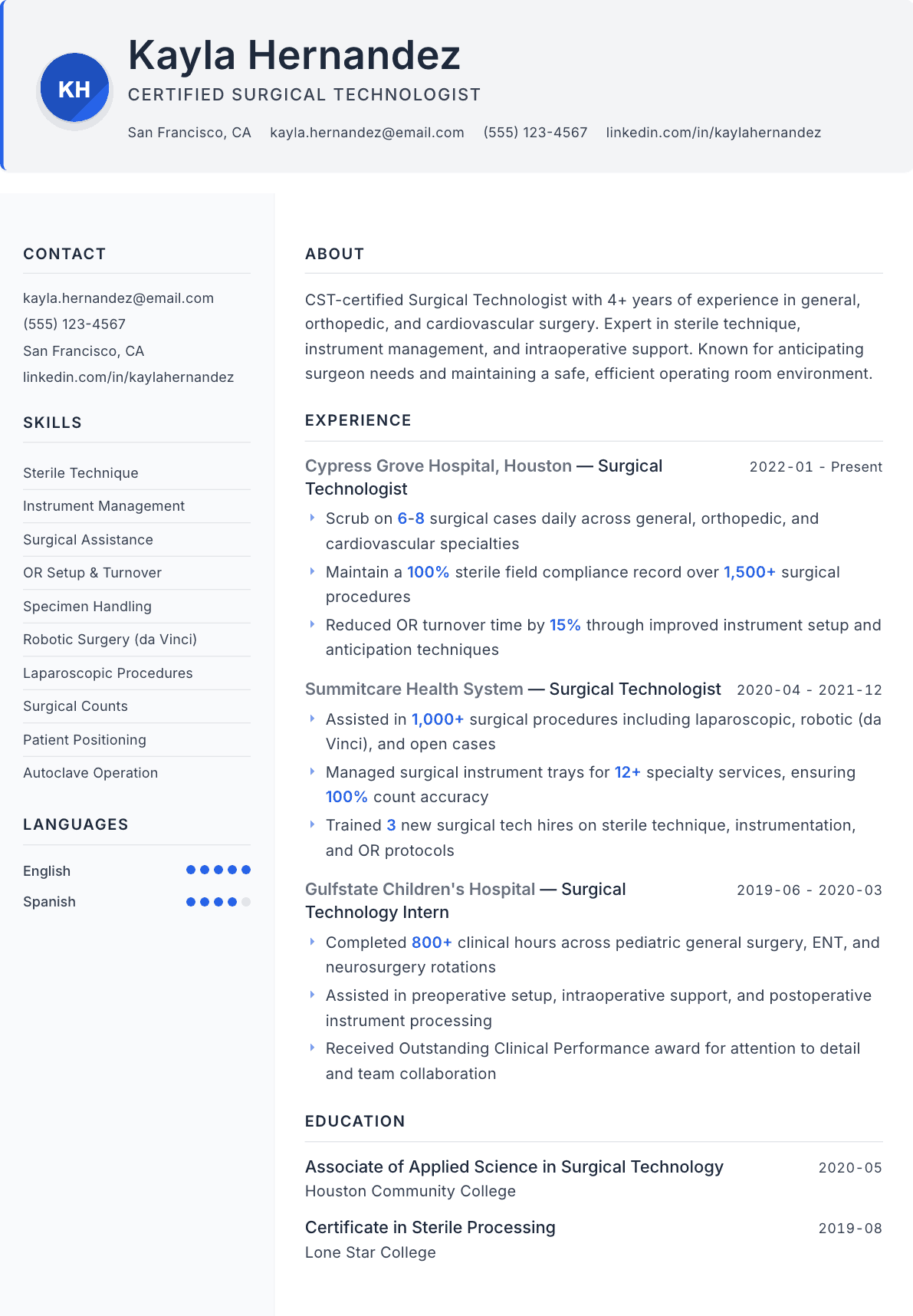
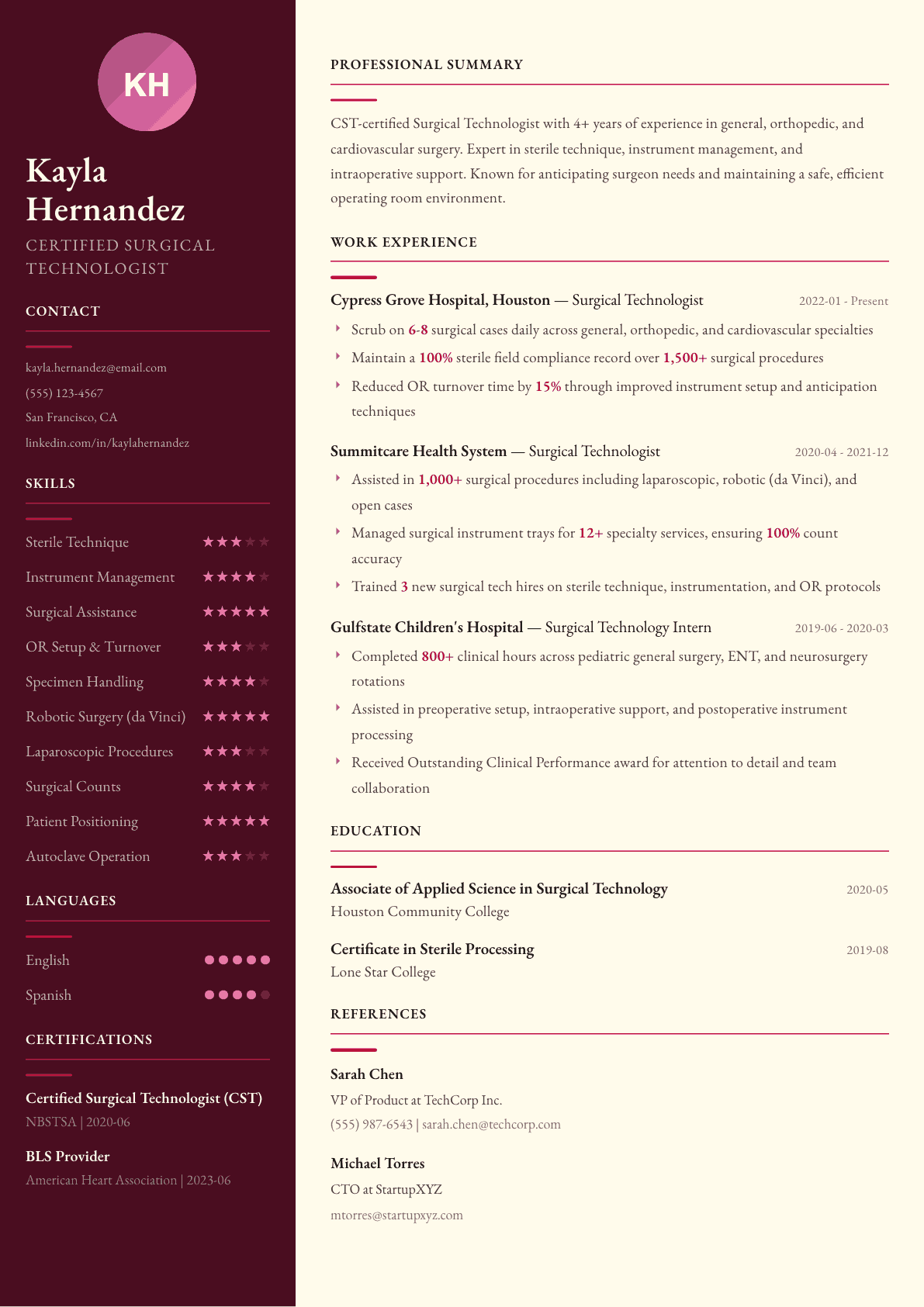
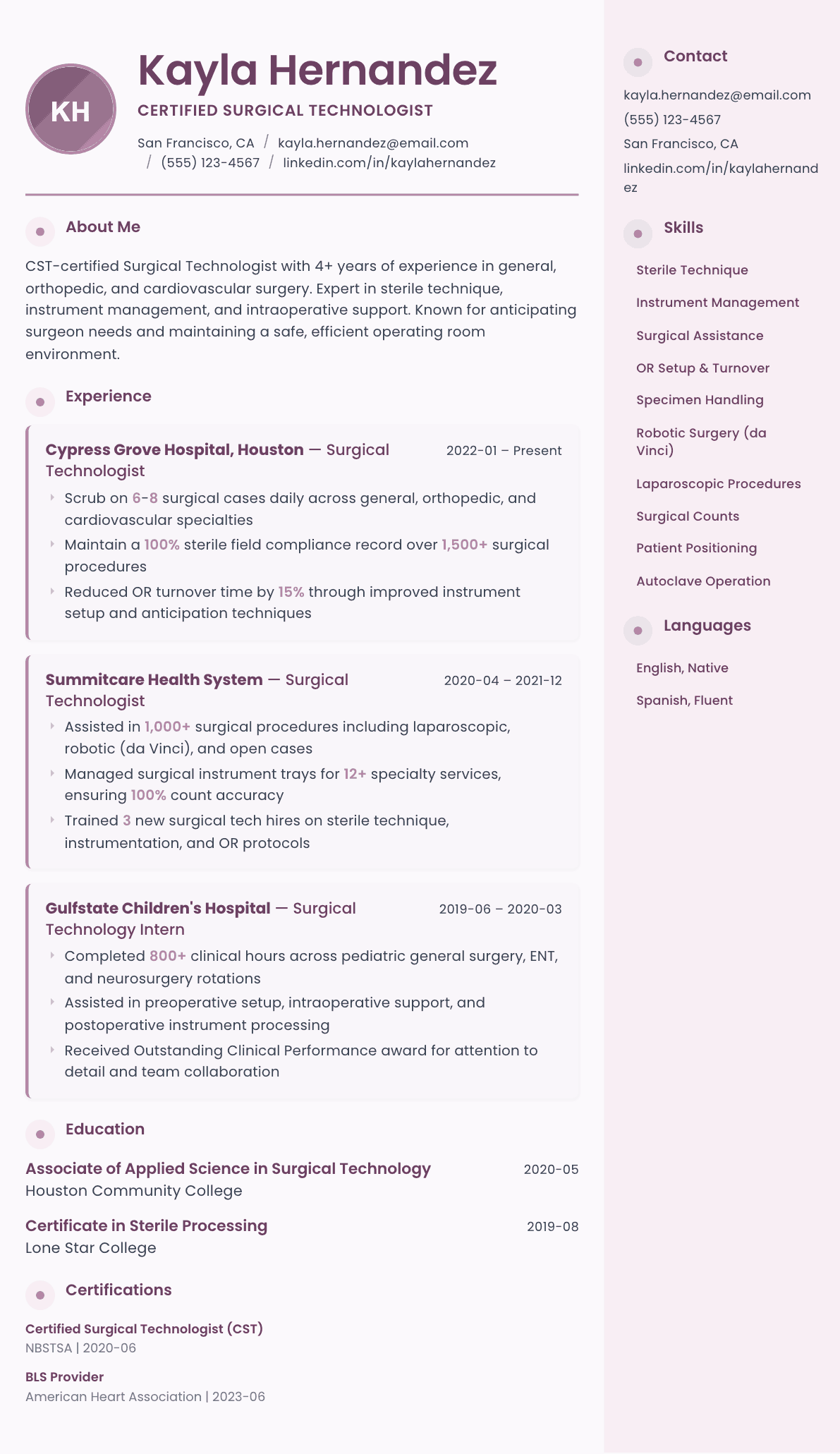
The same surgical technologist content laid out in three CVBooster templates, so you can see what the finished document looks like before you write a word.
Example Surgical Technologist summary
CST-certified Surgical Technologist with 4 years of experience scrubbing in general, orthopedic, and cardiovascular surgery. Maintained a 100% sterile field compliance rate across 1,500+ procedures and reduced OR turnover time by 15%. Seeking an OR position at a Level I trauma center.
Skills to list on a Surgical Technologist resume
- Sterile Technique
- Instrument Management
- Surgical Assistance
- OR Turnover
- Surgical Counts
- Specimen Handling
- Robotic Surgery
- Laparoscopic Surgery
- Patient Positioning
- Autoclave Operation
- Suturing Assistance
- Electrosurgery
- Hemostasis
- Case Cart Preparation
What actually gets this resume read
- Display your CST certification from NBSTSA prominently on your resume.
- Quantify surgical case volumes, specialties, and efficiency improvements.
- List specific surgical specialties and advanced technologies you have experience with.
- Highlight sterile technique compliance and surgical count accuracy.
- Mention robotic surgery platforms (da Vinci) if applicable, as demand is growing.
- Include clinical rotation hours and any awards received during training.
How to write a surgical technologist resume
A surgical technologist resume is read by an operating room manager who is trying to fill a specific service line. She is not looking for a general scrub. She is looking for someone who can take total joints on Tuesday, or open hearts, or robotic urology, without another tech standing behind them. Which specialties you can scrub unsupervised is the single most important thing your resume communicates, and most resumes bury it.
Before that, a quick credential check: certification status, whether your state requires registration, and current life support cards. Sterile processing certification is a bonus in departments that share staff between the operating room and central sterile.
This guide sets out the layout operating room managers read, three summaries from new graduate to lead surgical technologist, before-and-after bullets built on case volume and turnover, and the questions scrub techs ask when adding a service.
Format: specialties block right under the summary
One page under five years, two after that. Put your certification after your name, then a certification and licensure block, then a specialties block. That third block is the one that gets you called, because a manager filling a cardiovascular rotation scans for the words open heart and cannulation, not for adjectives.
Single column only. Hospital parsers reorder sidebar layouts and can lose the certification dates, and case volume tables rarely survive them either.
- Header: name, CST or CSFA, city and state, phone, email, state registration where required.
- Order: summary, certification and licensure, surgical specialties, experience, education and clinical hours, skills.
- New graduates list clinical case counts by specialty from the program log, which is real evidence.
Summary: specialties, case load, call, and what you own
Three sentences. Name the specialties you scrub independently, the daily case count, whether you take call, and one thing you own beyond the field: instrument trays for a service, preference card maintenance, robot setup, or orientation of new techs.
A surgical technologist who can be put on the call roster from week one is worth more to a schedule than one who cannot, so say it plainly rather than leaving it for the interview.
Experience: cases per day, services covered, and role in the room
Head each job with the facility, the number of operating rooms, the services you covered and the daily case load. A line such as surgical technologist, 14-room operating suite, 6 to 8 cases daily across general, orthopedic and vascular, sets the scale immediately.
Then bullets on the specific work: setting up and scrubbing named procedures, robotic docking and instrument exchange on the da Vinci platform, laparoscopic tower setup, tourniquet and positioning for total joints, bone graft and implant handling, cell salvage, specimen handling and labeling, and counts with the circulating nurse.
Add the things that keep an operating room running. Preference card corrections, instrument tray builds, loaner set intake and processing, turnover time work, and first case on time starts are all bullets a manager can act on. What she cannot act on is maintained a sterile field, which is the definition of the job.
The numbers an operating room manager checks
Case volume by specialty is first, because it is the proof of competence. Then count accuracy and any record of no retained item events. Then room turnover time, because operating room minutes are the most expensive minutes in the building, and a tech who cut turnover through better setup sequencing is directly valuable.
First case on time starts is another metric with real weight. If you changed the morning setup routine and starts improved, that belongs at the top of the job, not in the last bullet.
Sterile processing, instruments and the keyword block
Name the instrument sets and platforms you know: major and minor generals, laparoscopic and robotic instrumentation by vendor, orthopedic implant systems, spine sets, cardiovascular and vascular trays, and the endoscopic towers. If you have worked in central sterile with steam and low temperature sterilization, decontamination and biological indicators, list it separately, because dual-competent techs are scarce.
The keyword block that postings use is narrow and predictable: sterile technique, aseptic technique, instrument management, surgical counts, specimen handling, patient positioning, preference cards, and the specialty names. Use each once where it is demonstrated.
Surgical Technologist resume summary examples
New graduate scrub tech
Certified surgical technologist and recent program graduate with 800 clinical hours and 130 logged cases across general, orthopedic, ear nose and throat, gynecology and neurosurgery. Trained in sterile technique, instrument tray management and laparoscopic setup, and seeking a hospital operating room position with service rotation.
Four years, multi-service
Certified surgical technologist with 4 years in a 14-room operating suite, scrubbing 6 to 8 cases daily across general, orthopedic and vascular service lines. Independent on robotic docking and total joint setup, takes weekend and overnight call, and holds a clean surgical count record across 1,500 cases.
Lead surgical technologist
Lead surgical technologist with 10 years including 6 in cardiovascular surgery, scrubbing open heart, valve and vascular cases. Owns instrument tray builds and preference cards for 3 service lines, orients new technologists, and cut average room turnover by 15% through setup sequencing.
Work experience bullets: before and after
Before: Scrubbed in on surgical cases every day.
After: Scrubbed 6 to 8 cases daily across general, orthopedic and vascular service lines in a 14-room operating suite, including trauma add-ons on call weekends.
Case count, service lines and call coverage tell the manager exactly where you fit on next month's schedule.
Before: Maintained a sterile field during procedures.
After: Held sterile field integrity across more than 1,500 procedures with no reported break in technique and no retained item event, including counts with the circulating nurse on every case.
Volume and a verifiable safety record turn the baseline duty into a real credential.
Before: Worked with robotic surgery equipment.
After: Docked and undocked the da Vinci platform for urologic and general cases, managed instrument exchange during the procedure, and troubleshot arm collisions without stopping the case.
Naming the platform and the specific actions proves robotic competency rather than proximity to it.
Before: Helped reduce turnover time between cases.
After: Resequenced back table setup and pulled the next case cart during closing, bringing average room turnover down by 15% across the orthopedic block.
The mechanism explains how the number moved, which is what makes the claim believable.
Before: Trained new surgical techs.
After: Oriented 3 new surgical technologists through service-line checkoffs in general, orthopedics and gynecology, and rewrote the preference cards they trained against.
Checkoffs and a written deliverable show real teaching responsibility rather than informal help.
Hard skills
- Sterile and aseptic technique
- Instrument tray management
- Surgical counts
- Robotic surgery setup and docking
- Laparoscopic tower setup
- Orthopedic implant handling
- Patient positioning and prepping
- Specimen handling and labeling
- Preference card maintenance
- Steam and low temperature sterilization
- Loaner set intake and processing
- Electrosurgery and tourniquet setup
Soft skills
- Anticipating the surgeon
- Composure during a case
- Closed-loop communication in the room
- Team coordination at turnover
- Attention to detail on counts
Certifications worth listing
- Certified Surgical Technologist (CST) (National Board of Surgical Technology and Surgical Assisting)
- Certified Surgical First Assistant (CSFA) (National Board of Surgical Technology and Surgical Assisting)
- Tech in Surgery Certified, TS-C (National Center for Competency Testing)
- Certified Registered Central Service Technician (CRCST) (Healthcare Sterile Processing Association)
- Basic Life Support (BLS) (American Heart Association)
Mistakes that cost surgical technologist candidates the interview
- Not naming the service lines you scrub independently, which is the one thing an operating room manager is hiring for.
- Writing sterile technique as an achievement when it is the minimum condition of the job.
- Leaving out case volume per day, so nobody can tell a low-volume outpatient center from a busy hospital suite.
- Skipping call availability, when call coverage is often the reason the position is open.
- Omitting robotic platform experience by vendor in a market where robotic services are expanding.
- Listing every program rotation years after graduation instead of the paid case volume that replaced it.
- Leaving certification status and state registration off the header, which stalls the file at screening.
Surgical Technologist resume questions
How do I show which surgical specialties I can scrub alone?
Put a specialties block under the summary listing each service line with approximate case volume, and mark which you scrub independently versus which you have assisted on. Operating room managers hire to fill one service, so make that scan take five seconds.
Should a new surgical technologist list clinical case counts?
Yes. Your program case log is the only volume evidence you have, so list total clinical hours and cases by specialty. Keep it until you have a year of paid operating room experience, then replace it with employed case volume.
Does robotic experience need to name the platform?
It does. Naming the platform and the actions you performed, such as docking, instrument exchange and troubleshooting arm collisions, proves you worked the case rather than watched it. Departments expanding robotic services screen for exactly that wording.
What metrics can a scrub tech realistically put on a resume?
Cases scrubbed per day and in total, count accuracy and any record of zero retained items, room turnover time improvements, and first case on time start rates. Those are the operating room numbers managers report on and therefore recognize.
Is sterile processing certification worth adding?
It is worth adding when you have actually worked in decontamination and sterilization, because departments that share staff between the operating room and central sterile value dual competency. List the certification with its issuing body and the sterilization methods you have run.