Anesthesiologist Resume Examples: the lines they read
Create an Anesthesiologist Resume That Reflects Your Expertise
By Mustafa Tarabya, founder of CVBooster · Published · Updated
Build a distinguished anesthesiologist resume with physician-level templates, perioperative examples, and tips for anesthesia positions.
Sample resumes for a anesthesiologist
The same anesthesiologist content laid out in three CVBooster templates, so you can see what the finished document looks like before you write a word.
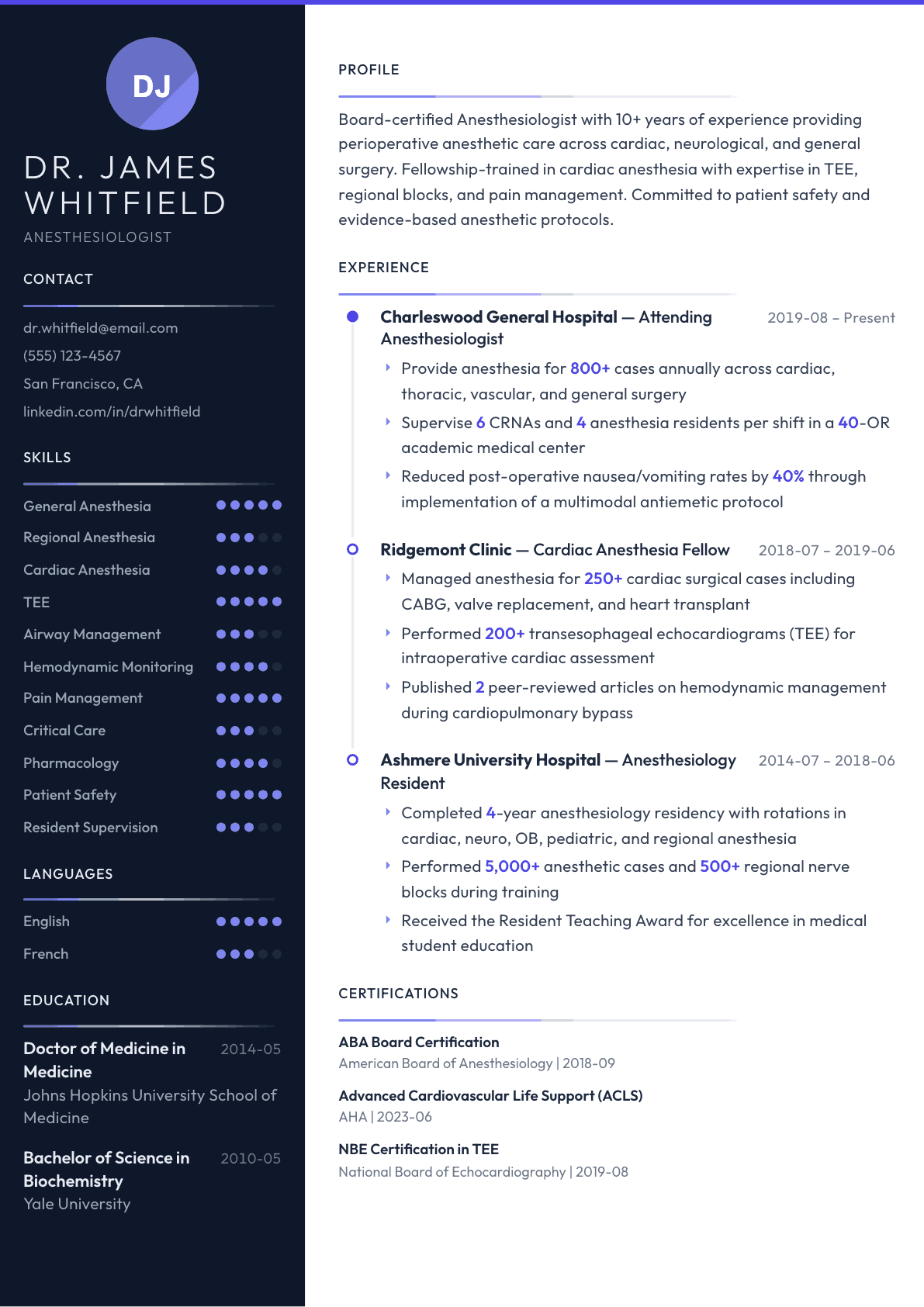
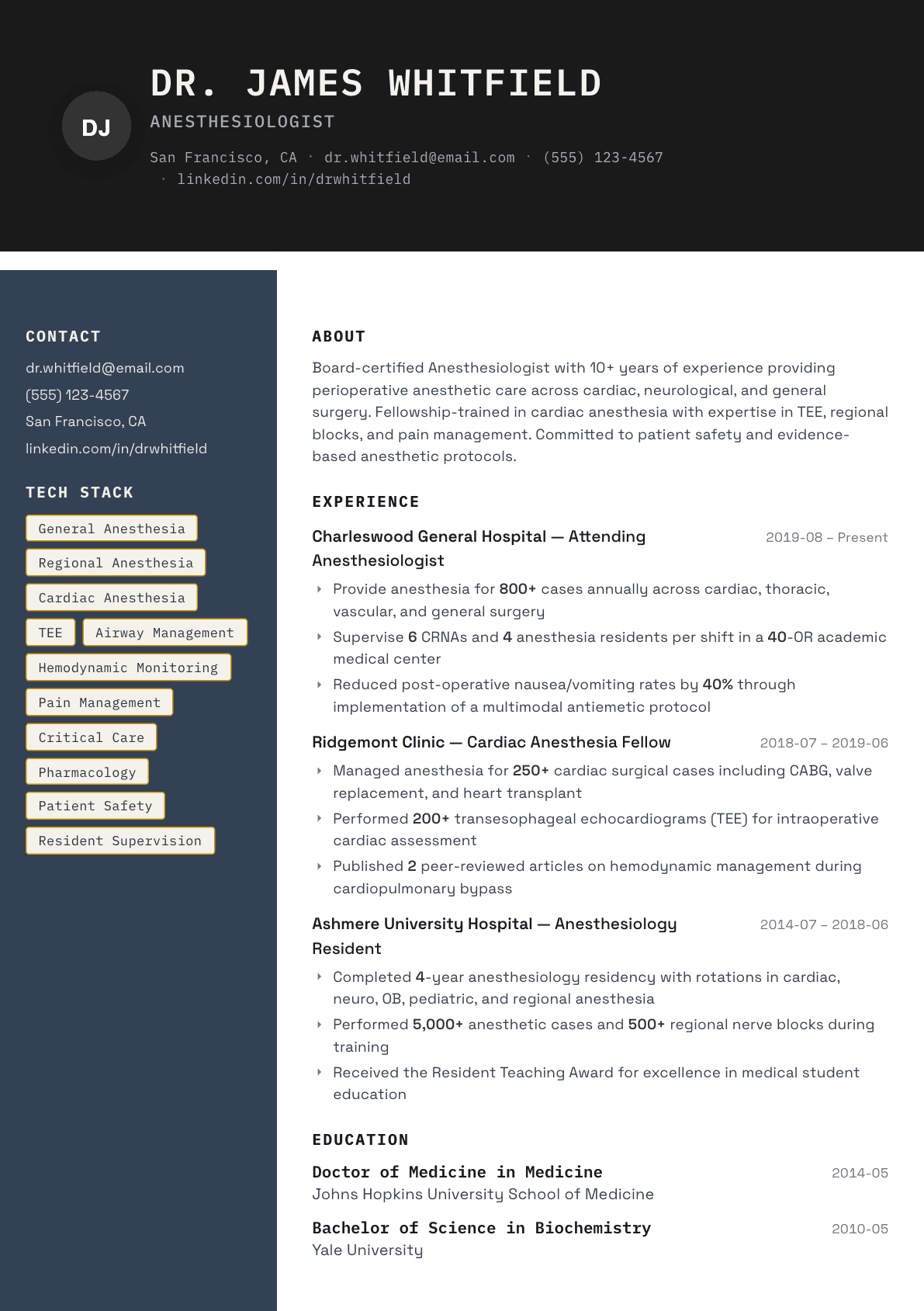
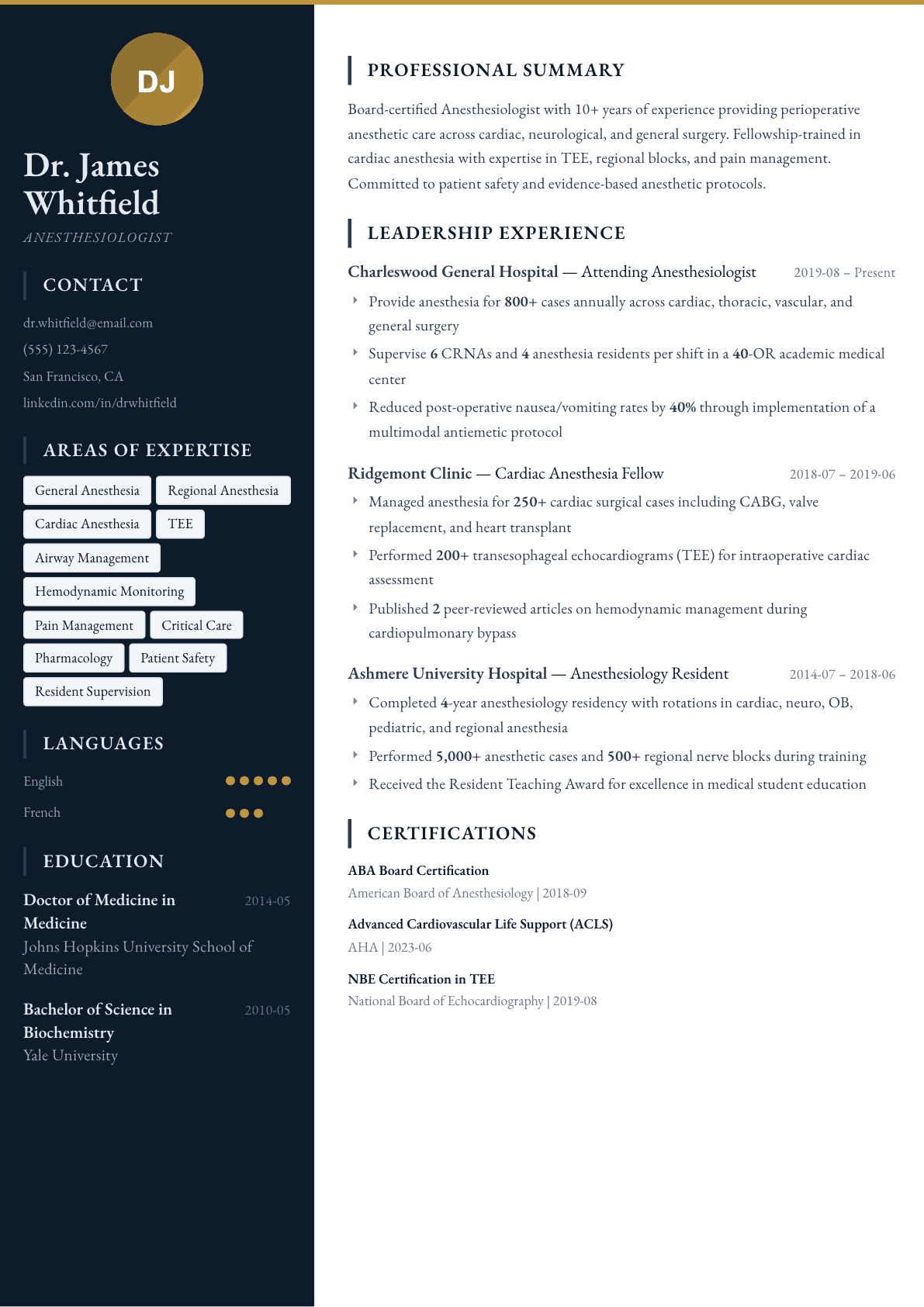
Example Anesthesiologist summary
ABA board-certified Anesthesiologist with 10 years of experience and cardiac anesthesia fellowship training. Provide anesthesia for 800+ cases annually and supervise CRNAs and residents in a 40-OR academic center. Seeking a cardiac anesthesia attending position at a high-volume transplant program.
Skills to list on a Anesthesiologist resume
- General Anesthesia
- Regional Anesthesia
- Cardiac Anesthesia
- Neuroanesthesia
- Obstetric Anesthesia
- TEE
- Airway Management
- Pain Management
- Hemodynamic Monitoring
- Critical Care
- Pharmacology
- Ultrasound-Guided Blocks
- Patient Safety
- Quality Improvement
What actually gets this resume read
- Include ABA board certification and fellowship training prominently.
- Quantify annual case volumes, subspecialty cases, and procedure counts.
- List specific anesthetic techniques: general, regional, neuraxial, cardiac.
- Highlight quality improvement initiatives and safety metrics.
- Include teaching and supervisory experience for academic positions.
- Mention publications and research contributions relevant to anesthesia.
How to write a anesthesiologist resume
An anesthesiologist applying for a position is usually submitting a curriculum vitae rather than a one page resume, and the rules are different. Nothing is trimmed for space, chronology must be unbroken, and every credential is expected to appear in full with dates. The reader is a department chair, a group president or a credentialing coordinator, and each of them is checking a different thing on the same document.
The chair or practice president reads for case mix and coverage: which subspecialty cases you can take independently, whether you can run a room list solo or supervise a care team, and whether you take call, cover obstetrics overnight and manage an airway emergency outside the operating room. The credentialing side reads for board status, training dates, licensure, Drug Enforcement Administration registration and any gaps in the timeline.
This guide covers the sections an anesthesia curriculum vitae needs, how to present case volume and subspecialty depth, three summaries for different career stages, before and after bullets, and the questions anesthesiologists ask when moving between academic, private and locum practice.
Format: a curriculum vitae, chronological and complete
Use a curriculum vitae, not a condensed resume. Length is expected to grow with career stage, and a two page document from a mid career attending reads as incomplete rather than concise. Keep the layout plain, put your name and credentials in a running header, and number the pages.
Chronology must be continuous from medical school onward. Credentialing bodies flag any unexplained gap, so account for research years, parental leave, military service or a delayed start in one line each rather than leaving a hole a coordinator has to chase.
- Order: header and credentials, summary, licensure and certifications, education and training, clinical practice, procedures and case experience, teaching, quality improvement, research and presentations, professional memberships.
- Header: name with degree, board status, state licenses held with status, National Provider Identifier available on request.
- Residents and fellows put education and training above clinical practice; attendings reverse it.
Summary: board status, fellowship, case mix and practice model
Three to four lines at the top. Name your board certification with the American Board of Anesthesiology, any fellowship training, the years in practice, the practice model you have worked in, and the subspecialty cases you cover. The practice model matters as much as the training: physician only, care team supervising certified registered nurse anesthetists and anesthesiologist assistants, or a mixed model with resident coverage.
Say what you are looking for in one clause. Groups are staffing a specific gap, most often cardiac, obstetric, pediatric or regional coverage, and naming your target makes the match obvious rather than leaving it to inference.
Clinical practice: coverage, case mix, and independence
For each position give the facility type and size, the number of operating rooms and anesthetizing locations, the surgical services covered, the model you worked in, and the call structure. A line such as tertiary academic center, 32 operating rooms plus cardiac catheterization, endoscopy and interventional radiology, care team model supervising three to four rooms, in house night call one in seven describes your working life in a sentence.
Then case experience. Give annual case volume with the subspecialty breakdown that matters for the job you want: cardiac cases with cardiopulmonary bypass, thoracic with lung isolation, neurosurgical, obstetric including cesarean delivery and labor analgesia, pediatric with an age range, transplant, trauma, and ambulatory volume. A chair hiring for a cardiac slot wants the cardiac number, not your total.
List techniques you perform independently and separately those you are trained in but perform occasionally. General anesthesia, neuraxial including spinal, epidural and combined, peripheral nerve blocks by named block under ultrasound guidance, arterial and central venous access, awake fiberoptic intubation, one lung ventilation, transesophageal echocardiography with certification status, and hemodynamic and neuromonitoring interpretation.
Include the work outside the operating room, because it is often what a group is short of: preoperative clinic and optimization, acute pain service and catheter management, code and difficult airway response, intensive care coverage if you hold it, and non operating room anesthesia locations.
Credentials: exactly as the credentialing office needs them
Give the American Board of Anesthesiology certification with the year of initial certification and your Maintenance of Certification status, plus any subspecialty certification in critical care medicine, pain medicine, pediatric anesthesiology, cardiac anesthesiology or adult cardiac anesthesiology as applicable. Add Advanced Cardiovascular Life Support, Pediatric Advanced Life Support and Basic Life Support with expiry.
List every active state medical license with the state and status, note any license that has lapsed rather than omitting it, and include Drug Enforcement Administration registration status. Also list National Board of Echocardiography certification if you hold the examination in perioperative transesophageal echocardiography, since it is a direct hiring criterion for cardiac positions.
Teaching, quality and scholarship
For academic positions this section decides the outcome, and for private groups it is still a differentiator. Name the learners you supervise and at what level, any course directorship, simulation teaching, and formal evaluations or teaching awards. Residency programs hire attendings who can be relied on to teach a regional block list, not just to cover the room.
Quality and safety work is worth its own heading. Operating room efficiency and first case on time starts, perioperative surgical home or enhanced recovery pathways you helped write, difficult airway response protocols, medication safety, blood management, and any morbidity and mortality or root cause analysis leadership. Follow it with publications, abstracts and invited presentations in a standard citation format, most recent first.
Anesthesiologist resume summary examples
Graduating resident
Anesthesiology resident completing training at an academic center, board eligible with the American Board of Anesthesiology. Roughly 1,400 cases across general, regional, obstetric, pediatric and cardiac rotations, with 300 ultrasound guided peripheral nerve blocks. Seeking a general anesthesiology position in a care team practice.
Seven years as an attending
Board certified anesthesiologist with seven years in a hospital based care team practice, supervising three to four rooms and covering obstetrics and the acute pain service. Roughly 900 cases a year including thoracic with lung isolation and complex spine. Fellowship trained in regional anesthesia and acute pain medicine.
Cardiac attending and section lead
Board certified anesthesiologist with 15 years in academic cardiac anesthesiology, certified in perioperative transesophageal echocardiography by the National Board of Echocardiography. Cover roughly 250 bypass and structural heart cases a year, lead the cardiac section, and direct the resident regional anesthesia rotation.
Work experience bullets: before and after
Before: Provided anesthesia for a wide variety of surgical cases.
After: Provided anesthesia for roughly 900 cases a year across general surgery, orthopedics, thoracic with lung isolation and complex spine, in a care team model supervising three to four rooms.
The annual volume, the named services and the supervision model tell a chair exactly what coverage you can take.
Before: Performed regional anesthesia blocks.
After: Performed roughly 400 ultrasound guided peripheral nerve blocks a year including interscalene, supraclavicular, adductor canal and erector spinae plane, and managed continuous catheters through the acute pain service.
Naming the blocks and the catheter service turns a general claim into a verifiable scope of practice.
Before: Supervised nurse anesthetists and residents.
After: Supervised three to four rooms of certified registered nurse anesthetists and taught two residents a month on the regional rotation, with formal block teaching sessions each week.
Ratios and a teaching cadence show how you actually work in a care team rather than that you were present.
Before: Participated in quality improvement projects.
After: Led the enhanced recovery pathway for colorectal surgery with the surgical service, standardizing multimodal analgesia and fluid management and reducing average length of stay by a full day.
A named pathway, a partner service and a measured outcome show leadership rather than committee attendance.
Before: Handled emergency airways in the hospital.
After: Covered the hospital difficult airway response, rewrote the emergency airway algorithm with the emergency department, and ran quarterly simulation drills for the code team.
Rewriting the protocol and running the drills demonstrate ownership of a system, not just responses to pages.
Hard skills
- General anesthesia across surgical services
- Neuraxial anesthesia including spinal and epidural
- Ultrasound guided peripheral nerve blocks
- Cardiac anesthesia with cardiopulmonary bypass
- Perioperative transesophageal echocardiography
- Obstetric anesthesia and labor analgesia
- Pediatric anesthesia
- Difficult airway management and awake fiberoptic intubation
- One lung ventilation and thoracic anesthesia
- Arterial and central venous access
- Hemodynamic monitoring and vasoactive management
- Acute pain service and catheter management
- Preoperative assessment and optimization
- Enhanced recovery pathway design
Soft skills
- Calm decision making in an emergency
- Clear handover to the recovery team
- Teaching residents and nurse anesthetists
- Preoperative communication with anxious patients
- Negotiating case scheduling with surgeons
Certifications worth listing
- Board Certification in Anesthesiology (American Board of Anesthesiology)
- Subspecialty Certification in Critical Care Medicine (American Board of Anesthesiology)
- Subspecialty Certification in Pain Medicine (American Board of Anesthesiology)
- Subspecialty Certification in Pediatric Anesthesiology (American Board of Anesthesiology)
- Advanced Perioperative Transesophageal Echocardiography (Advanced PTEeXAM) (National Board of Echocardiography)
- Advanced Cardiovascular Life Support (ACLS) (American Heart Association)
- Pediatric Advanced Life Support (PALS) (American Heart Association)
Mistakes that cost anesthesiologist candidates the interview
- Submitting a condensed one page resume when the specialty expects a full curriculum vitae with complete dates.
- Leaving an unexplained gap in the timeline, which a credentialing coordinator will stop on immediately.
- Giving a total case number with no subspecialty breakdown, when the group is hiring for one specific service.
- Omitting the practice model and call structure, so a chair cannot tell whether you can supervise a care team.
- Listing techniques you saw in training alongside those you perform independently, with no distinction between them.
- Burying board certification and license status at the end instead of directly under the summary.
- Skipping quality improvement and teaching, which are often the deciding factors between two clinically equivalent applicants.
Anesthesiologist resume questions
Should an anesthesiologist use a resume or a curriculum vitae?
A curriculum vitae in almost every case. Hospitals, academic departments and credentialing offices expect complete training dates, full licensure detail and a publication list. A short resume is only appropriate for a non clinical or industry role outside of hospital medicine.
How should I present case volumes?
Give an annual figure with a subspecialty breakdown relevant to the position. A cardiac group cares about your bypass and structural heart numbers, an obstetric heavy practice cares about deliveries and labor epidurals, and a total number alone answers neither question.
Do I need to list every state license I have held?
List all active licenses with their status, and disclose lapsed ones rather than omitting them. Credentialing verifies your full licensure history independently, so any omission surfaces later and looks far worse than a lapsed license explained in a line.
How do I move from academic practice to a private group?
Reframe around productivity and coverage: cases per year, rooms supervised, call taken, turnover and on time starts, and the services you can cover without a colleague. Keep teaching and research but compress them, since a private group values reliable independent coverage first.
What matters most for a cardiac anesthesiology position?
Fellowship training, annual bypass and structural heart case numbers, and National Board of Echocardiography certification in perioperative transesophageal echocardiography. Name your experience with mechanical support, transcatheter valve procedures and transplant if you have it, since those separate otherwise similar candidates.