Operating Room Nurse Resume Examples: what gets the call
Craft an OR Nurse Resume Around Service Lines and Counts
By Mustafa Tarabya, founder of CVBooster · Published · Updated
Operating room nurse resume example with circulating and scrub duties, CNOR credentials, service line detail and a section writing guide.
Sample resumes for a operating room nurse
The same operating room nurse content laid out in three CVBooster templates, so you can see what the finished document looks like before you write a word.
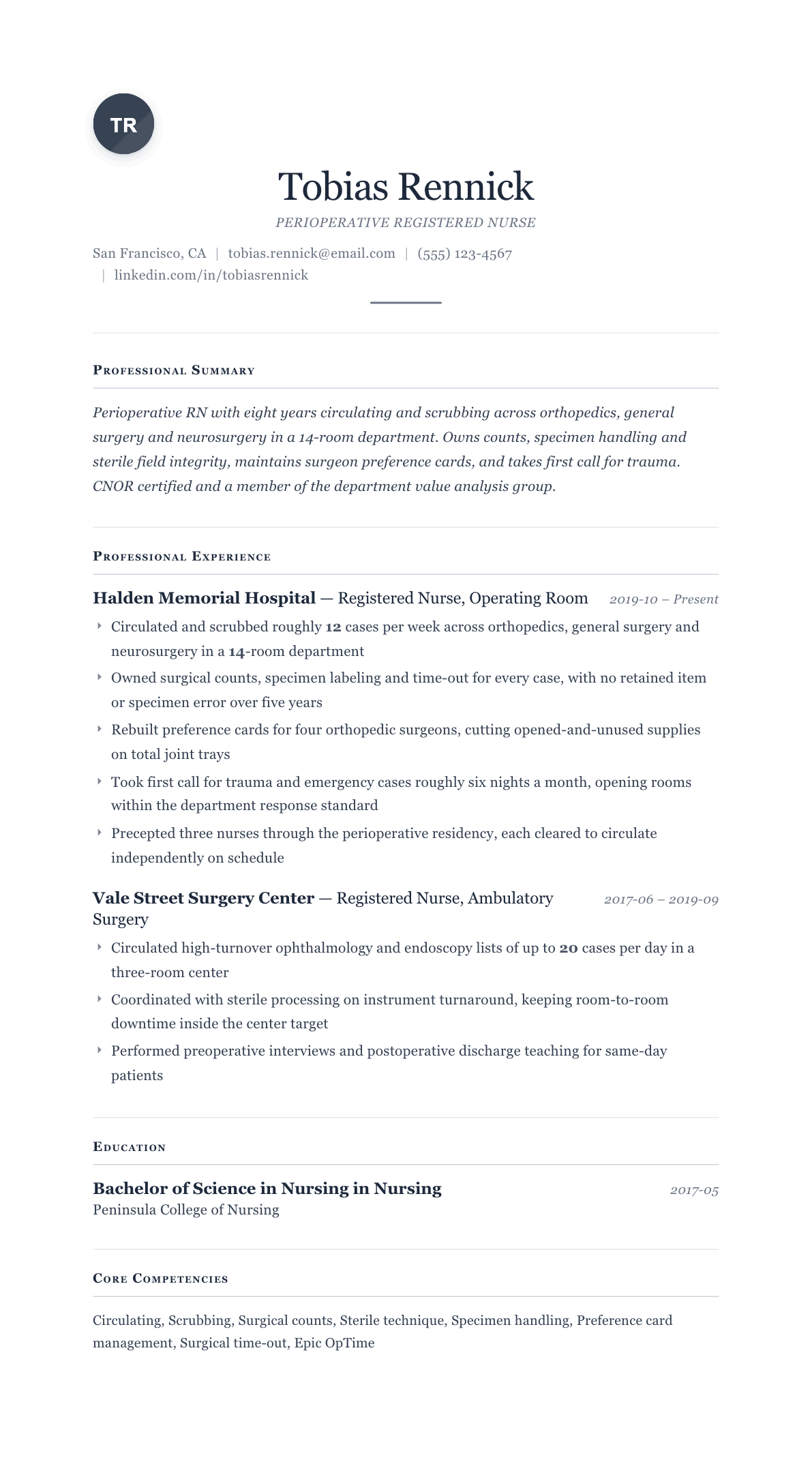
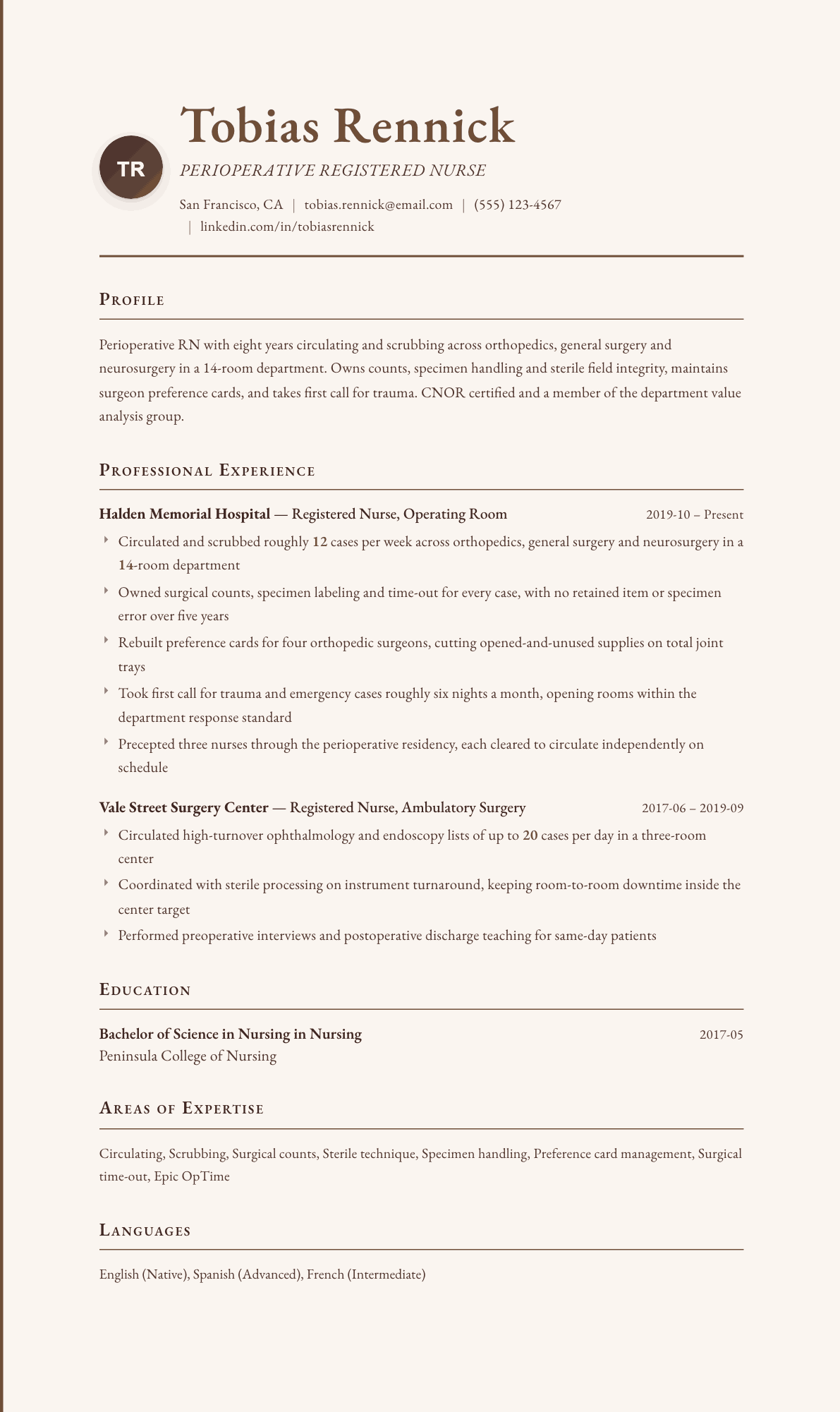
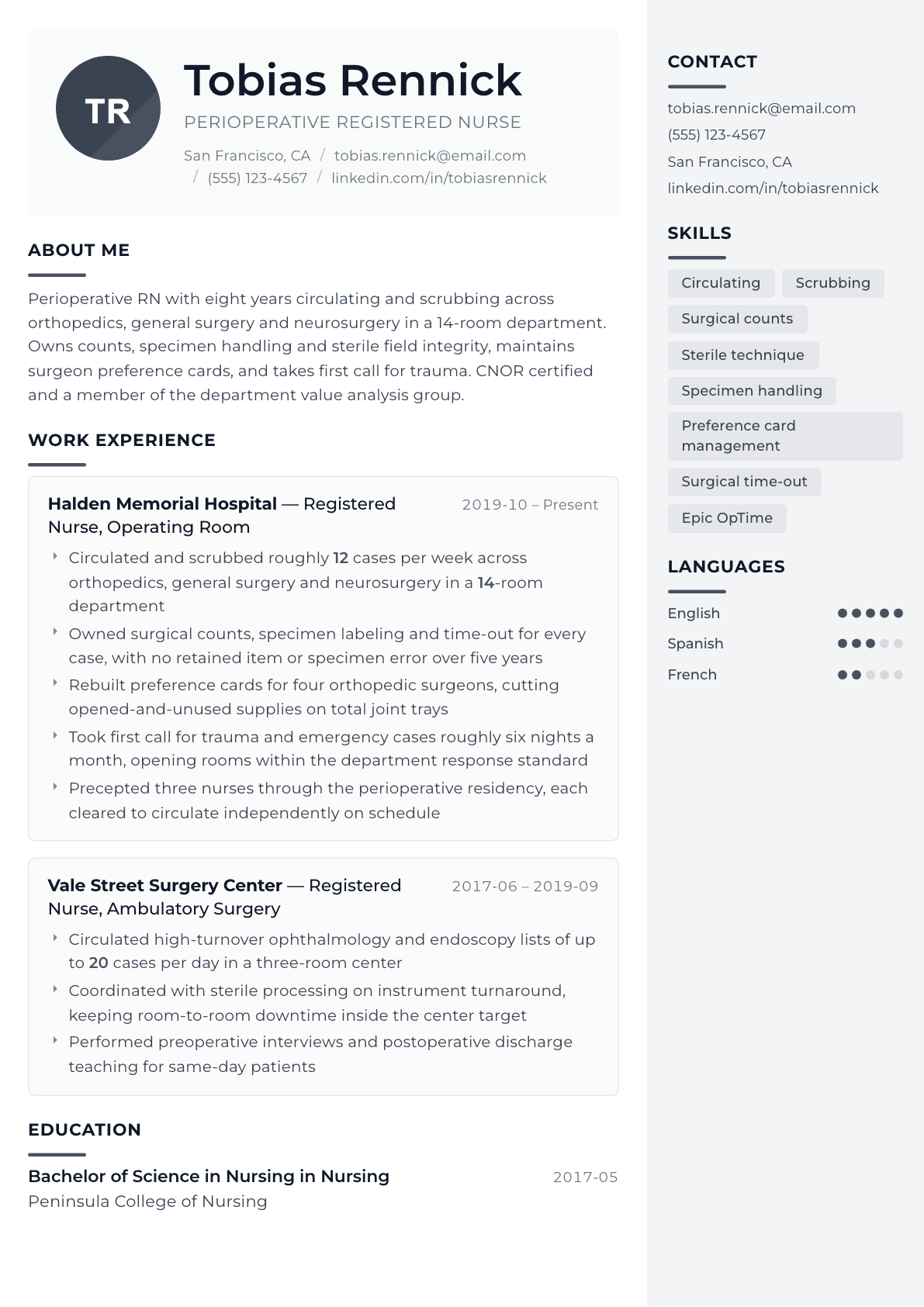
Example Operating Room Nurse summary
Perioperative nurse with eight years circulating and scrubbing orthopedic, general and neurosurgical cases in a 14-room department. Owns counts, specimens and sterile field integrity, rebuilt preference cards for four surgeons, and takes trauma call about six nights a month. CNOR certified and active in value analysis. Looking for a cardiovascular operating room where I can grow into a service line lead.
Skills to list on a Operating Room Nurse resume
- Circulating nurse duties
- Scrub nurse duties
- Sterile field management
- Surgical counts
- Specimen collection and labeling
- Surgical positioning
- Robotic surgery setup
- Laparoscopic instrumentation
- Preference card maintenance
- Time-out and safety checklist
- Electrosurgery safety
- Sterile processing coordination
- Trauma call readiness
- Epic OpTime
- Malignant hyperthermia response
What actually gets this resume read
- List your service lines by name, because an orthopedic team and a neurosurgery team hire on completely different experience.
- Say clearly whether you circulate, scrub, or both, and how many rooms the department runs.
- Give the case volume you handled per week or per day, so a manager can judge your pace against her own board.
- Name your instrumentation and equipment: robotic platforms, C-arm, microscope, laparoscopic towers, tourniquets.
- Put CNOR and any specialty credential in the header, since perioperative managers filter resumes on that acronym.
- Show call experience with the number of nights or weekends per month, because call coverage is a hiring constraint.
How to write a operating room nurse resume
Perioperative hiring is service line hiring. The manager reading an operating room nurse resume is filling a specific hole on a specific board, and she needs to know within seconds whether you have circulated the cases she runs. Orthopedics, general surgery, neurosurgery, cardiovascular, urology, ophthalmology, obstetric surgery and robotics each build different reflexes, different instrument knowledge and different positioning skills. A resume that lists none of them is unreadable to the person doing the hiring.
The second question is role. Circulating and scrubbing are separate jobs with separate accountability, and in many departments they are separate hires. Saying which you did, in which rooms, at what case volume, and whether you took call is more useful than any adjective about teamwork ever written.
This guide covers the credential block, the department line that opens every job, how to write count and sterile field bullets that a director will trust, how to handle preference cards and turnover as measurable work, and what to do when you are moving into the operating room from another unit.
Header and credentials: CNOR belongs beside your name
Put your credentials after your name in the order degree, license, certification, then a licenses and certifications block with the RN license and state, CNOR, basic and advanced life support, and any specialty credential such as sterile processing or surgical services management. Perioperative directors filter on the CNOR acronym directly, so it should appear in the header and again in the block.
Keep the layout to one column. Surgical departments run their applications through the same hospital parsers as every other unit, and a decorative two-column operating room resume tends to arrive with its dates scrambled.
- Name with credentials, city and state, phone, email.
- Certifications: license and state, CNOR, ACLS, BLS, specialty courses.
- Order: summary, certifications, perioperative experience, education, skills.
- List service lines as a short line under each job, not scattered through the bullets.
The department line: rooms, service lines, case volume
Every job opens with the department itself: the number of operating rooms, the facility type, the service lines you covered, and whether the site runs trauma. "Registered Nurse, 14-room department at a Level II trauma center, orthopedics, general surgery and neurosurgery" gives the reader more than a page of task bullets.
Follow it with case volume per week or per day, and be honest about the difference between a hospital main department and a high-turnover ambulatory center. Twenty short ophthalmology cases in a day is a genuine skill, and so is one twelve-hour spinal fusion, but they are not the same skill.
Counts, specimens and the sterile field: your accountability bullets
The parts of the role that carry legal weight deserve their own bullets. Surgical counts of sponges, sharps and instruments at every mandated point, specimen collection, labeling and handoff to pathology, and the surgical safety time-out are what a director is legally accountable for, and evidence that you own them cleanly is the strongest thing on the page.
A record without a retained item or a specimen error is worth stating in plain terms with the years attached. Add positioning, prepping and skin integrity checks, tourniquet management, electrosurgery safety, and malignant hyperthermia cart readiness, because those are the competencies a perioperative educator checks off during orientation.
Preference cards, turnover and supply cost
Operating room leaders live with two numbers: room turnover time and supply cost per case. A nurse who rebuilt preference cards for a surgeon, cut opened-and-unused items on a tray, or coordinated with sterile processing to hold instrument turnaround inside the department target has done work that shows up in a budget. Write it as work, not as an initiative.
The same applies to first-case on-time starts, block utilization support, and the pre-operative interview that prevents a cancellation on the morning of surgery. These are the bullets that separate an experienced circulating nurse from a competent one.
Call, cross-training and moving into the operating room
State your call obligation with a number: nights per month, weekend rotations, and how quickly you were expected to be in the department. Call coverage is a scheduling constraint for every surgical service, and a nurse who takes it reliably is easier to hire than one whose availability is unclear.
If you are coming from another unit, do not hide it. Name your perioperative course or residency, your sterile technique training, the observation hours you completed, and any procedural experience from an endoscopy suite, a cardiac catheterization lab or an interventional radiology department. Those settings share the sterile field discipline that the operating room is built on.
Operating Room Nurse resume summary examples
Perioperative residency graduate
Registered nurse completing a perioperative residency with rotations through general surgery, orthopedics and gynecology in a six-room department. Trained in circulating, counts, positioning, prepping and sterile field management under preceptor supervision. Seeking a circulating position with continued service line development.
Eight years in the operating room
Perioperative nurse with eight years circulating and scrubbing orthopedic, general and neurosurgical cases in a 14-room department. Owns counts, specimens and sterile field integrity, rebuilt preference cards for four surgeons, and takes trauma call about six nights a month. CNOR certified and active in value analysis.
Service line coordinator
Cardiovascular service line coordinator with fifteen years of perioperative practice, managing room assignments, instrument sets and surgeon preference standards across four cardiac rooms. Leads perioperative orientation, chairs the department safety committee, and holds CNOR alongside surgical services management certification.
Work experience bullets: before and after
Before: Worked as a circulating nurse in the operating room.
After: Circulated and scrubbed roughly twelve cases per week across orthopedics, general surgery and neurosurgery in a 14-room department at a Level II trauma center.
Case volume, service lines and department size let the manager match you to her board instead of guessing.
Before: Performed surgical counts.
After: Owned sponge, sharp and instrument counts, specimen labeling and the surgical time-out for every assigned case, with no retained item or specimen error across five years.
Naming the count elements and the clean record turns a mandatory task into a demonstrated accountability.
Before: Helped reduce supply waste.
After: Rebuilt preference cards for four orthopedic surgeons after reviewing opened-and-unused items on total joint trays, cutting waste on every subsequent case.
The specific method and the tray it applied to give a director something she can verify and repeat.
Before: Took call for emergency surgeries.
After: Took first call for trauma and emergency cases about six nights a month, opening and staffing a room within the department response standard on every activation.
Frequency and the response standard make call coverage a measurable commitment rather than an availability note.
Before: Trained new operating room nurses.
After: Precepted three nurses through the perioperative residency, building competency checklists by service line, and all three cleared to circulate independently on schedule.
The structure of the teaching and the outcome show you can build staff, which is a department's hardest problem.
Hard skills
- Circulating nurse duties
- Scrub nurse duties
- Sterile field establishment and monitoring
- Surgical counts
- Specimen collection and labeling
- Surgical positioning and skin integrity
- Robotic surgery setup and docking
- Laparoscopic tower and instrumentation
- Electrosurgery and tourniquet safety
- Preference card maintenance
- Sterile processing coordination
- Malignant hyperthermia response
Soft skills
- Anticipating the surgeon's next move
- Closed-loop communication during a case
- Advocacy for the anesthetized patient
- Composure during a room conversion
- Coordination with anesthesia and sterile processing
- Preceptor patience
Certifications worth listing
- CNOR (Perioperative Nursing) (Competency and Credentialing Institute)
- CSSM (Certified Surgical Services Manager) (Competency and Credentialing Institute)
- CFPN (Certified Foundational Perioperative Nurse) (Competency and Credentialing Institute)
- Advanced Cardiovascular Life Support (ACLS) (American Heart Association)
- Basic Life Support (BLS) (American Heart Association)
Mistakes that cost operating room nurse candidates the interview
- Leaving service lines off the page, which makes it impossible for a manager to match you to an open room.
- Failing to say whether you circulate, scrub or both, when many departments hire for one function only.
- Skipping the room count and case volume, so an ambulatory center and a trauma department read identically.
- Describing sterile technique in the abstract instead of naming counts, specimens, time-outs and positioning.
- Omitting call availability, which is the constraint that decides many perioperative hires.
- Listing every instrument you have ever touched rather than the platforms and sets you set up independently.
Operating Room Nurse resume questions
How do I get into the operating room without perioperative experience?
Apply to a perioperative residency and write the resume around transferable sterile discipline: endoscopy, cardiac catheterization lab, interventional radiology, labor and delivery cesarean circulating, or sterile processing. Name the observation hours you completed and the course you finished.
Should I list the surgeons or the procedures I have supported?
List procedures and service lines, never individual surgeon names. Total joints, spinal fusions, craniotomies, laparoscopic cholecystectomies and robotic prostatectomies tell the reader what you can staff, while a surgeon's name means nothing outside your own building.
Is CNOR required for operating room jobs?
It is rarely required for hire but frequently rewarded with a differential and used as a tiebreaker between candidates. If you have the required perioperative practice hours, state your eligibility and the month you plan to sit the exam.
How do I show ambulatory surgery center experience to a hospital?
Lead with case volume and turnover speed, then add the complexity you did handle, including any cases converted or transferred. Hospitals value that pace, but they also need reassurance that you have managed longer, higher acuity cases or are ready to learn them.
Do I need to mention room turnover times?
Only if you influenced them and can describe how, such as preference card cleanup, instrument coordination or first-case start preparation. Quoting a department average you did not change reads as borrowed credit and invites a question you cannot answer.