Tax Consultant Resume Examples: the lines they read
Create a Tax Consultant Resume That Demonstrates Deep Expertise
By Mustafa Tarabya, founder of CVBooster · Published · Updated
Build a professional tax consultant resume showcasing tax planning, compliance mastery, and advisory skills with quantified savings for corporate and individual clients.
Sample resumes for a tax consultant
The same tax consultant content laid out in three CVBooster templates, so you can see what the finished document looks like before you write a word.
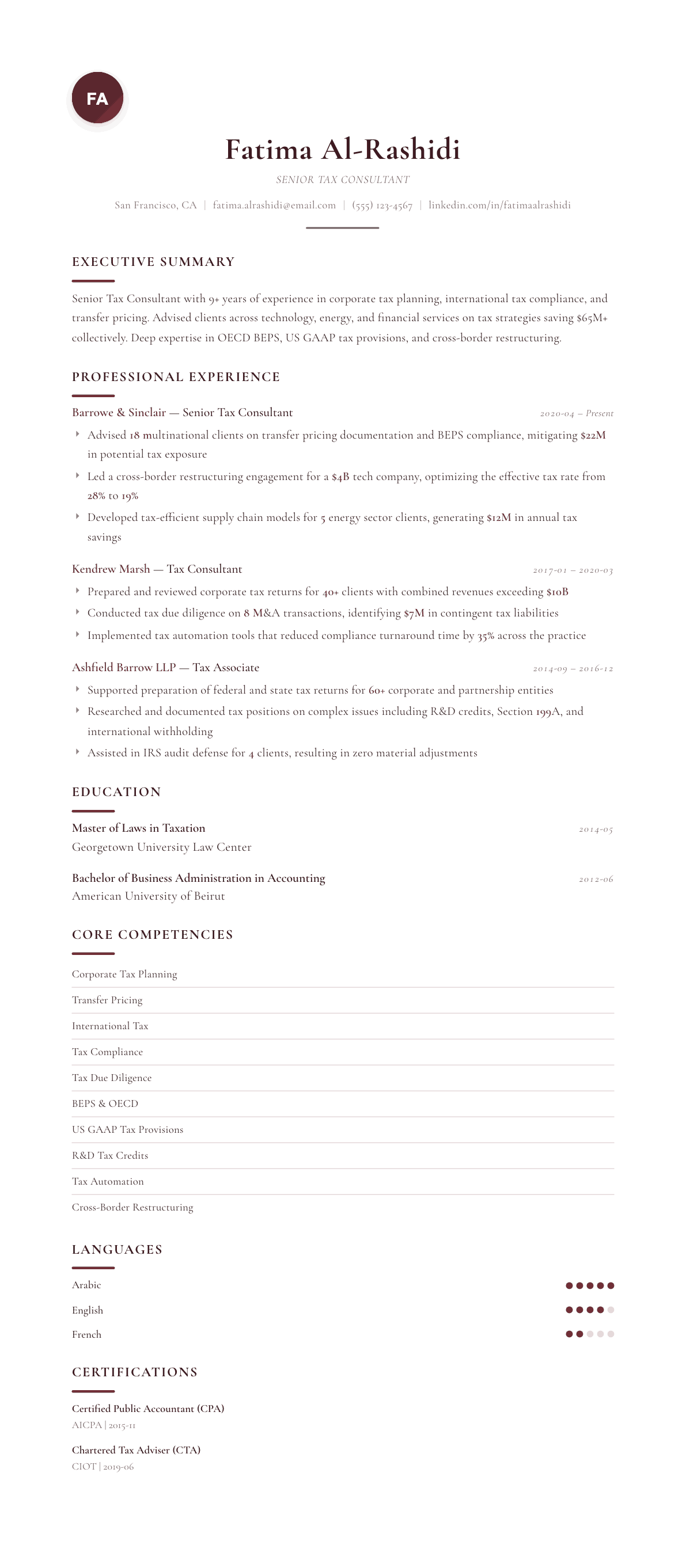
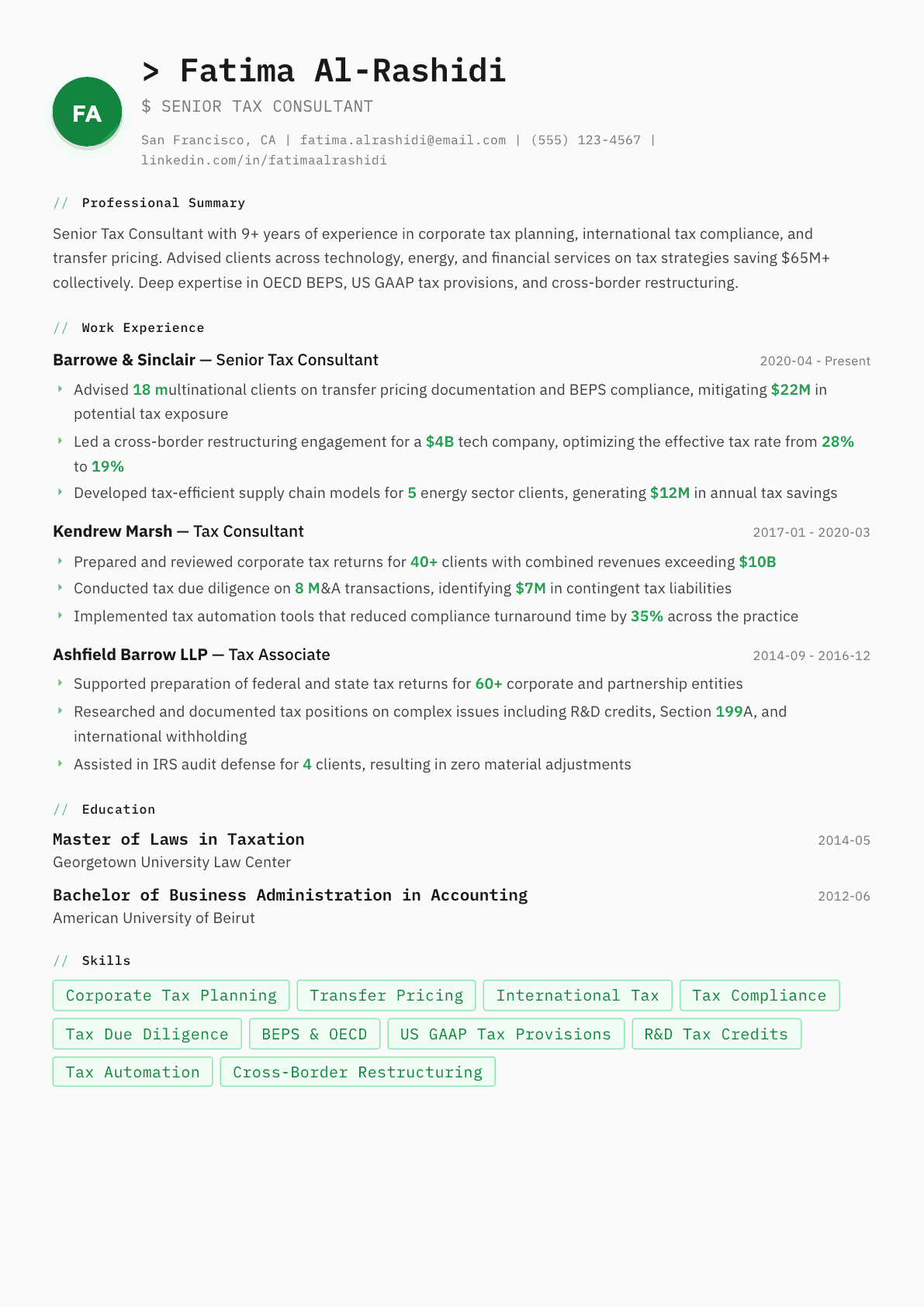
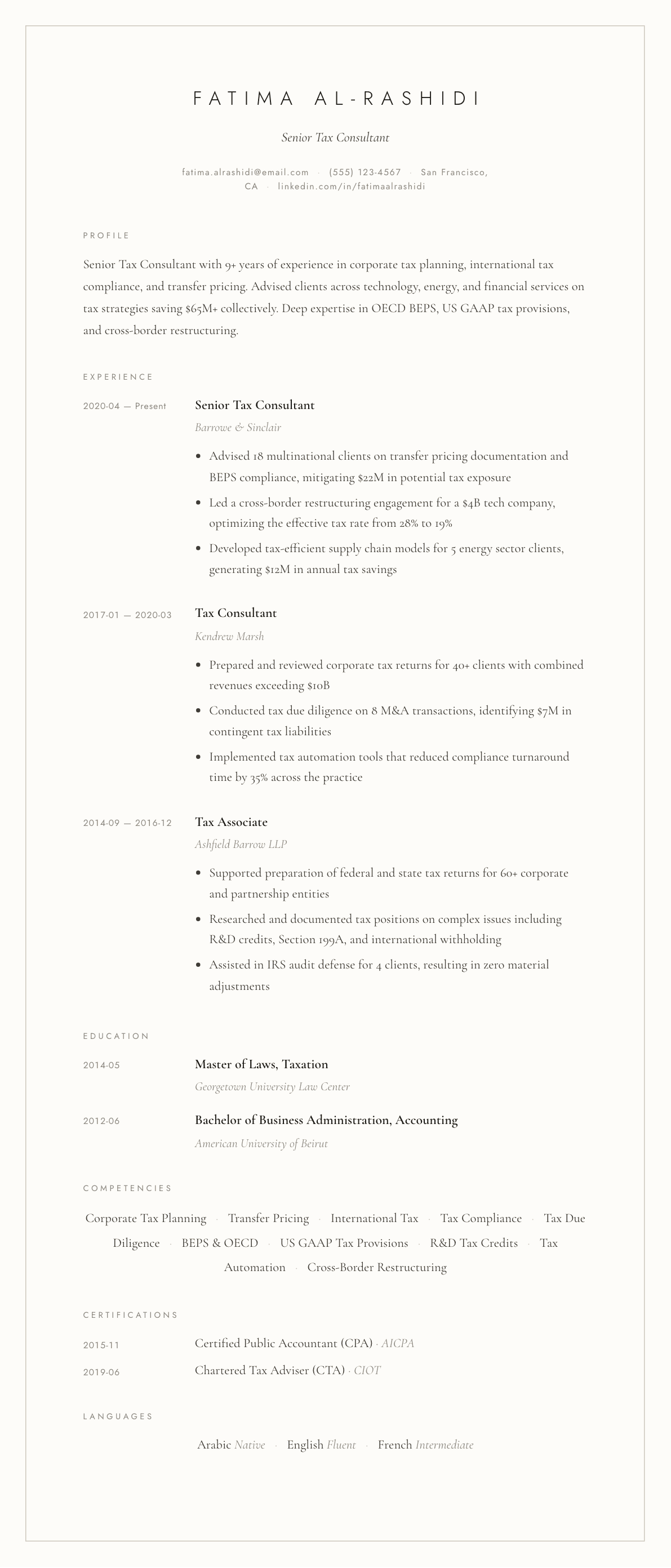
Example Tax Consultant summary
Senior Tax Consultant with 9 years of experience advising multinationals on corporate tax planning, transfer pricing, and international compliance. CPA and CTA with a track record of delivering $65M+ in tax savings and mitigating material exposure across 50+ engagements.
Skills to list on a Tax Consultant resume
- Corporate Tax Planning
- Transfer Pricing
- International Tax
- Tax Compliance
- Tax Due Diligence
- BEPS
- Tax Provisions (ASC 740)
- R&D Tax Credits
- Tax Automation
- Cross-Border Restructuring
- M&A Tax Advisory
- Indirect Tax (VAT/GST)
What actually gets this resume read
- Quantify tax savings delivered, exposure mitigated, and compliance efficiencies achieved.
- Highlight jurisdictional expertise. List specific tax codes, treaties, and regulatory frameworks.
- Showcase technology proficiency with tax software like OneSource, Alteryx, or Thomson Reuters.
- Emphasize advisory scope: number of clients, transaction values, and industries served.
- Include CPA, CTA, or EA credentials at the top of your resume for immediate credibility.
How to write a tax consultant resume
A tax consultant resume is screened by a partner or a senior manager who is staffing engagements, and the first thing she wants is your technical footprint: which taxes, which entity types, which jurisdictions, and which stage of the cycle you can be dropped into without supervision.
That footprint is usually missing. Most tax resumes describe the calendar. Prepared returns, reviewed returns, supported the provision, met the deadline, with no indication of what kind of returns, for what size of client, in what industry, under which authority. Two candidates who write the same sentence can be doing work that is years apart in difficulty.
This guide covers how tax resumes are read in public accounting and in industry, how to write compliance, provision and advisory work so it survives a technical interview, three summaries, before and after bullets, and the licensing questions people ask most.
Format: credentials in the header, technical footprint under each role
Reverse chronological, one column, two pages once you are past the senior associate level. Put your license and credentials after your name: CPA and the state, Enrolled Agent, or a tax degree. Public accounting screeners filter on those characters before they read a line of prose.
Under each employer, add a line describing the book you carried: client type, revenue band in words, industries, and the return types. A senior who reviews consolidated returns for multinational manufacturers is doing a different job from a senior who prepares individual and partnership returns for a local book.
- Order: summary, credentials and licenses, experience, education, technical skills, systems.
- Name the forms you have owned: 1120, 1120-S, 1065, 1040, 990, 5471, 5472, 8858, 1118 and 1116.
- Name the jurisdictions: federal, the states you file in, and the countries if you do cross-border work.
- Say whether you prepared, reviewed or signed, because the three describe different levels of trust.
Summary: the taxes you own and the clients you carry
Three or four lines. Lead with the credential and the years, then the specialization: corporate compliance, provision under ASC 740, international and transfer pricing, state and local, partnership allocations, or private client and estates. Close with the client profile, because staffing decisions turn on industry familiarity.
Advisory work belongs here if you want advisory work. A consultant trying to move out of pure compliance has to show at least one planning engagement in the summary, or the resume will be read for the compliance seat it describes.
Experience: technical depth, then the outcome
Write bullets a reviewer could quiz you on. Name the issue, the authority you worked from, the position you took, and what happened: a credit claimed and sustained, an exposure reserved, a method change filed, an examination closed with no adjustment. Vague competence is invisible in this field. A named code section is not.
Give volume where volume is the point and complexity where complexity is the point. A compliance season is described by return count, entity mix and the review layer. A planning engagement is described by the structure, the jurisdictions and the exposure at stake.
For provision work, say whether you prepared or reviewed, whether it was interim or annual, whether you handled uncertain tax positions and valuation allowances, and whether external auditors tested your workpapers. That last detail tells a hiring manager the work had to be defensible.
Systems and research tools
Tax is a software job as much as a technical one. Name the compliance platform, the provision tool, the research service and the data environment, because a firm that runs one stack does not want to retrain you on all four during busy season.
- Compliance: CCH Axcess, GoSystem Tax RS, OneSource, Lacerte, UltraTax, Drake.
- Provision: OneSource Tax Provision, Corptax, or a controlled spreadsheet model you can describe.
- Research: Checkpoint, CCH AnswerConnect, Bloomberg Tax.
- Data and workflow: Excel at a serious level, Alteryx, Power Query, and the client ERP you pulled trial balances from.
Credentials, education and continuing education
The CPA is the dividing line in public accounting. Say the state and whether you are licensed, exam complete or eligible to sit, rather than leaving it ambiguous. The Enrolled Agent credential is the practical alternative for representation work. A Master of Taxation or a tax law degree belongs on the first page for anyone doing technical planning.
Keep continuing education off the resume unless a course maps directly to the opening, such as a transfer pricing or international program. A long list of hours reads as filler and pushes your engagement history onto the second page.
Keywords a tax posting repeats
Tax postings are built from a technical checklist: tax provision, ASC 740, compliance, tax research, transfer pricing, nexus, apportionment, due diligence, entity structuring, audit defense and the form numbers. Match the wording exactly. A firm searching for provision experience will not find your ASC 740 bullet if you only wrote deferred tax computation.
Tax Consultant resume summary examples
First busy seasons
CPA candidate with 2 years of corporate tax compliance at a national firm, preparing federal and multistate returns for privately held manufacturers and partnerships. Comfortable in GoSystem and Checkpoint, and completed a full provision cycle alongside a senior. Master of Taxation, exam complete in 3 sections.
Senior consultant
Tax consultant and licensed CPA with 6 years in corporate compliance and provision work for technology and energy clients. Reviews consolidated federal and multistate returns, prepares annual and interim ASC 740 provisions tested by external auditors, and guides a group of 4 associates through busy season.
Manager with an advisory book
Senior tax consultant with 11 years across compliance, provision and cross-border planning for multinational clients. Leads transfer pricing documentation, restructuring and examination defense, and has closed federal audits with no material adjustment. CPA with a graduate tax degree, and mentors a team of 7.
Work experience bullets: before and after
Before: Prepared corporate tax returns for clients.
After: Prepared and reviewed consolidated federal and 22-state returns for privately held manufacturers, including Forms 1120, 5471 and 1118 for the foreign subsidiaries.
Forms, jurisdiction count and client type let a reviewer place your technical level immediately.
Before: Assisted with the tax provision.
After: Prepared the annual ASC 740 provision for a multinational client, including the rate reconciliation, valuation allowance analysis and uncertain tax positions, then defended the workpapers to the external auditors.
Naming the components and the audit test converts assisted into work that someone relied on.
Before: Researched complex tax issues.
After: Researched and documented the research credit position for a software client, drafting the memo that supported qualification of 4 project categories, and the position was sustained on examination.
A specific issue with a written product and an outcome is verifiable, where researched complex issues is not.
Before: Worked on transfer pricing projects.
After: Led local file and master file documentation for 18 entities across 9 jurisdictions, and rebuilt the intercompany services markup using an updated comparables set.
Entity and jurisdiction counts with the actual deliverable show the scale a staffing partner needs to know.
Before: Helped clients save money on taxes.
After: Identified an accounting method change that accelerated deductions for a construction client, filed the Form 3115, and the reduction in current tax held through review.
A named mechanism and a filed form replace a claim that every tax resume already makes.
Hard skills
- Corporate income tax compliance
- ASC 740 tax provision
- Multistate apportionment and nexus analysis
- Partnership taxation and allocations
- International compliance including Forms 5471 and 8858
- Transfer pricing documentation
- Tax research and technical memoranda
- Examination defense and revenue authority correspondence
- Accounting method changes
- CCH Axcess and GoSystem Tax RS
- OneSource Tax Provision
- Checkpoint and Bloomberg Tax research
- Excel modeling and Power Query
- Tax due diligence for acquisitions
Soft skills
- Client communication under deadline
- Technical writing
- Review and coaching of associates
- Judgment on unclear positions
- Busy season workload management
- Working alongside external auditors
Certifications worth listing
- Certified Public Accountant (CPA) (State Board of Accountancy)
- Enrolled Agent (EA) (Internal Revenue Service)
- Chartered Tax Adviser (CTA) (Chartered Institute of Taxation)
- Certified Financial Planner (CFP) (Certified Financial Planner Board of Standards)
Mistakes that cost tax consultant candidates the interview
- Describing the calendar instead of the work: prepared returns, reviewed returns, met deadlines, with no form, entity type or jurisdiction anywhere on the page.
- Leaving CPA status ambiguous. Licensed, exam complete and eligible to sit are three different answers and a recruiter will ask for the exact one.
- Listing every piece of software you have opened. Name the stack you can work in unsupervised and drop the rest.
- Claiming a saving for a client without naming the mechanism, which invites a technical question you then cannot answer in the same detail.
- Burying advisory and planning work underneath compliance bullets when the target role is advisory.
- Filling half a page with continuing education hours while the engagement history gets one line per year.
Tax Consultant resume questions
Should I list specific tax forms on my resume?
Yes. Form numbers are the fastest signal of technical range in this field, and staffing managers search for them directly. List the forms you have owned rather than every form your team touched, because you will be asked about the ones you claim.
How do I show CPA progress if I am not licensed yet?
State it plainly: CPA candidate with a named number of sections passed, or CPA eligible with the credit hours complete. Ambiguity costs you more than an incomplete license, since firms hire at both levels and plan the timeline around your answer.
Is public accounting experience required for a tax consultant role?
It is the common path, but industry tax departments and law firm tax groups produce strong candidates too. If you come from industry, emphasize provision work, examination defense and cross-functional projects, since those translate directly into consulting engagements.
How do I write about clients I cannot name?
Describe them by industry, ownership structure and rough size, such as a privately held distributor with operations in three countries. That is standard practice in tax resumes and gives the reader everything needed to judge complexity without breaching confidentiality.
What separates a senior tax resume from a staff one?
Review rather than preparation, judgment on unclear positions, and responsibility for people and deadlines. Show that you reviewed others, made calls on positions with support behind them, and owned a client or auditor relationship rather than only feeding a workflow.
Related resume examples
- Financial Advisor Resume example
- Auditor Resume example
- Accountant Resume example
- Tax Accountant Resume example
- Tax Manager Resume example
- CPA Resume example