About Me Examples: 12 Written for a Resume and a Bio
By Mustafa Tarabya, founder of CVBooster · Published · Updated
8 min read
Twelve complete about me examples follow, one for each career stage, checked in September 2026. An "about me" section is three to five sentences at the top of a resume, a LinkedIn profile or a company bio page, and the one thing about me that every version must contain is a number, because that is the only part a reader cannot argue with. Purdue University's OWL, which has published resume guidance since 1995, frames the whole page as a design problem of "using white space, headings, and fonts" plus "tailoring your résumé for specific employers", and this section is where the tailoring happens. Written by Mustafa Tarabya, who hired for his own company, read every application himself and now writes CVBooster's guides.
Start with the four examples most people need, then read the formula underneath them.
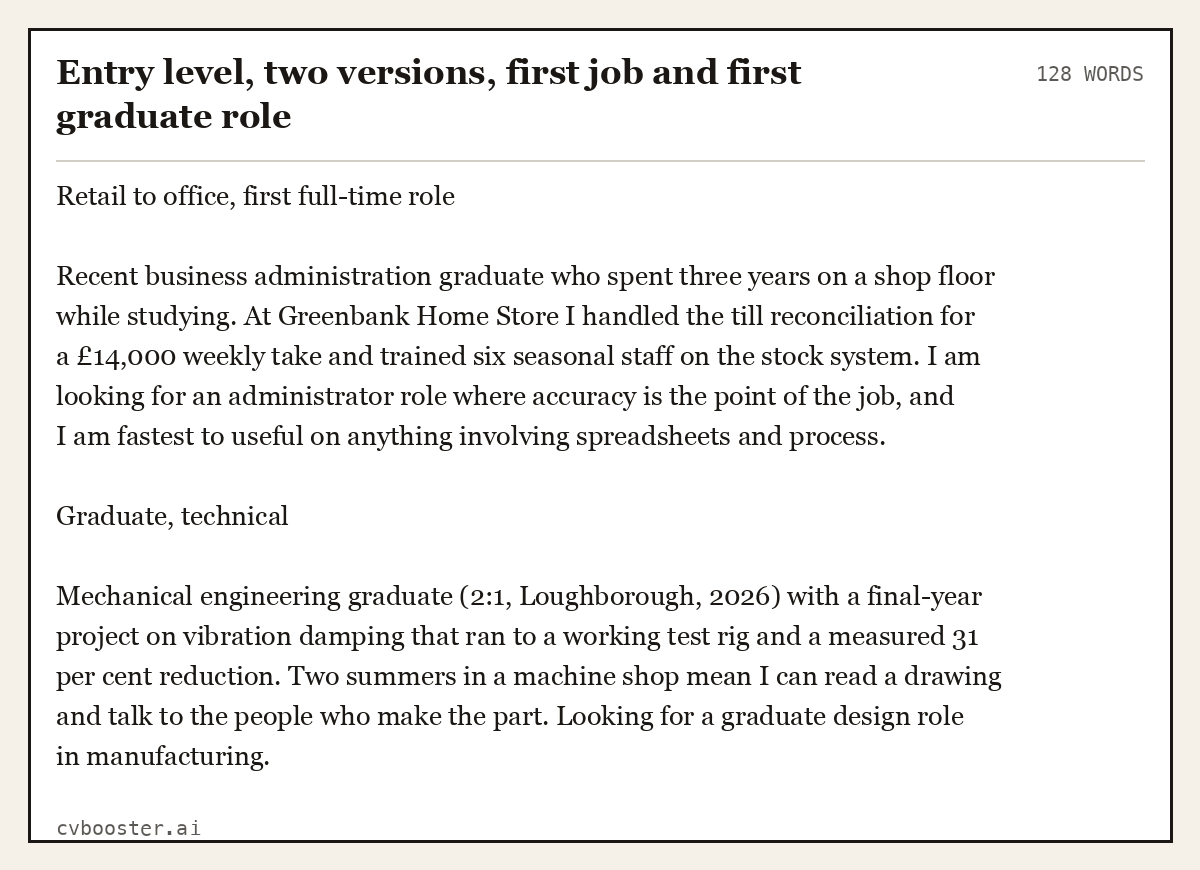
Entry level, two versions, first job and first graduate role (128 words)
Retail to office, first full-time role
Recent business administration graduate who spent three years on a shop floor while studying. At Greenbank Home Store I handled the till reconciliation for a £14,000 weekly take and trained six seasonal staff on the stock system. I am looking for an administrator role where accuracy is the point of the job, and I am fastest to useful on anything involving spreadsheets and process.
Graduate, technical
Mechanical engineering graduate (2:1, Loughborough, 2026) with a final-year project on vibration damping that ran to a working test rig and a measured 31 per cent reduction. Two summers in a machine shop mean I can read a drawing and talk to the people who make the part. Looking for a graduate design role in manufacturing.
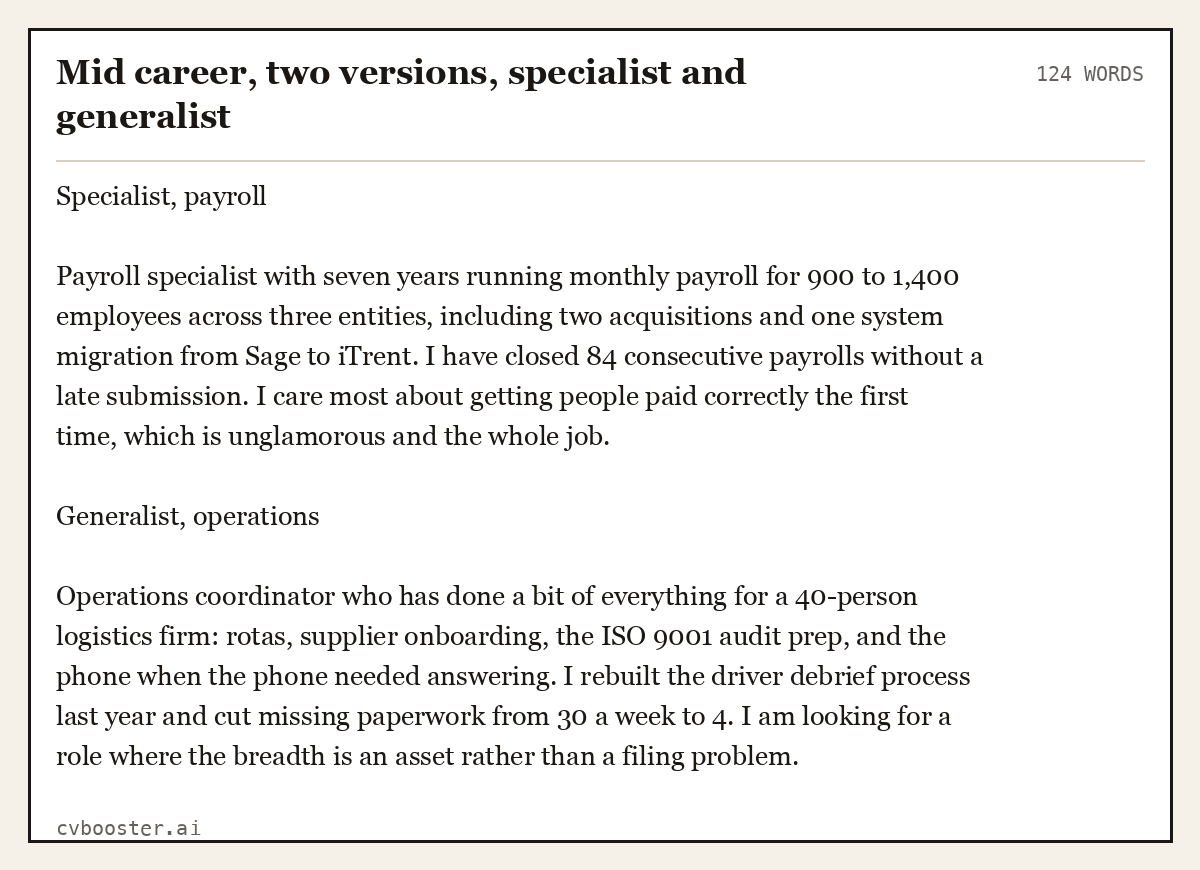
Mid career, two versions, specialist and generalist (124 words)
Specialist, payroll
Payroll specialist with seven years running monthly payroll for 900 to 1,400 employees across three entities, including two acquisitions and one system migration from Sage to iTrent. I have closed 84 consecutive payrolls without a late submission. I care most about getting people paid correctly the first time, which is unglamorous and the whole job.
Generalist, operations
Operations coordinator who has done a bit of everything for a 40-person logistics firm: rotas, supplier onboarding, the ISO 9001 audit prep, and the phone when the phone needed answering. I rebuilt the driver debrief process last year and cut missing paperwork from 30 a week to 4. I am looking for a role where the breadth is an asset rather than a filing problem.
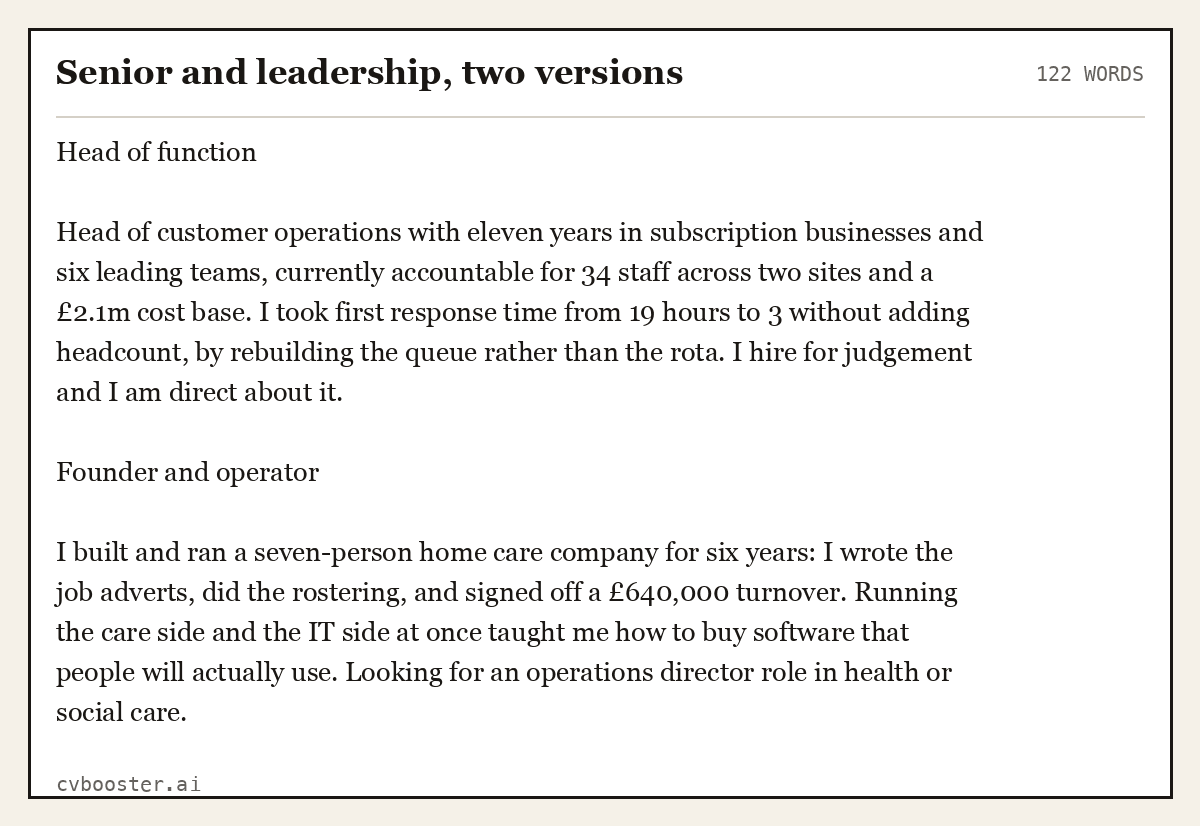
Senior and leadership, two versions (122 words)
Head of function
Head of customer operations with eleven years in subscription businesses and six leading teams, currently accountable for 34 staff across two sites and a £2.1m cost base. I took first response time from 19 hours to 3 without adding headcount, by rebuilding the queue rather than the rota. I hire for judgement and I am direct about it.
Founder and operator
I built and ran a seven-person home care company for six years: I wrote the job adverts, did the rostering, and signed off a £640,000 turnover. Running the care side and the IT side at once taught me how to buy software that people will actually use. Looking for an operations director role in health or social care.
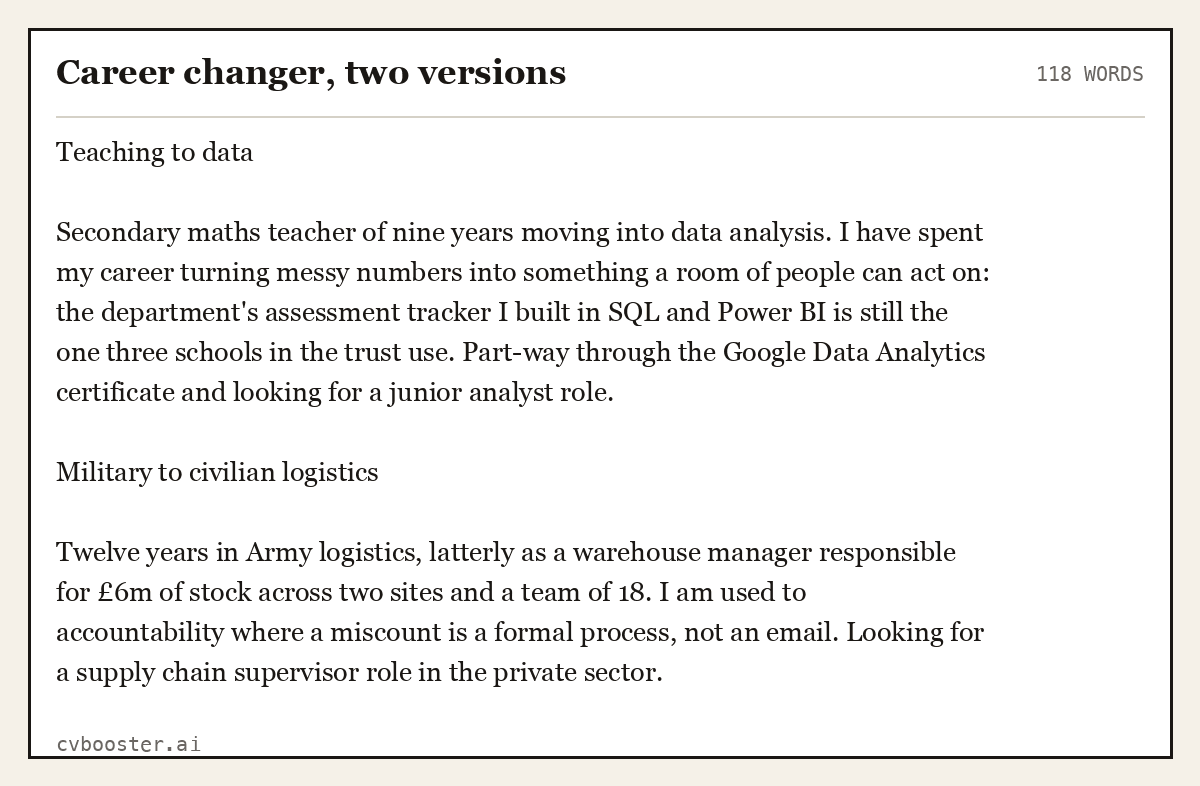
Career changer, two versions (118 words)
Teaching to data
Secondary maths teacher of nine years moving into data analysis. I have spent my career turning messy numbers into something a room of people can act on: the department's assessment tracker I built in SQL and Power BI is still the one three schools in the trust use. Part-way through the Google Data Analytics certificate and looking for a junior analyst role.
Military to civilian logistics
Twelve years in Army logistics, latterly as a warehouse manager responsible for £6m of stock across two sites and a team of 18. I am used to accountability where a miscount is a formal process, not an email. Looking for a supply chain supervisor role in the private sector.
The formula underneath all twelve
Four moves, in this order.
- What you are, in three words. Job title plus a qualifier. Not "passionate professional".
- The scale you have worked at. Team size, budget, volume, number of clients, headcount paid. One number.
- One thing you changed, with the before and after. This is the sentence that gets read twice.
- What you want next, in plain terms. One clause. It filters out the wrong employers, which is the point.
Three to five sentences. Anything longer stops being an about me and becomes a cover letter that nobody asked for.
Four more, for the situations the templates skip
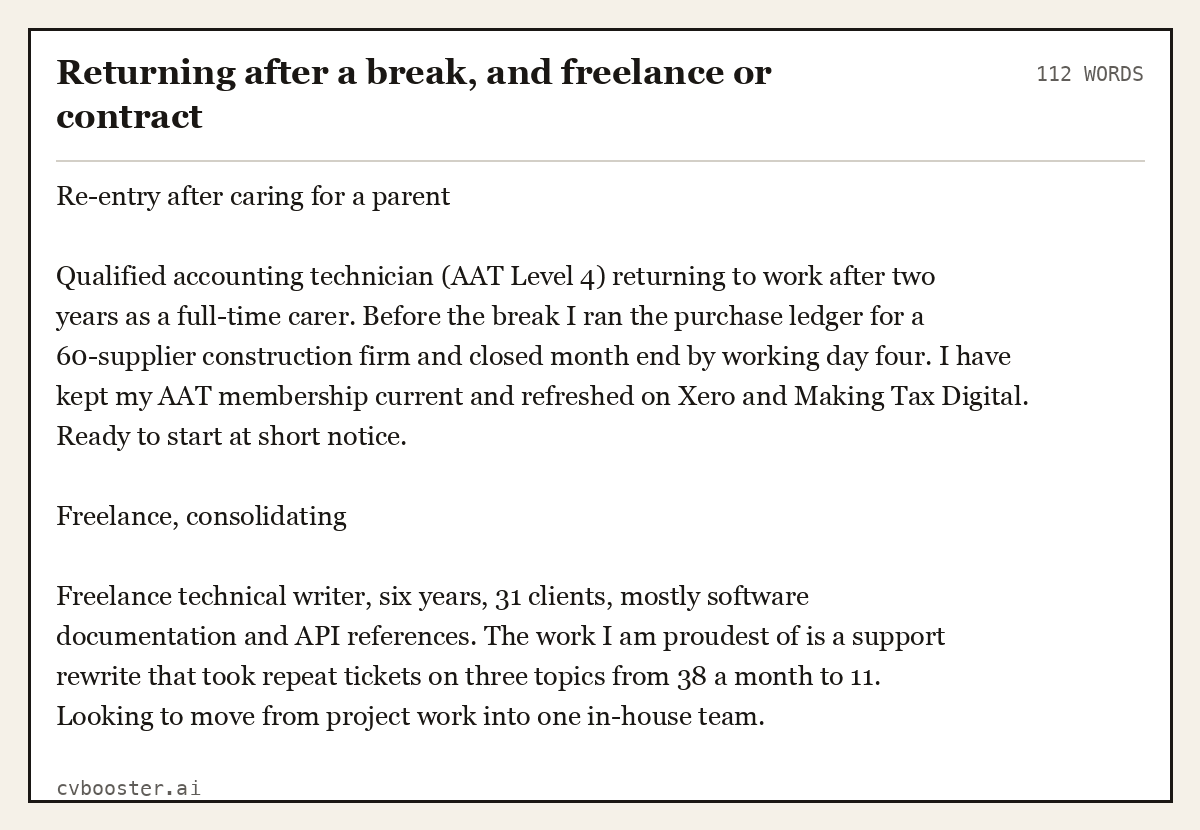
Returning after a break, and freelance or contract (112 words)
Re-entry after caring for a parent
Qualified accounting technician (AAT Level 4) returning to work after two years as a full-time carer. Before the break I ran the purchase ledger for a 60-supplier construction firm and closed month end by working day four. I have kept my AAT membership current and refreshed on Xero and Making Tax Digital. Ready to start at short notice.
Freelance, consolidating
Freelance technical writer, six years, 31 clients, mostly software documentation and API references. The work I am proudest of is a support rewrite that took repeat tickets on three topics from 38 a month to 11. Looking to move from project work into one in-house team.
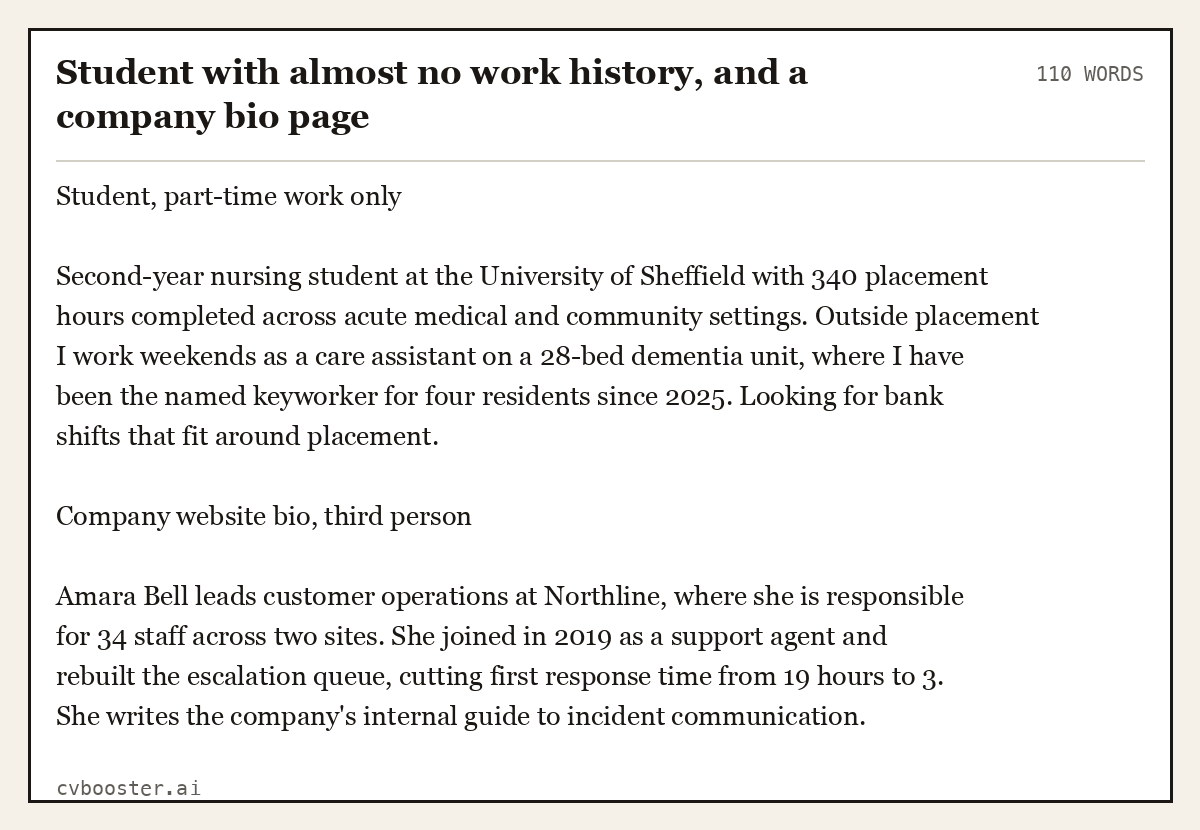
Student with almost no work history, and a company bio page (110 words)
Student, part-time work only
Second-year nursing student at the University of Sheffield with 340 placement hours completed across acute medical and community settings. Outside placement I work weekends as a care assistant on a 28-bed dementia unit, where I have been the named keyworker for four residents since 2025. Looking for bank shifts that fit around placement.
Company website bio, third person
Amara Bell leads customer operations at Northline, where she is responsible for 34 staff across two sites. She joined in 2019 as a support agent and rebuilt the escalation queue, cutting first response time from 19 hours to 3. She writes the company's internal guide to incident communication.
Where the section goes, and what it is called
| Where you are writing | Heading to use | Length |
|---|---|---|
| Resume, entry level | Profile, or About Me | 3 sentences |
| Resume, experienced | Professional Summary | 3 to 5 sentences |
| Federal resume | Summary of qualifications | 3 to 5 lines, plain text |
| LinkedIn About | About | 3 short paragraphs, first person |
| Company bio page | Nothing, just the name | 3 sentences, third person |
| Portfolio site | About | As long as you like, but front-load it |
Two formatting rules that people learn the hard way. On a federal application, USAJOBS requires that "You must upload or build a resume that is two pages or less", so the summary has to be tight. And in any document that might be read by a screen reader, structure matters: Section508.gov publishes the authoring guides for accessible word processing documents, and a summary typed into a text box shaped like a heading breaks them.
Describe yourself in words a reader can check
The commonest failure in an about me section is adjectives with nothing behind them. A useful test comes from the government's own occupational data. O*NET lists the work styles that matter for each job and defines them, so instead of guessing, you can borrow the definition and then prove it.
For bartenders, for instance, O*NET names three: self-control, "a tendency to remain calm and composed and to manage emotions effectively in response to criticism or difficult situations at work"; social orientation; and dependability, "a tendency to be reliable, responsible, and consistent in meeting work-related obligations".
Look up your own occupation, take the work styles it lists, then write the sentence that proves one. "Dependable" is worthless. "Closed 84 consecutive payrolls without a late submission" is the same claim, evidenced.
What to cut
- "Passionate", "results-driven", "team player", "detail-oriented" with no example after them.
- Your hobbies, unless the job is in that field.
- The words "I am a people person".
- Anything about what you are looking for that runs past one clause.
- A restatement of your job title in three different ways.
- Age, marital status, a photo, or anything that belongs nowhere on a resume.
Once the section is written, check it against the rest of the page: the professional summary guide covers the experienced version in depth, resume summary vs objective settles which heading to use, and resume summary examples has more worked openings. Purdue's résumés and CVs section is the best free reference on the page design around it, and the USAJOBS resume help sets out the federal rules.
Frequently asked questions
How to answer tell me about yourself?
Give a 60-second version of the about me section: what you are, the scale you have worked at, one thing you changed with a before and after, and what you want next. Practise it out loud once. Do not narrate your CV from school onwards.
How to answer tell me about yourself in an interview?
Start where the job starts. If the advert is about volume, open with your volume number. If it is about accuracy, open with your error rate. Then one specific change you made, then one sentence on why this job. Ninety seconds is the ceiling.
How to follow up about an interview?
Send a thank you email the same day naming one specific thing from the conversation, then wait for the date they gave you. If that date passes, one short email asking about the timeline is enough. Two is too many.
What to say in an interview about weaknesses?
Name a real one that does not disqualify you, then the mechanism you use to manage it. "I am slow to delegate, so I now write the handover note before I start the task" is an answer. "I work too hard" is not.
When asked tell me about yourself in an interview?
Answer first, context second. Lead with the sentence you would want quoted back to the panel afterwards. The examples above are written to be said out loud as well as read, which is why none of them start with the word "I".
When an interviewer asks tell me about yourself?
Treat it as the question "why are you in this room", not "what is your life story". Three beats: current role and scale, the change you are proudest of, the reason this job is the next step. Then stop and let them ask.
Related articles
- How to Write a Professional Summary (With Examples)
- How to Make a Resume: A Complete Step by Step Guide
- Resume Summary vs Objective: Which Should You Use?
- Resume Summary Examples for Every Career Level
More articles
- Acting Resume: A Credits Sheet, Not a CV
- How to Address Selection Criteria: 6 Worked STAR Examples
- Adjectives to Describe Yourself and the Sentence for Each
Looking for a worked example for your job title? Browse the resume examples by job title.