Professional Summary Example for a Resume: 8 Samples
By Mustafa Tarabya, founder of CVBooster · Published · Updated
7 min read
A professional summary is two to four lines at the top of your resume or CV that say what you are, the proof that you are good at it, and the kind of role you want next. The constraint is that it must say something the rest of the page cannot; a summary that repeats your job titles wastes the one block every reader actually reads. The National Careers Service describes it as "a few short lines that sum up who you are and what you hope to do," placed "just under your name and contact details." Below are eight professional summary examples for a resume, checked in October 2026, from first job to senior manager. Written by Mustafa Tarabya, who hired for his own company, read every application himself and now writes CVBooster's guides.
Every summary on earth starts with "hardworking and motivated". If those two words got people hired, everyone would be employed by Tuesday.
The formula behind every example on this page
Each summary below follows the same three parts, in this order.
- What you are, in the first five words. A noun phrase with your field and level: "Band 5 staff nurse", "Chartered accountant", "Customer service team leader".
- Proof. One or two facts the reader can check: scope, a result, a system you run, a qualification that matters for the role.
- Direction. What you want next, if it is not obvious from the first line.
Prospects puts the job of this block plainly: "A CV personal profile is a concise statement that highlights your key attributes and helps you stand out from the crowd." Every name, employer and number in the examples is invented for illustration. Copy the structure, not the figures.
Graduate professional summary example
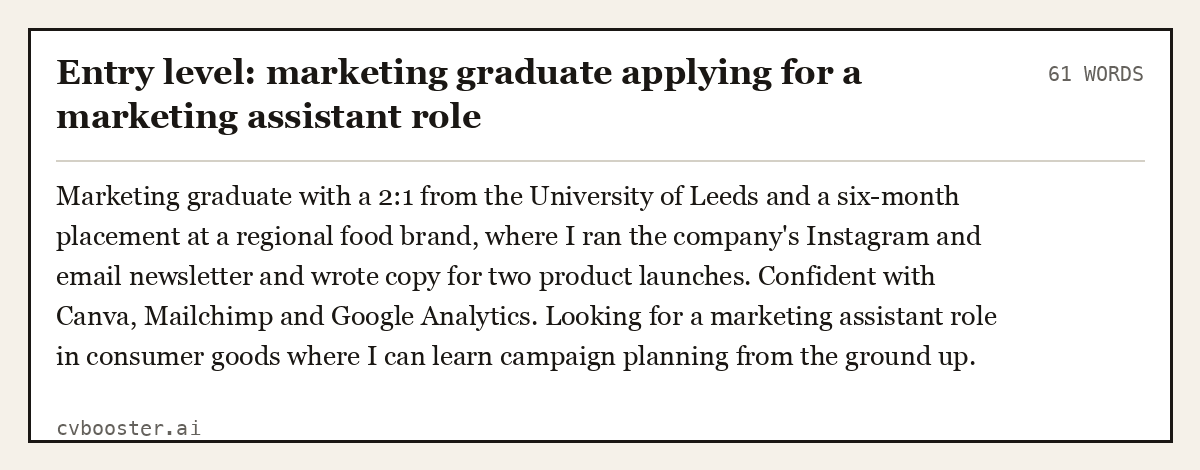
Entry level: marketing graduate applying for a marketing assistant role (61 words)
Marketing graduate with a 2:1 from the University of Leeds and a six-month placement at a regional food brand, where I ran the company's Instagram and email newsletter and wrote copy for two product launches. Confident with Canva, Mailchimp and Google Analytics. Looking for a marketing assistant role in consumer goods where I can learn campaign planning from the ground up.
First job professional summary example
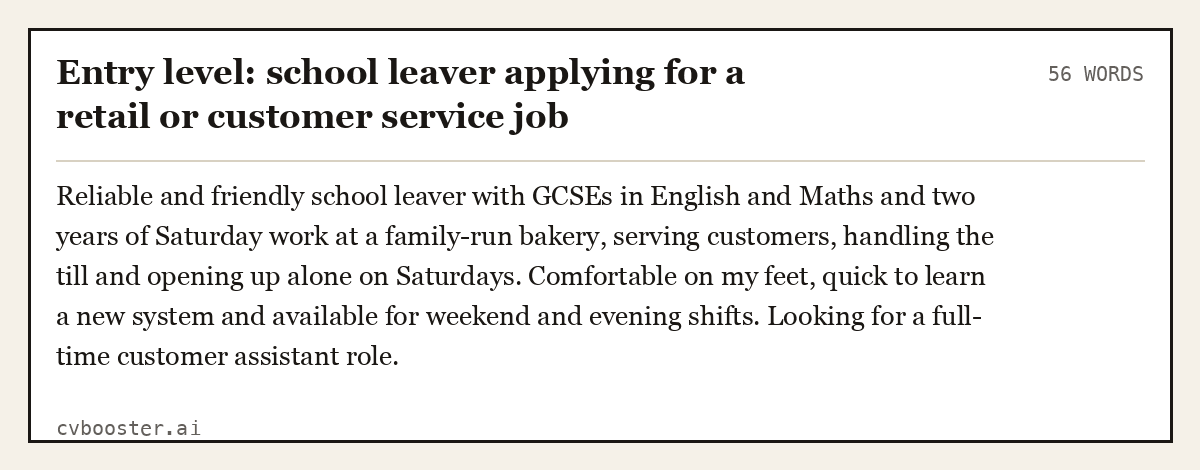
Entry level: school leaver applying for a retail or customer service job (56 words)
Reliable and friendly school leaver with GCSEs in English and Maths and two years of Saturday work at a family-run bakery, serving customers, handling the till and opening up alone on Saturdays. Comfortable on my feet, quick to learn a new system and available for weekend and evening shifts. Looking for a full-time customer assistant role.
The first job summary is the one place where an objective-style last line earns its space, because direction is genuinely the news. If you have no paid work at all, our guide to a CV personal statement with no experience shows how to use school, volunteering and projects instead.
Nurse professional summary example
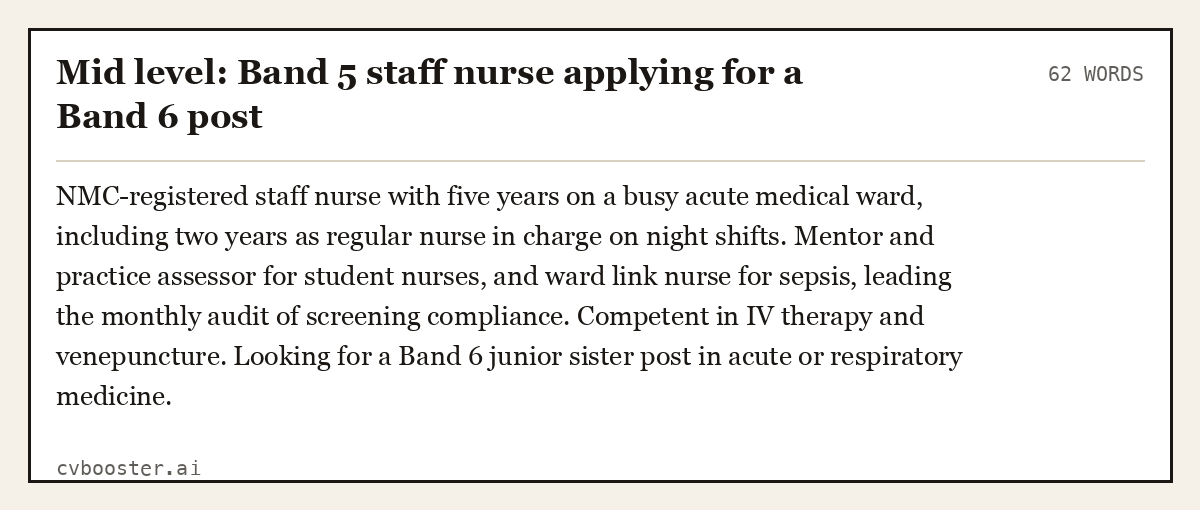
Mid level: Band 5 staff nurse applying for a Band 6 post (62 words)
NMC-registered staff nurse with five years on a busy acute medical ward, including two years as regular nurse in charge on night shifts. Mentor and practice assessor for student nurses, and ward link nurse for sepsis, leading the monthly audit of screening compliance. Competent in IV therapy and venepuncture. Looking for a Band 6 junior sister post in acute or respiratory medicine.
Accountant professional summary example
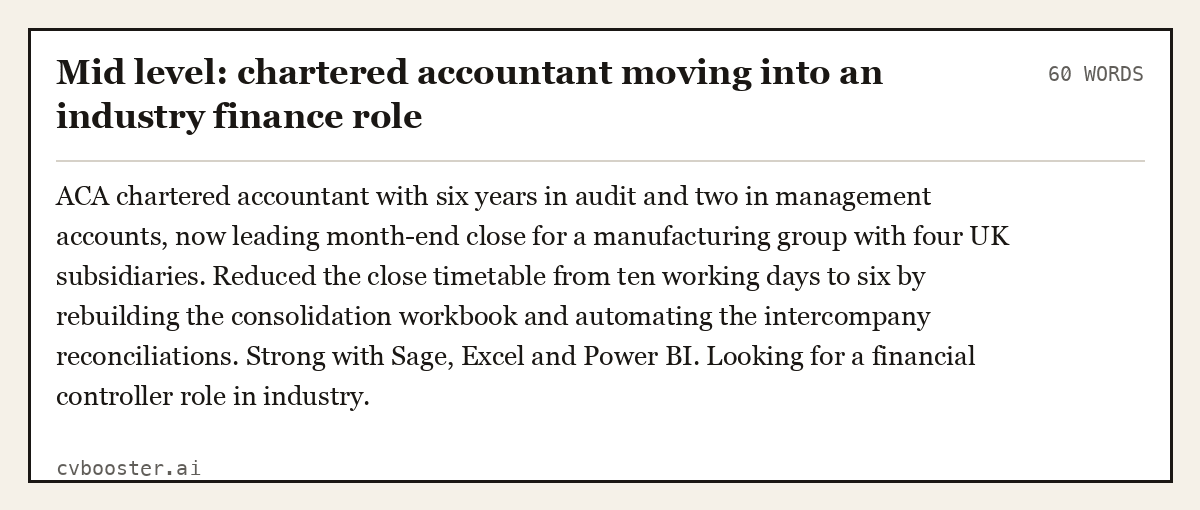
Mid level: chartered accountant moving into an industry finance role (60 words)
ACA chartered accountant with six years in audit and two in management accounts, now leading month-end close for a manufacturing group with four UK subsidiaries. Reduced the close timetable from ten working days to six by rebuilding the consolidation workbook and automating the intercompany reconciliations. Strong with Sage, Excel and Power BI. Looking for a financial controller role in industry.
Career changer professional summary example
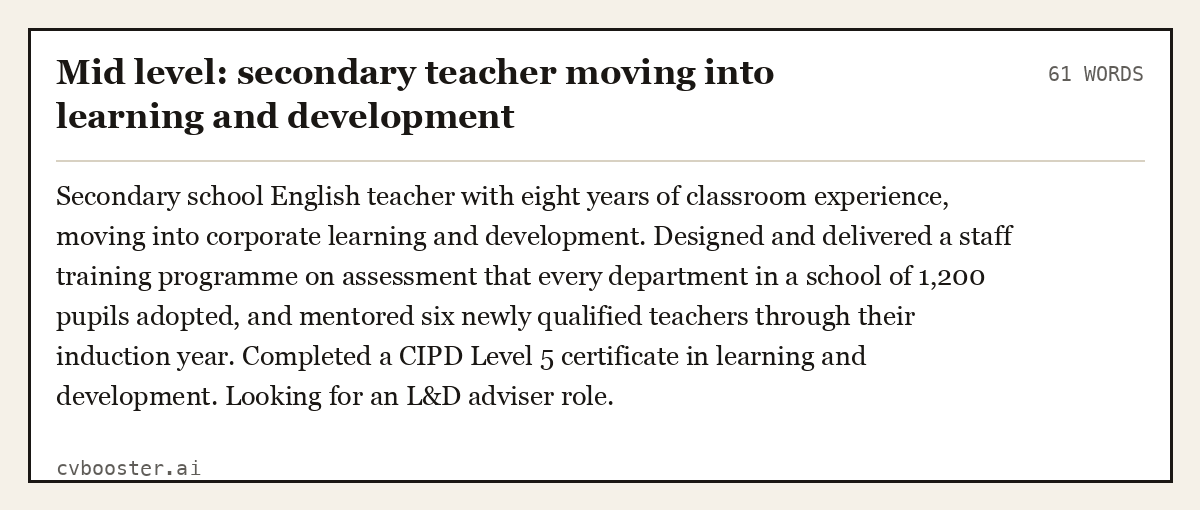
Mid level: secondary teacher moving into learning and development (61 words)
Secondary school English teacher with eight years of classroom experience, moving into corporate learning and development. Designed and delivered a staff training programme on assessment that every department in a school of 1,200 pupils adopted, and mentored six newly qualified teachers through their induction year. Completed a CIPD Level 5 certificate in learning and development. Looking for an L&D adviser role.
The career changer summary states the move in the first line, then spends every following word on why the old job is evidence for the new one. Hiding the change only makes the reader find it later and wonder what else is hidden.
Team leader professional summary example
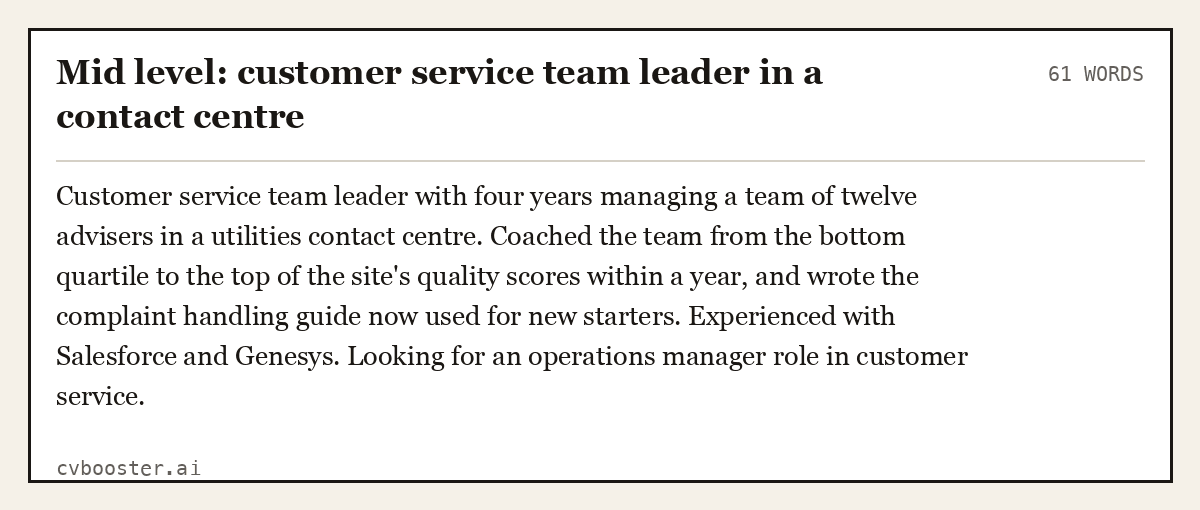
Mid level: customer service team leader in a contact centre (61 words)
Customer service team leader with four years managing a team of twelve advisers in a utilities contact centre. Coached the team from the bottom quartile to the top of the site's quality scores within a year, and wrote the complaint handling guide now used for new starters. Experienced with Salesforce and Genesys. Looking for an operations manager role in customer service.
Senior manager professional summary example
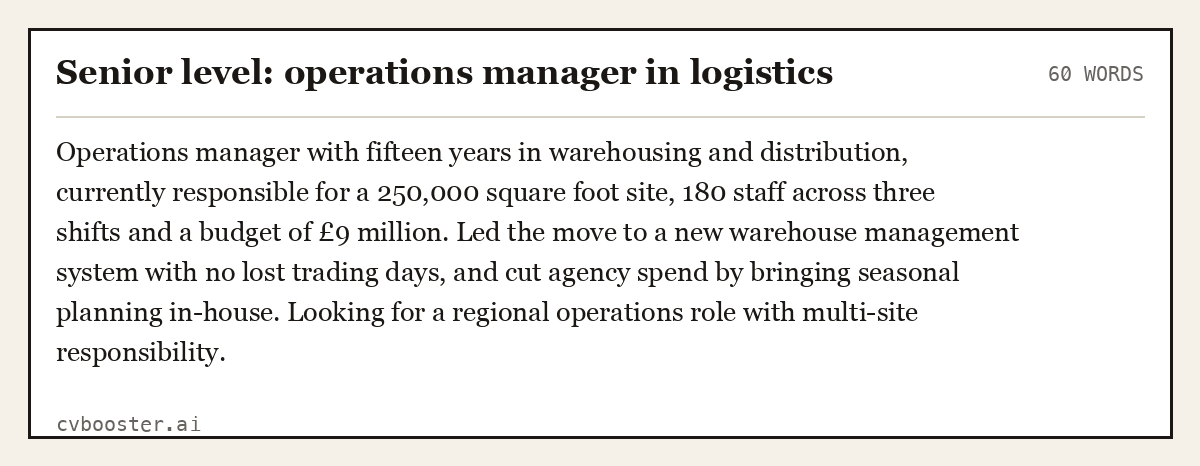
Senior level: operations manager in logistics (60 words)
Operations manager with fifteen years in warehousing and distribution, currently responsible for a 250,000 square foot site, 180 staff across three shifts and a budget of £9 million. Led the move to a new warehouse management system with no lost trading days, and cut agency spend by bringing seasonal planning in-house. Looking for a regional operations role with multi-site responsibility.
Returner professional summary example
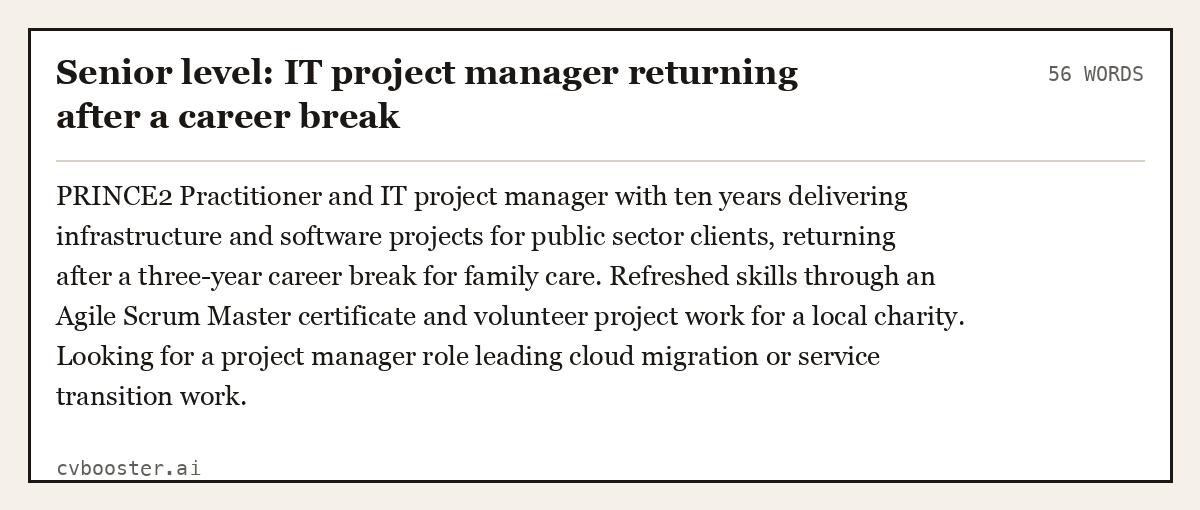
Senior level: IT project manager returning after a career break (56 words)
PRINCE2 Practitioner and IT project manager with ten years delivering infrastructure and software projects for public sector clients, returning after a three-year career break for family care. Refreshed skills through an Agile Scrum Master certificate and volunteer project work for a local charity. Looking for a project manager role leading cloud migration or service transition work.
The returner names the gap in one clause, without apology, and then moves on to what is current. The reader's real worry about a gap is whether your skills are out of date, so answer that worry, not the gap itself.
Weak summary versus strong summary
Here is the same candidate, the team leader above, written two ways.
Weak: "Highly motivated and results-driven professional with excellent communication skills and a passion for customer service. A natural leader and team player who thrives under pressure."
Strong: the team leader example above, with the team size, the quality score movement, the guide and the systems.
The weak version is two sentences and zero facts. Every phrase in it could be written by a candidate who has never led anyone. Try the test on your own draft: cross out every phrase a bad candidate could also write. What is left is your actual summary. If nothing is left, the problem is not the wording, it is that you have not yet put a fact in.
How long should a professional summary be, and where does it go?
Two to four sentences, roughly 40 to 90 words. UCAS says it "shouldn't be longer than a few sentences" and suggests mentioning "key strengths and attributes here, especially any that the role explicitly requires." That last part is the instruction most people skip. The posting is the brief: read it first, then make sure your summary answers its top two requirements in words the advert uses.
Place it directly under your name and contact details, above everything else. In the UK this block is usually called a personal profile or personal statement on a CV, and a professional summary on a resume. The job it does is the same. For more examples sorted by profession, see our resume summary examples, and if you are not sure whether you need a summary or an objective, the resume summary versus objective guide settles it. Once the summary is done, match the rest of the page to the advert with our guide to tailoring your resume for each job.
Frequently asked questions
What is a good professional summary for a resume?
A good professional summary names your field and level in the first few words, gives one or two checkable facts such as scope, a result or a key qualification, and ends with the role you want if that is not obvious. It answers the top requirements of the job advert and contains no phrase a weaker candidate could also write.
How do I write a professional summary with no experience?
Lead with what you are studying or have just finished, then use placements, part-time work, volunteering or projects as proof. Name the tools or skills the role asks for, and finish with the kind of role you are looking for. Keep it to three lines; a short, specific summary beats a long, general one.
Is a professional summary the same as a personal profile on a CV?
Yes, in practice. UK employers and careers services usually call it a personal profile or personal statement, and US employers call it a professional summary or resume summary. Both sit under your contact details and do the same job: a few lines on who you are, your proof and what you want next.
Should a professional summary be written in the first person?
Most summaries drop the pronoun and start with a noun phrase, such as "Chartered accountant with six years in audit". Using "I" in a short closing line is acceptable, as in some examples above. Whichever you choose, stay consistent and never switch to the third person with your own name.
How many lines should a resume summary be?
Three to four lines on the page, or two to four sentences. Anything longer starts to look like a paragraph the reader will skip, and the important facts get buried. If you need more space for achievements, put them in your experience section as bullet points instead.
Related articles
- Accounting Executive Resume: 5 Examples by Career Level
- Administration Resume Examples: 8 Samples, Entry to Manager
- Aged Care Resume: 6 Australian Examples and a Template
- Another Word for Resume: CV, Bio and 10 More Options
More articles
- Program Manager Interview Questions and Answers: 8 Samples
- Project Management Keywords for a Resume: 6 Examples
- Interview Questions for Job Promotion: 6 Full Answers
Looking for a worked example for your job title? Browse the resume examples by job title.