Resume Summary Examples: 12 Opening Statements by Level
By Mustafa Tarabya, founder of CVBooster · Published · Updated
7 min read
A resume summary is a two to four line opening statement at the top of your resume that says what you do, the strongest proof that you do it well, and the job you want next. The constraint is that it must be written for the job advert in front of you, not for every job you might apply to. The Purdue OWL explains why the top matters: "When your page is balanced, the reader will typically read anything in quadrant 1 first." Your summary sits in that quadrant. Below are twelve complete resume summary examples and opening statements, checked in October 2026, tagged by level, for entry level, career changers, customer service, medical assistants, managers and executives. Written by Mustafa Tarabya, who hired for his own company, read every application himself and now writes CVBooster's guides.
Every resume summary on earth begins "Results-driven professional". Somewhere there is a professional who is not driven by results, and he has never written a resume, because he is not driven by anything.
The formula
Three lines, three jobs:
- Line 1, who you are: job title, years and field. "Medical assistant with three years in family practice."
- Line 2, proof: one or two results with numbers or specifics from your best work.
- Line 3, where you are going: the job you are applying for, by name if possible.
Leave out adjectives you cannot prove: motivated, passionate, dynamic, hardworking. If a result shows the quality, the adjective is not needed. If no result shows it, the adjective will not convince anyone.
Entry level and students
Students can reuse these three lines as the About section of a LinkedIn profile, and the sample LinkedIn profile for students guide shows seven of them written out in full.
Entry level: recent graduate, accounting (49 words)
Accounting graduate (BS, Ohio State, May 2026) with a summer internship in audit at a regional CPA firm, where I tested 200 expense samples and drafted two workpapers used in the final file. Proficient in Excel and QuickBooks. Seeking a staff accountant role with a path to CPA licensure.
Entry level: high school student, first job (43 words)
High school junior with two summers of volunteer work at the Riverside Food Bank, where I sorted donations and helped run the Saturday distribution line for 150 families. Reliable, available weekends and after 3 pm. Looking for a part-time cashier or stocking position.
Career change
A career change summary has one extra task: translate. Name the new target role first, then the old experience in the new role's language.
Career changer: teacher to instructional designer (50 words)
Instructional designer moving from eight years of high school teaching. Designed and delivered a blended learning unit used by 14 teachers across the district, and built 30 self-paced modules in Canvas. Completed the ATD instructional design certificate in 2026. Seeking an entry instructional designer role in corporate learning and development.
Career changer: military to logistics (43 words)
Logistics coordinator with six years in US Army supply operations. Managed inventory and transport for a 400-person unit, with equipment worth more than $8 million accounted for at every audit. Holds a Secret clearance. Seeking a civilian logistics or supply chain coordinator role.
Customer service and retail
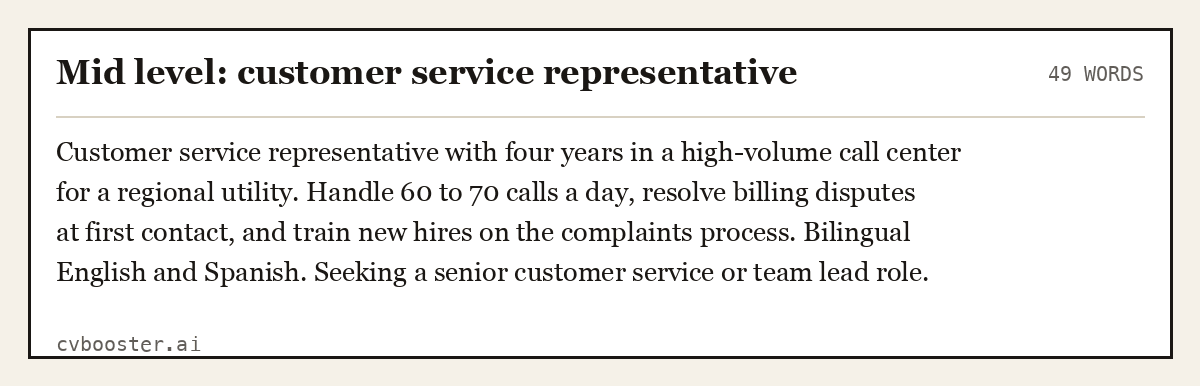
Mid level: customer service representative (49 words)
Customer service representative with four years in a high-volume call center for a regional utility. Handle 60 to 70 calls a day, resolve billing disputes at first contact, and train new hires on the complaints process. Bilingual English and Spanish. Seeking a senior customer service or team lead role.
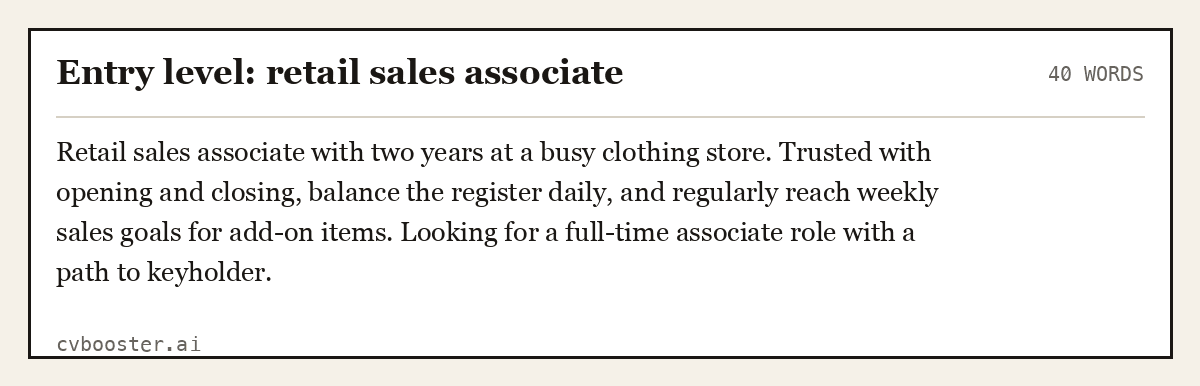
Entry level: retail sales associate (40 words)
Retail sales associate with two years at a busy clothing store. Trusted with opening and closing, balance the register daily, and regularly reach weekly sales goals for add-on items. Looking for a full-time associate role with a path to keyholder.
Healthcare
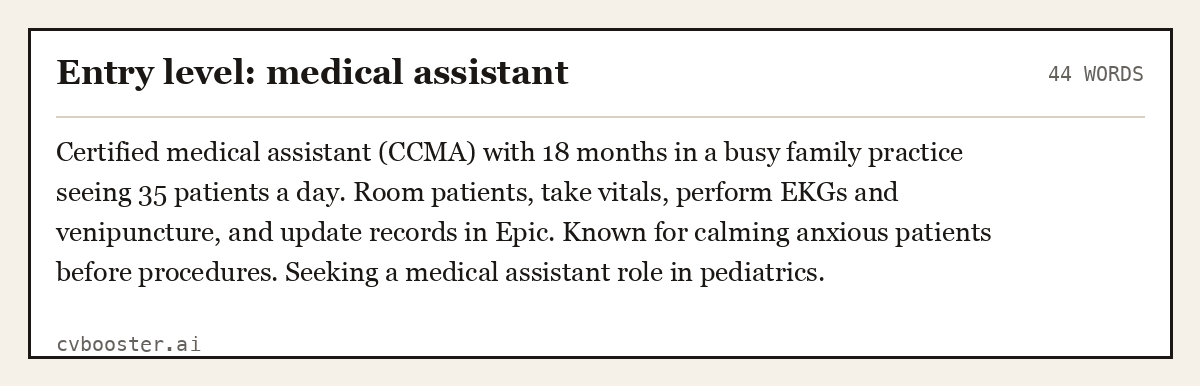
Entry level: medical assistant (44 words)
Certified medical assistant (CCMA) with 18 months in a busy family practice seeing 35 patients a day. Room patients, take vitals, perform EKGs and venipuncture, and update records in Epic. Known for calming anxious patients before procedures. Seeking a medical assistant role in pediatrics.
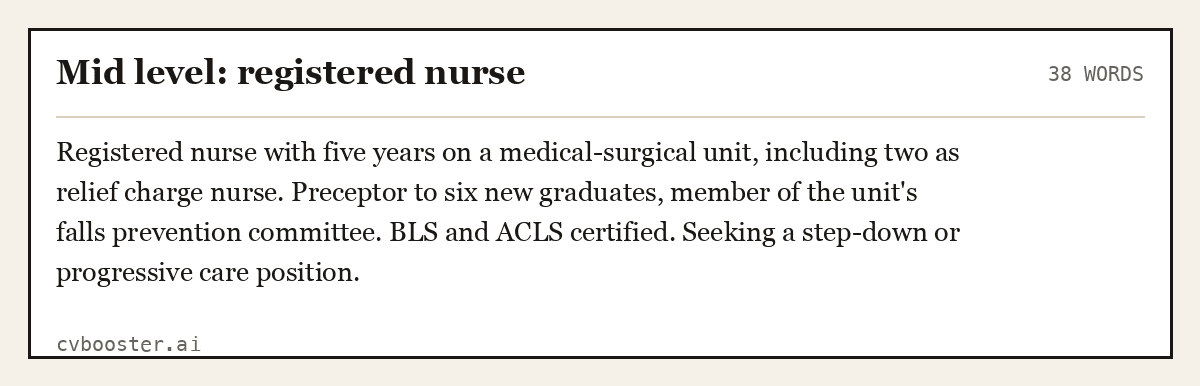
Mid level: registered nurse (38 words)
Registered nurse with five years on a medical-surgical unit, including two as relief charge nurse. Preceptor to six new graduates, member of the unit's falls prevention committee. BLS and ACLS certified. Seeking a step-down or progressive care position.
Managers and executives
At senior level the summary carries the scope: budget, team size, the one result that defines your career so far.
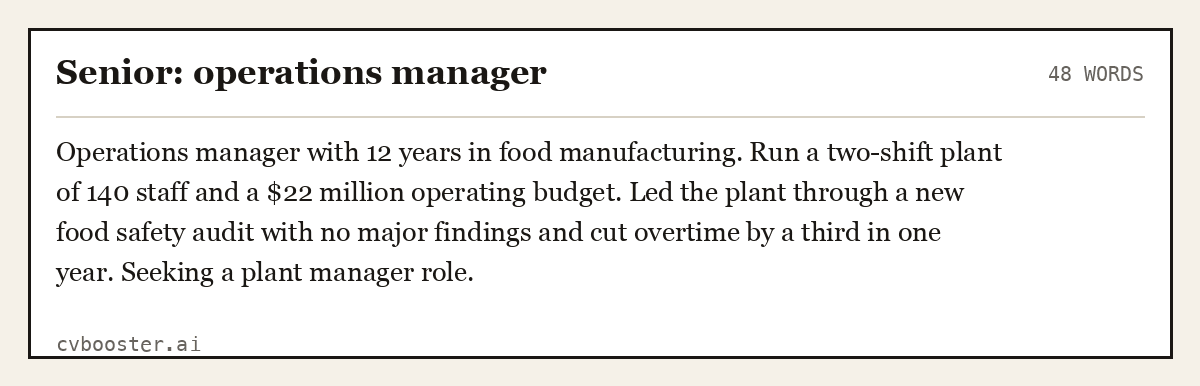
Senior: operations manager (48 words)
Operations manager with 12 years in food manufacturing. Run a two-shift plant of 140 staff and a $22 million operating budget. Led the plant through a new food safety audit with no major findings and cut overtime by a third in one year. Seeking a plant manager role.
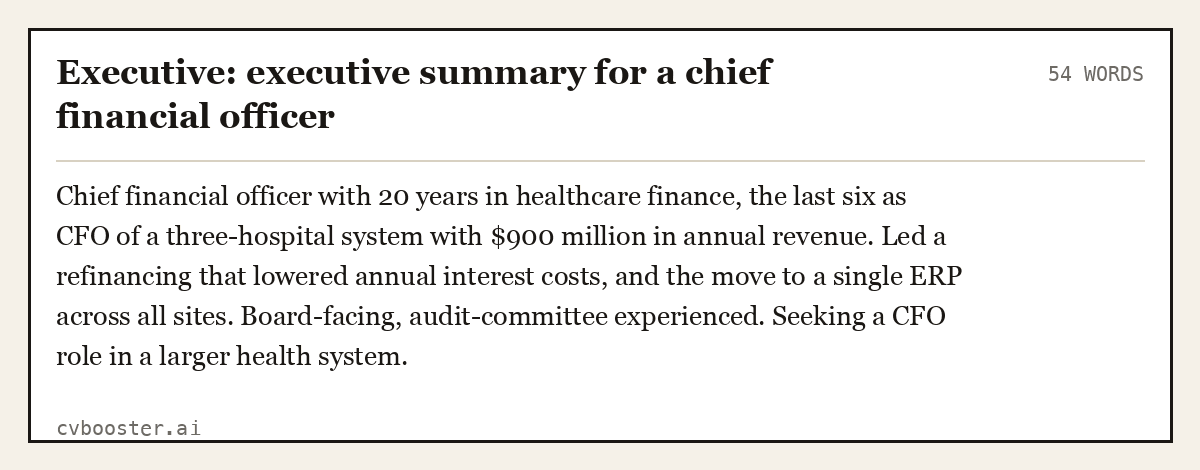
Executive: executive summary for a chief financial officer (54 words)
Chief financial officer with 20 years in healthcare finance, the last six as CFO of a three-hospital system with $900 million in annual revenue. Led a refinancing that lowered annual interest costs, and the move to a single ERP across all sites. Board-facing, audit-committee experienced. Seeking a CFO role in a larger health system.
UK CV opening statements
In the UK the opening statement is usually called a personal profile. It works the same way and uses British spelling.
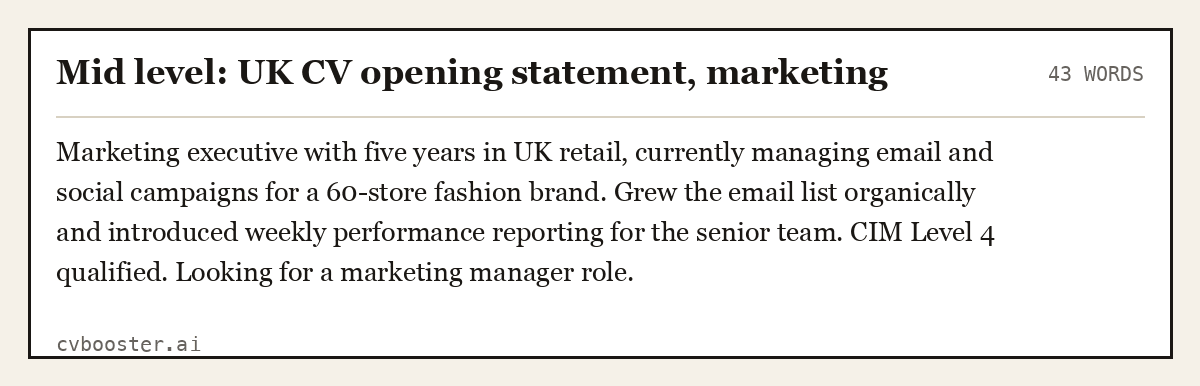
Mid level: UK CV opening statement, marketing (43 words)
Marketing executive with five years in UK retail, currently managing email and social campaigns for a 60-store fashion brand. Grew the email list organically and introduced weekly performance reporting for the senior team. CIM Level 4 qualified. Looking for a marketing manager role.
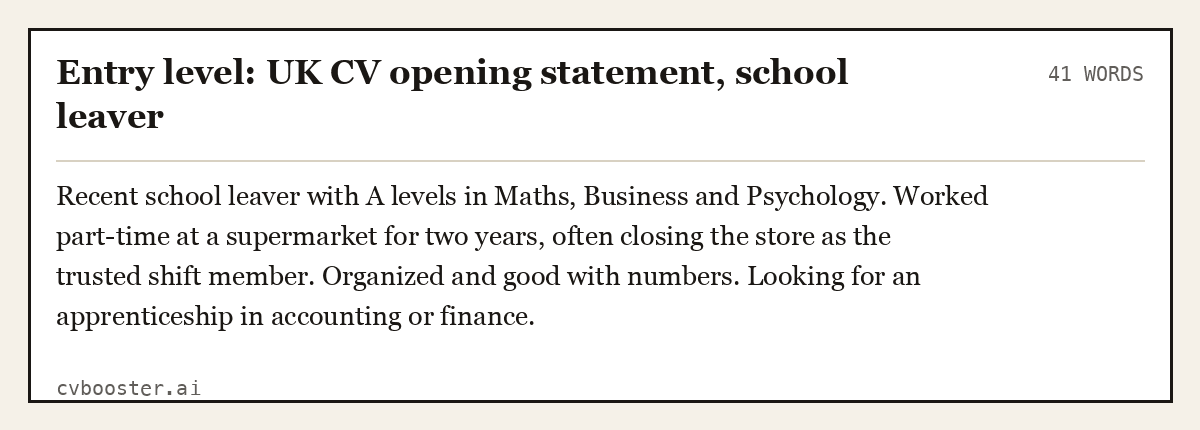
Entry level: UK CV opening statement, school leaver (41 words)
Recent school leaver with A levels in Maths, Business and Psychology. Worked part-time at a supermarket for two years, often closing the store as the trusted shift member. Organized and good with numbers. Looking for an apprenticeship in accounting or finance.
Summary, objective or profile
A summary describes what you have done; an objective describes what you want. Today most employers prefer the summary, because it starts with evidence. An objective still has a place when you have no relevant experience, and our resume objective examples show how to write one. The resume summary vs objective guide explains which to use when.
CareerOneStop, the US Department of Labor's careers site, walks through each section of a resume in its Resume Writing Guide, and treats the summary as part of the core structure.
How to write yours in ten minutes
Open the job advert. Underline the job title and the three requirements that appear first or most often. Write line 1 with your job title, your years and the field. For line 2, pick the result from your resume that best matches the first requirement. For line 3, name the role. The same job title belongs in the line under your name, as our job resume title guide shows with twelve examples.
Then read it aloud. MIT's career office says that "Resumes don't require complete sentences and you should avoid using the first person (I, me, my)", which is why the examples above drop "I" in most lines. Whether you keep "I" in the summary is a style choice; be consistent.
For a deeper guide to longer versions, see the professional summary for a resume. If your bullets need the same treatment, the resume action verbs list and the bad resume examples show the before and after.
Frequently asked questions
What is a good summary for a resume?
A good resume summary is two to four lines that state your job title and experience, give one or two specific results, and name the job you want next. It is written for the job advert you are answering, and it avoids adjectives that cannot be proven, such as motivated or passionate.
What is an opening statement on a resume?
An opening statement is the short paragraph at the top of a resume, under your name and contact details. It is also called a resume summary, professional summary or, in the UK, a personal profile. Its job is to tell the reader in a few seconds what you do and why you fit the role.
How do I write a resume summary with no experience?
Use what you have: your degree or course, a relevant project, volunteer work, a part-time job, or skills listed in the advert that you can prove. State availability if the job is part-time. Name the role you want. A short, specific summary beats a long generic one at any level.
How do I write a resume summary for a career change?
Lead with the new job title you are targeting, then describe your past experience in the new field's language. Add one result that transfers directly and any new qualification or course. End with the role you are applying for so the reader does not have to guess why you applied.
How long should a resume summary be?
Two to four lines, or roughly 30 to 60 words. Senior and executive summaries can run slightly longer to cover scope, such as budget and team size. If your summary is longer than five lines, the reader will skip it, and you lose the most valuable space on the page.
More in this series: related guides
- Bad Resume Examples: 10 Mistakes and the Fixed Version
- Resume Format Guide: Dates, Layout, Color and File Type
Related articles
- Leadership Skills Examples: 12 Skills and the Resume Lines
- Product Management Keywords: 48 Terms and 6 Resume Examples
- Summa Cum Laude: Meaning and How to List It on a Resume
- Things to Put on a Resume: 9 Sections With Examples
More articles
- Resume Objective vs Summary: Which to Use, With 8 Examples
- Resume Synonyms: Better Words for 10 Tired Resume Verbs
- Resume in Past Tense or Present: The Rule and 6 Examples
Looking for a worked example for your job title? Browse the resume examples by job title.