Executive Officer Competency Examples: 6 Full Answers
By Mustafa Tarabya, founder of CVBooster · Published · Updated
15 min read
Executive officer competency examples have to show you running something, not helping with it, because the EO indicators are written around managing people, evidence and delivery. The constraint is the grade line: at EO the published wording expects complex problems and balanced recommendations, where the Clerical Officer wording expects the same work done with support. The indicators quoted here were read in September 2026 in the PAS Executive Officer competency model and on the Executive Officer capability framework page. Six full answers follow, one per competency, annotated line by line. Written by Mustafa Tarabya, who hired for his own company, read every application himself and now writes CVBooster's guides.
What separates an EO answer from a CO answer
The two models use near identical sentences with one word changed, and that word is the grade.
- At Clerical Officer, problems are solved "with support". At Executive Officer, the wording is "Identifies and solves complex problems, with the support of their team if needed". You are the one holding the problem.
- At Clerical Officer, judgement is "good". At Executive Officer it is "balanced", and the model asks you to make "balanced and fair recommendations backed up with evidence".
- Only the EO model carries People Management, which at this grade means getting work out of people who do not report to you as often as it means managing those who do.
So an EO answer that ends with a task completed has stopped a paragraph early. It has to end with a decision taken, a person developed or a service changed.
People Management, annotated
Fiona Hegarty leads a customer contact team for an energy supplier in Sligo.
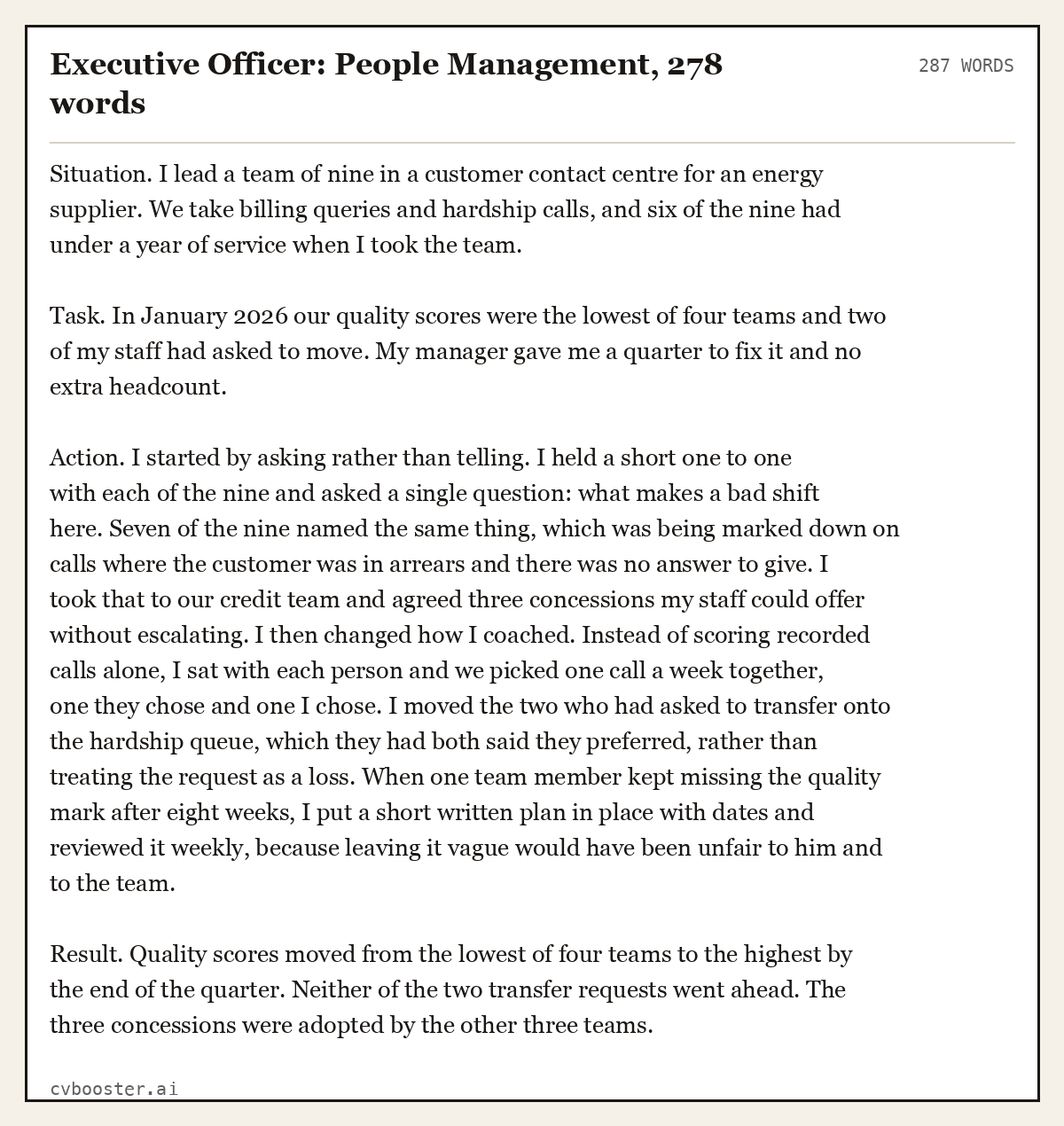
Executive Officer: People Management, 278 words (287 words)
Situation. I lead a team of nine in a customer contact centre for an energy supplier. We take billing queries and hardship calls, and six of the nine had under a year of service when I took the team.
Task. In January 2026 our quality scores were the lowest of four teams and two of my staff had asked to move. My manager gave me a quarter to fix it and no extra headcount.
Action. I started by asking rather than telling. I held a short one to one with each of the nine and asked a single question: what makes a bad shift here. Seven of the nine named the same thing, which was being marked down on calls where the customer was in arrears and there was no answer to give. I took that to our credit team and agreed three concessions my staff could offer without escalating. I then changed how I coached. Instead of scoring recorded calls alone, I sat with each person and we picked one call a week together, one they chose and one I chose. I moved the two who had asked to transfer onto the hardship queue, which they had both said they preferred, rather than treating the request as a loss. When one team member kept missing the quality mark after eight weeks, I put a short written plan in place with dates and reviewed it weekly, because leaving it vague would have been unfair to him and to the team.
Result. Quality scores moved from the lowest of four teams to the highest by the end of the quarter. Neither of the two transfer requests went ahead. The three concessions were adopted by the other three teams.
What the sifter is scoring
- Indicator quoted: "Consults and encourages the full engagement of the team, encouraging open and constructive discussions around work issues" (PAS Executive Officer competency model, People Management). One question, asked nine times, with a change that followed.
- Indicator quoted: "Gets the best out of individuals and the team, encouraging good performance and addressing any performance issues that may arise". The written plan with dates is the addressing half, which most answers skip.
- Indicator quoted: "Encourages, listens to and acts on feedback from the team to make improvements".
- Indicator quoted: "Deals with tensions within the team in a constructive fashion". Moving the two who wanted out, rather than persuading them to stay, is a decision a board will remember.
The word budget at EO
An EO box is usually 450 words. The difference from a CO answer is not length, it is what the Action paragraph contains.
| Part | Words | What an EO box needs that a CO box does not |
|---|---|---|
| Situation | 60 | The size of what you are accountable for, in numbers |
| Task | 60 | Who asked, and what the consequence of failure was |
| Action | 250 | A decision with options considered, or a person developed |
| Result | 80 | A number, plus what changed for other people afterwards |
The publicjobs.ie interview advice page describes the Action step as: "Outline what you did to either resolve the situation or contribute to the success of the example."
Tip: Count the sentences in your Action that begin with I decided, I agreed, I refused or I proposed. If there are none, you have written a CO answer for an EO box.
Analysis and Decision Making, annotated
Arun Pillai is a procurement officer at a university in Galway.
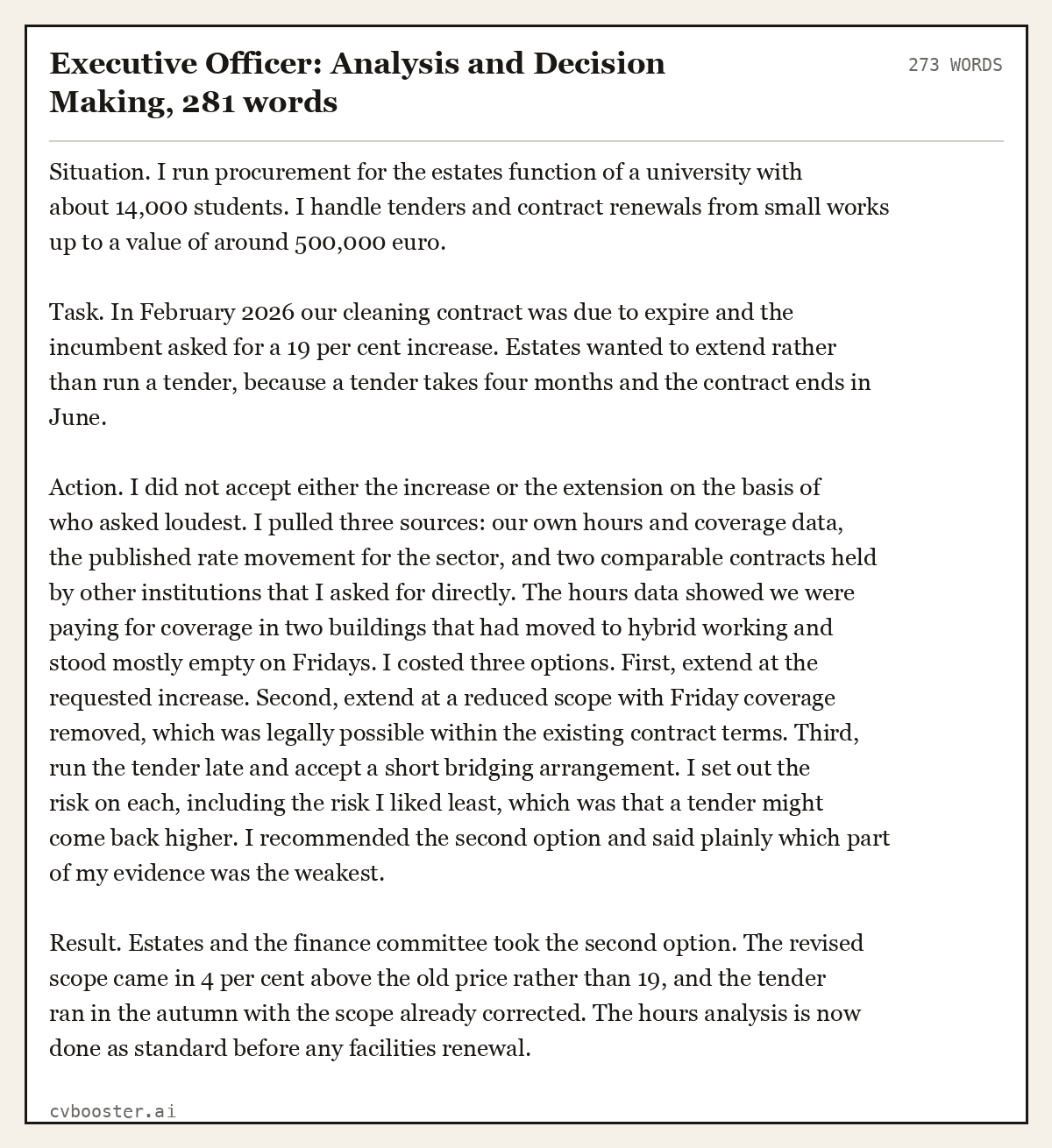
Executive Officer: Analysis and Decision Making, 281 words (273 words)
Situation. I run procurement for the estates function of a university with about 14,000 students. I handle tenders and contract renewals from small works up to a value of around 500,000 euro.
Task. In February 2026 our cleaning contract was due to expire and the incumbent asked for a 19 per cent increase. Estates wanted to extend rather than run a tender, because a tender takes four months and the contract ends in June.
Action. I did not accept either the increase or the extension on the basis of who asked loudest. I pulled three sources: our own hours and coverage data, the published rate movement for the sector, and two comparable contracts held by other institutions that I asked for directly. The hours data showed we were paying for coverage in two buildings that had moved to hybrid working and stood mostly empty on Fridays. I costed three options. First, extend at the requested increase. Second, extend at a reduced scope with Friday coverage removed, which was legally possible within the existing contract terms. Third, run the tender late and accept a short bridging arrangement. I set out the risk on each, including the risk I liked least, which was that a tender might come back higher. I recommended the second option and said plainly which part of my evidence was the weakest.
Result. Estates and the finance committee took the second option. The revised scope came in 4 per cent above the old price rather than 19, and the tender ran in the autumn with the scope already corrected. The hours analysis is now done as standard before any facilities renewal.
What the sifter is scoring
- Indicator quoted: "Effectively deals with a wide range of information sources, investigating all relevant issues" (PAS Executive Officer competency model, Analysis and Decision Making). Three named sources, one of which he had to go and ask for.
- Indicator quoted: "Draws accurate conclusions & makes balanced and fair recommendations backed up with evidence". Three costed options with the risks stated is what balanced means on paper.
- Indicator quoted: "Correctly extracts & interprets numerical information, conducting accurate numerical calculations". The two figures, 19 per cent and 4 per cent, do the work.
- Why it scores at EO, not HEO: he recommends and the committee decides. Claiming the decision itself would read as overstating the grade.
Delivery of Results, annotated
Ciara Fitzgerald is a service delivery coordinator for a waste management company in Carlow.
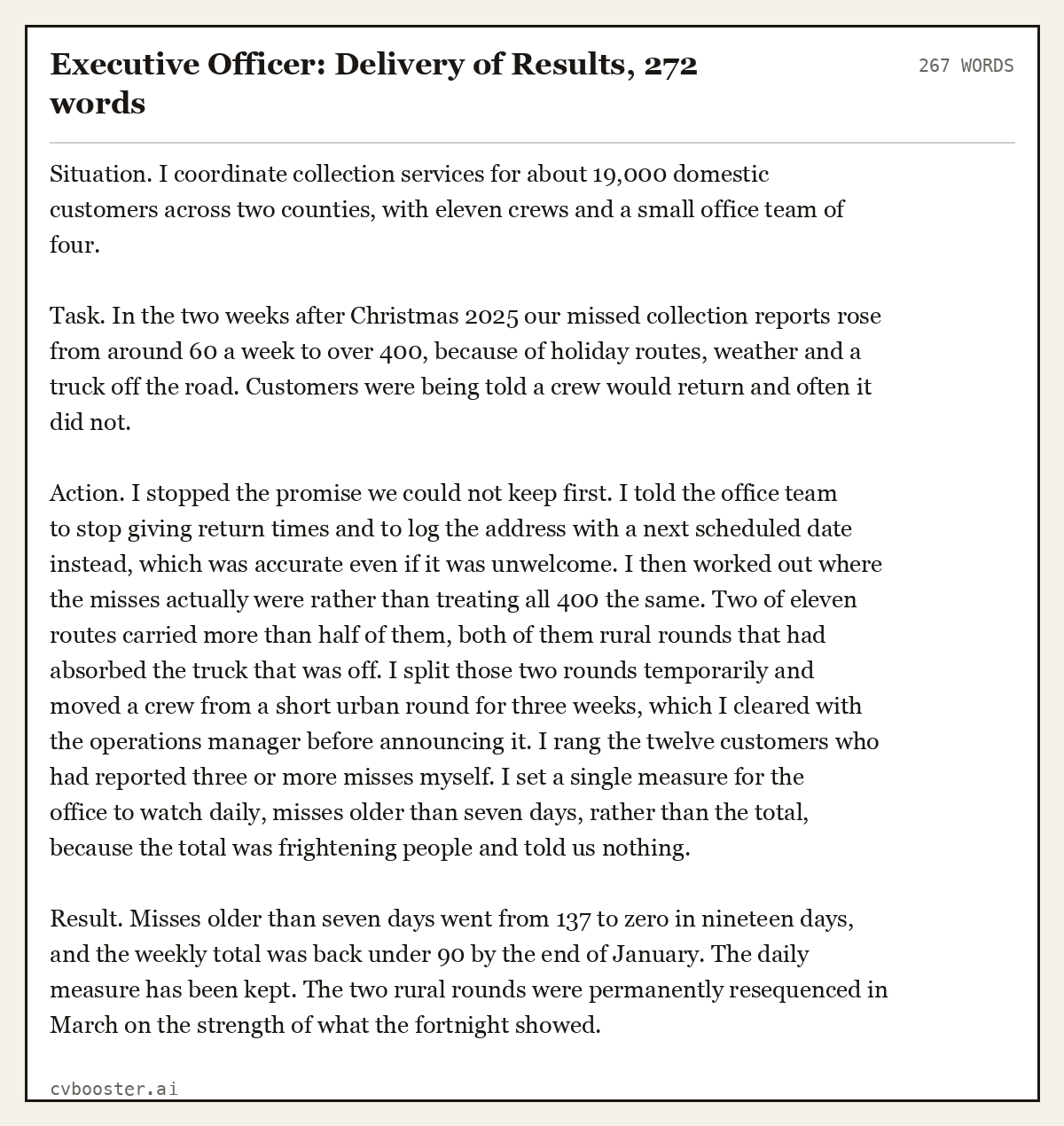
Executive Officer: Delivery of Results, 272 words (267 words)
Situation. I coordinate collection services for about 19,000 domestic customers across two counties, with eleven crews and a small office team of four.
Task. In the two weeks after Christmas 2025 our missed collection reports rose from around 60 a week to over 400, because of holiday routes, weather and a truck off the road. Customers were being told a crew would return and often it did not.
Action. I stopped the promise we could not keep first. I told the office team to stop giving return times and to log the address with a next scheduled date instead, which was accurate even if it was unwelcome. I then worked out where the misses actually were rather than treating all 400 the same. Two of eleven routes carried more than half of them, both of them rural rounds that had absorbed the truck that was off. I split those two rounds temporarily and moved a crew from a short urban round for three weeks, which I cleared with the operations manager before announcing it. I rang the twelve customers who had reported three or more misses myself. I set a single measure for the office to watch daily, misses older than seven days, rather than the total, because the total was frightening people and told us nothing.
Result. Misses older than seven days went from 137 to zero in nineteen days, and the weekly total was back under 90 by the end of January. The daily measure has been kept. The two rural rounds were permanently resequenced in March on the strength of what the fortnight showed.
What the sifter is scoring
- Indicator quoted: "Is logical and pragmatic in approach, setting objectives and delivering the best possible results with the resources available through effective prioritisation" (PAS Executive Officer competency model, Delivery of Results). No extra crews, one temporary move, one measure.
- Indicator quoted: "Constructively challenges existing approaches to improve efficient customer service delivery". Stopping the return time promise is the challenge, and it costs her something.
- Indicator quoted: "Ensures proper service delivery procedures/protocols/reviews are in place and implemented". The daily measure survived the crisis.
- Indicator quoted: "Maximises the input of own team in ensuring effective delivery of results".
Interpersonal and Communication Skills, annotated
Brendan Healy manages community services for a voluntary housing body in Dundalk.
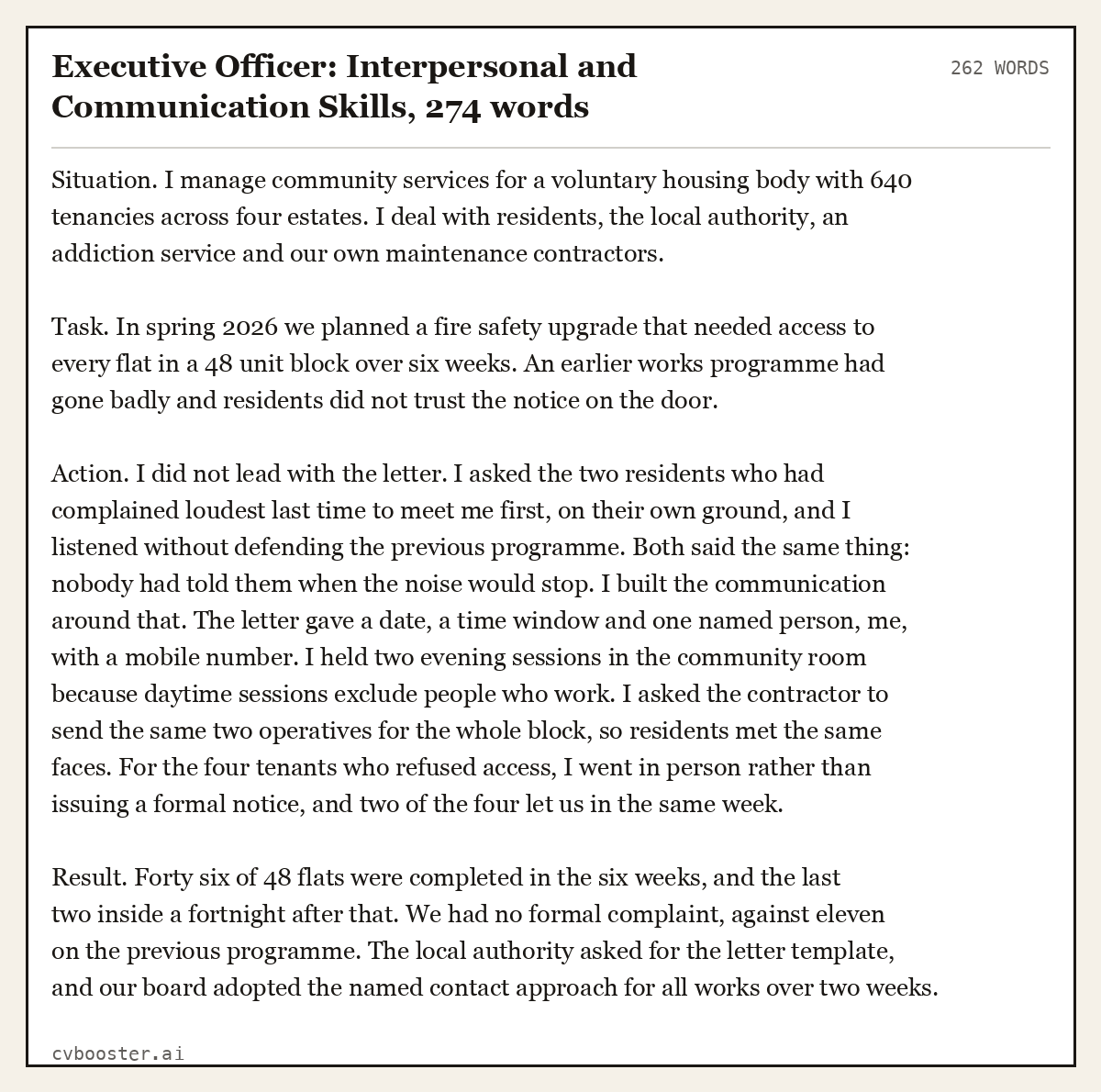
Executive Officer: Interpersonal and Communication Skills, 274 words (262 words)
Situation. I manage community services for a voluntary housing body with 640 tenancies across four estates. I deal with residents, the local authority, an addiction service and our own maintenance contractors.
Task. In spring 2026 we planned a fire safety upgrade that needed access to every flat in a 48 unit block over six weeks. An earlier works programme had gone badly and residents did not trust the notice on the door.
Action. I did not lead with the letter. I asked the two residents who had complained loudest last time to meet me first, on their own ground, and I listened without defending the previous programme. Both said the same thing: nobody had told them when the noise would stop. I built the communication around that. The letter gave a date, a time window and one named person, me, with a mobile number. I held two evening sessions in the community room because daytime sessions exclude people who work. I asked the contractor to send the same two operatives for the whole block, so residents met the same faces. For the four tenants who refused access, I went in person rather than issuing a formal notice, and two of the four let us in the same week.
Result. Forty six of 48 flats were completed in the six weeks, and the last two inside a fortnight after that. We had no formal complaint, against eleven on the previous programme. The local authority asked for the letter template, and our board adopted the named contact approach for all works over two weeks.
What the sifter is scoring
- Indicator quoted: "Modifies communication approach to suit the needs of a situation/ audience" (PAS Executive Officer competency model, Interpersonal and Communication Skills). Evening sessions are a decision about the audience, with a reason attached.
- Indicator quoted: "Actively listens to the views of others". He meets the two critics first and changes the letter because of what they said.
- Indicator quoted: "Liaises with other groups to gain co-operation". The contractor staffing request is co-operation asked for and won.
- Indicator quoted: "Is assertive and professional when dealing with challenging issues". Going in person before issuing a notice is the assertive line without the confrontation.
The two competencies that decide close calls
Lucia Romero is a training officer for a transport and logistics company in Monaghan.
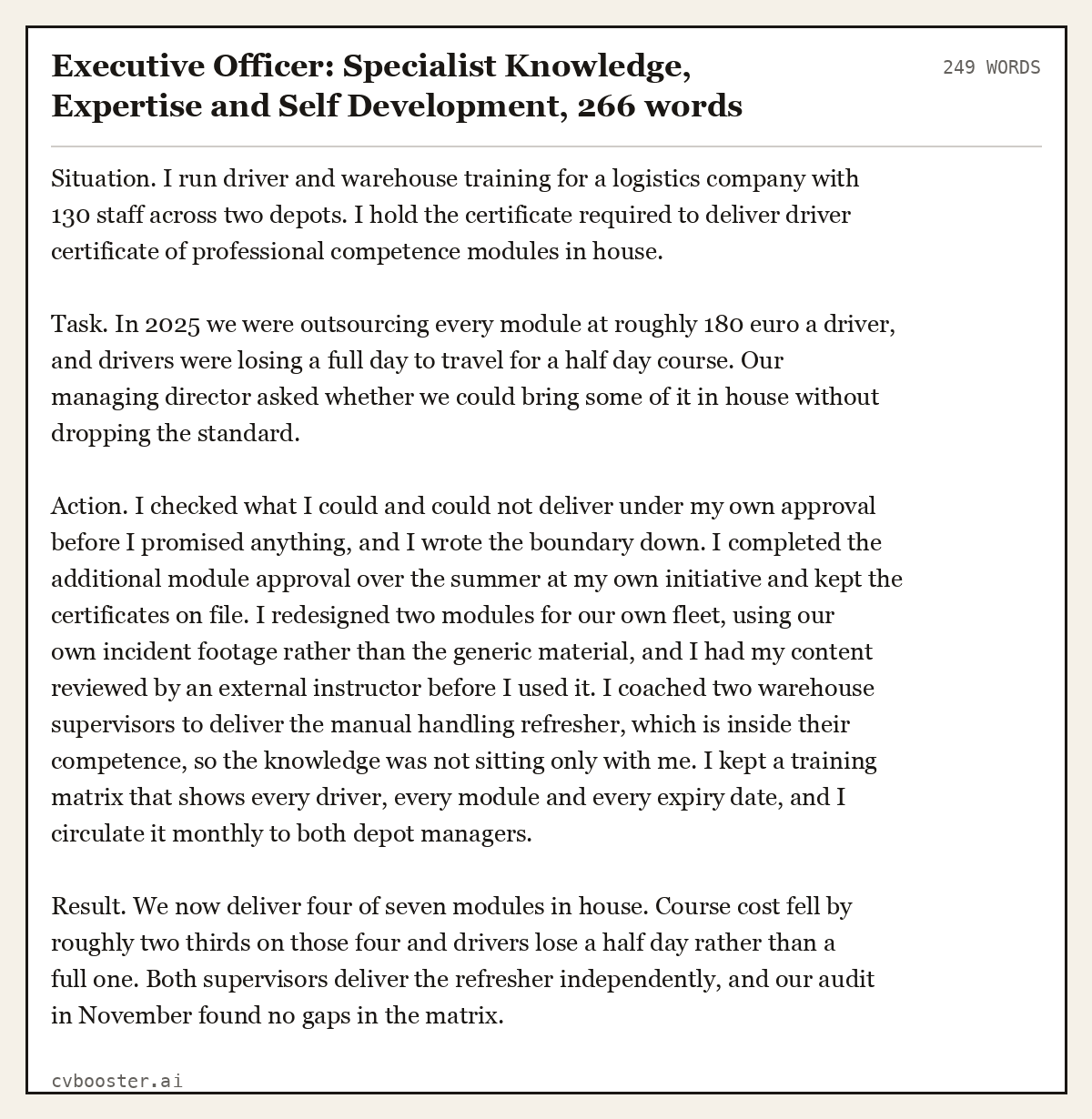
Executive Officer: Specialist Knowledge, Expertise and Self Development, 266 words (249 words)
Situation. I run driver and warehouse training for a logistics company with 130 staff across two depots. I hold the certificate required to deliver driver certificate of professional competence modules in house.
Task. In 2025 we were outsourcing every module at roughly 180 euro a driver, and drivers were losing a full day to travel for a half day course. Our managing director asked whether we could bring some of it in house without dropping the standard.
Action. I checked what I could and could not deliver under my own approval before I promised anything, and I wrote the boundary down. I completed the additional module approval over the summer at my own initiative and kept the certificates on file. I redesigned two modules for our own fleet, using our own incident footage rather than the generic material, and I had my content reviewed by an external instructor before I used it. I coached two warehouse supervisors to deliver the manual handling refresher, which is inside their competence, so the knowledge was not sitting only with me. I kept a training matrix that shows every driver, every module and every expiry date, and I circulate it monthly to both depot managers.
Result. We now deliver four of seven modules in house. Course cost fell by roughly two thirds on those four and drivers lose a half day rather than a full one. Both supervisors deliver the refresher independently, and our audit in November found no gaps in the matrix.
What the sifter is scoring
- Indicator quoted: "Displays high levels of skills/ expertise in own area and provides guidance to colleagues" (PAS Executive Officer competency model, Specialist Knowledge, Expertise and Self Development). Coaching two supervisors is the guidance half, which most answers leave out.
- Indicator quoted: "Leads by example, demonstrating the importance of development by setting time aside for development initiatives for self and the team".
- Capability wording that also fits: "Finds opportunities to share or showcase their specialist knowledge" (Executive Officer capability framework, Leading and Knowledge Sharing).
- Why it scores: she names the limit of her own approval before describing what she did. Boards trust a candidate who marks the edge of their competence.
Seamus Duffy is an Executive Officer in the freedom of information unit of a state agency in Dublin.
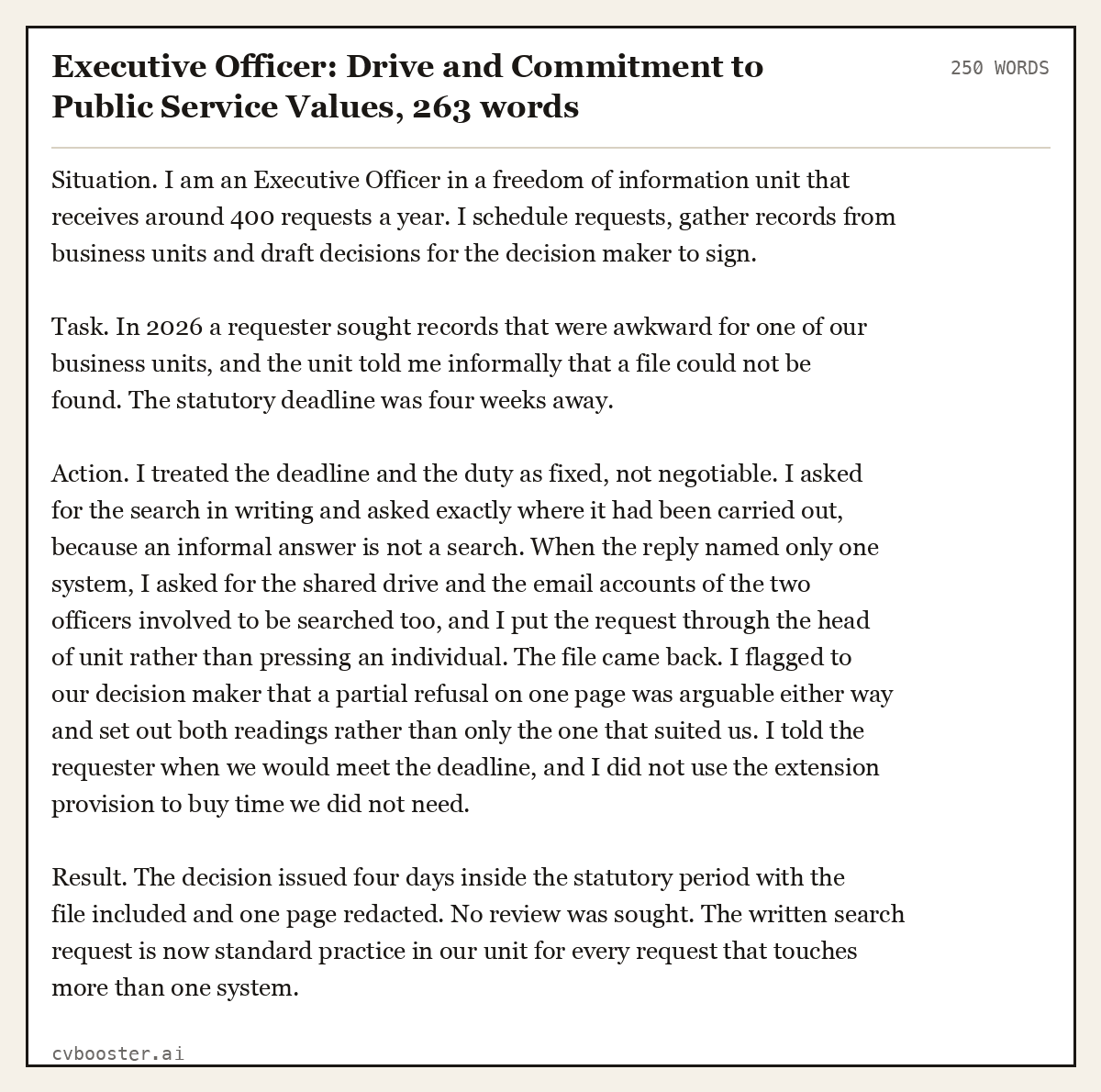
Executive Officer: Drive and Commitment to Public Service Values, 263 words (250 words)
Situation. I am an Executive Officer in a freedom of information unit that receives around 400 requests a year. I schedule requests, gather records from business units and draft decisions for the decision maker to sign.
Task. In 2026 a requester sought records that were awkward for one of our business units, and the unit told me informally that a file could not be found. The statutory deadline was four weeks away.
Action. I treated the deadline and the duty as fixed, not negotiable. I asked for the search in writing and asked exactly where it had been carried out, because an informal answer is not a search. When the reply named only one system, I asked for the shared drive and the email accounts of the two officers involved to be searched too, and I put the request through the head of unit rather than pressing an individual. The file came back. I flagged to our decision maker that a partial refusal on one page was arguable either way and set out both readings rather than only the one that suited us. I told the requester when we would meet the deadline, and I did not use the extension provision to buy time we did not need.
Result. The decision issued four days inside the statutory period with the file included and one page redacted. No review was sought. The written search request is now standard practice in our unit for every request that touches more than one system.
What the sifter is scoring
- Indicator quoted: "Is personally honest and trustworthy" (PAS Executive Officer competency model, Drive and Commitment to Public Service Values). The indicator is proved by the awkward search request, not by the word honest.
- Indicator quoted: "Acts with integrity and encourages this in others". Going through the head of unit rather than pressing an individual is integrity handled with judgement.
- Indicator quoted: "Is resilient and perseveres to obtain objectives despite obstacles or setbacks".
- Indicator quoted: "Ensures that customer service is at the heart of own/team work". Not using the extension is a small decision that a board reads as a value.
The sentences that cost marks at EO
- "I managed the team on a day to day basis." A board cannot score a day to day basis. Give one week, with a date.
- "I made sure the work was done to a high standard." Which check, on what, and what did it catch.
- "I liaised with stakeholders." Name them. Liaised is the least informative verb in public sector writing.
- "We took the decision to." At EO this is the most expensive we on the form, because People Management and Analysis both need your name on the decision.
- "I supported my manager with." Support is a CO claim. At EO, say what you held.
- An answer that ends when the task ends. End it with what changed for other people.
The grade below is covered on clerical officer competency examples. The form itself, box by box, is on publicjobs competency examples and competency based application form examples. For the board stage, see competency-based interview questions in Ireland. Health service equivalents advertised through HSE careers use their own competency names, so check the booklet before reusing an answer.
Frequently asked questions
Can you give me an example of a competency?
People Management is a competency in the PAS Executive Officer model. Its indicators include "Values and supports the development of others and the team" and "Actively shares information, knowledge and expertise to help the team to meet it's objectives". The competency is the heading, the indicators are what is marked, and your answer is the evidence. The contact centre answer above is one competency, evidenced once.
What are the 5 core competencies examples?
At Executive Officer level the model runs to six, and the five that carry the most marks in practice are People Management, Analysis and Decision Making, Delivery of Results, Interpersonal and Communication Skills, and Specialist Knowledge, Expertise and Self Development. Drive and Commitment to Public Service Values is the sixth and is often the tie breaker between two candidates with similar scores elsewhere.
Can you give me an example of a competency question?
"Tell me about a time you had to make a recommendation without complete information." That question targets Analysis and Decision Making, and the board is listening for the sources you used, the options you rejected and the evidence behind the recommendation. Answer it with one occasion, a date, the options you costed, and what was decided. The procurement answer above is built for exactly that question.
What are top 3 competencies?
The three your competition weights highest, which the booklet tells you. At Executive Officer that is usually People Management, Analysis and Decision Making, and Delivery of Results, because those three carry the most indicators and the board has the most to tick. Choose the three where you hold a dated example with a number in the result, not the three you find easiest to talk about.
More in this series: related guides
- Clerical Officer Competency Examples: 6 Full Answers
- Competency Based Application Form: 5 Filled Examples
- Competency-Based Interview Questions and 15 Answers, Ireland
- publicjobs Competency Examples: 7 Worked Form Answers
Related articles
- Clerical Officer Competency Examples: 6 Full Answers
- Competency Based Application Form: 5 Filled Examples
- publicjobs Competency Examples: 7 Worked Form Answers
- Competency-Based Interview Questions and 15 Answers, Ireland
More articles
- Federal Resume Example: A Complete GS-9 Program Analyst
- How to Write a Resume for Your First Job (No Experience Needed)
- Free ATS Resume Checker: Score Your Resume Before You Apply
Looking for a worked example for your job title? Browse the resume examples by job title.