Clerical Officer Competency Examples: 6 Full Answers
By Mustafa Tarabya, founder of CVBooster · Published · Updated
15 min read
Clerical officer competency examples are marked against published indicators, so every answer has to land a named indicator rather than sound keen. The constraint is that a Clerical Officer competition uses one box per competency with a hard word cap, and a single weak box can end the application. The indicator wording quoted here was read in September 2026 in the PAS Clerical Officer competency model and on the Clerical Officer capability framework page. Six complete answers follow, one per competency, each annotated line by line. Written by Mustafa Tarabya, who hired for his own company, read every application himself and now writes CVBooster's guides.
What a Clerical Officer board is ticking
There are two published documents and your competition booklet names one of them.
- The PAS Clerical Officer competency model lists six competencies: Team work, Information Management / Processing, Delivery of Results, Customer Service and Communication Skills, Specialist Knowledge, Expertise and Self Development, and Drive and Commitment to Public Service Values.
- The capability framework covers the same ground in three dimensions: Building Future Readiness, Evidence Informed Delivery, and Communicating and Collaborating.
Under either heading sit short statements the model calls effective performance indicators. They are written as observable behaviour, which tells you what the answer has to contain. The Team work indicator "Understands own role in the team, making every effort to play his/her part" cannot be evidenced by saying you are a team player. It needs an occasion where your part was visible and someone else's was not yours.
Team work, annotated
Niamh Costello works in the office of a builders' merchant in Castlebar, County Mayo.
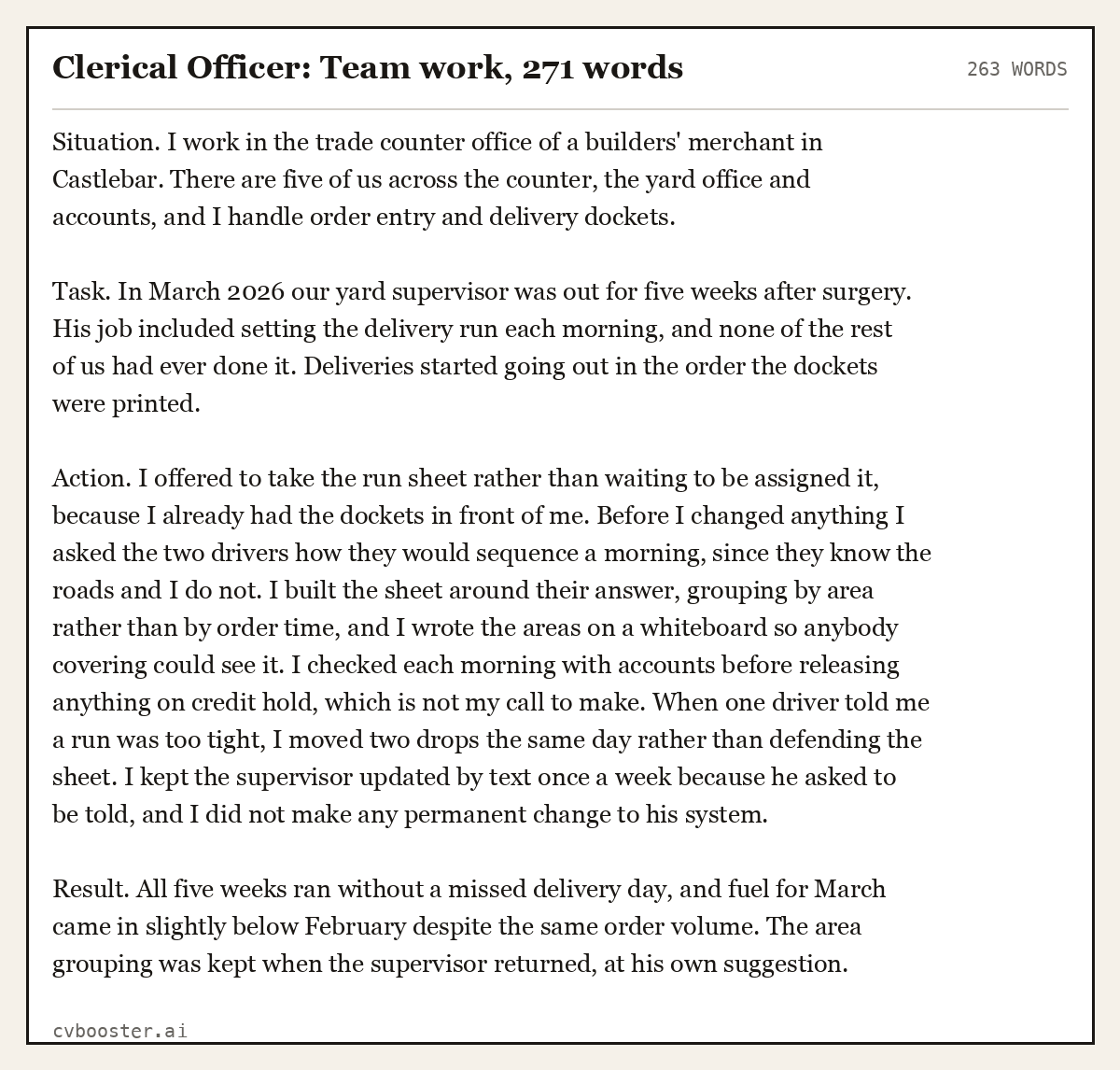
Clerical Officer: Team work, 271 words (263 words)
Situation. I work in the trade counter office of a builders' merchant in Castlebar. There are five of us across the counter, the yard office and accounts, and I handle order entry and delivery dockets.
Task. In March 2026 our yard supervisor was out for five weeks after surgery. His job included setting the delivery run each morning, and none of the rest of us had ever done it. Deliveries started going out in the order the dockets were printed.
Action. I offered to take the run sheet rather than waiting to be assigned it, because I already had the dockets in front of me. Before I changed anything I asked the two drivers how they would sequence a morning, since they know the roads and I do not. I built the sheet around their answer, grouping by area rather than by order time, and I wrote the areas on a whiteboard so anybody covering could see it. I checked each morning with accounts before releasing anything on credit hold, which is not my call to make. When one driver told me a run was too tight, I moved two drops the same day rather than defending the sheet. I kept the supervisor updated by text once a week because he asked to be told, and I did not make any permanent change to his system.
Result. All five weeks ran without a missed delivery day, and fuel for March came in slightly below February despite the same order volume. The area grouping was kept when the supervisor returned, at his own suggestion.
What the sifter is scoring
- Indicator quoted: "Understands own role in the team, making every effort to play his/her part" (PAS Clerical Officer competency model, Team work). Niamh takes a job nobody owned and stops short of the credit decision that is not hers.
- Indicator quoted: "Develops and maintains good working relationships with others, sharing information and knowledge, as appropriate". The whiteboard and the weekly text are the sharing line, made specific.
- Indicator quoted: "Offers own ideas and perspectives". Grouping by area is her idea, and she says so without claiming the drivers' knowledge as her own.
- Why it scores: a board can see exactly which sentence is her and which is the team. That is the whole test in this competency.
The shape of a Clerical Officer answer
Spend the box where the indicators live. Action is the only part a marker can score.
| Part | Share of the box | What belongs there |
|---|---|---|
| Situation | 15 per cent | The employer, your actual job title, the scale in numbers |
| Task | 15 per cent | The problem, who asked for what, the deadline |
| Action | 55 per cent | Your own steps in order, first person singular |
| Result | 15 per cent | One number, plus one thing that outlasted the task |
The publicjobs.ie application advice page sets the standard for the form itself: "The application form is designed to ensure you can clearly demonstrate the skills and experiences that you have."
Tip: Write the indicator you are aiming at above the box while you draft, then delete it. If you cannot point to the sentence that hits it, the answer is not finished.
Information Management and Processing, annotated
Kevin Sheehan is a part time library assistant in a county library service in Ennis, County Clare.
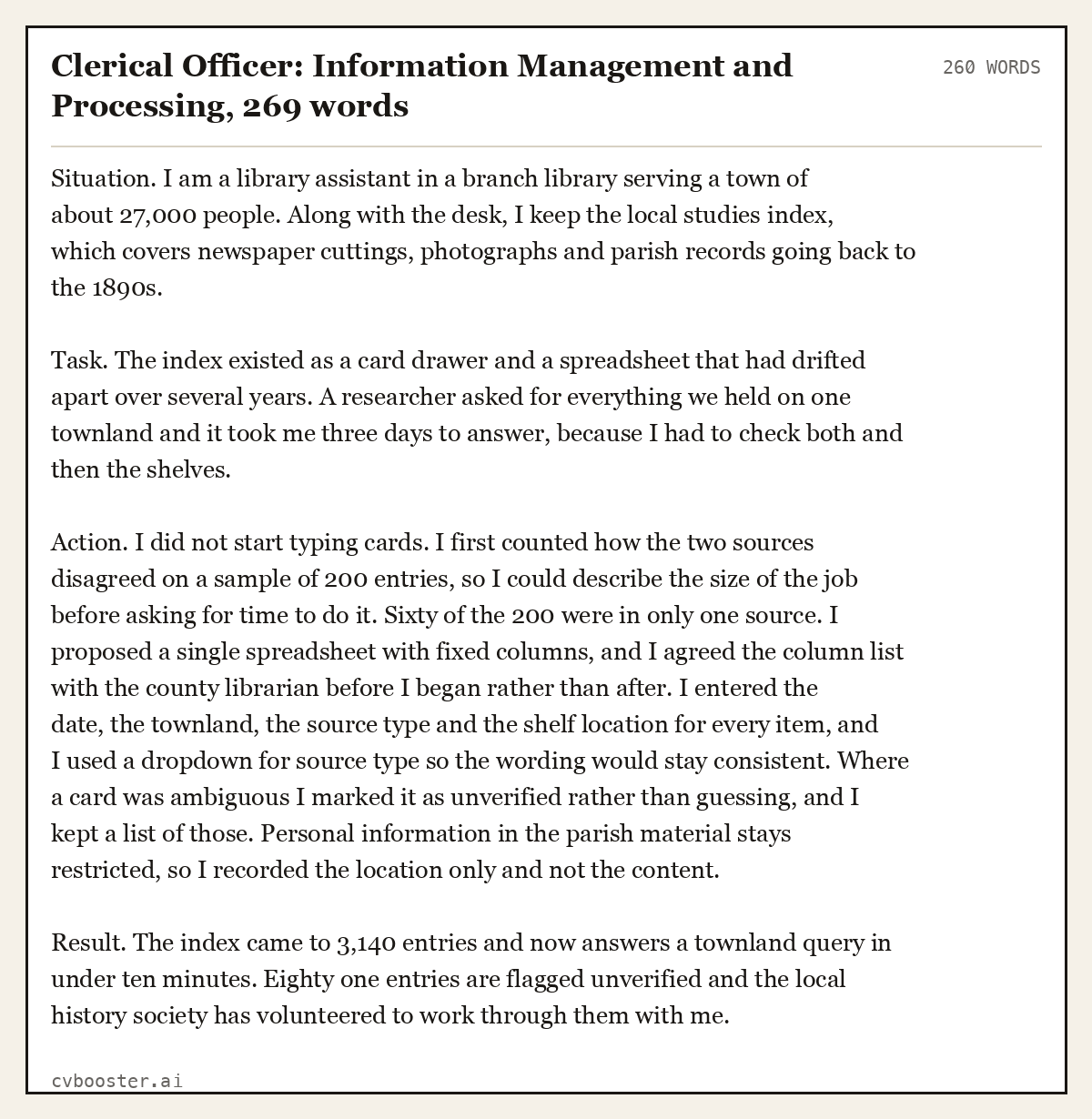
Clerical Officer: Information Management and Processing, 269 words (260 words)
Situation. I am a library assistant in a branch library serving a town of about 27,000 people. Along with the desk, I keep the local studies index, which covers newspaper cuttings, photographs and parish records going back to the 1890s.
Task. The index existed as a card drawer and a spreadsheet that had drifted apart over several years. A researcher asked for everything we held on one townland and it took me three days to answer, because I had to check both and then the shelves.
Action. I did not start typing cards. I first counted how the two sources disagreed on a sample of 200 entries, so I could describe the size of the job before asking for time to do it. Sixty of the 200 were in only one source. I proposed a single spreadsheet with fixed columns, and I agreed the column list with the county librarian before I began rather than after. I entered the date, the townland, the source type and the shelf location for every item, and I used a dropdown for source type so the wording would stay consistent. Where a card was ambiguous I marked it as unverified rather than guessing, and I kept a list of those. Personal information in the parish material stays restricted, so I recorded the location only and not the content.
Result. The index came to 3,140 entries and now answers a townland query in under ten minutes. Eighty one entries are flagged unverified and the local history society has volunteered to work through them with me.
What the sifter is scoring
- Indicator quoted: "Approaches and delivers all work in a thorough and organised manner" (PAS Clerical Officer competency model, Information Management / Processing). The sample of 200 before starting is thoroughness with a method behind it.
- Indicator quoted: "Keeps high quality records that are easy for others to understand". Fixed columns and a dropdown are the reason the record is usable by somebody else.
- Indicator quoted: "Draws appropriate conclusions from information". Sixty in one source only is a conclusion, not a complaint.
- Capability wording that also fits: "Handles all information and data carefully, particularly when dealing with sensitive or confidential matters" (Clerical Officer capability framework). Restricting the parish content earns that line.
Delivery of Results, annotated
Marta Kowalczyk is a payroll assistant for a hotel group in Killarney, County Kerry.
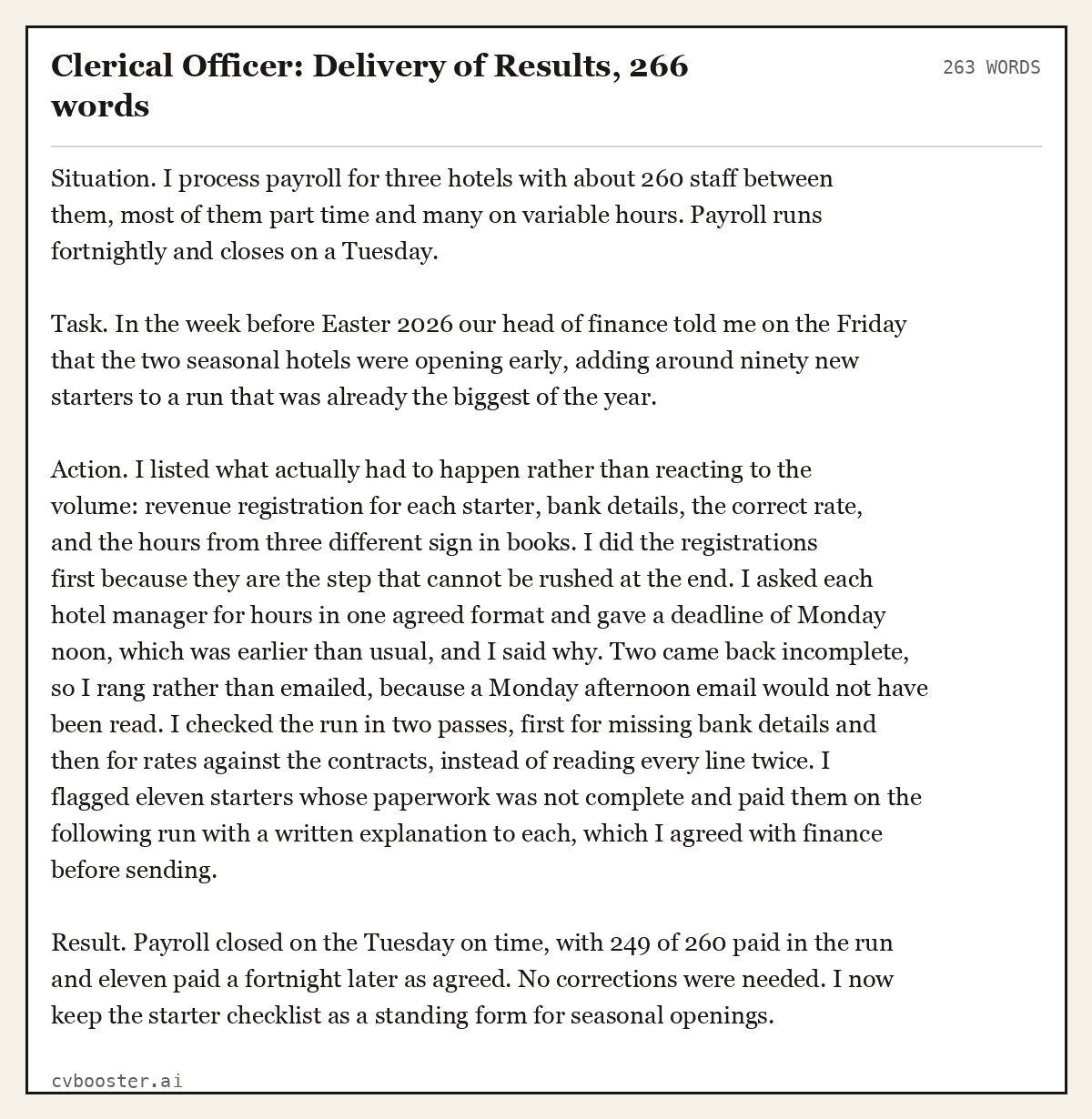
Clerical Officer: Delivery of Results, 266 words (263 words)
Situation. I process payroll for three hotels with about 260 staff between them, most of them part time and many on variable hours. Payroll runs fortnightly and closes on a Tuesday.
Task. In the week before Easter 2026 our head of finance told me on the Friday that the two seasonal hotels were opening early, adding around ninety new starters to a run that was already the biggest of the year.
Action. I listed what actually had to happen rather than reacting to the volume: revenue registration for each starter, bank details, the correct rate, and the hours from three different sign in books. I did the registrations first because they are the step that cannot be rushed at the end. I asked each hotel manager for hours in one agreed format and gave a deadline of Monday noon, which was earlier than usual, and I said why. Two came back incomplete, so I rang rather than emailed, because a Monday afternoon email would not have been read. I checked the run in two passes, first for missing bank details and then for rates against the contracts, instead of reading every line twice. I flagged eleven starters whose paperwork was not complete and paid them on the following run with a written explanation to each, which I agreed with finance before sending.
Result. Payroll closed on the Tuesday on time, with 249 of 260 paid in the run and eleven paid a fortnight later as agreed. No corrections were needed. I now keep the starter checklist as a standing form for seasonal openings.
What the sifter is scoring
- Indicator quoted: "Identifies and appreciates the urgency and importance of different tasks" (PAS Clerical Officer competency model, Delivery of Results). Doing registrations first is priority stated as a decision with a reason.
- Indicator quoted: "Demonstrates initiative and flexibility in ensuring work is delivered". Ringing the two managers instead of emailing is initiative at a scale a board believes.
- Indicator quoted: "Checks all work thoroughly to ensure it is completed to a high standard and learns from mistakes". Two targeted passes beat a vague claim to be careful.
- Indicator quoted: "Is self reliant and uses judgment on when to ask manager or colleagues for guidance". She agrees the eleven deferrals with finance rather than deciding alone.
Customer Service and Communication Skills, annotated
Eoin Daly works the front desk of a council leisure centre in Navan, County Meath.
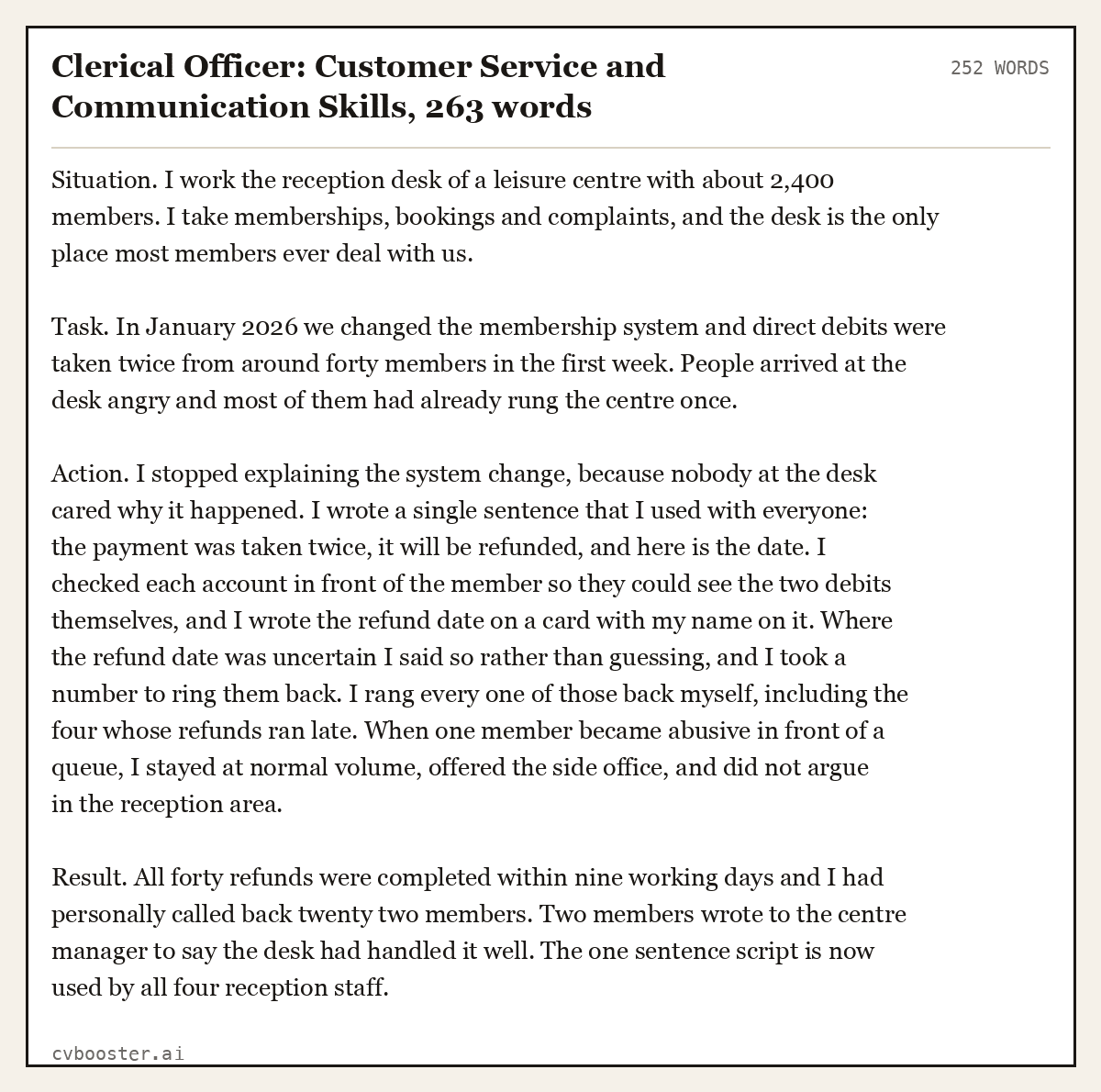
Clerical Officer: Customer Service and Communication Skills, 263 words (252 words)
Situation. I work the reception desk of a leisure centre with about 2,400 members. I take memberships, bookings and complaints, and the desk is the only place most members ever deal with us.
Task. In January 2026 we changed the membership system and direct debits were taken twice from around forty members in the first week. People arrived at the desk angry and most of them had already rung the centre once.
Action. I stopped explaining the system change, because nobody at the desk cared why it happened. I wrote a single sentence that I used with everyone: the payment was taken twice, it will be refunded, and here is the date. I checked each account in front of the member so they could see the two debits themselves, and I wrote the refund date on a card with my name on it. Where the refund date was uncertain I said so rather than guessing, and I took a number to ring them back. I rang every one of those back myself, including the four whose refunds ran late. When one member became abusive in front of a queue, I stayed at normal volume, offered the side office, and did not argue in the reception area.
Result. All forty refunds were completed within nine working days and I had personally called back twenty two members. Two members wrote to the centre manager to say the desk had handled it well. The one sentence script is now used by all four reception staff.
What the sifter is scoring
- Indicator quoted: "Is respectful, courteous and professional, remaining composed, even in challenging circumstances" (PAS Clerical Officer competency model, Customer Service and Communication Skills). Composure is shown by what he did with the queue, not claimed.
- Indicator quoted: "Understands the steps or processes that customers must go through and can clearly explain these". The card with the date and his name is that explanation in a form the member can take away.
- Indicator quoted: "Communicates clearly and fluently when speaking and in writing". One sentence, reused, adopted by four colleagues.
- Indicator quoted: "Can be firm when necessary and communicate with confidence and authority". Offering the side office is firmness without a confrontation.
The two competencies people leave thin
Most candidates put their best material in the first four boxes and run out. These two decide close calls.
Rachel Byrne is a clerical assistant in a veterinary practice in Kilkenny.
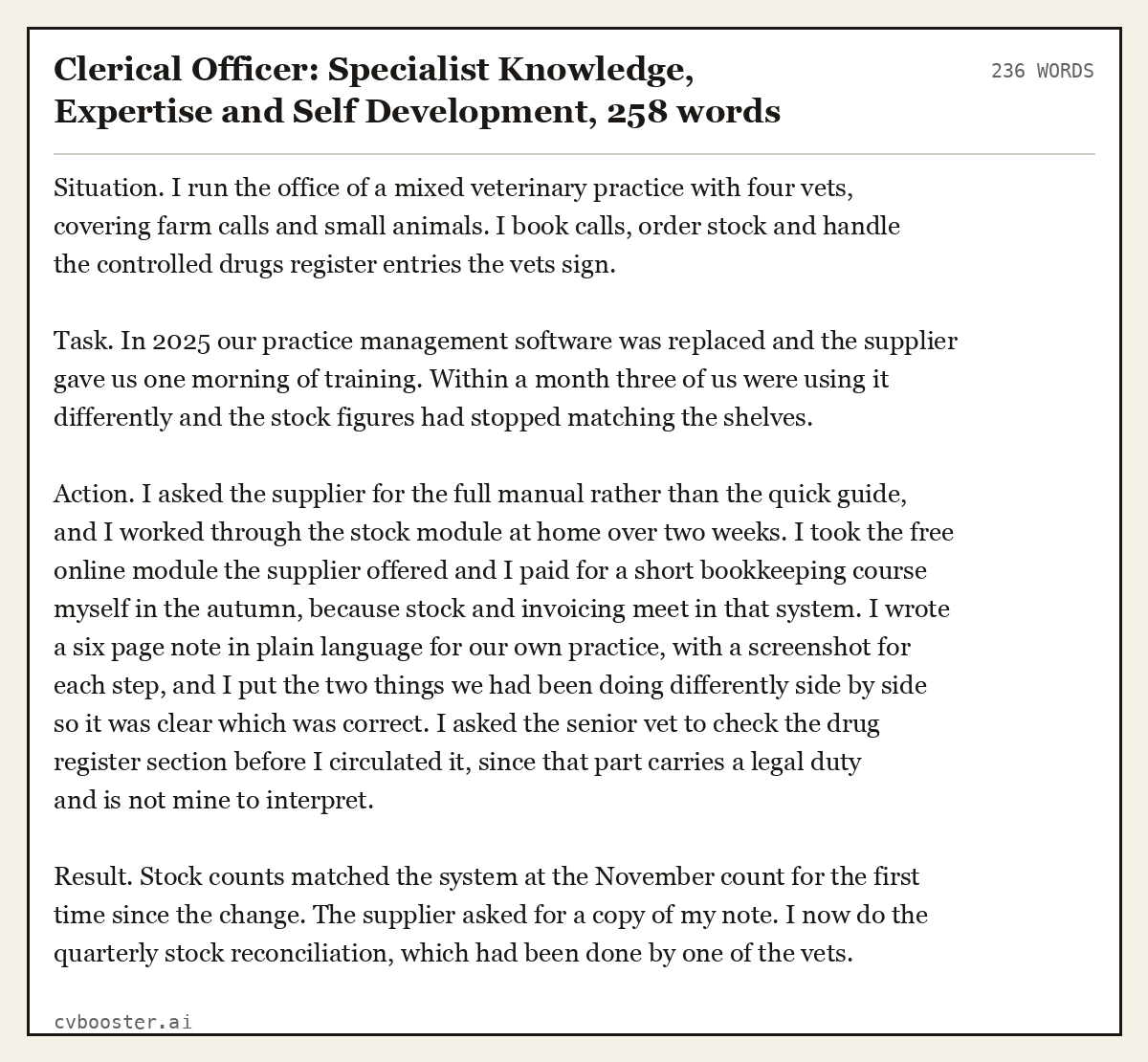
Clerical Officer: Specialist Knowledge, Expertise and Self Development, 258 words (236 words)
Situation. I run the office of a mixed veterinary practice with four vets, covering farm calls and small animals. I book calls, order stock and handle the controlled drugs register entries the vets sign.
Task. In 2025 our practice management software was replaced and the supplier gave us one morning of training. Within a month three of us were using it differently and the stock figures had stopped matching the shelves.
Action. I asked the supplier for the full manual rather than the quick guide, and I worked through the stock module at home over two weeks. I took the free online module the supplier offered and I paid for a short bookkeeping course myself in the autumn, because stock and invoicing meet in that system. I wrote a six page note in plain language for our own practice, with a screenshot for each step, and I put the two things we had been doing differently side by side so it was clear which was correct. I asked the senior vet to check the drug register section before I circulated it, since that part carries a legal duty and is not mine to interpret.
Result. Stock counts matched the system at the November count for the first time since the change. The supplier asked for a copy of my note. I now do the quarterly stock reconciliation, which had been done by one of the vets.
What the sifter is scoring
- Indicator quoted: "Develops and maintains the skills and expertise required to perform in the role effectively, e.g. relevant technologies, IT systems, spreadsheets, Microsoft Office, relevant policies etc." (PAS Clerical Officer competency model, Specialist Knowledge, Expertise and Self Development).
- Indicator quoted: "Is committed to self development and continuously seeks to improve personal performance". A paid course and a free module, both named and dated, beat the phrase eager to learn.
- Indicator quoted: "Clearly understands the role, objectives and targets and how they fit into the work of the unit". Checking the drug register section with the vet shows she knows where her role stops.
Joseph Mensah is on a temporary contract at a motor tax office in Portlaoise, County Laois.
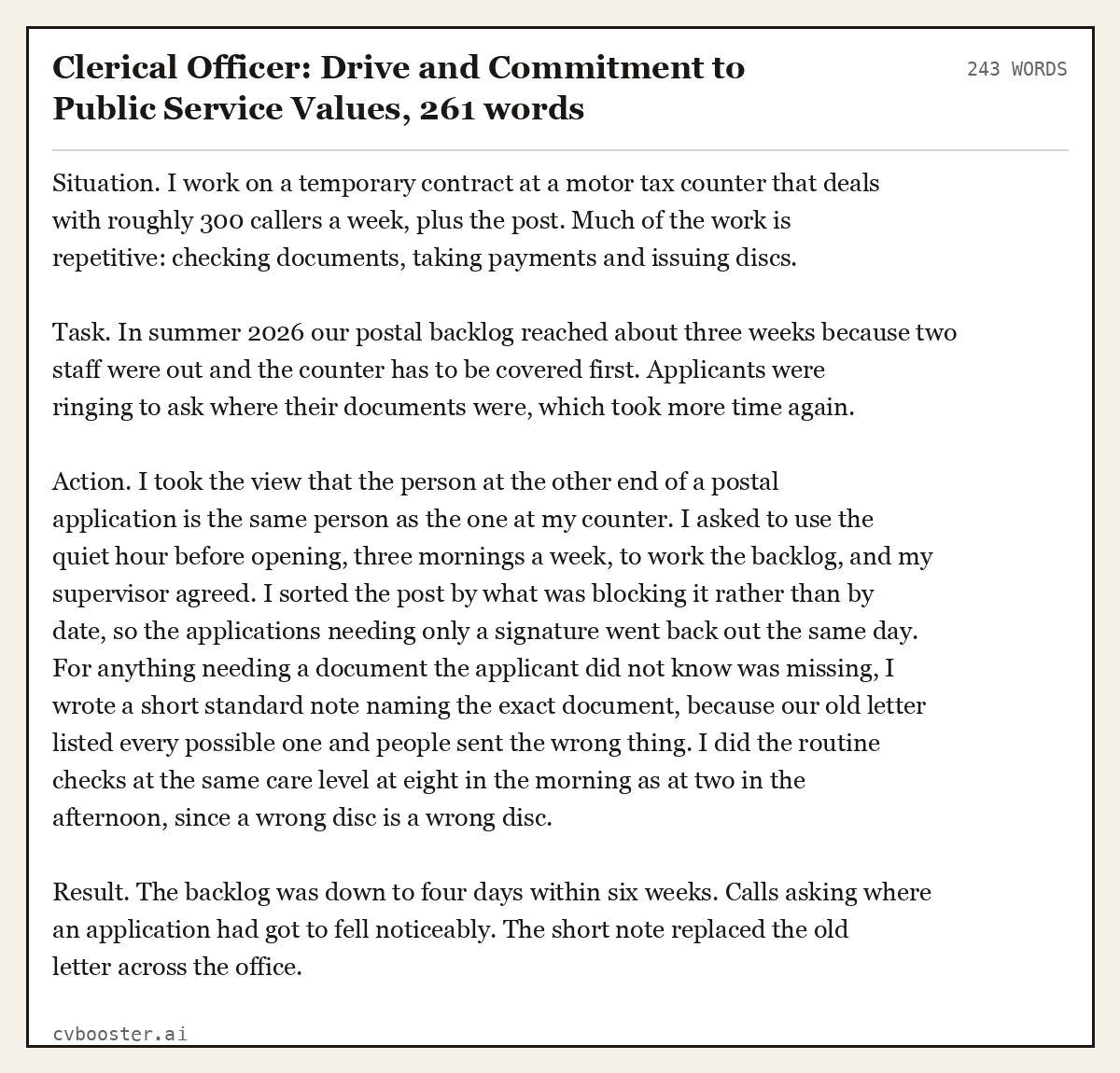
Clerical Officer: Drive and Commitment to Public Service Values, 261 words (243 words)
Situation. I work on a temporary contract at a motor tax counter that deals with roughly 300 callers a week, plus the post. Much of the work is repetitive: checking documents, taking payments and issuing discs.
Task. In summer 2026 our postal backlog reached about three weeks because two staff were out and the counter has to be covered first. Applicants were ringing to ask where their documents were, which took more time again.
Action. I took the view that the person at the other end of a postal application is the same person as the one at my counter. I asked to use the quiet hour before opening, three mornings a week, to work the backlog, and my supervisor agreed. I sorted the post by what was blocking it rather than by date, so the applications needing only a signature went back out the same day. For anything needing a document the applicant did not know was missing, I wrote a short standard note naming the exact document, because our old letter listed every possible one and people sent the wrong thing. I did the routine checks at the same care level at eight in the morning as at two in the afternoon, since a wrong disc is a wrong disc.
Result. The backlog was down to four days within six weeks. Calls asking where an application had got to fell noticeably. The short note replaced the old letter across the office.
What the sifter is scoring
- Indicator quoted: "Is thorough and conscientious, even if work is routine" (PAS Clerical Officer competency model, Drive and Commitment to Public Service Values). The line about the same care at eight as at two is that indicator, and nothing else.
- Indicator quoted: "Consistently strives to perform at a high level and deliver a quality service".
- Indicator quoted: "Serves the Government and people of Ireland". The opening decision, that the postal applicant is the same person as the counter caller, is a public service value expressed as a choice.
- Indicator quoted: "Is enthusiastic and resilient, persevering in the face of challenges and setbacks".
The sentences that cost marks
- "I have excellent attention to detail." No indicator anywhere in this model rewards an adjective about yourself.
- "We reduced the backlog." The board cannot give a mark to we. Say which part was you.
- "I dealt with customers on a daily basis." Daily basis is a duty. One occasion with a date is evidence.
- "I am a fast learner and a good team player." Both of these have indicators underneath them that you have just skipped.
- "It improved things a lot." A result with no number is unscored.
- Reusing the same story in two boxes. Assessors read all the boxes together and the repeat reads as one thin story.
Health service Grade III and IV competitions advertised through HSE careers use a similar structure with their own competency names, so read the booklet for your competition before reusing an answer. For the grade above, see executive officer competency examples. For the form itself, see publicjobs competency examples and competency based application form examples. For the board, see competency-based interview questions in Ireland.
Before you submit
- One experience per competency, and no experience used twice.
- Every box is at least half Action, in the first person singular.
- Every Result carries a number and one thing that outlasted the task.
- You have counted the words in a word processor, not in the browser.
- You have the closing time. Clerical Officer competitions usually close at 12 noon.
- You saved a copy. The interview board builds its questions from what you wrote.
Frequently asked questions
What are the key competencies of a Clerical Officer?
Six, in the PAS Clerical Officer competency model: Team work, Information Management / Processing, Delivery of Results, Customer Service and Communication Skills, Specialist Knowledge, Expertise and Self Development, and Drive and Commitment to Public Service Values. The newer capability framework groups the same behaviour into three dimensions, Building Future Readiness, Evidence Informed Delivery, and Communicating and Collaborating. Your competition booklet names which document applies.
Can you give me an example of a competency?
Delivery of Results is a competency. It is defined by indicators including "Takes responsibility for work and sees it through to the appropriate next level" and "Completes work in a timely manner". A competency is an area of performance with published indicators, not a personal quality. You prove one with a dated occasion, your own actions and a measurable result, which is what the payroll answer above does.
Can you give me some examples of clerical skills?
The Clerical Officer capability framework lists key skills examples directly: IT skills such as Microsoft Office, digital literacy, customer service, time management, planning and organising, working with data, information processing, problem solving, written skills, active listening and teamwork. Naming a skill earns nothing on its own. The mark comes from the occasion where you used it, with the scale and the outcome attached.
What are the 5 core competencies examples?
Irish public sector competitions rarely stop at five, but the five that appear most often at Clerical Officer level are Team work, Information Management and Processing, Delivery of Results, Customer Service and Communication Skills, and Drive and Commitment to Public Service Values. Local authority Grade III booklets usually use a similar five and add Personal Effectiveness, which expects knowledge of the council and the role of councillors.
More in this series: related guides
- Competency Based Application Form: 5 Filled Examples
- Competency-Based Interview Questions and 15 Answers, Ireland
- Executive Officer Competency Examples: 6 Full Answers
- publicjobs Competency Examples: 7 Worked Form Answers
Related articles
- Executive Officer Competency Examples: 6 Full Answers
- Competency Based Application Form: 5 Filled Examples
- publicjobs Competency Examples: 7 Worked Form Answers
- Competency-Based Interview Questions and 15 Answers, Ireland
More articles
- Interview Questions and Answers: the 20 You Will Be Asked
- Communicating and Influencing: 4 Civil Service Examples
Looking for a worked example for your job title? Browse the resume examples by job title.