Another Word for Experienced on a Resume: 35 Synonyms

Another word for experienced on a resume is seasoned, skilled, proficient, well-versed, accomplished or hands-on, but the best replacement of all is the number of years plus the thing you did in them. Every synonym is still a claim, so it needs a fact in the same line or it reads as filler. The Merriam-Webster thesaurus has the long list, and Harvard's career office asks for resume language that is "Specific rather than general". Below are the synonyms by meaning, eight more for the noun experience, six rewrites from entry level to senior, and when experienced stays.
Read thirty resumes in a row and you meet thirty experienced professionals and not a single experience. The word turns up so early, and so often, that it stops meaning years and starts meaning "owns a resume".
Another word for experienced on a resume, in one summary line
Experienced lives in the summary at the top of the page, so that is where to fix it first. A mid-level support lead, before and after.
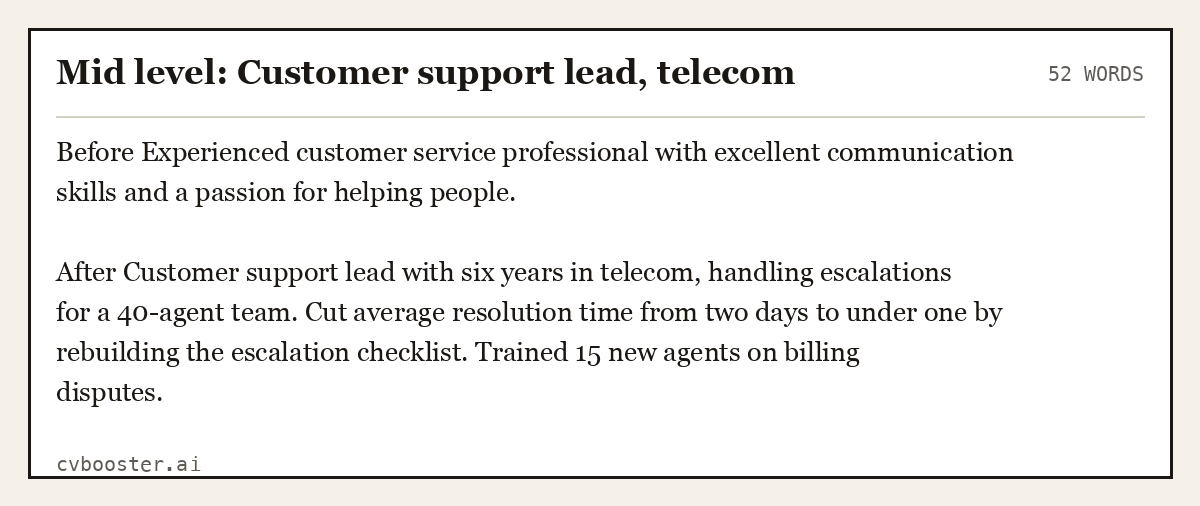
Mid level: Customer support lead, telecom
52 wordsBefore Experienced customer service professional with excellent communication skills and a passion for helping people.
After Customer support lead with six years in telecom, handling escalations for a 40-agent team. Cut average resolution time from two days to under one by rebuilding the escalation checklist. Trained 15 new agents on billing disputes.
The word experienced is gone and nobody misses it. "Six years in telecom" says it with a number, and the next two sentences prove it.
Create my CVOr start from one of our free resume templates
Experienced synonyms, grouped by what you mean
Cambridge Dictionary's entry for experienced defines the word as "having knowledge or skill in a job or activity". That covers three separate claims: time, skill and knowledge. Decide which one you are making, then take a word from that group.
- Time spent doing it: seasoned, veteran, long-serving, established
- Skill at doing it: skilled, proficient, accomplished, capable, adept, expert
- Knowledge of an area: well-versed in, trained in, specialized in, knowledgeable about
- Done it for real, not in theory: hands-on, practical, field-tested, working knowledge of
- Done it at a level that was checked: proven, certified (only with the certificate), licensed (only with the license)
- The verb, as in "experienced growth": saw, went through, managed through, handled, faced
Expert is the riskiest word on the list. Write it and the interview turns into a quiz, so keep it for the one thing you could teach.
Another word for experience, the noun
Experience is also a noun, and the noun needs its own words: in a summary line, in a skills line and for the section heading itself. Thesaurus.com files background, exposure, know-how, knowledge and practice under the noun. On a resume each one makes a different claim.
| Instead of | Write | Example line |
|---|---|---|
| five years of experience in | five years in, a background in | Five years in B2B sales, the last two on enterprise accounts |
| experience with Excel | working knowledge of, hands-on use of | Working knowledge of Excel pivot tables and Power Query |
| extensive experience | a track record of | A track record of closing six-figure renewals |
| some experience in a new area | exposure to | Exposure to FDA audit preparation as a quality intern |
| deep experience | expertise in | Expertise in payroll tax for multi-state employers |
| practical experience | know-how, field experience | Field experience installing commercial HVAC systems |
| Experience, as a heading | Work Experience, Professional Experience, Employment History | One of these as the heading, nothing clever |
| relevant experience, as a student | Relevant Projects, Coursework, Volunteer Work | A heading for each, with dates like a job |
Exposure is the honest word when you saw the work but did not own it. Keep expertise for one area, for the same reason as expert above. For the heading, use a standard name such as Work Experience, because that is the label a reader scans for; a clever label like My Journey makes them hunt.
The opposites, for describing a gap honestly, are inexperienced, untrained and green. On a resume only new to helps, as in new to healthcare after five years in hospitality. And if the phrase you want to replace is worked with, that is a different problem, covered in worked with synonyms for a resume.
Rewrites for every kind of experienced
Each pair keeps the person and the facts. Only the claim gets proof attached.
Hands-on: you are early in your career
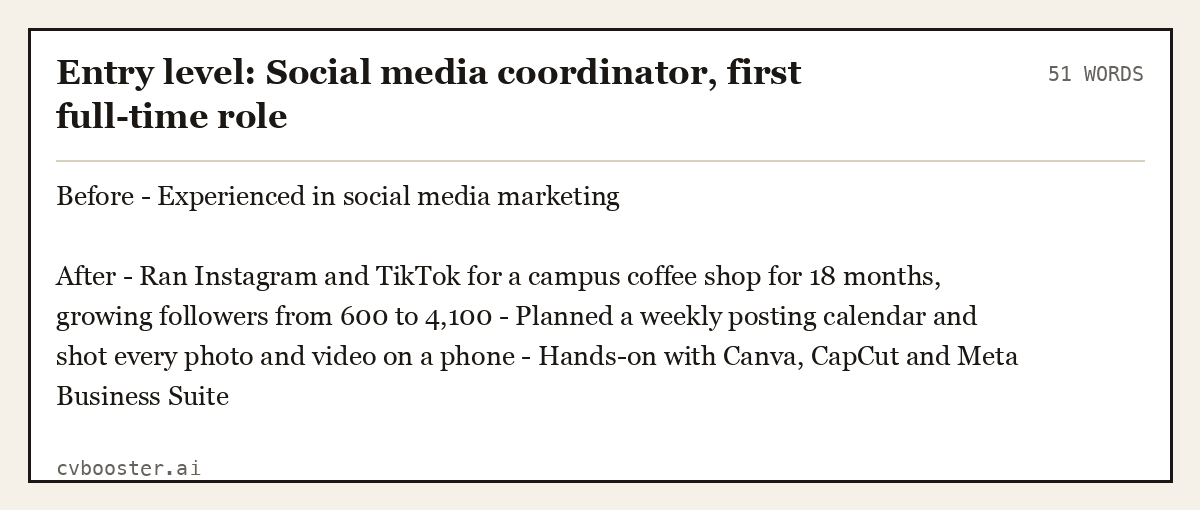
Entry level: Social media coordinator, first full-time role
51 wordsBefore - Experienced in social media marketing
After - Ran Instagram and TikTok for a campus coffee shop for 18 months, growing followers from 600 to 4,100 - Planned a weekly posting calendar and shot every photo and video on a phone - Hands-on with Canva, CapCut and Meta Business Suite
Eighteen months on one account is real experience. Saying so in numbers is better than calling it experience.
Seasoned: you have the years, so count them
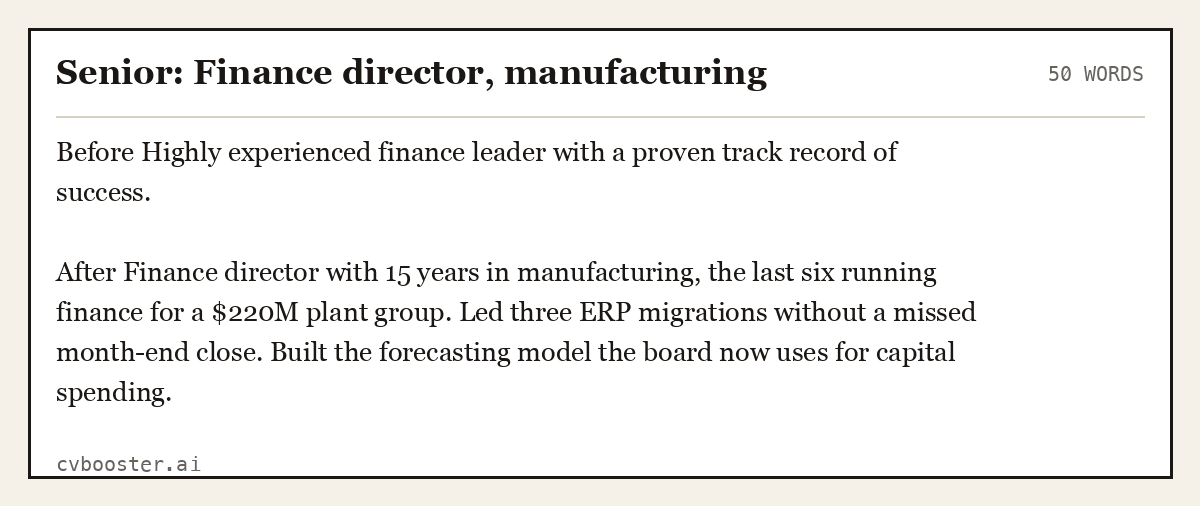
Senior: Finance director, manufacturing
50 wordsBefore Highly experienced finance leader with a proven track record of success.
After Finance director with 15 years in manufacturing, the last six running finance for a $220M plant group. Led three ERP migrations without a missed month-end close. Built the forecasting model the board now uses for capital spending.
Proficient: the skills line
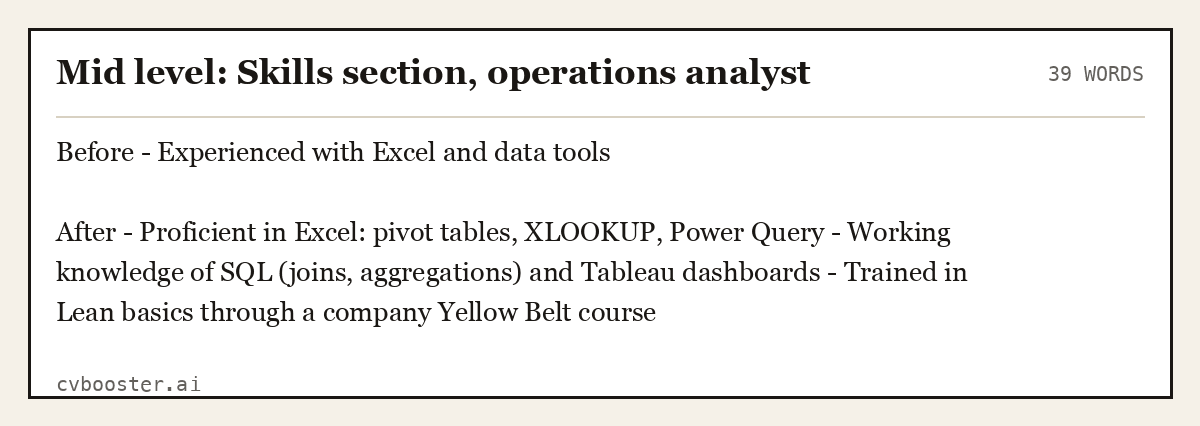
Mid level: Skills section, operations analyst
39 wordsBefore - Experienced with Excel and data tools
After - Proficient in Excel: pivot tables, XLOOKUP, Power Query - Working knowledge of SQL (joins, aggregations) and Tableau dashboards - Trained in Lean basics through a company Yellow Belt course
Saw: the verb that hides your part
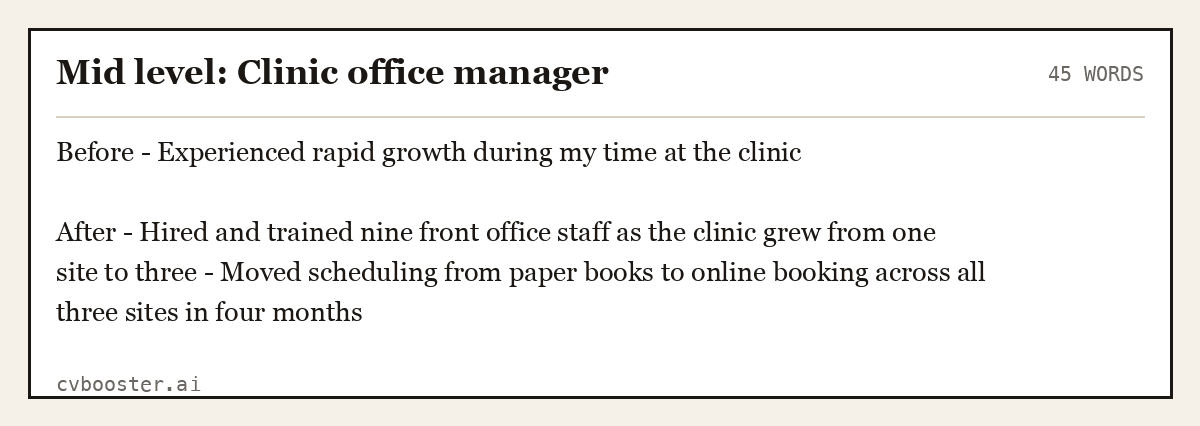
Mid level: Clinic office manager
45 wordsBefore - Experienced rapid growth during my time at the clinic
After - Hired and trained nine front office staff as the clinic grew from one site to three - Moved scheduling from paper books to online booking across all three sites in four months
"Experienced rapid growth" tells the reader the company grew. The rewrite tells them what you did while it grew, which is the only part they are hiring.
Experience from another field
A career change is where experienced does the most damage, because the years were spent somewhere else. MIT's career advising office puts it in one line: "Remember: experience comes in many forms." Your job is to translate the old years into the new field's words.
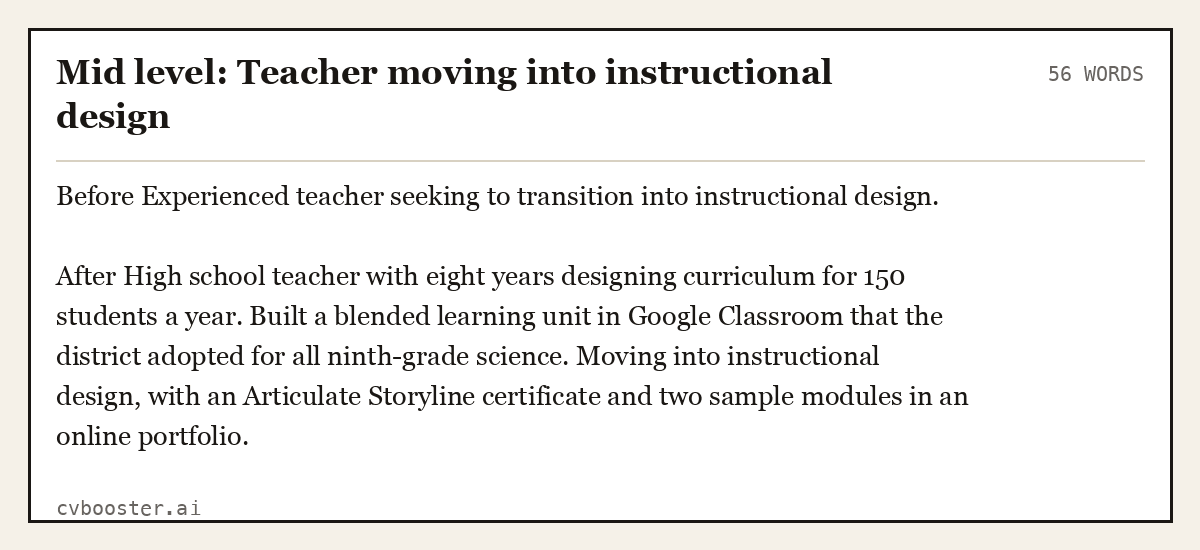
Mid level: Teacher moving into instructional design
56 wordsBefore Experienced teacher seeking to transition into instructional design.
After High school teacher with eight years designing curriculum for 150 students a year. Built a blended learning unit in Google Classroom that the district adopted for all ninth-grade science. Moving into instructional design, with an Articulate Storyline certificate and two sample modules in an online portfolio.
The new field hears curriculum, blended learning and Storyline. It does not hear "transition", which is a word about you rather than about the work. Our career change resume guide covers the rest of the page.
Why the adjective fails and the number works
An adjective asks the reader to trust you. A number lets them check. "Seasoned" and "experienced" both ask; "eight years" and "40-agent team" both show. That is the whole difference, and it is why the summaries in our resume summary examples open with a job title and a count rather than a description of the person.
There is a second problem. Experienced is a word about you, and a resume reads best when every line is about the work. If a bullet starts with an action, it will rarely need experienced at all. For the verbs to start with, see resume action verbs, and for other tired resume words, see resume synonyms.
When to keep experienced
Keep the word when it does a job no synonym does better:
- The job ad asks for it. "Experienced line cook" in a posting means one use of "experienced line cook" in your summary helps the match.
- It is part of a job title. "Experienced Hire Program" or a role literally titled that way stays as written.
- The number follows straight after. "Experienced electrician, 11 years in commercial fit-outs" is fine, because the claim is paid for in the same line.
What does not work is experienced as the first word of the resume with nothing after it but adjectives. If you want a sharper word for drive and energy, see the motivated synonym page. If your bullets lean on "performed", the performed synonym page has the replacements.
For the other adjective that says nothing on its own, see strong synonym.
Frequently asked questions
What is another word for experienced on a resume?
Seasoned, skilled, proficient, well-versed, accomplished and hands-on all work, but each still needs proof. The strongest option is often no adjective at all: write the years and the field, such as "nine years in commercial insurance claims", and let the bullets underneath show what those years produced.
How do you say "highly experienced" professionally?
Swap the intensifier for a fact. "Highly experienced" becomes "15 years in" plus the field, or the scale you worked at, such as "led a team of 30" or "managed a $4M budget". Readers discount "highly" because every resume uses it. They do not discount a number they can ask you about.
What can I say instead of experienced if I am entry level?
Use hands-on, practical or trained in, and attach the real source: an internship, a part-time job, a class project or a volunteer role. "Hands-on with QuickBooks from two years of part-time bookkeeping" is honest and specific, and it reads better than claiming years of experience you have not had yet.
Is seasoned better than experienced on a resume?
Not by itself. Seasoned is slightly less common, so it stands out a little, but it makes the same claim and needs the same proof. Use it only when you have many years in one field, and follow it with the count, such as "seasoned payroll specialist with 12 years in healthcare".
What is another way to say experience on a resume?
Use background, track record, working knowledge or expertise, depending on the claim: years, results, tool use or depth. Better still, write the years and the field, as in five years in B2B sales. For the section heading, Work Experience, Professional Experience and Employment History are the standard names.
What is the opposite of experienced?
Inexperienced is the direct opposite, and Thesaurus.com also lists green, untrained, unskilled and unseasoned. None of them belong on a resume. If you are new to a field, write new to and then the experience you do have, as in new to healthcare after five years in hospitality.
More on resume synonyms
- Another Word for Established: 30 Synonyms With Examples
- Collaborated Synonym: Teamwork Verbs for Resume Bullets
- Contribute Synonym: 30 Stronger Resume Words With Examples
- Implemented Synonym: Resume Verbs by What You Actually Did
- Motivated Synonym: 30 Stronger Words and 6 Resume Rewrites
- Oversaw Synonyms: Resume Verbs for People, Budgets, Projects
- Performed Synonym: 30 Better Words for Duties and Tasks
Looking for a worked example for your job title? Browse the resume examples by job title.