Competency Based Application Form: 5 Filled Examples
By Mustafa Tarabya, founder of CVBooster · Published · Updated
14 min read
The competency based application form examples on this page are one form, filled in by one candidate, box by box. The constraint that decides the score is that each box is marked on its own, so the same experience cannot carry two boxes and a single weak box can end the application. The indicator wording quoted here was read in September 2026 in the PAS Clerical Officer competency model and on the publicjobs.ie application advice page. Five complete boxes follow, 250 to 300 words each, each annotated against the indicators it lands. Written by Mustafa Tarabya, who hired for his own company, read every application himself and now writes CVBooster's guides.
The candidate and the form
Sorcha Dunne is 29, works as a hotel receptionist in Sligo, and cares for her father two evenings a week. She has no public sector experience. She is applying for a Clerical Officer post through publicjobs.ie, and the form gives her five boxes at 300 words each.
Her form works because she decided which experience owned which box before she typed anything. Her inventory had seven usable experiences. Five went into the boxes, two were held back for the interview.
| Box | Competency | Experience she assigned |
|---|---|---|
| 1 | Team work | Covering a colleague's wedding week at the hotel |
| 2 | Information Management / Processing | Rebuilding the function bookings diary |
| 3 | Delivery of Results | The night the property management system went down |
| 4 | Customer Service and Communication Skills | A complaint from a wheelchair user about room access |
| 5 | Drive and Commitment to Public Service Values | Her father's care package and the HSE paperwork |
Nothing appears twice. That is the single decision most applicants skip.
Box 1: Team work
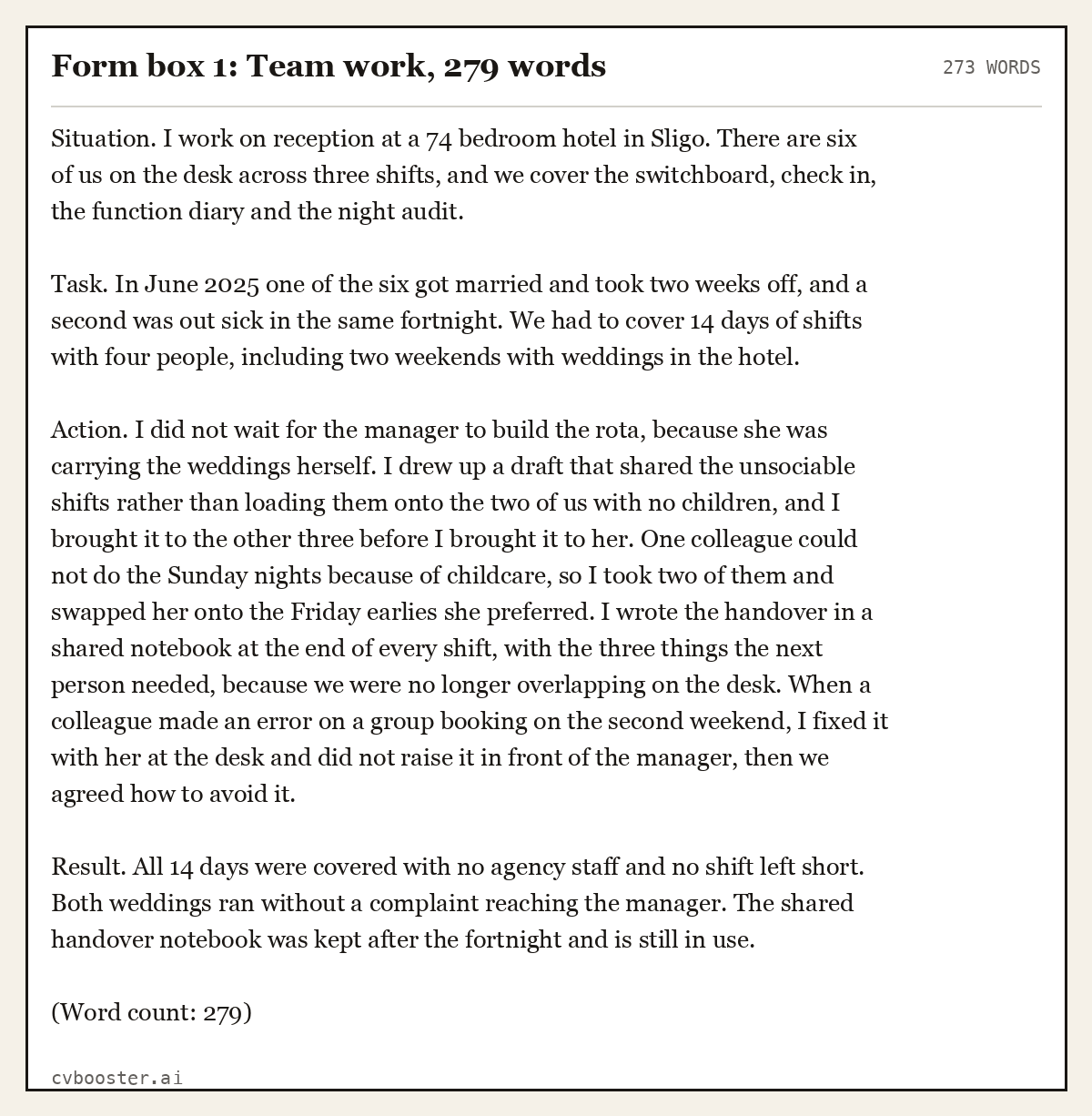
Form box 1: Team work, 279 words (273 words)
Situation. I work on reception at a 74 bedroom hotel in Sligo. There are six of us on the desk across three shifts, and we cover the switchboard, check in, the function diary and the night audit.
Task. In June 2025 one of the six got married and took two weeks off, and a second was out sick in the same fortnight. We had to cover 14 days of shifts with four people, including two weekends with weddings in the hotel.
Action. I did not wait for the manager to build the rota, because she was carrying the weddings herself. I drew up a draft that shared the unsociable shifts rather than loading them onto the two of us with no children, and I brought it to the other three before I brought it to her. One colleague could not do the Sunday nights because of childcare, so I took two of them and swapped her onto the Friday earlies she preferred. I wrote the handover in a shared notebook at the end of every shift, with the three things the next person needed, because we were no longer overlapping on the desk. When a colleague made an error on a group booking on the second weekend, I fixed it with her at the desk and did not raise it in front of the manager, then we agreed how to avoid it.
Result. All 14 days were covered with no agency staff and no shift left short. Both weddings ran without a complaint reaching the manager. The shared handover notebook was kept after the fortnight and is still in use.
(Word count: 279)
What the sifter is scoring
- Box scored against: "Shows respect for colleagues and co-workers" (PAS Clerical Officer competency model, Team work). Taking the two Sunday nights so a colleague could keep her childcare is that line, without the word respect appearing once.
- Box scored against: "Offers own ideas and perspectives". Drafting the rota unasked, and testing it with the team before the manager, is an idea offered rather than an instruction followed.
- Why a board believes it: the numbers are ordinary and checkable. Six staff, 14 days, two weddings. Nothing here needs a public sector job to have happened.
- What she left out on purpose: the second weekend error is hers to tell at interview if asked. The form is not the place to volunteer a colleague's mistake in detail.
The mechanics that fail good applications
Boxes are lost on process more often than on writing. The publicjobs.ie application advice page states the standard for the form itself: "Read each question on the application form carefully and make sure that you answer all of the questions including any sub-questions. Please also ensure you adhere to any word limits given."
- The cap is per box, not per form. Five boxes at 300 words is 1,500 words of drafting. That is not an evening job.
- Over the cap is a fail, not a trim. Count in a word processor and state the count if the form asks for it.
- Save as draft is not submit. The same page tells candidates to save at regular intervals using the Save as Draft button, and a draft at the closing time is not an application.
- The closing time is usually 12 noon, not midnight, and it is the time on the competition booklet that counts.
- Keep your own copy. The form becomes the interview. Boards build questions from what you wrote.
Tip: Read the Competition Information Booklet before the form, not after. It names the competencies, the word caps and the eligibility criteria, and eligibility is often checked only at the final stage.
Box 2: Information Management and Processing
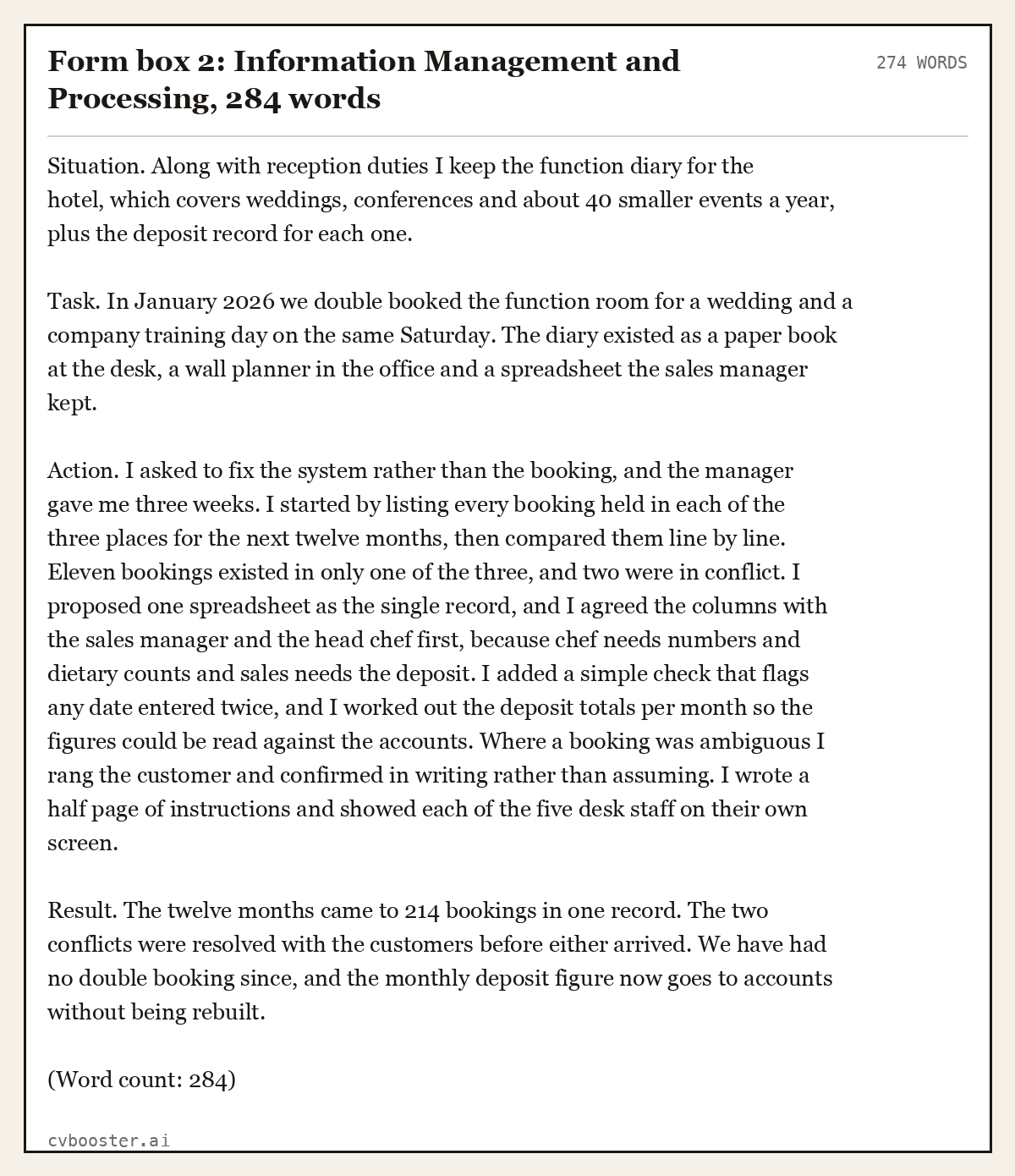
Form box 2: Information Management and Processing, 284 words (274 words)
Situation. Along with reception duties I keep the function diary for the hotel, which covers weddings, conferences and about 40 smaller events a year, plus the deposit record for each one.
Task. In January 2026 we double booked the function room for a wedding and a company training day on the same Saturday. The diary existed as a paper book at the desk, a wall planner in the office and a spreadsheet the sales manager kept.
Action. I asked to fix the system rather than the booking, and the manager gave me three weeks. I started by listing every booking held in each of the three places for the next twelve months, then compared them line by line. Eleven bookings existed in only one of the three, and two were in conflict. I proposed one spreadsheet as the single record, and I agreed the columns with the sales manager and the head chef first, because chef needs numbers and dietary counts and sales needs the deposit. I added a simple check that flags any date entered twice, and I worked out the deposit totals per month so the figures could be read against the accounts. Where a booking was ambiguous I rang the customer and confirmed in writing rather than assuming. I wrote a half page of instructions and showed each of the five desk staff on their own screen.
Result. The twelve months came to 214 bookings in one record. The two conflicts were resolved with the customers before either arrived. We have had no double booking since, and the monthly deposit figure now goes to accounts without being rebuilt.
(Word count: 284)
What the sifter is scoring
- Box scored against: "Is comfortable working with different types of information, e.g. written, numerical, charts, and carries out calculations such as arithmetic, percentages etc." (PAS Clerical Officer competency model, Information Management / Processing). The monthly deposit totals are the numerical half, which most candidates never evidence.
- Box scored against: "Suggests new ways of doing things better and more efficiently". She asks to fix the system, which is a bigger claim than fixing the booking, and she has the result to carry it.
- Box scored against: "Follows procedures and protocols, understanding their value and the rationale behind them". Agreeing the columns with chef and sales is the rationale, stated.
- Capability wording that also fits: "Checks, processes, and interprets information and data, in an accurate and timely manner" (Clerical Officer capability framework, Gathering and Processing Information).
Box 3: Delivery of Results
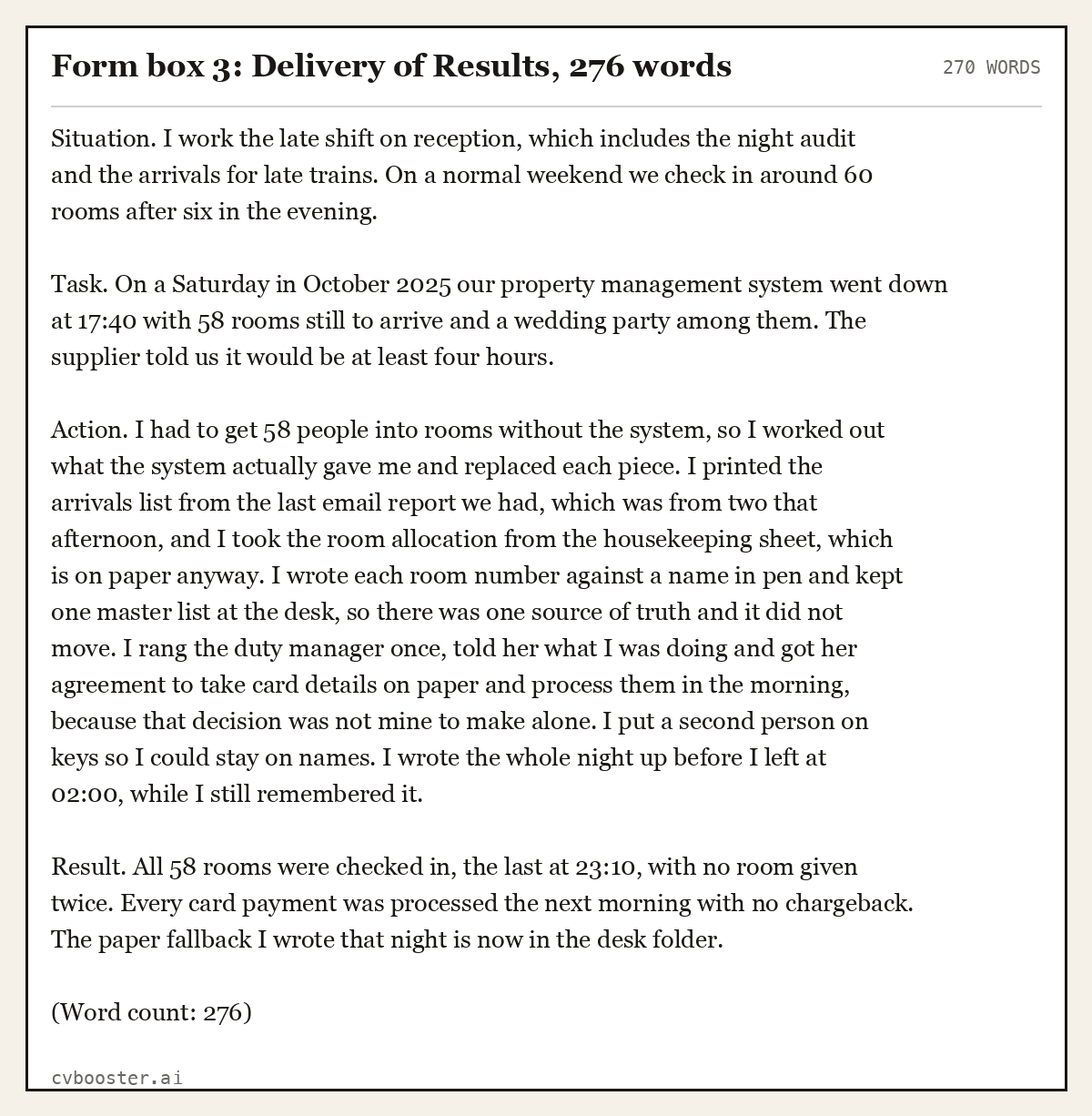
Form box 3: Delivery of Results, 276 words (270 words)
Situation. I work the late shift on reception, which includes the night audit and the arrivals for late trains. On a normal weekend we check in around 60 rooms after six in the evening.
Task. On a Saturday in October 2025 our property management system went down at 17:40 with 58 rooms still to arrive and a wedding party among them. The supplier told us it would be at least four hours.
Action. I had to get 58 people into rooms without the system, so I worked out what the system actually gave me and replaced each piece. I printed the arrivals list from the last email report we had, which was from two that afternoon, and I took the room allocation from the housekeeping sheet, which is on paper anyway. I wrote each room number against a name in pen and kept one master list at the desk, so there was one source of truth and it did not move. I rang the duty manager once, told her what I was doing and got her agreement to take card details on paper and process them in the morning, because that decision was not mine to make alone. I put a second person on keys so I could stay on names. I wrote the whole night up before I left at 02:00, while I still remembered it.
Result. All 58 rooms were checked in, the last at 23:10, with no room given twice. Every card payment was processed the next morning with no chargeback. The paper fallback I wrote that night is now in the desk folder.
(Word count: 276)
What the sifter is scoring
- Box scored against: "Takes responsibility for work and sees it through to the appropriate next level" (PAS Clerical Officer competency model, Delivery of Results). One call to the duty manager, for the one decision that was not hers, is the appropriate next level exactly.
- Box scored against: "Adapts quickly to new ways of doing things". The adaptation is described as a method, not as an attitude.
- Box scored against: "Completes work in a timely manner". The last check in at 23:10 is the timeliness claim, with a time on it.
- Box scored against: "Is self reliant and uses judgment on when to ask manager or colleagues for guidance".
Box 4: Customer Service and Communication Skills
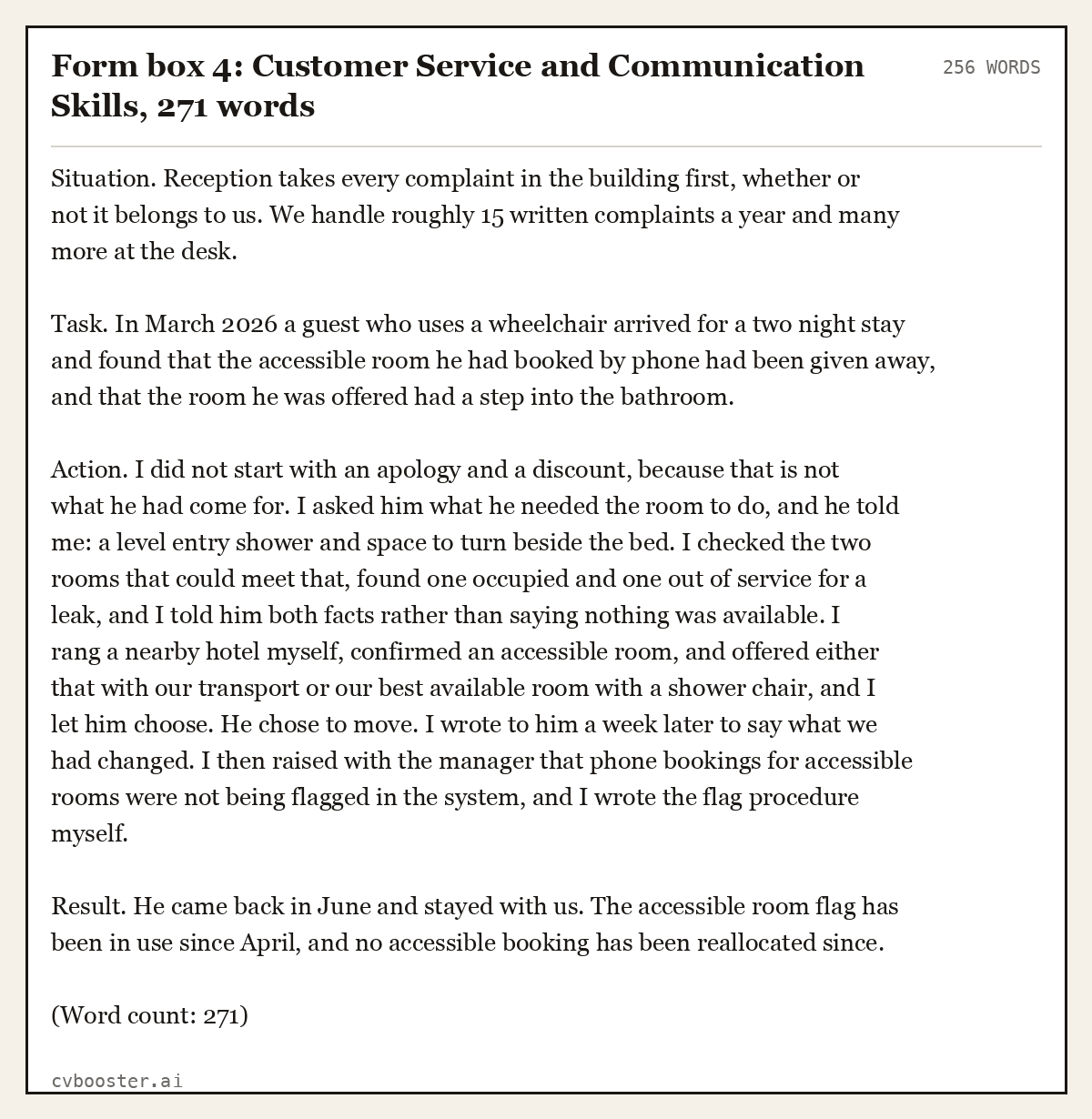
Form box 4: Customer Service and Communication Skills, 271 words (256 words)
Situation. Reception takes every complaint in the building first, whether or not it belongs to us. We handle roughly 15 written complaints a year and many more at the desk.
Task. In March 2026 a guest who uses a wheelchair arrived for a two night stay and found that the accessible room he had booked by phone had been given away, and that the room he was offered had a step into the bathroom.
Action. I did not start with an apology and a discount, because that is not what he had come for. I asked him what he needed the room to do, and he told me: a level entry shower and space to turn beside the bed. I checked the two rooms that could meet that, found one occupied and one out of service for a leak, and I told him both facts rather than saying nothing was available. I rang a nearby hotel myself, confirmed an accessible room, and offered either that with our transport or our best available room with a shower chair, and I let him choose. He chose to move. I wrote to him a week later to say what we had changed. I then raised with the manager that phone bookings for accessible rooms were not being flagged in the system, and I wrote the flag procedure myself.
Result. He came back in June and stayed with us. The accessible room flag has been in use since April, and no accessible booking has been reallocated since.
(Word count: 271)
What the sifter is scoring
- Box scored against: "Actively listens to others and tries to understand their perspectives/ requirements/ needs" (PAS Clerical Officer competency model, Customer Service and Communication Skills). Asking what the room had to do, rather than offering a discount, is the listening indicator made concrete.
- Box scored against: "Understands the steps or processes that customers must go through and can clearly explain these". She gives him both facts and a choice instead of an outcome.
- Box scored against: "Is respectful, courteous and professional, remaining composed, even in challenging circumstances".
- The sentence that earns the extra mark: the flag procedure. A complaint answer that ends with the complaint closed scores; one that ends with the cause removed scores higher.
Box 5: Drive and Commitment to Public Service Values
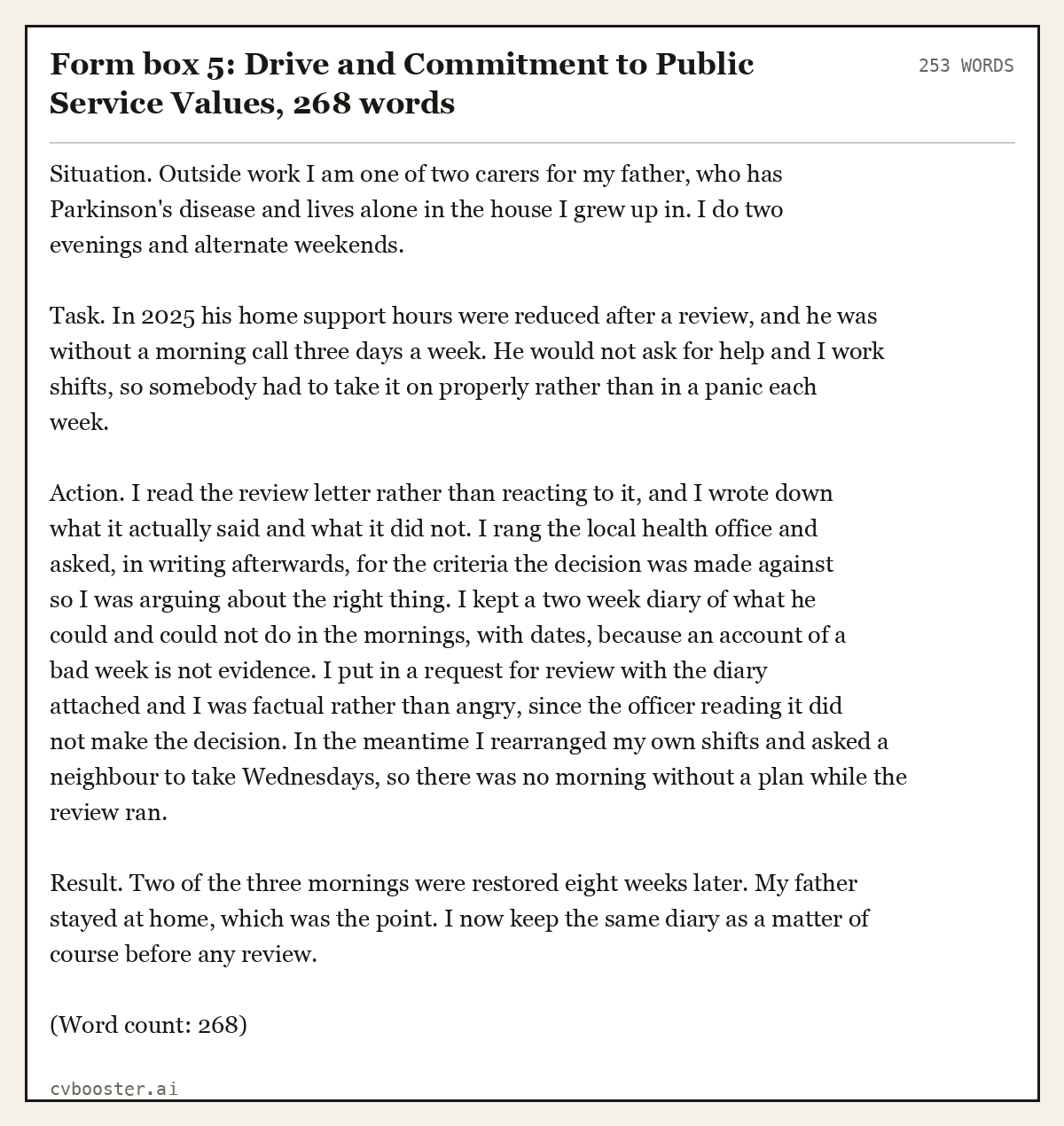
Form box 5: Drive and Commitment to Public Service Values, 268 words (253 words)
Situation. Outside work I am one of two carers for my father, who has Parkinson's disease and lives alone in the house I grew up in. I do two evenings and alternate weekends.
Task. In 2025 his home support hours were reduced after a review, and he was without a morning call three days a week. He would not ask for help and I work shifts, so somebody had to take it on properly rather than in a panic each week.
Action. I read the review letter rather than reacting to it, and I wrote down what it actually said and what it did not. I rang the local health office and asked, in writing afterwards, for the criteria the decision was made against so I was arguing about the right thing. I kept a two week diary of what he could and could not do in the mornings, with dates, because an account of a bad week is not evidence. I put in a request for review with the diary attached and I was factual rather than angry, since the officer reading it did not make the decision. In the meantime I rearranged my own shifts and asked a neighbour to take Wednesdays, so there was no morning without a plan while the review ran.
Result. Two of the three mornings were restored eight weeks later. My father stayed at home, which was the point. I now keep the same diary as a matter of course before any review.
(Word count: 268)
What the sifter is scoring
- Box scored against: "Is enthusiastic and resilient, persevering in the face of challenges and setbacks" (PAS Clerical Officer competency model, Drive and Commitment to Public Service Values). Eight weeks of a review process, handled without a row, is perseverance a board recognises.
- Box scored against: "At all times, acts with integrity". Being factual with an officer who did not make the decision is integrity expressed as a choice under pressure.
- Box scored against: "Is personally honest and trustworthy".
- Why an unpaid example is allowed: the competency models describe behaviour, not employment. Caring, a committee, a club treasurer role or a course all count, provided the actions are yours and dated. Health service competitions advertised through HSE careers use a different competency set, so check the booklet before reusing this box.
What the five boxes have in common
Read side by side, the form works for four reasons that have nothing to do with her career.
- Five different settings: a rota, a diary, a system outage, a complaint and a family care review. A board reading all five sees a person, not a job description.
- Every box is at least half Action, and every Action is written as I.
- Every Result carries a number and one thing that stayed in place afterwards.
- No box is under 260 words or over the 300 cap. She counted.
Two experiences were deliberately kept back, a first aid course she organised and a stocktake she rebuilt. Those are her interview answers, so the board hears something new rather than the form read aloud.
The grade specific versions of these boxes are on clerical officer competency examples and executive officer competency examples. The capability framework version of the same form is on publicjobs competency examples, and the board stage is on competency-based interview questions in Ireland.
Before you press submit
- One experience per box, and no phrase repeated between boxes.
- Each box counted in a word processor and inside the cap.
- Each box at least half Action, first person singular throughout.
- Each Result has a number and something that outlasted the task.
- Eligibility criteria read properly, not skimmed.
- The closing time checked. It is usually 12 noon on the stated date.
- The application reads Submitted, not Draft, and you saved your own copy.
Frequently asked questions
How to fill a competency form?
Assign one experience to each competency before writing, then write each box as Situation, Task, Action and Result with roughly half the words in Action. Name the employer, the date and the scale in the first two sentences. Write I rather than we throughout, finish with a number and something that outlasted the task, and count the words before pasting. Do not reuse a story in two boxes.
Can you give me an example of a competency-based assessment?
A competency based application form is one. Each box asks for a specific occasion against a named competency, and an assessor scores each box separately against published indicators, commonly on a scale where the lowest mark is insufficient evidence and the highest is very good to excellent. Interviews, presentations and job simulations are the other common forms. In each case the assessment is of evidence you supply, not of your general suitability.
What are 10 common questions asked in competency-based interviews?
Ten that recur across Irish public sector boards: describe a time you worked in a team under pressure, a time you managed a large volume of information, a difficult customer you dealt with, a tight deadline you met, a mistake you made and what followed, a decision you took with incomplete information, a change you had to adapt to, a time you improved a process, a colleague you supported, and why you want this role. Each one maps to a competency on the form.
Can you give me an example of a competency?
Customer Service and Communication Skills is a competency in the PAS Clerical Officer model. Its indicators include "Communicates clearly and fluently when speaking and in writing" and "Can be firm when necessary and communicate with confidence and authority". The heading names the area, the indicators are what gets ticked, and box 4 above is one occasion written to land them. A competency is never a personality trait.
More in this series: related guides
- Clerical Officer Competency Examples: 6 Full Answers
- Competency-Based Interview Questions and 15 Answers, Ireland
- Executive Officer Competency Examples: 6 Full Answers
- publicjobs Competency Examples: 7 Worked Form Answers
Related articles
- Clerical Officer Competency Examples: 6 Full Answers
- Executive Officer Competency Examples: 6 Full Answers
- publicjobs Competency Examples: 7 Worked Form Answers
- Skills to Put on a Job Application Form
More articles
- Competency Based Interview Questions and 20 Answers
- Competency-Based Interview Questions and 15 Answers, Ireland
- Competency Examples: 12 Definitions and Worked Proof
Looking for a worked example for your job title? Browse the resume examples by job title.