How to Explain Getting Fired in an Interview: 5 Answers
By Mustafa Tarabya, founder of CVBooster · Published · Updated
9 min read
How to explain getting fired in an interview: say it in one honest sentence, name what you learned or changed, and move straight to why you fit this job, all in under a minute. The one constraint is that you cannot lie. A reference check, a background check or a former coworker can contradict you, and a lie found later can cost you the new job too. The U.S. Department of Labor explains why so many firings happen at all, quoted below. Five full answers follow, for the most common reasons. Written by Mustafa Tarabya, who hired for his own company, read every application himself and now writes CVBooster's guides.
You rehearsed this answer in the car, in the shower and at three in the morning. In every version the interviewer gasps. In the real one, they nod, write two words and ask about your Excel skills.
Why being fired is less fatal than it feels
Most American jobs are at will, which is why people get fired for reasons that have little to do with talent: a new manager, a restructuring, a bad fit. The Department of Labor's termination page puts it in legal terms: unless the reason is discrimination, whistleblowing or a complaint under a law it enforces, "the termination is subject only to any private contract between the employer and employee or a labor contract between the employer and those covered by the labor contract."
In plain words, an employer usually does not need a strong reason. Interviewers know that. What they want to find out is whether the reason will repeat in their team. A firing on its own rarely decides an application. The way the person talks about it often does.
Here is the shape that works, in an answer for a first job that ended badly.
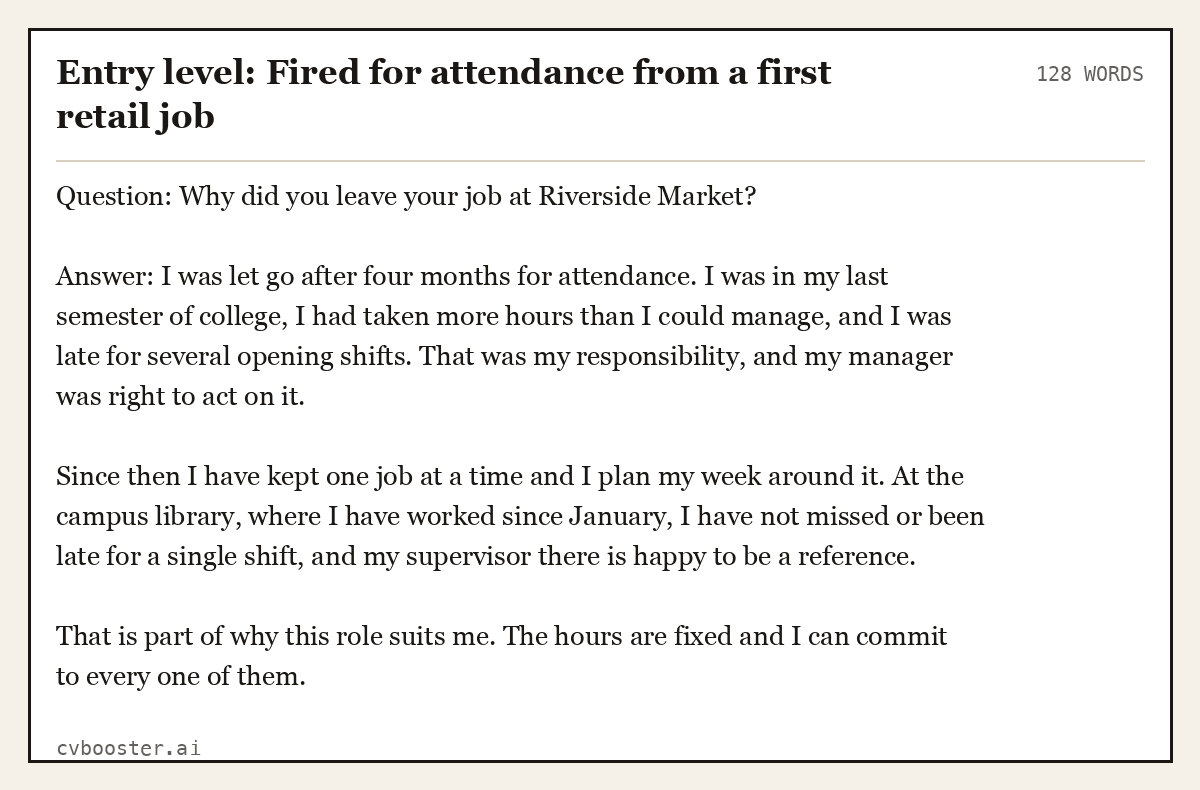
Entry level: Fired for attendance from a first retail job (128 words)
Question: Why did you leave your job at Riverside Market?
Answer: I was let go after four months for attendance. I was in my last semester of college, I had taken more hours than I could manage, and I was late for several opening shifts. That was my responsibility, and my manager was right to act on it.
Since then I have kept one job at a time and I plan my week around it. At the campus library, where I have worked since January, I have not missed or been late for a single shift, and my supervisor there is happy to be a reference.
That is part of why this role suits me. The hours are fixed and I can commit to every one of them.
The three-part answer
Every good answer to "why were you fired" has the same three parts, and it takes about forty-five seconds to say.
- The fact, in one sentence. "I was let go after a year for not meeting my sales targets." Use neutral words such as let go, terminated or my position ended. Do not tell the whole story.
- What you learned or changed. One or two sentences with something concrete: a course you finished, a habit you changed, a result at the next job.
- The bridge to this job. Why the thing you learned makes you a good hire here.
Then stop talking. The interviewer will ask a follow-up if they need one. Most do not, and the longer you speak, the more the firing becomes the theme of the interview.
How to explain being fired for performance
Performance firings are the most common, and the easiest to explain, because the fix is usually measurable. Show the result after the firing, not just the intention.
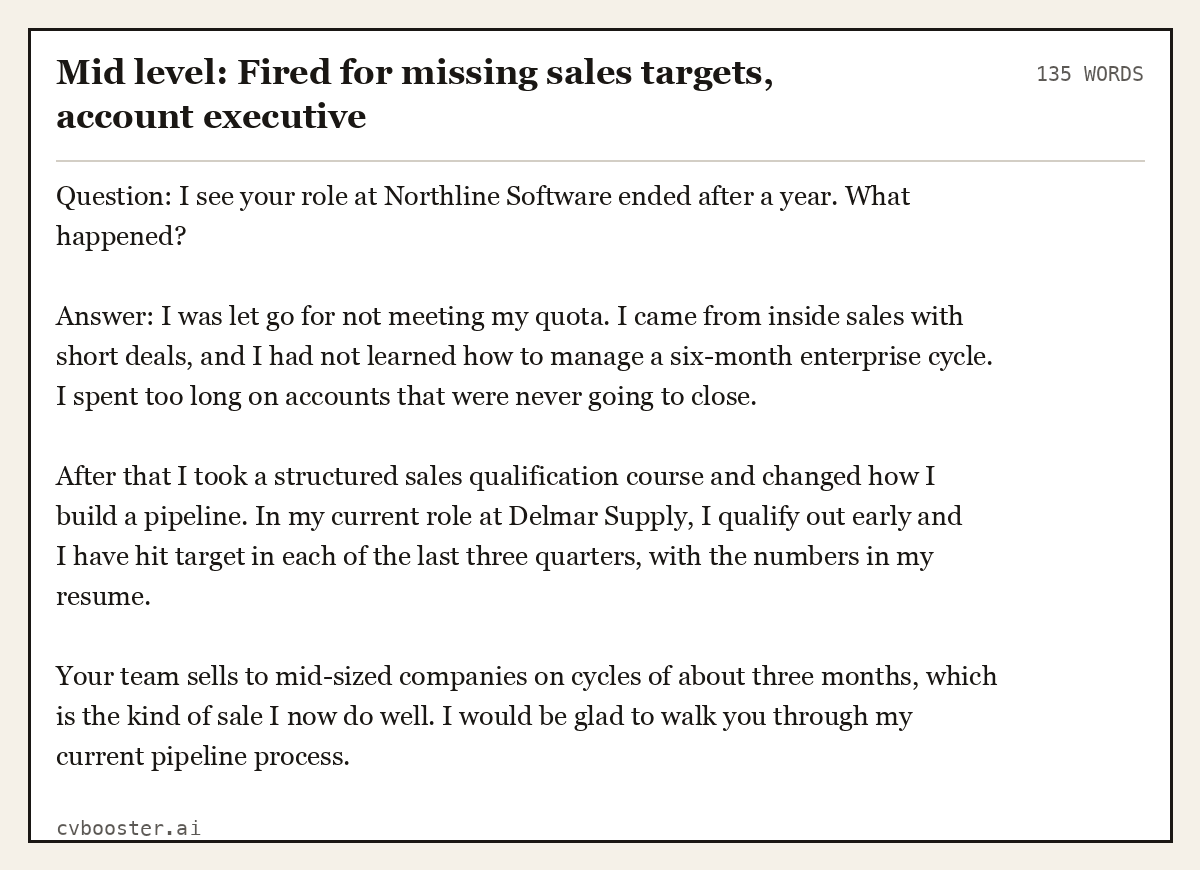
Mid level: Fired for missing sales targets, account executive (135 words)
Question: I see your role at Northline Software ended after a year. What happened?
Answer: I was let go for not meeting my quota. I came from inside sales with short deals, and I had not learned how to manage a six-month enterprise cycle. I spent too long on accounts that were never going to close.
After that I took a structured sales qualification course and changed how I build a pipeline. In my current role at Delmar Supply, I qualify out early and I have hit target in each of the last three quarters, with the numbers in my resume.
Your team sells to mid-sized companies on cycles of about three months, which is the kind of sale I now do well. I would be glad to walk you through my current pipeline process.
How to explain getting fired for a mistake or conduct
A firing for one serious mistake or a policy breach is harder, because the interviewer is now asking about judgment. Own it completely, name the rule you broke, and show what you do differently. Never minimize it, and never blame the company for having a rule.
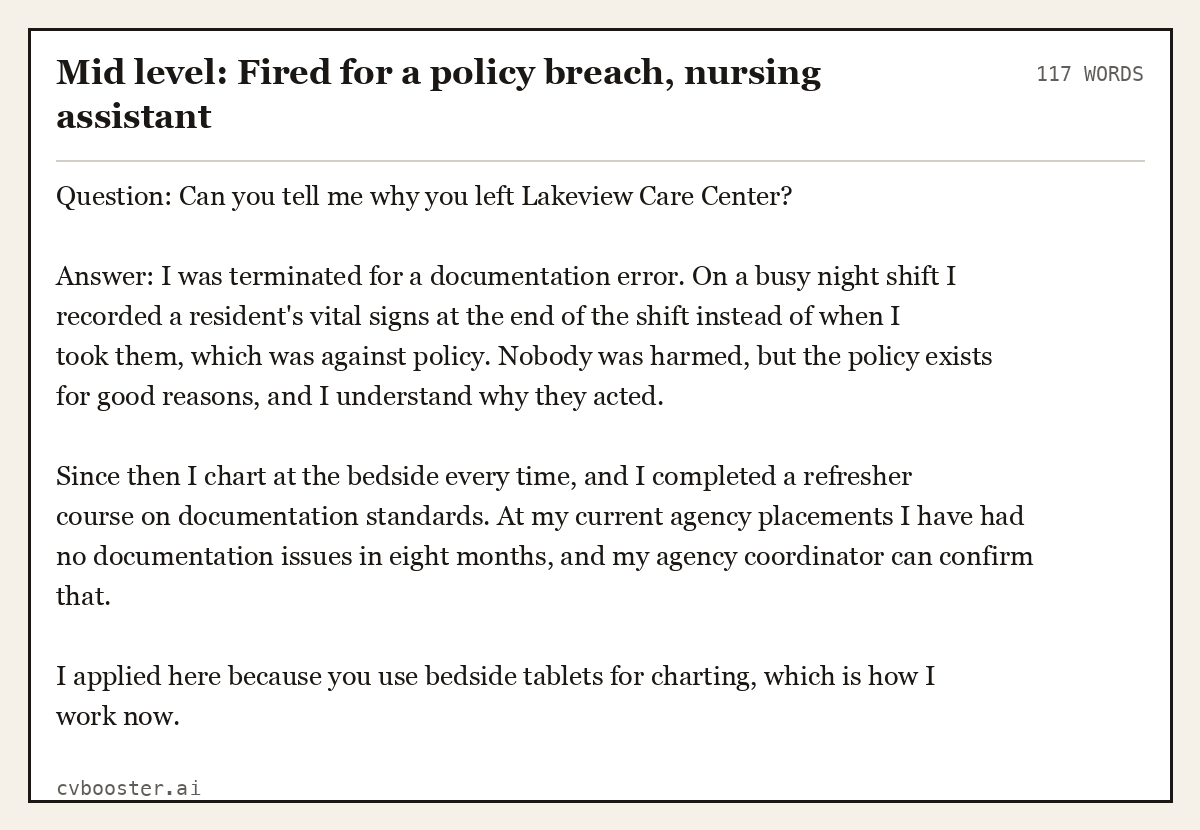
Mid level: Fired for a policy breach, nursing assistant (117 words)
Question: Can you tell me why you left Lakeview Care Center?
Answer: I was terminated for a documentation error. On a busy night shift I recorded a resident's vital signs at the end of the shift instead of when I took them, which was against policy. Nobody was harmed, but the policy exists for good reasons, and I understand why they acted.
Since then I chart at the bedside every time, and I completed a refresher course on documentation standards. At my current agency placements I have had no documentation issues in eight months, and my agency coordinator can confirm that.
I applied here because you use bedside tablets for charting, which is how I work now.
If the firing involved anything a background check will show, mention it before the check does. An interviewer forgives a mistake you told them about much more readily than one they found.
How to avoid saying you were fired in an interview
Many people search for a way to avoid the word fired altogether. You can choose neutral words, and you do not need to volunteer the word "fired" if nobody asks. But if the interviewer asks directly whether you were terminated, or an application form asks, answer yes. A clever dodge sounds like what it is.
What you can control is emphasis. Lead with the role, the dates and what you achieved there, and keep the ending to one sentence. Our guide to employment gaps covers how to handle the time between jobs on the resume itself.
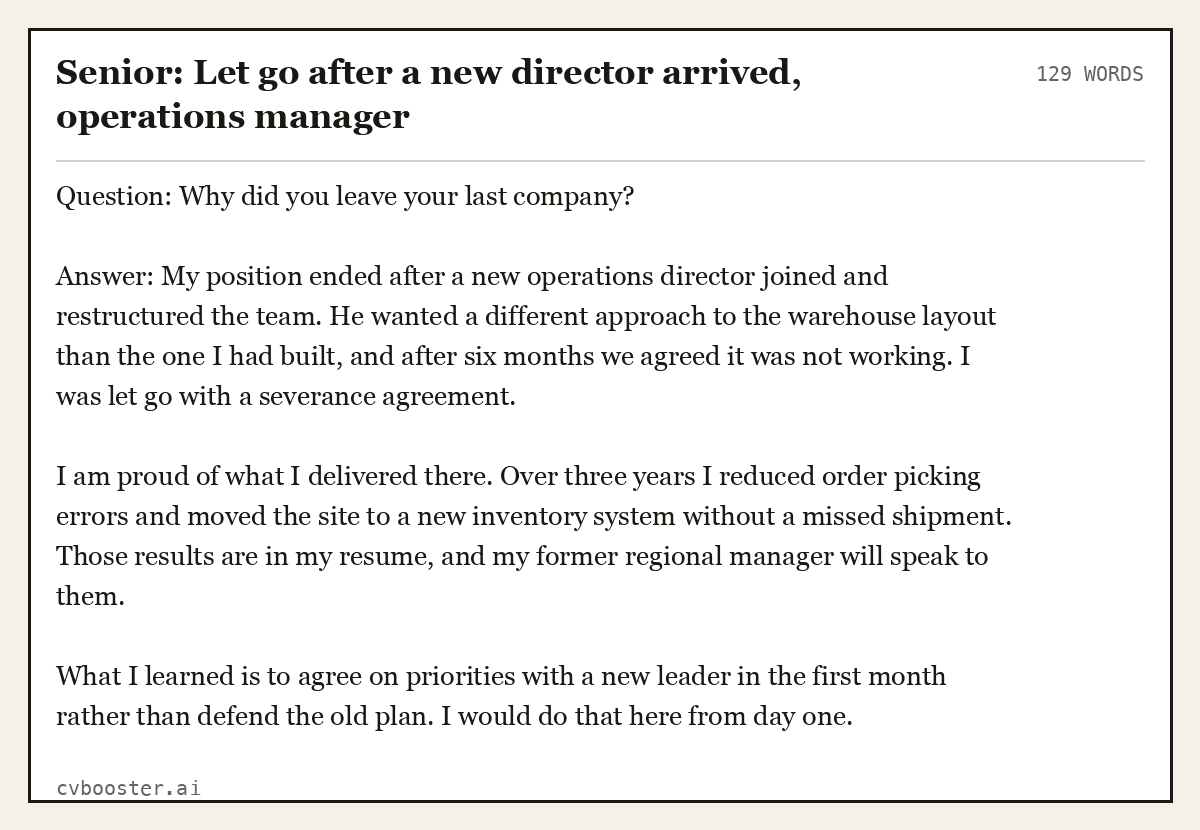
Senior: Let go after a new director arrived, operations manager (129 words)
Question: Why did you leave your last company?
Answer: My position ended after a new operations director joined and restructured the team. He wanted a different approach to the warehouse layout than the one I had built, and after six months we agreed it was not working. I was let go with a severance agreement.
I am proud of what I delivered there. Over three years I reduced order picking errors and moved the site to a new inventory system without a missed shipment. Those results are in my resume, and my former regional manager will speak to them.
What I learned is to agree on priorities with a new leader in the first month rather than defend the old plan. I would do that here from day one.
What never to say about a firing
- Anything negative about your former boss. Even if it is true, the interviewer hears how you will talk about them one day.
- A long story. Every extra sentence invites another question.
- A lie about the dates or the reason. References and background checks exist.
- "It was not my fault." Say what you would do differently, even when the firing was unfair.
If you believe you were fired illegally, that is a matter for the right agency, not for the interview. The EEOC's page on prohibited practices states: "It is also illegal to retaliate against a person because he or she complained about discrimination, filed a charge of discrimination, or participated in an employment discrimination investigation or lawsuit." In the interview itself, keep to the neutral version.
When the job simply was not a fit
Some firings have no dramatic reason. The role changed, the expectations were different from the posting, or the culture did not suit you. Say that without criticizing anyone, and show you have learned to check fit before accepting.
Entry level: Let go during probation, junior marketing coordinator (122 words)
Question: You were only at Brightpath Media for three months. Why?
Answer: I was let go at the end of my probation period. The role was advertised as content writing, but it was mostly paid social media buying, which I had not done before. I tried to learn quickly, but my manager needed someone who could run campaigns from the first week.
It taught me to ask much more specific questions about the day-to-day work before I accept an offer, which is why I asked earlier about how the role splits between writing and analytics.
Writing is where I am strongest. My portfolio has the blog series I wrote for my university's alumni office, which grew its newsletter sign-ups over a semester.
Prepare for the follow-up and the references
The follow-up is usually "what would your former manager say about you?" Answer honestly and positively: the strengths they saw and the thing they wanted you to improve. If you can, choose a different reference from that company, such as a peer or another manager, and tell them the interviewer may call. Our guide to references on a resume explains who to ask and how.
If you are between jobs right now, check whether you can claim benefits. USA.gov's unemployment page says: "Unemployment insurance pays you money if you lose your job through no fault of your own." Eligibility depends on your state and on the reason you were let go.
For the rest of the interview, our list of common interview questions and answers and the short job interview tips help you move on from the hard question quickly.
Frequently asked questions
Should I tell an interviewer I was fired?
Yes, if they ask why you left or ask directly whether you were terminated. You do not need to volunteer it in your opening, but you must not lie when asked. Give one honest sentence, say what you learned or changed, and connect it to the new role. A short, calm answer usually ends the topic.
Can a new employer find out I was fired?
Often, yes. A former employer may confirm dates and sometimes the reason, a background check may show it, and the industry may be smaller than you think. Many employers only confirm dates and title, but you cannot count on that. Assume they can find out, and make your answer match the record.
What is the best way to say you were fired?
Use neutral words: "I was let go", "my position was terminated" or "my employment ended after my probation period". Follow with one sentence on the reason and one on what you changed. Avoid emotional words and blame. The interviewer is judging how you handle the topic more than the firing itself.
How do I explain being fired for attendance or lateness?
Name the reason plainly, explain the circumstance briefly without making excuses, and show a record since then: a job where you have not missed shifts, a reference who can confirm it. Then say why the schedule of the new job works for you. Proof that the problem is solved matters more than an apology.
Should I put a job I was fired from on my resume?
Usually yes, especially if you were there several months and achieved something. Leaving it out creates a gap that raises its own question. List the role normally with your results, and save the explanation for the interview. A very short job of a few weeks can sometimes be left off.
Related articles
- Accountancy CV Example: 6 UK Accounts CVs by Career Level
- Accounting Interview Questions and Answers: 7 Full Examples
- Activity Resume Example: 6 Samples for College Applications
- Administration CV Example: 6 Admin CVs from Entry to Senior
More articles
- Fast Learner on a Resume: 6 Example Lines That Prove It
- Federal Resume Example: A Complete GS-9 Program Analyst
- Female Job Interview Attire: Six UK Outfits by Job Type
Looking for a worked example for your job title? Browse the resume examples by job title.