Teaching Interview Questions and 15 Full STAR Answers
By Mustafa Tarabya, founder of CVBooster · Published · Updated
16 min read
Every strong answer to interview questions and answers for a teacher is one classroom, one date, one number. The day itself is the constraint: a lesson observation, a pupil panel and one interview, all scored against the same published standards. Those standards are the Department for Education's Teachers' Standards, and the safeguarding wording is Keeping children safe in education. Below are fifteen questions, each answered in full, each followed by the standard the panel marks. Written by Mustafa Tarabya, who hired for his own company, read every application himself and now writes CVBooster's guides. Updated September 2026.
The set covers primary and secondary. Where a question changes at key stage 4, the answer says so.
Opening questions
Three warm-ups that are still scored. The panel checks whether you talk about your own practice in specifics.
Tell us about yourself and why you applied to this school
Tests whether you researched this school or sent the same application everywhere.
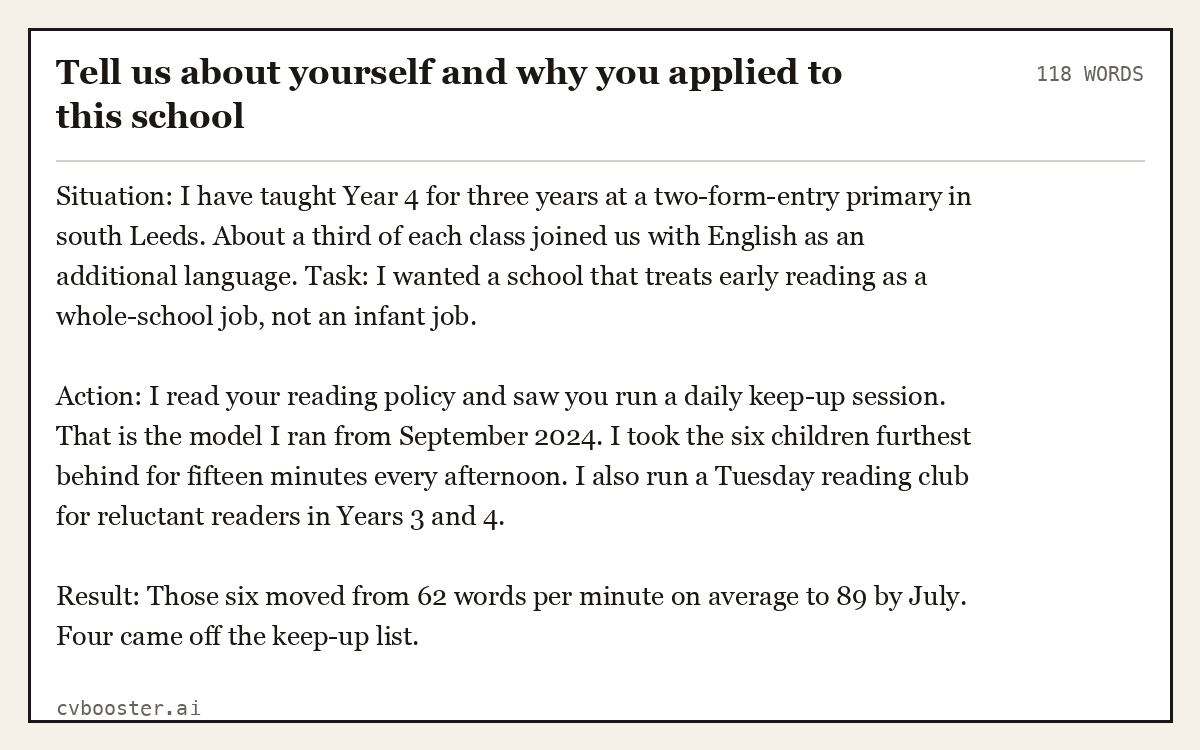
Situation: I have taught Year 4 for three years at a two-form-entry primary in south Leeds. About a third of each class joined us with English as an additional language. Task: I wanted a school that treats early reading as a whole-school job, not an infant job.
Action: I read your reading policy and saw you run a daily keep-up session. That is the model I ran from September 2024. I took the six children furthest behind for fifteen minutes every afternoon. I also run a Tuesday reading club for reluctant readers in Years 3 and 4.
Result: Those six moved from 62 words per minute on average to 89 by July. Four came off the keep-up list.
Panel is listening for: "have a secure knowledge of the relevant subject(s) and curriculum areas, foster and maintain pupils' interest in the subject, and address misunderstandings" (Teachers' Standards, standard 3).
Common wrong answer: your career history in order, with no mention of this school.
What makes a good lesson
Tests whether you judge a lesson by delivery or by learning.
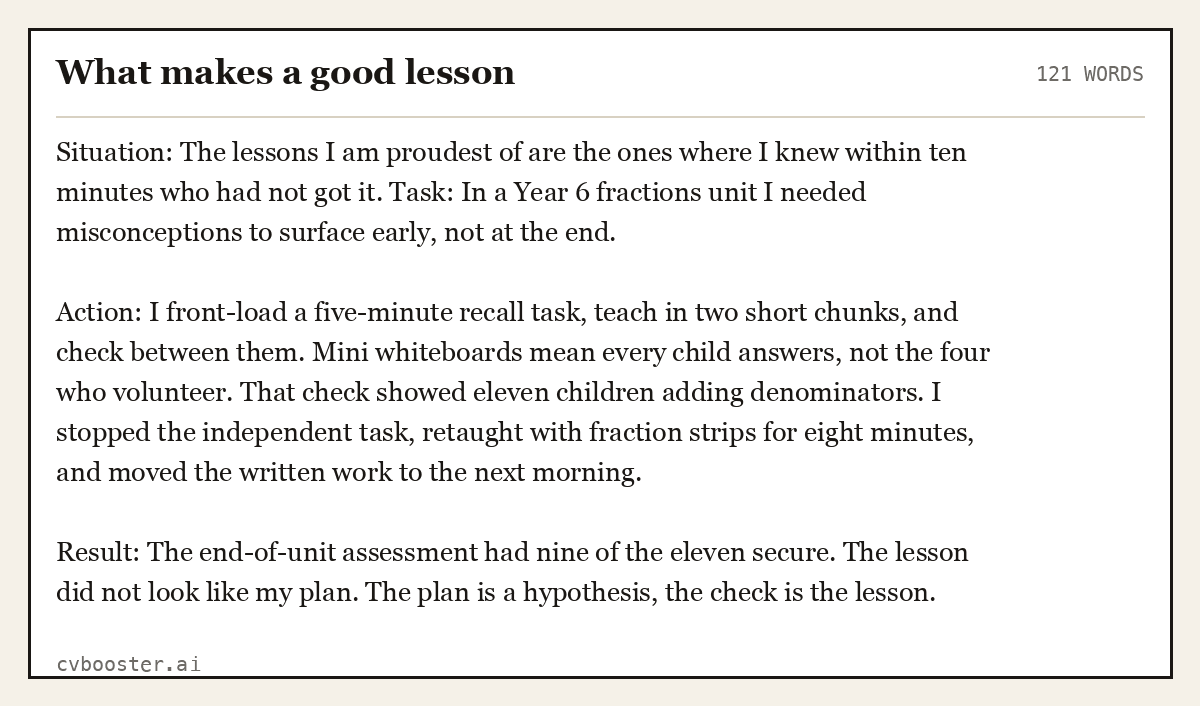
Situation: The lessons I am proudest of are the ones where I knew within ten minutes who had not got it. Task: In a Year 6 fractions unit I needed misconceptions to surface early, not at the end.
Action: I front-load a five-minute recall task, teach in two short chunks, and check between them. Mini whiteboards mean every child answers, not the four who volunteer. That check showed eleven children adding denominators. I stopped the independent task, retaught with fraction strips for eight minutes, and moved the written work to the next morning.
Result: The end-of-unit assessment had nine of the eleven secure. The lesson did not look like my plan. The plan is a hypothesis, the check is the lesson.
Panel is listening for: "reflect systematically on the effectiveness of lessons and approaches to teaching" (Teachers' Standards, standard 4).
Common wrong answer: a list of activities, engagement and pace, with no evidence anyone learned anything.
How do you build relationships with a new class in September
Tests whether you rely on routine or on personality.
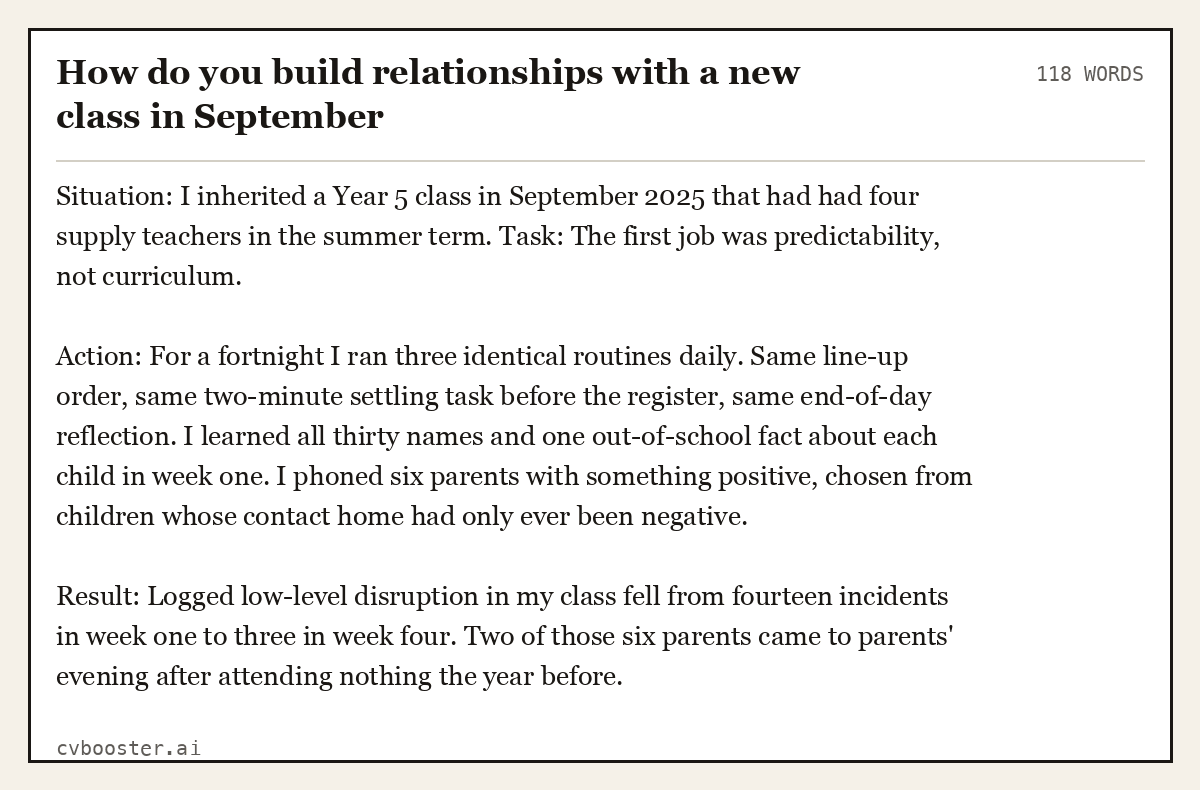
Situation: I inherited a Year 5 class in September 2025 that had had four supply teachers in the summer term. Task: The first job was predictability, not curriculum.
Action: For a fortnight I ran three identical routines daily. Same line-up order, same two-minute settling task before the register, same end-of-day reflection. I learned all thirty names and one out-of-school fact about each child in week one. I phoned six parents with something positive, chosen from children whose contact home had only ever been negative.
Result: Logged low-level disruption in my class fell from fourteen incidents in week one to three in week four. Two of those six parents came to parents' evening after attending nothing the year before.
Panel is listening for: "maintain good relationships with pupils, exercise appropriate authority, and act decisively when necessary" (Teachers' Standards, standard 7).
Common wrong answer: saying you build rapport by being approachable, with no routine attached.
Values and safeguarding questions
Safeguarding answers are pass or fail. Name the policy, name the designated safeguarding lead, never promise confidentiality.
A child discloses something to you at the end of the day. What do you do
Tests whether you know your limits: listen and report, do not investigate.
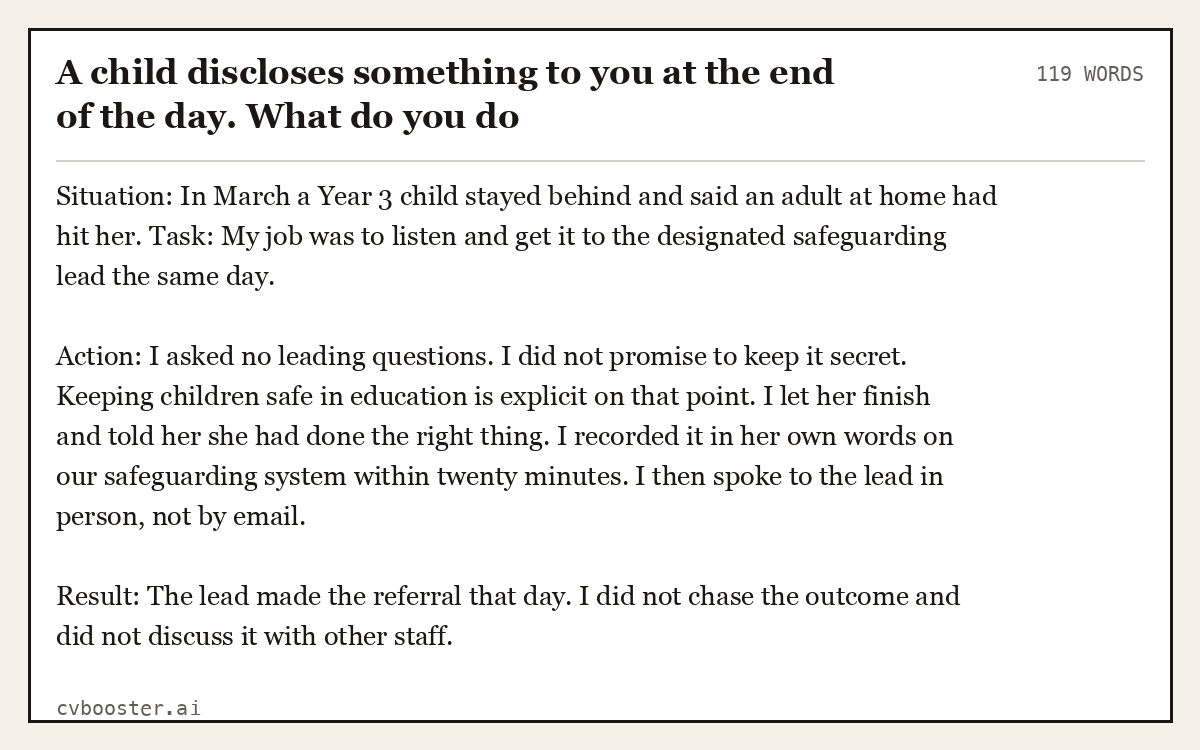
Situation: In March a Year 3 child stayed behind and said an adult at home had hit her. Task: My job was to listen and get it to the designated safeguarding lead the same day.
Action: I asked no leading questions. I did not promise to keep it secret. Keeping children safe in education is explicit on that point. I let her finish and told her she had done the right thing. I recorded it in her own words on our safeguarding system within twenty minutes. I then spoke to the lead in person, not by email.
Result: The lead made the referral that day. I did not chase the outcome and did not discuss it with other staff.
Panel is listening for: "Staff should never promise a child that they will not tell anyone about a report of any form of abuse, as this may ultimately not be in the best interests of the child" (Keeping children safe in education 2026, part one, paragraph 14).
Common wrong answer: promising the child you will keep it between you.
What would you do if you had a low-level concern about a colleague
Tests whether you report upwards or quietly decide it is nothing.
Situation: A teaching assistant in my year group started giving one child lifts home without telling anyone. Task: It was not an allegation. It was also not nothing.
Action: Our staff behaviour policy covers this as a low-level concern. I reported it to the headteacher that week. I did not raise it with the assistant first, because that judgement is not mine. I did not mention it in the staffroom. I wrote down what I saw and the dates, with no interpretation.
Result: The head recorded it, spoke to her, and the lifts stopped. My rule is simple. I report, the head decides.
Panel is listening for: "Appropriate whistleblowing procedures should be put in place" and concerns "shared in accordance with the school or college's low-level concerns policy" (Keeping children safe in education 2026, part one).
Common wrong answer: saying you would have a quiet word with the colleague yourself.
How do you promote inclusion and British values in your classroom
Tests whether this lives in your curriculum or in one assembly a term.
Situation: My Year 6 class in 2025 had nine home languages and two children with an education, health and care plan. Task: I wanted the curriculum itself to carry inclusion.
Action: I rebuilt the local history unit around the streets the children live on. We used census records from 1911 and 2021, so the class could see who arrived when and why. Every child researched one household. I also changed the class reading spine, so five of twelve novels had a protagonist who is not white British.
Result: Two parents who had never been in came to be interviewed by their own child. Both Year 6 classes now teach the unit.
Panel is listening for: "set goals that stretch and challenge pupils of all backgrounds, abilities and dispositions" (Teachers' Standards, standard 1).
Common wrong answer: listing the five British values back at the panel with no classroom evidence.
Classroom scenario questions
This is where weak candidates speak in general terms. Put one child, one date and one outcome in each.
How do you manage a child who repeatedly disrupts the lesson
Tests whether you work the pattern or reach for the sanction.
Situation: A Year 8 boy in my bottom-set maths group called out and left his seat about ten times a lesson in September 2025. Task: I had been going straight to the departmental remove.
Action: I changed three things. I moved him front left, so a hand signal replaced his name and the audience went. I cut the first task to four questions, so he finished something in ten minutes. I rang home on the Tuesday of week two about a good lesson. I logged every incident so his head of year could see the pattern.
Result: Removes went from three a fortnight to none in the last six weeks. Calling out settled at about three a lesson, and I stopped treating that as the emergency.
Panel is listening for: "have high expectations of behaviour, and establish a framework for discipline with a range of strategies, using praise, sanctions and rewards consistently and fairly" (Teachers' Standards, standard 7).
Common wrong answer: describing the sanction ladder with no adjustment to your own teaching.
You have a class with a wide attainment range. How do you plan for it
Tests whether your differentiation is three lessons or one lesson with scaffolds.
Situation: My Year 9 English group last year spanned reading ages from 8 years 2 months to 15 years 6 months. Task: Three tasks meant three half-planned lessons.
Action: I moved to one task with scaffolds that come off. Everyone wrote the same analytical paragraph on the same extract. Those who needed it had the topic sentence written and five verbs on the desk. Those who did not had a harder extract and no sentence starters. The scaffold followed need that week, not the table you sat at.
Result: By summer, sixteen of twenty-eight wrote the paragraph unscaffolded, up from six in October. The mean mark rose from 4.1 to 6.8 out of 12 on the department rubric.
Panel is listening for: "know when and how to differentiate appropriately, using approaches which enable pupils to be taught effectively" (Teachers' Standards, standard 5).
Common wrong answer: three colour-coded worksheets and a permanent bottom table.
Tell us about a time you supported a pupil with special educational needs
Tests whether you worked with the special educational needs coordinator or alone.
Situation: A Year 5 girl with an education, health and care plan for autism was leaving my lessons within fifteen minutes most days. Task: The trigger was unpredictable change, not the work.
Action: With the coordinator and her teaching assistant I built a visual timetable strip for her desk. She got it at the start of the day, so change was known before it happened. I gave a two-minute warning before every transition for the whole class, which helped four other children. We agreed a card she could show to take five minutes in a named safe space.
Result: Unplanned exits fell from about four a week in November to one a fortnight by March. In May she finished a full written assessment in class.
Panel is listening for: "have a clear understanding of the needs of all pupils, including those with special educational needs" (Teachers' Standards, standard 5).
Common wrong answer: describing what the teaching assistant did, with no action of your own.
How do you use teaching assistants in your lessons
Tests whether support staff are deployed or parked.
Situation: When I arrived, the assistant in my Year 2 class sat beside the same three children all lesson. Task: That model kept those children permanently dependent on an adult.
Action: I started giving her the plan and success criteria on the Friday before, with the misconception to watch for. During the input she circulates and feeds me names. In independent work she takes a rotating group, including the top group once a week. She runs the Monday pre-teach of new vocabulary instead of a catch-up afterwards.
Result: By spring, two of the original three worked independently for the whole session. In appraisal she said she finally knew what she was for in the lesson.
Panel is listening for: "deploy support staff effectively" (Teachers' Standards, standard 8).
Common wrong answer: saying the assistant supports lower-ability children, and stopping there.
Subject, assessment and data questions
Bring a real number. Panels notice at once when a candidate discusses data without quoting any.
How do you assess progress without adding to workload
Tests whether you can separate the information from the marking.
Situation: My department marked every book fortnightly, at about four hours a week each. Task: We needed the information without the marking load.
Action: I moved to live marking during independent work. A coloured dot flags a misconception I will reteach, and a written comment appears only where the whole class needs it. Every Monday I run a five-question recall starter on the previous unit and record the question-level score, not a mark per child.
Result: My marking dropped to about ninety minutes a week. I could name the three topics to reteach before the mock instead of after it. The department adopted the Monday grid in September.
Panel is listening for: "make use of formative and summative assessment to secure pupils' progress" (Teachers' Standards, standard 6).
Common wrong answer: promising to mark everything, which the panel reads as unsustainable.
What would you do if your data showed a group underperforming
Tests whether you interrogate scripts or accept the spreadsheet.
Situation: In February my Year 10 science data showed eleven pupil premium students a grade below the rest of the set. Task: I had to find out whether this was attainment, attendance or my teaching.
Action: I read the eleven scripts against the mark scheme rather than the spreadsheet. Nine lost most marks on six-mark extended answers, not on recall. That is a writing problem inside a science exam. I added a fortnightly structured-response slot, modelled one answer live, and put a printed sentence frame in their folders. Two were below 85 per cent attendance, so I flagged them to the head of year.
Result: By June the gap on extended answers was about two marks. Two terms is not proof, and I would say so.
Panel is listening for: "use relevant data to monitor progress, set targets, and plan subsequent lessons" (Teachers' Standards, standard 6).
Common wrong answer: blaming prior attainment or the primary school.
How do you keep your subject knowledge current
Tests whether your subject knowledge has moved since training.
Situation: I teach key stage 3 geography, and the specification I trained on is not the one I teach. Task: I needed something sustainable, not one course a year.
Action: I read the subject association journal monthly. Last summer I rewrote our climate unit, because the department agreed the case studies were fifteen years old. I spent two days at another school in the trust. I watched synoptic links taught at key stage 4, so my sequencing feeds it. I keep a running list of the misconceptions my classes actually produce, now forty-one entries.
Result: All three geography staff teach the rewritten unit. The misconception list is what a new colleague was handed in September.
Panel is listening for: "demonstrate a critical understanding of developments in the subject and curriculum areas, and promote the value of scholarship" (Teachers' Standards, standard 3).
Common wrong answer: naming a course you attended and nothing that changed because of it.
Closing questions
How do you work with parents who are unhappy
Tests whether you hold the decision and the relationship at the same time.
Situation: A parent emailed the head, not me, saying her son was picked on after I moved his seat. Task: I wanted to keep the seating decision and the relationship.
Action: I rang her the same day, because tone does not survive email. I asked what he had said at home and listened without correcting. Then I gave the two incidents that led to the move, with dates, and what I expected it to fix. I offered a two-week review and one text each Friday.
Result: She agreed on the call. Both Friday messages were positive. At parents' evening she asked for the seat to stay, and his completed classwork went from about half to all of it.
Panel is listening for: "communicate effectively with parents with regard to pupils' achievements and well-being" (Teachers' Standards, standard 8).
Common wrong answer: defending the decision by email and copying in the head.
Why should we appoint you over the other candidates
Tests whether you can name what you arrive able to do in week one.
Situation: The job description asks for someone to lead early reading across key stage 2. Task: That is what I have done informally for two years.
Action: I have run a daily keep-up model, trained two teaching assistants to deliver it, and built the tracking sheet my year group uses. I presented the results to governors in March 2026. I have taught Year 2 to Year 6, so I can tell key stage 1 what I need from them. In my first half term I would audit where children are before touching the scheme.
Result: In my year group, reading at age-related expectation went from 68 per cent in September to 81 per cent in July. That is the school's own termly assessment.
Panel is listening for: "be accountable for pupils' attainment, progress and outcomes" (Teachers' Standards, standard 2).
Common wrong answer: passion and hard work, with no number attached.
The one-screen prep table
Take this in with you. One line per question, filled with your own evidence.
| Question | The point to land | Evidence to bring |
|---|---|---|
| Tell us about yourself | You chose this school for a named reason | One line from their policy or report |
| What makes a good lesson | Checking, not delivering | A lesson you abandoned mid-way |
| Relationships in September | Routine beats charisma | Behaviour log, week one and week four |
| A disclosure | Report, do not investigate | The wording of your safeguarding policy |
| Low-level concern | You report upwards, always | Your staff behaviour policy |
| Inclusion and values | It lives in the curriculum | One unit you rebuilt |
| Repeated disruption | Pattern, not punishment | Removes before and after |
| Wide attainment range | One task, scaffolds that come off | A rubric mean at two points |
| Pupil with SEN | You worked with the coordinator | Exits or completions, before and after |
| Teaching assistants | They get the plan in advance | What the assistant now runs alone |
| Assessing without workload | Question-level, not mark-level | Your marking hours, before and after |
| Underperforming group | Read scripts, not spreadsheets | Which question lost the marks |
| Subject knowledge | Something you rewrote | The document or unit itself |
| Unhappy parent | Phone, not email | The review you offered and kept |
| Why you | What you can do in week one | One number from your own tracking |
Tip: Write the fifteen evidence cells on one side of A4 the night before. An empty cell is the question you will be asked.
Three questions to ask them, and why
- What does reading or numeracy catch-up look like on a Tuesday afternoon? This asks for the timetable, not the policy. The answer says whether interventions are staffed or aspirational.
- Who do I go to with a safeguarding concern, and what is the route if they are out? Keeping children safe in education says a lead or deputy "should always be available to discuss safeguarding concerns". A vague answer is information.
- What did the last person in this post do that you would want me to keep? You get a concrete standard to meet, and a sense of how the post was vacated.
Ask one question, not three, unless they invite more. Leave pay, hours and trust finances until an offer.
If you are still at the paper stage, the same evidence belongs in the supporting statement. Our education interview questions and answers page covers teaching assistant, SEN support and school office roles with a different fifteen. Competency based interview questions and answers covers the generic STAR set. Common interview questions and answers covers the openers used in every sector. For a clinical comparison, see NHS interview questions and answers.
Frequently asked questions
What are the 10 most common interview questions and answers for teachers?
The ten are: tell us about yourself, why this school, what makes a good lesson, how you build relationships, and how you manage disruption. The other five are planning for a wide attainment range, a disclosure, assessment data, deploying teaching assistants, and why we should appoint you. All ten are answered in full above, each tied to the Teachers' Standard the panel marks.
What are the 10 main interview questions?
The ten main questions are the opener, motivation, strengths, a failure question and teamwork. The rest are conflict, pressure, change, a role scenario, and the closing "why you". Teaching interviews keep all ten but attach each to classroom evidence. An answer with no class, date or outcome in it scores badly, whatever the question was.
What are 20 interview questions?
Fifteen role-specific questions are answered in full above. Prepare five more. What your last headteacher would say about you, a lesson that went wrong, how you handle workload, your phonics or key stage 4 experience, and where you want to be in three years. Use the same shape: situation, task, action, result.
What are the 7 key skills of a teacher?
The Teachers' Standards set eight, not seven. Set high expectations, promote good progress and outcomes, demonstrate good subject and curriculum knowledge, and plan well structured lessons. Then adapt teaching to all pupils, use assessment accurately, manage behaviour effectively, and fulfil wider professional responsibilities. Part two adds personal and professional conduct, which is assessed all day rather than in one question.
More in this series: Interview answers by sector
- Education Interview Questions and 15 Full STAR Answers
- NHS Interview Questions and 15 Full Answers, Band 2 to 6
Related articles
- Teaching Supporting Statements That Get Shortlisted
- Competency Based Interview Questions and 20 Answers
- Competency-Based Interview Questions and 15 Answers, Ireland
- NHS Interview Questions and 15 Full Answers, Band 2 to 6
More articles
- Teacher Resume: Certification, Grades, Evidence
- Teaching Assistant Interview Questions and 15 Full Answers
- Teaching Assistant Supporting Statement: 3 Full Examples
Looking for a worked example for your job title? Browse the resume examples by job title.