Competency Based Interview Questions and 20 Answers
By Mustafa Tarabya, founder of CVBooster · Published · Updated
21 min read
A competency based interview scores one thing: what you actually did, in one real situation, in Situation, Task, Action, Result order. The constraint that catches people out is volume, because Prospects puts a standard interview at "between three and six questions in a standard interview (lasting around 45-60 minutes)", so three weak stories can sink the whole thing. The structure below is quoted from the National Careers Service STAR method page and the Prospects guide to competency-based interviews, both fetched in September 2026. Twenty competency based interview questions and answers follow, grouped by the competency each one targets, every one answered in full. Written by Mustafa Tarabya, who hired for his own company, read every application himself and now writes CVBooster's guides.
The National Careers Service defines the four parts plainly: "Situation - the situation you had to deal with", "Task - the task you were given to do", "Action - the action you took", and "Result - what happened as a result of your action and what you learned from the experience". Every answer below is labelled so you can see where the marks sit. The Action section is where almost all of them are.
Teamwork and communication
Prospects describes the logic behind these questions as "Working on the principle that past behaviour is the best indicator of future performance", and warns that "each question targets a skill needed for the job". Match your stories to the person specification before you pick them.
Give an example of a time you worked as part of a team to achieve a goal.
*What the panel is testing:* whether you can describe a contribution that is yours without erasing the team.
Situation. In autumn 2025 my branch of a building society in Derby moved 1,400 customer accounts onto a new online banking platform. We had eight weeks. Task. I was one of four cashiers asked to get customers registered at the counter.
Action. We were all doing it differently and losing time. I suggested we split by customer type instead of by queue. So I took the over-70s because I was the slowest talker and the most patient. I wrote a one-page script for the others with the three questions that caused the most confusion. I also asked the branch manager for a laptop on the counter so registrations happened there rather than at a desk.
Result. The branch registered 1,180 customers in the eight weeks, the highest in our region of nine branches. My script was used by two other branches.
*The wrong answer:* "we" for the whole story. The panel cannot score a team.
Tell us about a time you had a conflict with a colleague.
*What the panel is testing:* whether you separate the disagreement from the person.
Situation. At a logistics depot in Rugby the evening shift leader and I disagreed about loading order, and it had become short answers and sighing. Task. I was holding up two loads a night and so was he.
Action. I asked him for fifteen minutes before shift rather than raising it in the handover meeting where he would have been embarrassed. I brought the loading times for two weeks and asked him to explain his order first. His reason was a bay door that stuck, which I did not know about. I said mine was about pallet weight, and we built a combined order on the whiteboard.
Result. Average load time fell from around 40 minutes to 28 over the next month, and the stuck door got reported and fixed.
*The wrong answer:* a story where the colleague is simply wrong and you were right all along.
Describe a time you had to explain something complicated to someone.
*What the panel is testing:* whether you adapt to the listener instead of simplifying your own jargon.
Situation. On a council revenues team I had to explain a single person discount overpayment. The man was convinced he was being fined. Task. He was angry on the phone and the letter had not helped.
Action. I stopped using the words discount and liability. I asked him what he thought had happened, which told me he believed the council was taking money he had never received. I explained it as a shop refund in reverse, with real numbers. We gave you 312 pounds off. You should have had nothing off from March. So 312 pounds goes back on the bill. I then offered twelve monthly instalments before he asked.
Result. He agreed the plan on the call and the account cleared without recovery action.
*The wrong answer:* "I explained it in simpler terms." Show the actual words you swapped.
Give an example of when you had to influence someone without authority over them.
*What the panel is testing:* whether you persuade with evidence rather than persistence.
Situation. At a print firm in Nottingham I wanted the studio to stop sending artwork without bleed, which cost us a reprint most weeks. Task. The studio did not report to me and had ignored two emails from my supervisor.
Action. I stopped asking and instead collected the reprints for six weeks, with the job number, the client and the cost. It came to just over 2,000 pounds. I asked the studio lead for a coffee and showed her the list. Then asked what would make the check easy rather than telling her to do it. She said a template. I built one that afternoon.
Result. Bleed reprints went from roughly one a week to two in the following quarter, and the template was added to the studio induction.
*The wrong answer:* escalating to a manager as the first move.
Tell us about a time you received difficult feedback.
*What the panel is testing:* whether you changed anything, and whether you can say what you were bad at.
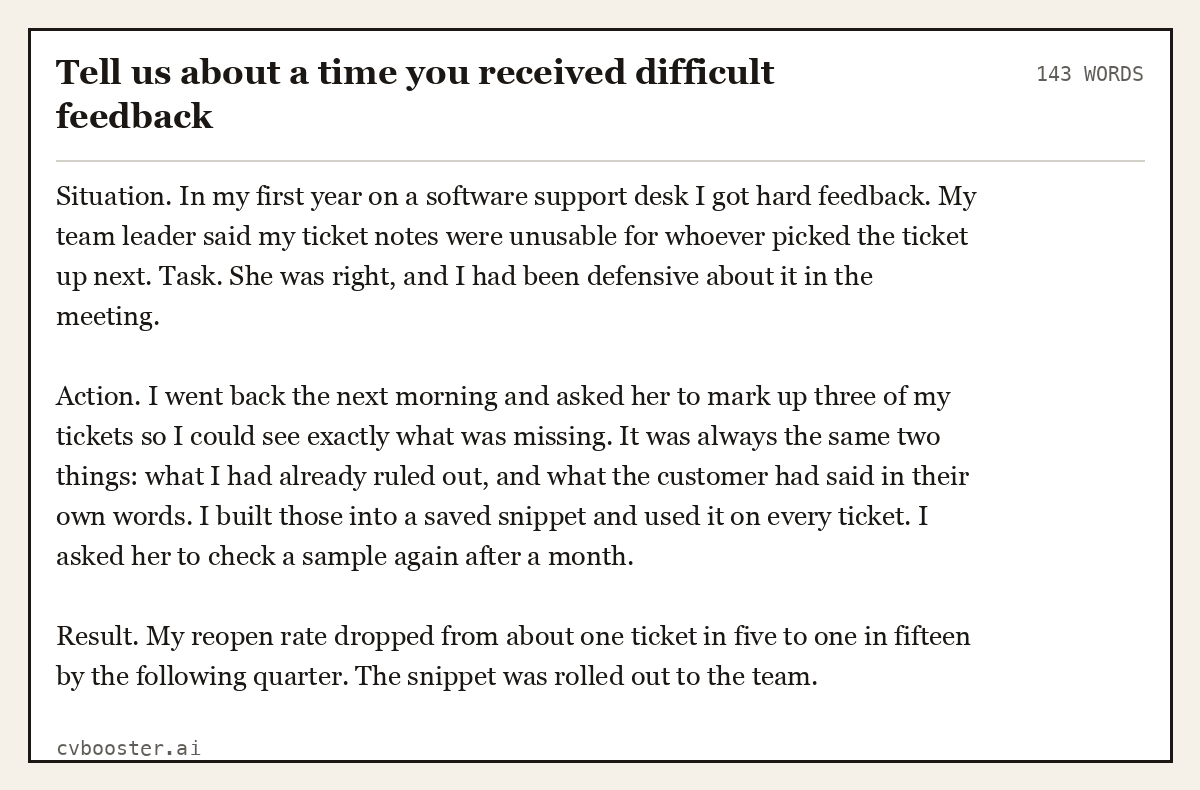
Situation. In my first year on a software support desk I got hard feedback. My team leader said my ticket notes were unusable for whoever picked the ticket up next. Task. She was right, and I had been defensive about it in the meeting.
Action. I went back the next morning and asked her to mark up three of my tickets so I could see exactly what was missing. It was always the same two things: what I had already ruled out, and what the customer had said in their own words. I built those into a saved snippet and used it on every ticket. I asked her to check a sample again after a month.
Result. My reopen rate dropped from about one ticket in five to one in fifteen by the following quarter. The snippet was rolled out to the team.
*The wrong answer:* feedback you disagreed with and quietly ignored.
Problem solving and adaptability
Prospects lists the typical openings as "Tell us about a time when you...", "Give an example of..." or "Describe how you...". Treat all three as the same request: one event, one set of your own actions.
Give an example of a situation where you solved a problem in a creative way.
*What the panel is testing:* whether creative means a new method or just extra effort.
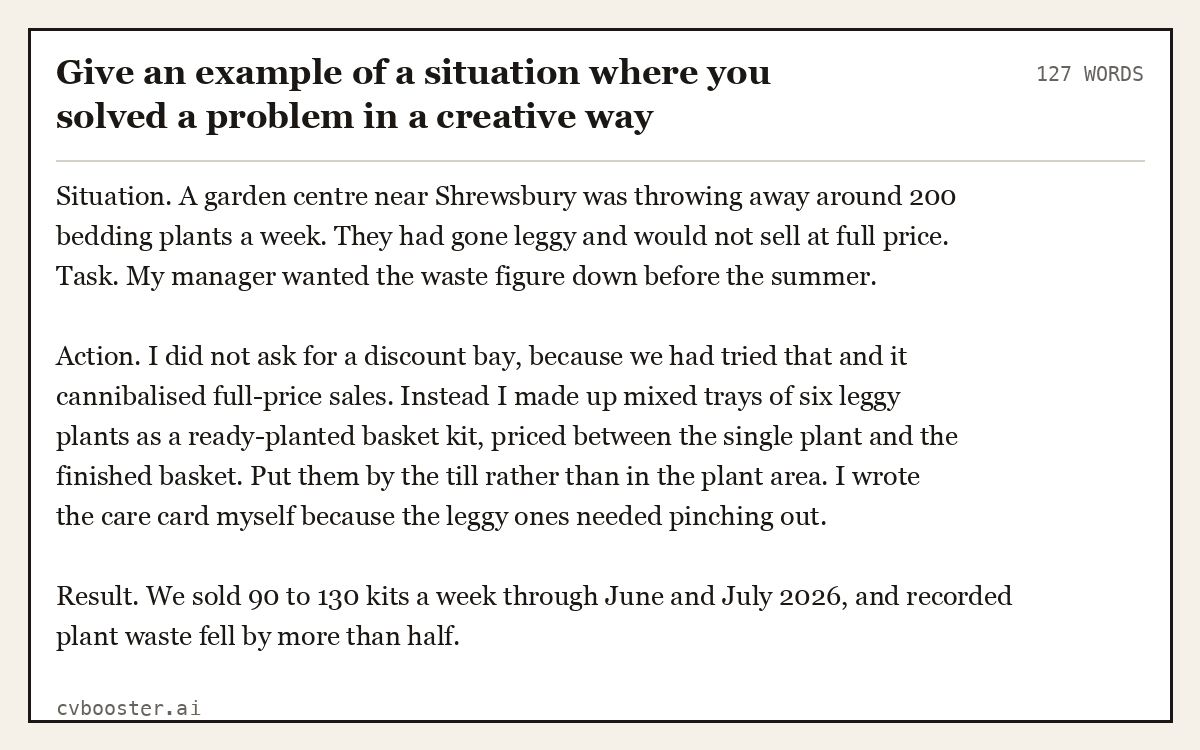
Situation. A garden centre near Shrewsbury was throwing away around 200 bedding plants a week. They had gone leggy and would not sell at full price. Task. My manager wanted the waste figure down before the summer.
Action. I did not ask for a discount bay, because we had tried that and it cannibalised full-price sales. Instead I made up mixed trays of six leggy plants as a ready-planted basket kit, priced between the single plant and the finished basket. Put them by the till rather than in the plant area. I wrote the care card myself because the leggy ones needed pinching out.
Result. We sold 90 to 130 kits a week through June and July 2026, and recorded plant waste fell by more than half.
*The wrong answer:* a problem you solved by working late. That is diligence, not problem solving.
Describe a time when you had to make a decision without all the information.
*What the panel is testing:* whether you can name what you did not know and still act.
Situation. I was duty manager at a hotel in Bath when the fire alarm panel showed a fault on the second floor at 23:40. The engineer was ninety minutes away. Task. Decide whether to evacuate 74 guests in the rain on a fault I could not confirm.
Action. I could not verify the zone, so I treated the unknown as the risk. I sent the night porter to walk the floor and check physically while I called the fire service for advice rather than as an emergency. With no smoke and no heat, I kept guests in place, posted a member of staff on the floor as a continuous watch. Wrote down the time of every decision.
Result. The panel fault was a failed detector head, replaced at 01:20, and no evacuation was needed.
*The wrong answer:* pretending you had all the facts. The competency is deciding under uncertainty.
Tell us about a time you had to adapt to a significant change at work.
*What the panel is testing:* whether you moved first or waited to be moved.
Situation. My insurance claims team moved from paper files to a new claims system in January 2026 with two days of training. Task. My handling time doubled in week one and I was the second slowest on the team.
Action. I asked for an hour with the person who had built the workflow, not the trainer. I wrote down the six keyboard shortcuts that covered most of my day. I then offered to run a thirty minute session for the rest of the team on my own time. That forced me to learn it properly.
Result. My handling time was back to the old average by the end of week four, and eleven of fourteen colleagues came to the session.
*The wrong answer:* "I am very adaptable." Describe the week it hurt.
Give an example of a challenge you faced at work and how you overcame it.
*What the panel is testing:* whether the challenge was genuinely hard and whether the result is measurable.
Situation. A catering company I worked for in Bristol lost its head chef three days before a 250 cover wedding. Task. I was the sous chef and the only person who had seen the menu tasting.
Action. I cut the menu from five courses to four with the couple's agreement on the phone. I chose the dish to drop by what needed the most last-minute plating. Rewrote the prep list by station rather than by course so agency staff could follow it. I called two former colleagues and got one experienced pastry chef for the day.
Result. All 250 covers went out, the main course was eleven minutes late and nothing else was, and the company kept the venue contract.
*The wrong answer:* a challenge that resolved itself.
Describe a time you made a mistake. What did you do?
*What the panel is testing:* whether you report your own errors before someone else finds them.
Situation. On a supermarket night shift in Sunderland I priced a promotion at 2 pounds instead of 2 pounds 50 across a full aisle end. Task. I found it at about four in the morning with the store opening at seven.
Action. I did not quietly change the labels and say nothing. I rang the duty manager. I told her the wrong price had been live for six hours online as well as in store, and asked whether we honoured it. She said honour it. I reprinted the labels, wrote the incident up with the times, and put a second-checker step into my own routine for aisle ends.
Result. The store honoured about 40 sales at the lower price, and I have not repeated it in two years.
*The wrong answer:* a mistake with no cost, or one you blame on a system.
Leadership and planning
Prospects is blunt about invention: "avoid embellishing the truth at all costs - any lies or invented examples can be easily checked". Every example below is the kind that survives a follow-up question, because the numbers are the kind you would actually remember.
Tell us about a time you led a team.
*What the panel is testing:* whether you led people or just held a title.
Situation. I ran a team of six on the customer desk of a bike shop chain in Manchester through the 2025 Christmas period. Task. We had two new starters and the busiest four weeks of the year.
Action. I put the two new starters on the same shifts as the two staff who were best at explaining rather than fastest at serving. I moved the daily briefing from the end of the shift to the start. Cut it to three things: what is in stock, what is not, and who is covering the phone. I did the phone myself on Saturdays because it was the job everybody hated.
Result. We cleared the December queue with no complaints logged, and both new starters were still there in June 2026.
*The wrong answer:* a story where leading means delegating. Say what you personally took on.
Describe a time you had to motivate someone who was underperforming.
*What the panel is testing:* whether you diagnose before you push.
Situation. A member of my team at a housing association was missing her repairs follow-up calls, about a third of them, for two months. Task. My manager wanted a performance conversation. I wanted to know why first.
Action. I sat with her for an hour and watched her work. She was not avoiding the calls, she was stuck on a system screen that made her re-enter the tenant reference for every call. I timed it at just under three minutes of retyping per call. I raised it with the systems team and gave her a temporary list export in the meantime.
Result. Her follow-up completion went from around 65 per cent to over 95 within three weeks. The screen was fixed for the whole team that quarter.
*The wrong answer:* a motivational talk with no diagnosis.
Give an example of when you delegated a task.
*What the panel is testing:* whether you match the task to the person and then check.
Situation. I was coordinating a charity's annual fundraising walk in Sheffield with eleven volunteers. Task. I had been doing the marshal briefing myself every year and it was the thing that made me late for everything else.
Action. I gave it to a volunteer who had marshalled three years running and was a retired driving instructor. That meant briefing people was literally her old job. I wrote down what the briefing had to cover, agreed a time to check in the week before. Then left her to write it in her own words. I did not sit in on the day.
Result. The briefing ran without me, two marshals told me it was clearer than mine, and I had ninety minutes back on the morning.
*The wrong answer:* delegating and then doing it anyway.
Tell us about a time you had to plan and prioritise competing deadlines.
*What the panel is testing:* whether you have a method or just work harder.
Situation. In March 2026 I had a quarterly VAT return, a year-end stock count and a new supplier onboarding all landing in the same fortnight. Task. Two had legal deadlines and one did not.
Action. I listed all three with their real deadline and the cost of missing it, not the noise around them. The VAT return had a penalty, the stock count had an auditor booked. The supplier could wait ten days without any cost beyond an awkward email. I told the supplier that on day one rather than letting it drift. I then blocked mornings for the return and afternoons for the count.
Result. Both statutory deadlines were met, the supplier went live nine days later than planned, and nothing was penalised.
*The wrong answer:* "I prioritise by urgency." Name the cost of missing each one.
Describe a time you had to deliver under significant time pressure.
*What the panel is testing:* whether you protect quality or drop it silently.
Situation. A laboratory I worked in had to return soil sample results in four days instead of ten. The client's planning hearing had moved. Task. Twenty-two samples, and the usual run was six a day.
Action. I said yes to sixteen, not twenty-two, and I said it on the first call rather than at the end. I picked the sixteen that covered every borehole, so the client still had full site coverage. I ran them in two batches with a single calibration to save set-up time. Had a colleague second-check the calculations instead of skipping the check.
Result. Sixteen results went out in three days, the remaining six on day nine as normal, and the client had what the hearing needed.
*The wrong answer:* agreeing to everything and then failing quietly.
Integrity and customer focus
The National Careers Service advice on using STAR is worth following literally: "keep examples short and to the point" and "be prepared to answer follow-up questions about the examples you give". Assume the panel will ask what you would do differently.
Tell us about a time you had to uphold a policy that was unpopular.
*What the panel is testing:* whether you can be firm without being cold.
Situation. I managed a small hotel bar and had to refuse alcohol to a guest who was clearly drunk at a colleague's leaving party. Task. He was a regular corporate client and the booker was watching.
Action. I did not announce it across the bar. I asked him to step to the end of the counter, told him quietly that I could not serve him any more tonight. Offered him food and a taxi on the house. I told the booker myself afterwards rather than letting the guest tell his version first, and I wrote it in the duty log.
Result. He left in a taxi without an argument, the company booked with us again in the spring. My licence and the hotel's were not at risk.
*The wrong answer:* enforcing the rule loudly, or bending it to keep the client.
Give an example of when you noticed something dishonest at work.
*What the panel is testing:* whether you report and how you handle not being certain.
Situation. At a recruitment agency I noticed that timesheets for one client were being approved by a consultant rather than the client manager. Task. It might have been a shortcut with permission, and it might have been billing for hours nobody worked.
Action. I did not accuse anyone and I did not ask the consultant. I checked six timesheets against the client's own signed copies, found three that did not match. Took it to the finance director with the copies rather than with my opinion. I said clearly that I did not know whether it was fraud or a process gap.
Result. It turned out to be an agreed shortcut that had never been documented. The process was changed to require a client signature within 48 hours.
*The wrong answer:* staying quiet because you were not sure.
Describe a time you went beyond what was expected for a customer.
*What the panel is testing:* whether the effort was useful, not just memorable.
Situation. A customer at a bathroom showroom in Leicester had a shower tray delivered damaged for the second time. His fitter was booked for the Monday. Task. The replacement lead time was eleven days.
Action. I rang three branches and found the same tray in Coventry. I asked my manager if I could collect it in my own car on the Saturday. The internal transfer van was not due until the Tuesday. I called the customer twice, once to say what I was trying and once to confirm. I checked the tray for damage in the branch car park before I drove back.
Result. The fitter worked on the Monday as planned. The customer spent about 3,400 pounds on the rest of the bathroom with us two months later.
*The wrong answer:* an act of heroism the customer did not actually need.
Tell us about a time you dealt with a difficult customer.
*What the panel is testing:* whether you can absorb anger and still resolve the issue.
Situation. A woman came into a pharmacy where I worked and shouted at the counter. Her mother's prescription was not ready for the third week running. Task. She was right, and the queue behind her was six people.
Action. I did not defend the process in front of the queue. I said out loud that she was right and that three weeks was not acceptable. I asked her into the consultation room and made the apology there. I found the cause, which was a repeat request stuck between the surgery and us. I rang the surgery while she was in the room so she could hear it.
Result. The prescription was ready in forty minutes. I set up a note on the record so her mother's repeats were checked manually each month.
*The wrong answer:* de-escalating without fixing anything.
Give an example of when you improved something for the people you serve.
*What the panel is testing:* whether you can show a before and an after.
Situation. The school office where I worked was fielding around thirty calls every morning from parents reporting absence. We were missing safeguarding calls behind them. Task. The absence line and the main line were the same number.
Action. I proposed a separate voicemail absence line, but the head was worried parents would not use it. I ran it for one year group for three weeks as a trial and counted the calls, then presented both numbers. Uptake in that year group was well over half. I wrote the parent message myself and put it on the newsletter and the gate poster.
Result. Morning calls to the main line dropped by roughly half within a term. Two safeguarding calls that term were picked up inside a minute.
*The wrong answer:* an improvement you suggested but never tested.
The competency table, and three questions to ask back
Prospects recommends having "five to eight STARR examples ready that you can adapt to different competencies", and adds that reusing an example is fine but "avoid overusing one example across the whole interview as it can seem like you have limited experience". Use this table to check your stories cover the eight competencies before you walk in.
| Competency | Question you will get | The point to land |
|---|---|---|
| Teamwork | Worked as part of a team to achieve a goal | Your own contribution, named |
| Teamwork | Conflict with a colleague | You separated the issue from the person |
| Communication | Explained something complicated | The words you swapped |
| Communication | Influenced without authority | Evidence, not persistence |
| Communication | Received difficult feedback | What you changed and the measure |
| Problem solving | Solved a problem creatively | A new method, not more hours |
| Problem solving | Decided without full information | You named the unknown and acted |
| Problem solving | A mistake you made | You reported it before it was found |
| Adaptability | A significant change at work | You moved first |
| Adaptability | A challenge you overcame | The result is countable |
| Leadership | Led a team | What you personally took on |
| Leadership | Motivated an underperformer | You diagnosed before pushing |
| Leadership | Delegated a task | Matched to the person, then checked |
| Planning | Competing deadlines | The cost of missing each one |
| Planning | Delivered under time pressure | You protected quality out loud |
| Integrity | Upheld an unpopular policy | Firm, quiet, logged |
| Integrity | Noticed something dishonest | You reported without accusing |
| Customer focus | Went beyond expectations | The effort was useful |
| Customer focus | A difficult customer | Absorbed the anger, fixed the cause |
| Customer focus | Improved something | A before and an after |
Tip: Write your eight stories on one page as four words each, not as scripts. The National Careers Service asks you to "try to get your points across in a conversational way so as not to appear too rehearsed", and a memorised paragraph is audible from the first sentence.
Ask these three at the end.
- Which competencies on the person specification carry the most weight in the scoring? A structured panel will have a matrix and will usually tell you.
- Who else does this role work with most. What do they find hardest about it? You get the real friction, not the advert version.
- What does the first ninety days look like. What would make you say it had gone well? It turns a vague role into a measurable one before you accept it.
The wording above is quoted from the National Careers Service STAR method page and the Prospects guide to competency-based interviews. A structured panel will mix these with ordinary questions, and the National Careers Service page on how to answer common interview questions advises that "Your answers should reflect the skills the employer wants". For sector versions of the same structure see care assistant interview questions and support worker interview questions and answers. The unstructured questions that sit alongside these are in common interview questions and answers. What to ask when the panel turns it round is in questions to ask in an interview. The weakness question gets its own page in weaknesses for job interviews.
Frequently asked questions
What are the most common competency-based interview questions?
The twenty above are the set, and they map to eight competencies: teamwork, communication, problem solving, adaptability, leadership, planning, integrity and customer focus. Prospects notes that the questions usually open with "Tell us about a time when you...", "Give an example of..." or "Describe how you...". Whatever the wording, the panel wants one event with your own actions in it.
What is your 3 weaknesses' best answer?
Name a real weakness, say what it has cost, and say what you have changed, in that order. For example: my ticket notes were unusable for the next person, which pushed my reopen rate to one in five. So I built a saved snippet covering what I had ruled out and the customer's own words. Avoid disguised strengths. A panel that hears perfectionism stops listening.
How to pass a competency-based interview?
Prepare between five and eight complete stories, map each to more than one competency, and label them in your head as Situation, Task, Action, Result. Spend most of each answer on the Action, because that is what is scored. Bring one number per story. Prospects warns to "avoid embellishing the truth at all costs - any lies or invented examples can be easily checked".
What are some good examples of how to answer competency-based interview questions?
Every answer here is a complete example, written in first person. The S, T, A and R labels show where each part starts and stops. Take the structure and the length, then replace the setting, the names and the numbers with your own. An answer of roughly 150 words takes about a minute to say out loud, which is the right size.
How many competency questions will I be asked?
Prospects states that "typically you can expect between three and six questions in a standard interview (lasting around 45-60 minutes)". That is why your five to eight prepared stories need to stretch across several competencies each. A story about leading a team through a system change can answer leadership, adaptability and communication, as long as you change which part you emphasise.
More in this series: Interview answers
- Care Assistant Interview Questions and 15 Full Answers
- Interview Questions and Answers: the 20 You Will Be Asked
- Support Worker Interview Questions and 15 Model Answers
Related articles
- STAR Method Answers Examples: 12 Weak Answers Rewritten
- Competency-Based Interview Questions and 15 Answers, Ireland
- Competency Examples: 12 Definitions and Worked Proof
- NHS Interview Questions and 15 Full Answers, Band 2 to 6
More articles
Looking for a worked example for your job title? Browse the resume examples by job title.