Interview Questions and Answers: the 20 You Will Be Asked
By Mustafa Tarabya, founder of CVBooster · Published · Updated
20 min read
Twenty questions cover almost every UK interview, and nine of them are behavioural, which means a general answer scores nothing. The constraint people miss is time. Most interviews run 45 to 60 minutes, so you get about two minutes a question and no room for a warm-up. The guidance quoted here is from the National Careers Service pages on common interview questions and the STAR method, both fetched in September 2026. All twenty interview questions and answers are below in full, grouped as a panel asks them. Each carries what they are really asking and the wrong answer. Written by Mustafa Tarabya, who hired for his own company, read every application himself and now writes CVBooster's guides.
Competency questions, the ones that decide it
Nine of the twenty are behavioural. They carry most of the marks, so they come first here.
Tell me about a time you worked as part of a team.
*What they are really asking:* what did you personally contribute.
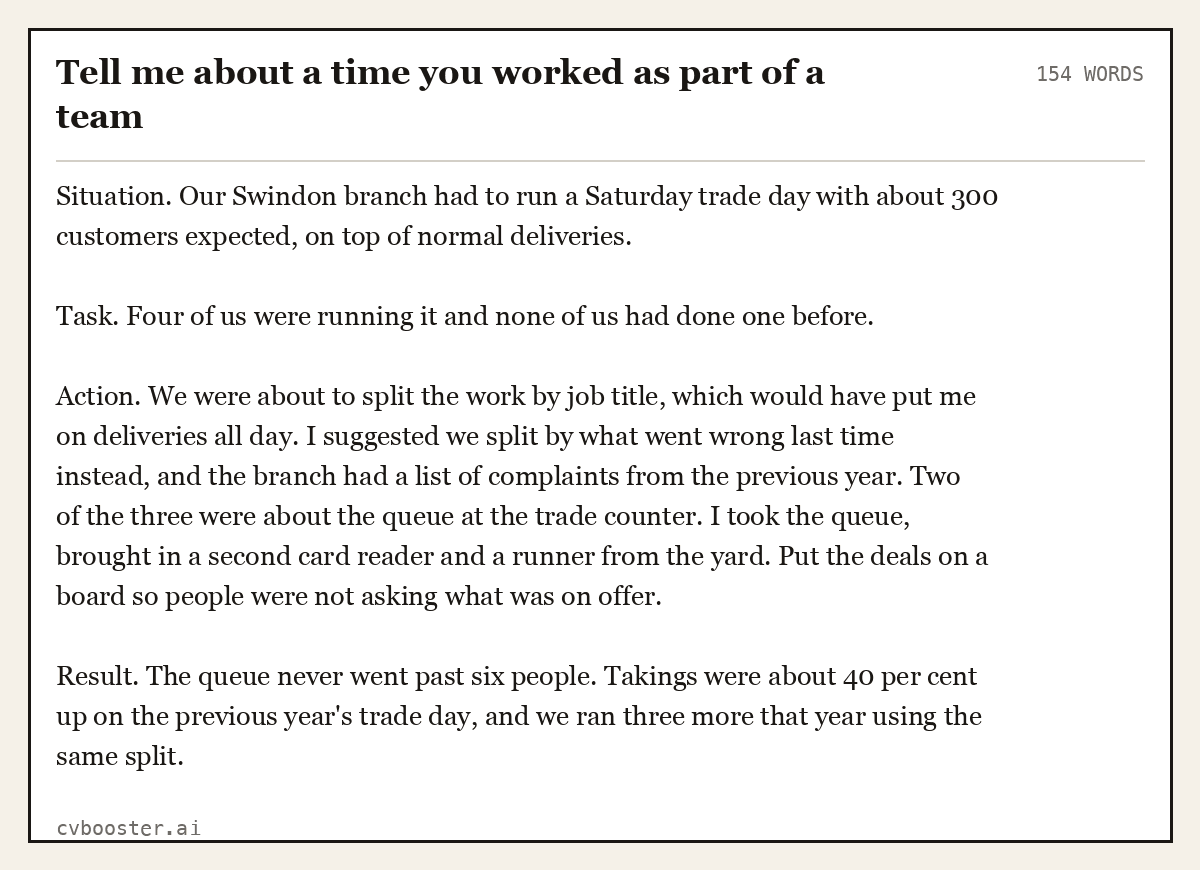
Situation. Our Swindon branch had to run a Saturday trade day with about 300 customers expected, on top of normal deliveries.
Task. Four of us were running it and none of us had done one before.
Action. We were about to split the work by job title, which would have put me on deliveries all day. I suggested we split by what went wrong last time instead, and the branch had a list of complaints from the previous year. Two of the three were about the queue at the trade counter. I took the queue, brought in a second card reader and a runner from the yard. Put the deals on a board so people were not asking what was on offer.
Result. The queue never went past six people. Takings were about 40 per cent up on the previous year's trade day, and we ran three more that year using the same split.
*The wrong answer:* saying "we" for the whole story. The panel cannot give marks to a team.
Give an example of a time you solved a problem.
*What they are really asking:* do you find causes or apply plasters.
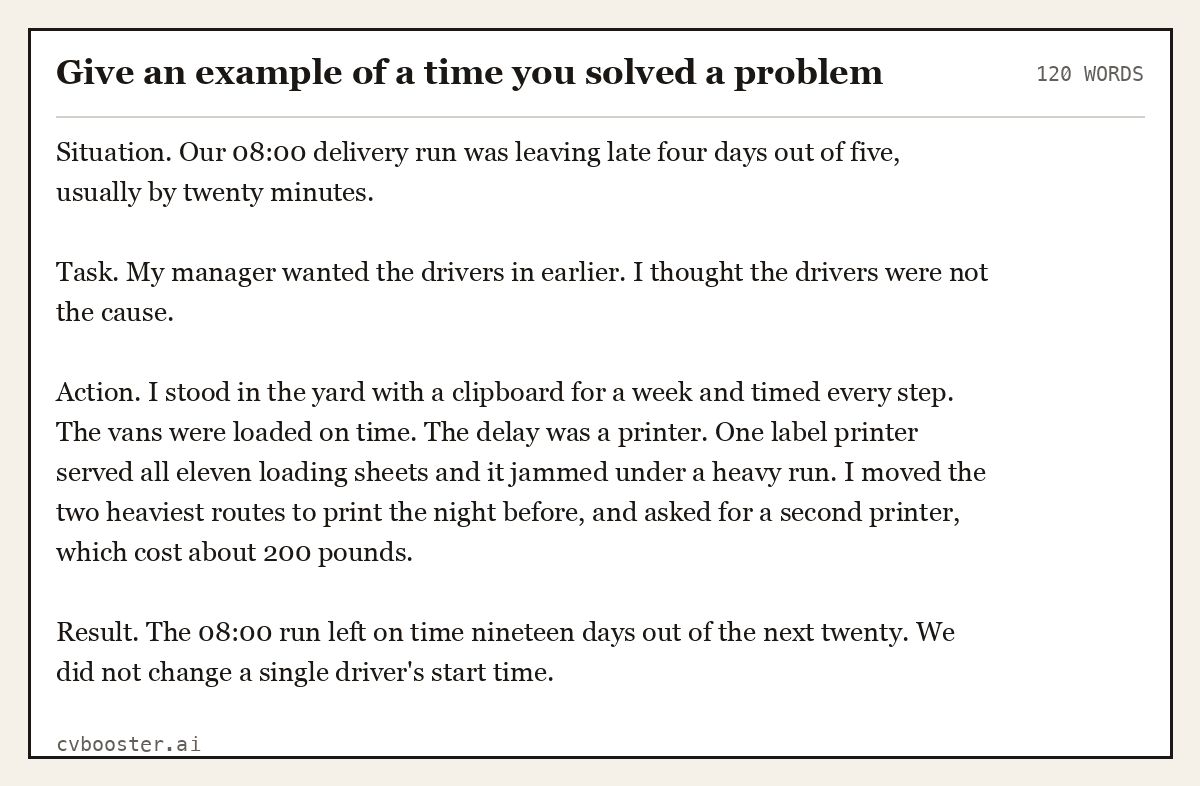
Situation. Our 08:00 delivery run was leaving late four days out of five, usually by twenty minutes.
Task. My manager wanted the drivers in earlier. I thought the drivers were not the cause.
Action. I stood in the yard with a clipboard for a week and timed every step. The vans were loaded on time. The delay was a printer. One label printer served all eleven loading sheets and it jammed under a heavy run. I moved the two heaviest routes to print the night before, and asked for a second printer, which cost about 200 pounds.
Result. The 08:00 run left on time nineteen days out of the next twenty. We did not change a single driver's start time.
*The wrong answer:* a problem you fixed by working later. That is effort, not problem solving.
Tell me about a time you missed a deadline.
*What they are really asking:* do you flag early, and do you own it.
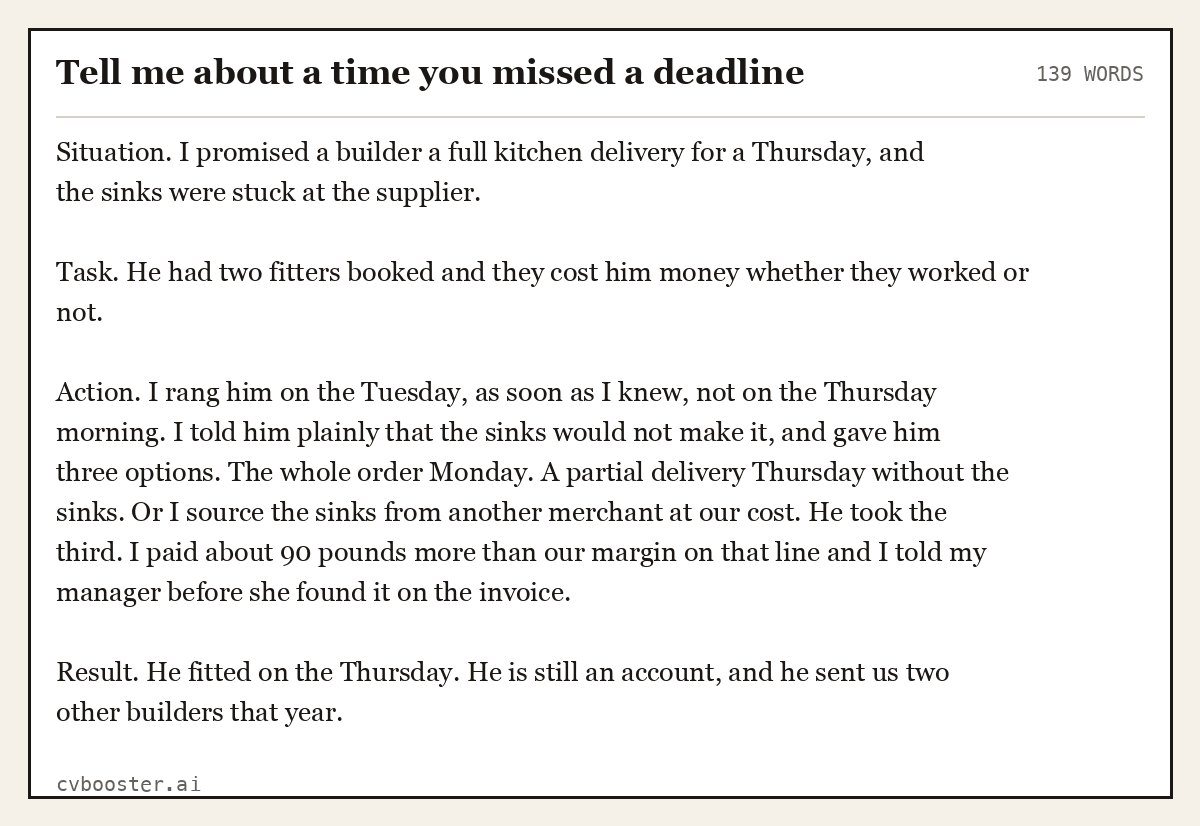
Situation. I promised a builder a full kitchen delivery for a Thursday, and the sinks were stuck at the supplier.
Task. He had two fitters booked and they cost him money whether they worked or not.
Action. I rang him on the Tuesday, as soon as I knew, not on the Thursday morning. I told him plainly that the sinks would not make it, and gave him three options. The whole order Monday. A partial delivery Thursday without the sinks. Or I source the sinks from another merchant at our cost. He took the third. I paid about 90 pounds more than our margin on that line and I told my manager before she found it on the invoice.
Result. He fitted on the Thursday. He is still an account, and he sent us two other builders that year.
*The wrong answer:* a missed deadline that was somebody else's fault throughout.
Describe a time you dealt with a difficult customer.
*What they are really asking:* can you absorb anger and still fix the cause.
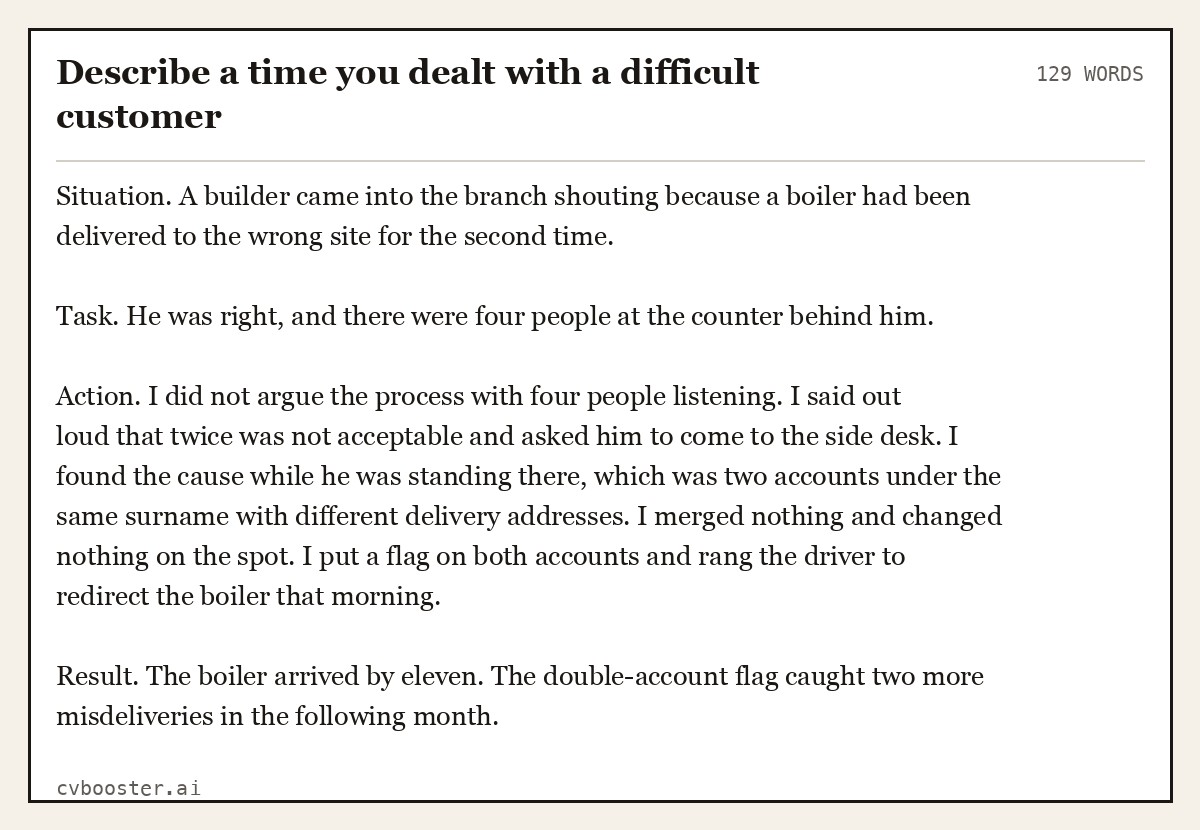
Situation. A builder came into the branch shouting because a boiler had been delivered to the wrong site for the second time.
Task. He was right, and there were four people at the counter behind him.
Action. I did not argue the process with four people listening. I said out loud that twice was not acceptable and asked him to come to the side desk. I found the cause while he was standing there, which was two accounts under the same surname with different delivery addresses. I merged nothing and changed nothing on the spot. I put a flag on both accounts and rang the driver to redirect the boiler that morning.
Result. The boiler arrived by eleven. The double-account flag caught two more misdeliveries in the following month.
*The wrong answer:* calming the customer without changing anything behind the scenes.
What is your greatest achievement?
*What they are really asking:* what do you rate, and does it match what this job rewards.
Situation. When I started, the branch had no delivery tracking at all beyond a paper sheet and a phone.
Task. Nobody had asked me to change that. It was not my job.
Action. I built a shared spreadsheet with the eleven routes, the drop times and a status column. I made myself update it three times a day for two months so people learned to trust it. When the counter staff started checking it instead of ringing me, I asked for it to be put on the screen behind the counter. Then I wrote a one-page guide so it survived my holiday.
Result. Delivery chase calls to my desk went from around twenty a day to under five. The system was still running when the new software replaced it eighteen months later.
*The wrong answer:* a personal achievement with no link to work you would do here.
About you
The National Careers Service sets out the four parts of a behavioural answer as "Situation - the situation you had to deal with", "Task - the task you were given to do", "Action - the action you took", and "Result - what happened as a result of your action and what you learned from the experience". The labels below show where each part starts.
Tell me about yourself.
*What they are really asking:* can you frame your own history for this job in under ninety seconds.
I am an operations coordinator at a plumbing merchant in Swindon. I run the delivery schedule for eleven vans and about four hundred trade accounts.
What I am actually good at is the exceptions. When a van goes off the road at six in the morning, somebody has to decide which accounts get pushed and which get a call. That is me, most mornings.
I have done it for three years, and the last two of those with the schedule on a new system I helped configure. Your advert describes the same job at roughly four times the volume, with two depots instead of one. That is why I applied, and it is the part I want to be tested on.
*The wrong answer:* a biography in date order. The relevant part arrives last, or never.
What are your greatest strengths?
*What they are really asking:* can you pick the strengths this job needs rather than the ones you like about yourself.
My strongest one for this role is holding a plan together when the information keeps changing. At the merchant, the stock feed updates four times a day and the drivers are on the road. I rebuilt my morning so that I check the feed once at 06:30, once at 09:00. Not in between, because constant checking was making me slower rather than faster.
The second is talking to people who are annoyed. I take about fifteen trade calls a week where a delivery is late. My rule is that I say the new time first and the apology second, because a builder wants the time.
The National Careers Service advice is to "Plan your answers around 2 or 3 examples that are relevant to the job", so those are my two.
*The wrong answer:* a list of five adjectives with no evidence behind any of them.
What is your greatest weakness?
*What they are really asking:* can you be honest about a real gap without talking yourself out of the job.
I am slow to hand work over. When I moved from driver to coordinator I kept doing the loading sheets myself. I could do them faster than the person I had given them to. It cost me most of my first month.
What I changed was specific. I wrote down what a correct loading sheet contains, gave that to the warehouse lead. Agreed I would check the first five and then stop. I checked the first five and I stopped.
I still notice the urge, so I have a rule now. If I am doing a task somebody else owns, I hand it back or I change who owns it in writing. The National Careers Service puts it plainly: "You should be honest when answering questions on your weaknesses. Say how you're working to improve them".
*The wrong answer:* a strength in disguise. A panel that hears perfectionism stops listening.
How would your last manager describe you?
*What they are really asking:* whether your self-image matches what is in your reference.
She would say I am the person she does not have to chase. That I ask too many questions at the start of a job.
Both are true. In my last appraisal in April 2026 she wrote that I had not missed a scheduling deadline in two years. She also wrote, in the development box, that I should be quicker to start when the brief is only eighty per cent clear.
I have taken that one seriously. I now give myself a fixed number of questions before I begin, usually three, and I start with what I have after that. On the depot transfer project in June I asked three questions, started on day two instead of day five, and the plan held.
*The wrong answer:* "She would say I am hard-working." Give something she actually wrote down.
Motivation and the employer
Why do you want this job?
*What they are really asking:* whether you want this job or any job.
Two reasons, and one of them is selfish. The first is the two-depot structure. I have run a single depot schedule for three years and I have taken it about as far as it goes. The problem I want next is the cross-depot one. A van from the wrong depot is often closer to the customer, and nobody owns that decision.
The second is that your advert mentions a move to route planning software next year. I have already been through one system migration and I was the person who wrote the cutover checklist. I would rather do the second one than the first one.
I want a job where the schedule is hard enough to be interesting. Yours is.
*The wrong answer:* praising the company's reputation. It applies to every candidate in the building.
What do you know about our company?
*What they are really asking:* did you do twenty minutes of homework.
You have four branches, the newest in Reading opened last year, and you supply mainly small builders rather than national contractors. Your latest accounts show growth in trade credit accounts rather than counter sales, which changes the delivery picture, because credit customers order bigger and later.
Your careers page says you promote branch managers from inside. That matters to me because I want to be running a depot in three or four years.
The National Careers Service advice is to "look at their website and 'about us' pages to find out more about their products, services and values", so I did that, and I also rang your Reading branch as a customer to see how the phone is answered. It was answered in four rings by a person who knew the stock.
*The wrong answer:* reciting the "about us" page back at them. Bring something you found that is not on it.
Why are you leaving your current job?
*What they are really asking:* are you running towards something or away from someone.
The schedule stopped growing. We went from seven vans to eleven in my first year, and we have been at eleven for two years. The interesting decisions are made now and I make them on autopilot.
I have no complaint about my manager or the company. I would give them a fair notice period and I would leave the handover in a state where the next person can pick it up. This is because that is how I would want to inherit it.
I looked internally first. There is no second depot to move to, so the move has to be external. The National Careers Service suggests that if you left by choice you should "be positive about why you want a new job and describe why their company suits you better", which is exactly the position I am in.
*The wrong answer:* criticising your current employer. The panel hears what you will say about them.
Where do you see yourself in five years?
*What they are really asking:* will you still be here in two, and do you have a direction.
Running a depot, or running the scheduling for a region. Not a director, and not in a different industry.
I know the route. It is depot coordinator, then assistant branch manager, then branch. What I am missing is the commercial side, which is why I asked about your branch manager development programme.
Five years is long enough that I would be lying if I gave you a job title and a date. What I can tell you is the direction and the next step, and the next step is this job for at least three years. This is because a schedule takes a year to learn and two more to improve.
*The wrong answer:* "In your job." It is meant as a joke and it lands as a threat.
Situational and pressure questions
How do you handle pressure?
*What they are really asking:* what do you actually do differently on a bad day.
I get quieter and I write more down. That is not a personality claim, it is a routine I built after a bad week.
In February 2026 we had three vans off the road with one driver off sick, and I tried to hold it in my head. I lost a drop and a builder waited four hours.
Now, when the day goes wrong, I stop. I spend five minutes writing the whole picture on paper: every van, every drop, what is already late. It feels like the wrong use of five minutes and it is the best five minutes of the day. I also tell the branch manager in one sentence at the point it goes wrong, not at four o'clock when it is unfixable.
*The wrong answer:* "I thrive under pressure." Everybody says it and nobody can be marked on it.
What would you do in your first ninety days?
*What they are really asking:* have you thought about the job or only about getting it.
For the first month I would not change anything. I would ride with a driver from each depot for a full day, because the schedule looks completely different from the cab.
In the second month I would build the picture you do not currently have, which from your advert sounds like cross-depot visibility. I would start by measuring how often a drop is served by the further depot, because until that number exists nobody can argue about it.
In the third month I would change one thing, not five. Probably the cross-depot rule, and only if the number says it is worth it.
I would also want a standing fifteen minutes with you each week. This is because a new person makes the most expensive mistakes in the first sixty days.
*The wrong answer:* a plan to fix everything by week two.
How do you prioritise when everything is urgent?
*What they are really asking:* do you have a method, or do you just work faster.
I rank by what it costs to be late, not by who is shouting.
A builder with fitters standing on site costs him money by the hour. A merchant restocking their own shelves does not. Those two calls sound identical on the phone and they are not the same job.
So I ask one question on every call, which is when do you actually need this on site. About half the time the honest answer is later than the request. That frees the van.
When two genuinely cost the same, I take the one that is already late. This is because a delivery that is two hours late becomes a complaint and a delivery that is thirty minutes late does not. I tell the other customer a real time rather than a hopeful one.
*The wrong answer:* "I prioritise by urgency." Say how you rank them.
Can you explain the gap in your employment?
*What they are really asking:* is there a problem here, and are you comfortable talking about it.
There is a nine month gap from March to December 2024. My father had a stroke and I was his main carer while my sister finished her degree.
I did two things in that time that are relevant. I did the level 3 transport planning course online, which I paid for myself and finished in the October. I also did Saturdays at a builders' merchant near home from the August, which is how I got back into the trade.
I am not looking for time off now. My father moved into supported housing in the November and my sister is nearby. I came back to full-time work in January 2025 and I have not had a day of unplanned absence since.
*The wrong answer:* being vague. A gap you skate over sounds worse than the reason usually is.
Closing and money questions
What are your salary expectations?
*What they are really asking:* are we in the same range, and do you know your own worth.
I am on 31,500 now. For this role, with two depots and the software project, I am looking at 34,000 to 37,000. I would take the lower end for a clear route into branch management.
I have looked at three similar coordinator roles advertised in the region this year and they sat between 32,000 and 38,000. That is where I got my range.
If the band is fixed, tell me now and I will tell you whether it works. This is because neither of us wants to find out at the offer stage. I would rather agree the number today than negotiate after I have met the team and got attached.
*The wrong answer:* "Whatever you think is fair." You have just handed over the only leverage you had.
Why should we hire you?
*What they are really asking:* did you listen to the problem we described at the start.
You said at the beginning that the two depots do not talk to each other. Drivers cross each other on the A419 most days.
That is the problem I fixed at a smaller scale. When we went from seven vans to eleven, the same thing happened inside one depot, with two loading bays working from separate sheets. I put both bays on one board, gave the yard lead the authority to move a drop between them without asking me. Measured the crossings for six weeks.
Crossings went from about nine a week to two. The 200 pound printer story I told you earlier came out of the same measuring habit.
So you are hiring somebody who has already solved the smaller version of the thing you described, and who measures before changing it.
*The wrong answer:* listing your qualities. Answer the problem they named out loud.
Do you have any questions for us?
*What they are really asking:* how seriously did you take this, and are you interviewing us too.
Yes, three. First, what does the cross-depot decision look like today, and who makes it when the two branch managers disagree?
Second, you mentioned route planning software next year. Is the supplier chosen, and is there a budget for the cutover or is it being done inside existing hours?
Third, say I am sitting here in twelve months and you are happy with the hire. What will have changed that has not changed in the last twelve months?
The National Careers Service calls this "a good chance to show your interest in the company and your enthusiasm for the job". It is also the only part of the interview where you find out whether you want it.
*The wrong answer:* "No, I think you've covered everything." It reads as indifference.
Your prep table and three questions to ask back
One line per question, what they are really asking, and the evidence to bring.
| Question | What they are really asking | The evidence to bring |
|---|---|---|
| Tell me about yourself | Can you frame yourself for this job | Your current scale, in numbers |
| Greatest strengths | Did you pick the ones this job needs | Two, with a routine behind each |
| Greatest weakness | Can you be honest and still be hired | The cost and the fix |
| How would your manager describe you | Does this match your reference | A line from your appraisal |
| Why this job | This job or any job | The next problem you want |
| What do you know about us | Did you do the homework | Something not on the about page |
| Why are you leaving | Running to or running from | What you tried internally |
| Five years | Direction and staying power | The next step, not a title |
| Teamwork | What did you contribute | Your own decision in it |
| Problem solving | Causes or plasters | The measurement you took |
| Missed deadline | Do you flag early | The date you rang them |
| Difficult customer | Did you fix the cause | The change behind the scenes |
| Greatest achievement | What do you rate | Something that outlived you |
| Pressure | What changes on a bad day | Your actual routine |
| First ninety days | Have you thought about the job | One change, not five |
| Prioritising | Method, not speed | How you rank the cost |
| Employment gap | Is there a problem here | The dates and what you did |
| Salary | Are we in range | Your number and your evidence |
| Why you | Did you listen | Their stated problem, solved smaller |
| Your questions | How seriously did you take this | Three written down |
Tip: Do not memorise these word for word. Memorise the first sentence and the last one. The middle then comes out in your own language, which is the difference between thought through and recited. The National Careers Service says the same thing: "try to get your points across in a conversational way so as not to appear too rehearsed".
Ask these three at the end if you have nothing better.
- What does success look like in this role at six months? You get the real priorities, not the advert version.
- What is the hardest part of this job that the advert does not mention? People answer this honestly more often than you would expect.
- What happens next, and when will I hear? It closes the loop and gives you a date to chase.
The wording above is quoted from the National Careers Service pages on how to answer common interview questions and the STAR method. For the structured version used by large employers, see competency based interview questions and answers. Prospects puts a typical competency interview at "between three and six questions in a standard interview (lasting around 45-60 minutes)", so pick your stories before you go in (Prospects, competency-based interviews). For care roles, see care assistant interview questions and support worker interview questions and answers. For the end of the interview, see questions to ask in an interview. For the weakness question in detail, see weaknesses for job interviews. For the day before, see how to prepare for an interview.
Frequently asked questions
What are the 10 main interview questions?
Tell me about yourself, why this job, what do you know about us, your strengths and your weakness. Then: a teamwork example, a problem you solved, how you handle pressure, your salary expectations, and do you have any questions. All ten are answered in full on this page. Nine of the twenty here are behavioural, so prepare stories rather than statements.
How do I introduce myself during an interview?
In three sentences: your current role and its scale, the part of it you are best at, and why this job is the next step. For example: an operations coordinator running eleven vans and four hundred accounts, strongest on the exceptions. Applying because this role is the same job at four times the size. Then stop and let them ask.
What are the 7 most common interview questions and answers?
Tell me about yourself, why do you want this job, what are your strengths and what is your weakness. Then: a time you worked in a team, why are you leaving, and do you have any questions for us. Each is answered above with what the panel is really asking and a full worked reply you can adapt.
What are 5 good interview questions to ask?
What does success look like at six months. What is the hardest part of the job that the advert does not mention. Who does this role work with most. What would have changed in twelve months if this hire went well. And what happens next. The National Careers Service treats the end of the interview as "a good chance to show your interest in the company and your enthusiasm for the job".
Do I need examples if I have little work history?
No, and the National Careers Service says so directly: "If you don't have much work history, you can use examples from outside of work. You can also use examples from volunteering experience." A charity walk you organised, a team you captained or a family business you helped run all give you a Situation, a Task, an Action and a Result, which is all a behavioural question needs.
More in this series: Interview answers
- Care Assistant Interview Questions and 15 Full Answers
- Competency Based Interview Questions and 20 Answers
- Support Worker Interview Questions and 15 Model Answers
Related articles
- Competency Based Questions and Six Full UK Answers
- Interesting Facts About Me: 6 Answers and 20 Examples
- STAR Interview Questions: 12 Full Answers and the Budget
- Competency Based Interview Questions and 20 Answers
More articles
- Communicating and Influencing: 4 Civil Service Examples
- Competency Based Application Form: 5 Filled Examples
Looking for a worked example for your job title? Browse the resume examples by job title.