Teacher Resume: Objective Examples, Certification, Evidence
By Mustafa Tarabya, founder of CVBooster · Published · Updated
12 min read
Lead with your certification and the grade band and subjects it authorises, then prove the classroom underneath it. A principal reading a teacher resume is answering two questions in sequence: can this person legally teach this timetable, and is there evidence they can teach it well? Answer them in that order. If you only need the top lines, the teacher resume objective examples below cover first-year, substitute, career-change and paraprofessional applications.
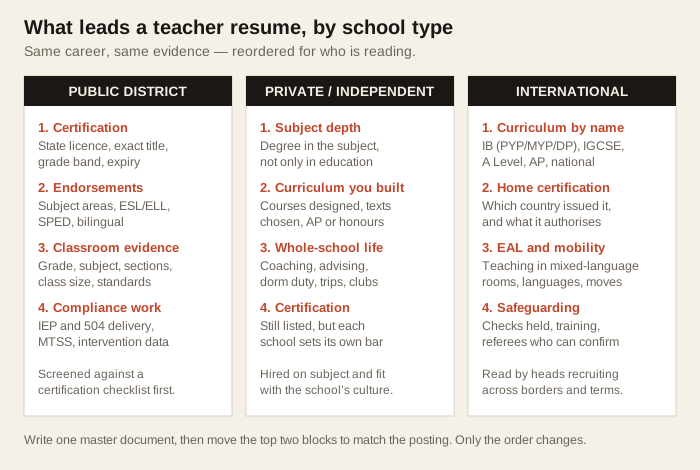
That order changes depending on who is hiring. A public school district screens against a certification checklist. An independent school hires on subject depth and school fit. An international school starts with the curriculum you have taught. Same career, different first paragraph.
Where do certification and endorsements go?
In their own block, high on page one, above your experience. Teaching certification in the United States is issued by the state rather than nationally, so the exact title of your credential, what it authorises and how it renews all differ depending on where it was issued. Texas, for example, publishes its own standard certificate renewal and continuing professional education requirements through the Texas Education Agency.
Because the systems differ, the safest thing you can do is copy your credential exactly as it is printed on the certificate itself. Do not translate it into a phrase you think sounds clearer, and do not invent a shorthand.
- The certificate's full official title, the issuing state or authority, and its status
- The grade band and subject areas it authorises, in the authority's own wording
- Endorsements or additional authorisations, each named in full
- The expiry or renewal date if your certificate carries one
- Certificates in other states, and any reciprocity application already in progress
- Anything pending, labelled as pending, with the date you expect it
Tip: If you are applying across a state line, say what you are doing about it in one line: which certificate you hold, that you have applied for reciprocity, and when you expect it. Silence on that point reads as a problem; a sentence turns it into a timeline.
How do you state grade bands and subjects?
Precisely, and in every place they appear. "Teacher" is not a job title on a resume that has to match a vacancy for a fourth-grade classroom or an AP Chemistry section. Write the grades, the subjects and the number of sections.
- Grades taught, as a band rather than a vague level: Grades 3 to 5, not "elementary"
- Subjects and courses by their real names, including honours, AP, IB or vocational designations
- Sections per day and typical class size
- Setting: general education, co-taught, inclusion, self-contained, pull-out, bilingual, online
- Standards or specification you taught to, named exactly
- Anything unusual about the population: newcomers, multi-age, split classes, high mobility
This is not detail for its own sake. It is the difference between a resume that can be matched to a specific vacancy and one that a principal has to guess about, and a busy principal with sixty applications does not guess.
What counts as classroom evidence?
Things that happened in your room, that a colleague could confirm, and that show a decision you made rather than a duty you held. Every teacher plans lessons and manages a class; that is the job description, not an achievement.
- A course, unit or intervention you designed, and who it was for
- Data you used and what you changed because of it: running records, benchmark assessments, exit tickets, common assessments
- A structure you introduced that outlived your class: a reading intervention block, a lab rotation, a homework routine other teachers adopted
- Curriculum or department work: mapping, textbook adoption, vertical alignment, pacing guides
- Mentoring, coaching student teachers, or leading professional development
- Family engagement that goes beyond the required conferences
- Clubs, coaching, trips, productions, competitions and the rest of the unpaid half of the job
Be careful with test scores. Student outcomes are shaped by the cohort, the school, the year and everything happening outside the building, and a large percentage gain attributed entirely to you is the kind of claim an experienced principal will probe. If you want to use assessment results, name the assessment, the cohort and the period, and describe what you did alongside the result rather than instead of it.
How does the document change for private and international schools?
Independent schools set their own hiring requirements rather than working from a state checklist, so they tend to read for subject mastery and for what you will contribute outside the timetable. Lead with your degree in the subject, the courses you have built, and the coaching, advising, dorm or trip commitments you have carried.
International schools read for curriculum first. Name the programme exactly (IB Primary Years, Middle Years or Diploma, IGCSE, A Level, AP, or a national curriculum) and say which subjects and levels within it. Add your experience teaching in mixed-language classrooms, the languages you use, and your safeguarding checks and training, because a head recruiting across borders needs those confirmed early.
- Public district: certification and endorsements first, then classroom evidence, then IEP, 504 and intervention work
- Independent: subject degree first, then curriculum you designed, then whole-school contribution
- International: curriculum by name first, then home-country certification, then EAL and safeguarding
- Charter and academy chains: usually closest to the district version, but check the posting for their own framework
- Supply, substitute and cover work: name the schools, the grade ranges and the subjects, because breadth is the selling point
What does a strong teacher resume look like?
The example below is invented. The teacher, the schools, the certificate number and every figure are fictional, and they are here to show the shape of the entries.
Example certification block: "Ohio Professional Educator Licence, Middle Childhood (Grades 4-9), Mathematics and Science, active, expires 06/2029. Endorsement: Teaching English to Speakers of Other Languages. Reciprocity application submitted to the Michigan Department of Education, 07/2026."
Example summary: "Middle school mathematics teacher with seven years in Grades 6 to 8, currently teaching five sections of Grade 7 maths and one Grade 8 algebra section, average class size 27. Built the school's Tier 2 numeracy intervention block and mentor two early-career teachers. TESOL endorsed, with four years in classrooms where a third of students were multilingual learners."
Example experience heading: "Mathematics Teacher, Grades 6-8, Ellsworth Middle School, Akron, OH. August 2021 to present. Title I school, roughly 640 students, six sections a day, co-taught inclusion model in two periods."
- Example bullet: "Teach six sections of Grade 7 mathematics and Grade 8 algebra to about 160 students a day, two of them co-taught with an intervention specialist for a caseload of nine students on IEPs."
- Example bullet: "Designed the school's 30-minute Tier 2 numeracy block: grouped students from benchmark data every six weeks, wrote the routine and the materials, and trained the four teachers who now run it."
- Example bullet: "Rebuilt the Grade 7 pacing guide with the department after mapping it against the state standards, moving proportional reasoning earlier so it lands before the state assessment window."
- Example bullet: "Mentor two first-year teachers through the district induction programme: weekly co-planning, three observation cycles a year, and written feedback against the district rubric."
- Example bullet: "Coach the Grade 7 and 8 quiz bowl team, running weekly practice and travelling to four county tournaments a year."
None of those bullets claims a test score jump. They describe decisions, structures and responsibilities, all of which a former colleague could confirm in a reference call, which is exactly where a teacher resume gets checked.
Teaching resume sample objectives, by situation
A teacher resume objective is two or three lines at the top that say what you are certified to teach, what you have done in a classroom, and which position you want. It earns its place when the principal needs a reason: a first-year teacher, a career changer, a substitute moving to a contract, or a teacher changing grade band. Experienced teachers staying in the same subject should write a summary instead, which states the same things with results. Each example is tagged by level.
First-year teacher: objective for an elementary position (41 words)
Newly certified elementary teacher (Grades EC-6, Texas) with a full semester of student teaching in a second-grade inclusion classroom. Planned and taught a six-week guided reading unit and ran small-group phonics interventions. Seeking a first-grade or second-grade position in Northside ISD.
Career changer: objective for an alternative certification teacher (45 words)
Former civil engineer with eight years of project experience, now enrolled in an alternative certification program for secondary mathematics. Tutored algebra students weekly for two years at a community center. Seeking a high school mathematics position under an intern certificate for the coming school year.
Substitute teacher: objective for a long-term or contract role (44 words)
Substitute teacher with two years of daily and long-term assignments across K-8 in Columbus City Schools, including a nine-week fifth-grade placement. Holds an Ohio substitute license and a bachelor's degree in English. Seeking a contracted English language arts position in grades 4 to 6.
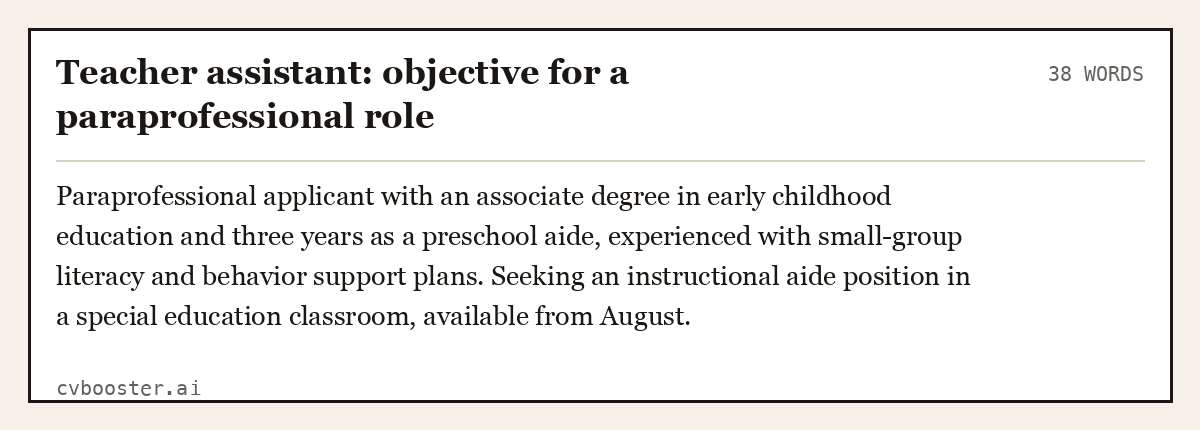
Teacher assistant: objective for a paraprofessional role (38 words)
Paraprofessional applicant with an associate degree in early childhood education and three years as a preschool aide, experienced with small-group literacy and behavior support plans. Seeking an instructional aide position in a special education classroom, available from August.
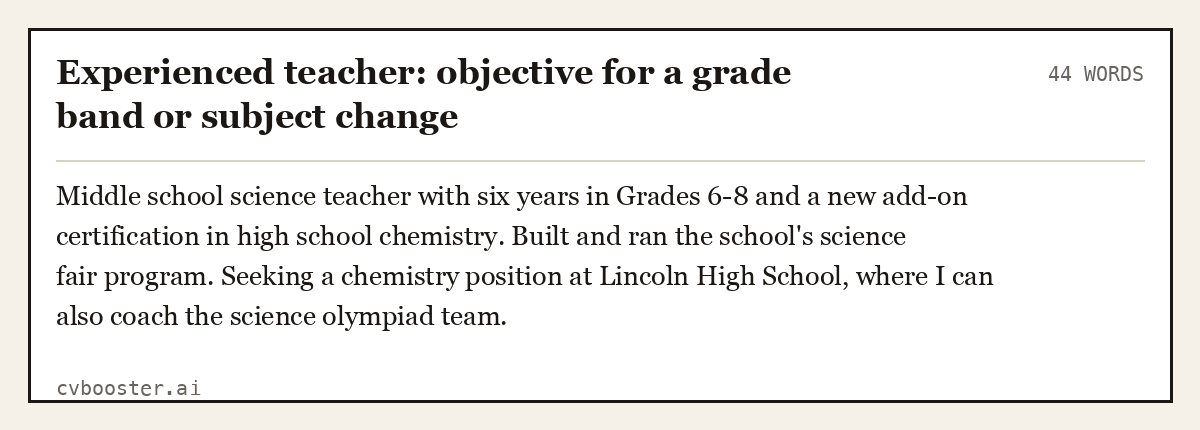
Experienced teacher: objective for a grade band or subject change (44 words)
Middle school science teacher with six years in Grades 6-8 and a new add-on certification in high school chemistry. Built and ran the school's science fair program. Seeking a chemistry position at Lincoln High School, where I can also coach the science olympiad team.
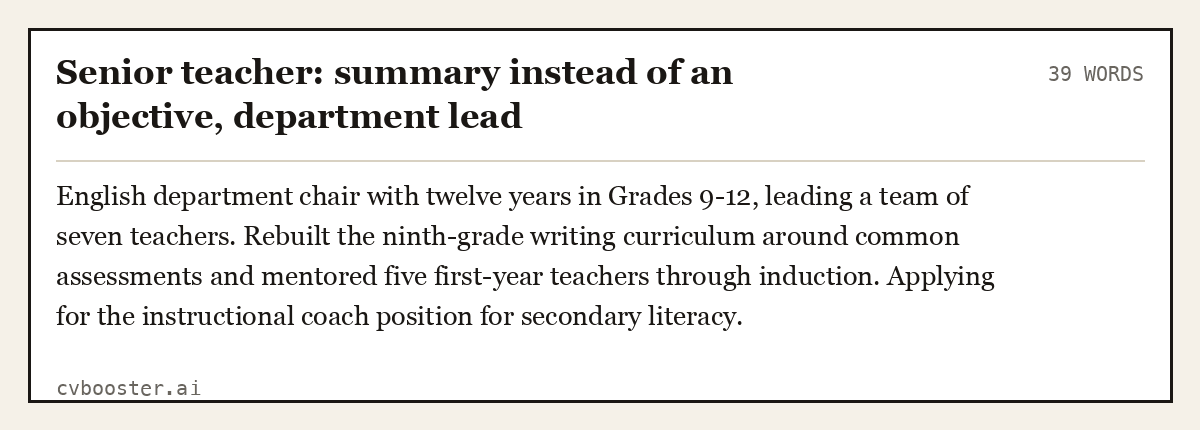
Senior teacher: summary instead of an objective, department lead (39 words)
English department chair with twelve years in Grades 9-12, leading a team of seven teachers. Rebuilt the ninth-grade writing curriculum around common assessments and mentored five first-year teachers through induction. Applying for the instructional coach position for secondary literacy.
The pattern is certification, classroom evidence, target position. Lines like "to obtain a teaching position where I can make a difference" are the most common teacher objective and the least useful, because every applicant could sign them. For the interview that follows, see the teacher interview questions guide.
To adapt any teaching resume sample objective above, keep its three slots and swap the contents: your certificate and grade band, one piece of classroom evidence with a number, and the exact position title from the posting. If you are applying for several subjects, write one objective per application rather than a general one that covers them all. Shorter subject versions built on the same pattern:
- High school math: Certified secondary mathematics teacher (Grades 6-12) with two years teaching Algebra I and Geometry to five sections a day. Seeking the Algebra I position at Lincoln High School.
- Special education: Newly certified special education teacher with a student teaching placement in a co-taught Grade 4 classroom, writing progress notes for nine IEPs. Seeking a resource room position.
- ESL: ESL-endorsed elementary teacher who has run pull-out English language development groups for 30 multilingual learners. Seeking an ESL teacher position for Grades K-5.
- Early childhood: Pre-K teacher with a CDA credential and three years in a play-based classroom of 18 children. Seeking a lead pre-K teacher role in a public school program.
How is a first-year teacher resume different?
Student teaching becomes your experience section, and you write it the way a working teacher writes a job: school, grade, subject, class size, cooperating teacher's setting, and what you actually planned and taught rather than observed.
- Placement school, grades, subjects, weeks and how many of them you led full-time
- Units you planned and taught end to end, with the standards they addressed
- Assessments you wrote, marked and used to change your next lesson
- Certification status stated plainly: issued, pending, or exams scheduled with dates
- Related work that counts: tutoring, camp leadership, paraprofessional or teaching assistant posts, coaching, youth work
- Education above experience until you have a first full post
Formatting for district applicant systems
Most districts run their hiring through an applicant system that parses your file and often asks you to retype the same information into fields. Keep the document plain so both copies agree.
- Standard headings: Certification, Experience, Education, Professional Development
- No tables or columns for your certification block
- Nothing important inside a page header, footer or text box
- Consistent MM/YYYY dates
- Spell out an acronym once before using it, so both a person and a search find it
- Two pages is normal for an experienced teacher; do not compress your certification block to hit one
Weak bullets, and what they should say instead
Teacher resumes fail in a specific way: they restate the job description of teaching. These pairs are invented examples showing the same work written twice.
Weak: "Planned and delivered engaging lessons to students of all abilities." Rewritten: "Teach six sections a day of Grade 7 mathematics and Grade 8 algebra to about 160 students, two periods co-taught with an intervention specialist for a caseload of nine students on IEPs."
Every teacher plans and delivers lessons. The rewrite says which grades, which courses, how many students, and what the staffing model was: the four things a principal needs to match you to a timetable.
Weak: "Used data to drive instruction and improve student outcomes." Rewritten: "Group students into the Tier 2 numeracy block every six weeks from benchmark assessment data, and rewrite the block's materials for each new grouping."
"Data-driven instruction" is a phrase from a district slide deck. Naming the assessment, the cycle length and what changed as a result turns it back into something you did.
Weak: "Increased state test scores by 22%." Rewritten: "Rebuilt the Grade 7 pacing guide with the department after mapping it against the state standards, moving proportional reasoning earlier so it lands before the assessment window."
An experienced principal knows how many variables sit between a teacher and a cohort's test result. Claiming the whole movement is a claim they will discount, and it costs you the credibility of everything else on the page.
Weak: "Maintained a positive and inclusive classroom environment." Rewritten: "Run a restorative check-in routine at the start of each period and hold weekly contact with the families of the six students on behaviour plans in my sections."
Classroom culture is real and worth claiming. It just has to be claimed through the routine that produced it, because the adjective version is on every resume in the stack.
The rest of the worked example: skills and professional learning
Continuing the invented example (fictional teacher, fictional school, fictional certificate), here are the two blocks that most teacher resumes leave thin.
Example skills block: "Instruction: standards-based unit design, co-teaching models, small-group intervention, formative assessment design, differentiation for multilingual learners. Systems: PowerSchool, Google Classroom, Desmos, IXL, Illuminate for benchmark data. Compliance: IEP and 504 implementation, MTSS documentation, ELL progress monitoring. Languages: Spanish (professional working)."
Example professional learning block: "District induction mentor training, 2025. Sheltered instruction for multilingual learners, 40 hours, 2024. Building assessment literacy, county consortium, 2023. Presented on the numeracy intervention block at the district professional learning day, 2025."
That last line matters more than it looks. A teacher who has presented their own work to other teachers is a different hire from one who has attended training, and one sentence is enough to establish it.
Supply, substitute and career-change resumes
Three common cases sit outside the standard full-time teacher resume, and each needs a different first page.
- Supply and substitute teaching: group the placements under the agency or district rather than listing each school as a separate job. Lead with breadth (the grade ranges, subjects and school types you have covered) and with reliability, such as how many days you worked in a term and how often you were requested back. If the district also asks for a letter, the substitute teacher cover letter examples show three versions.
- Long-term cover: treat it as a real post, because it is one. Name the length, the classes, the planning and assessment you owned, and the reports you wrote.
- Career changers: keep your previous industry expertise visible when it is the subject you now teach, because a former engineer teaching physics is a stronger candidate on that point than a generalist. Then show classroom evidence early, since that is the part the reader will doubt.
- Returning after a break: state the break plainly in one line, and lead with anything that kept you current: supply work, tutoring, coaching, training, or a certificate renewal.
- Teaching assistants and paraprofessionals moving to a lead role: name the caseload, the interventions you delivered and the planning you contributed to, rather than describing yourself as supporting the teacher.
Tip: Whichever of these you are, put the grade band and the subjects in the first two lines. Everything else on a teacher resume is read through that filter, and a reader who cannot find it early tends to stop looking.
What does teacher hiring actually look like?
The sequence explains why certification sits at the top and why classroom evidence has to be specific enough to talk about for twenty minutes.
- An application through a district or school system, usually with transcripts, certification details and referees entered as separate fields alongside the upload.
- A screening stage that checks the certificate authorises the exact vacancy: the grade band, the subject and any endorsement the posting requires.
- A screening interview, often short, focused on fit with the grade level and the school's approach.
- A demonstration lesson or a sample teaching task, which is where the units and routines you described get tested in front of real students.
- A panel interview, frequently including other teachers and sometimes students or parents, that returns to the specifics on your resume.
- Reference checks with people who saw you teach, then an offer conditional on background checks and verified certification.
Two things follow from that. Anything you put on the page should be something you would be happy to be asked to teach in a demo lesson. And the referees who can confirm your classroom evidence matter more than the ones with the most impressive titles. If you are applying for special education posts, prepare with the special education teacher interview questions too. The special education teacher cover letter examples show how to put the same evidence in a letter.
The check before you send it
- Your certificate title matches the certificate itself, word for word
- Grade band and subjects appear in the summary, not only in the experience section
- Every job states grades, subjects, sections and class size
- No student outcome is claimed as your sole result
- The curriculum or standards named match the ones in the posting
- The top two blocks are ordered for the type of school you are applying to
If you would rather start from a layout than a blank page, our teacher resume page at /resume/teacher has a sample structure, a skills list and a summary example to edit. This guide is the deeper version of the same argument; that page gives you the frame. For the letter that goes with it, see our elementary school teacher cover letter examples, and if you tutor on the side, our tutor cover letter examples. If you are applying for your first administrative post, our assistant principal cover letter examples show how to turn department and grade level leadership into evidence.
Related articles
- Accounting Executive Resume: 5 Examples by Career Level
- Administration Resume Examples: 8 Samples, Entry to Manager
- Aged Care Resume: 6 Australian Examples and a Template
- Another Word for Resume: CV, Bio and 10 More Options
More articles
- Teaching Assistant Interview Questions and 17 Full Answers
- Teaching Assistant Supporting Statement: 3 Full Examples
- Teaching Supporting Statements That Get Shortlisted