Psychiatrist Salary, Career Path and CV
By CVBooster TeamPublished Updated
The median psychiatrist salary in the United States is $281,870 a year, or $135.51 an hour, according to the U.S. Bureau of Labor Statistics (BLS), OEWS May 2025. That is the national middle: states, employers and hours move it, and BLS publishes nothing by years of experience. BLS counts psychiatrists as one of the detailed occupations inside physicians and surgeons. Psychiatry sits just above the median for all physicians and surgeons, $5,940 a year more, and it is one of the few specialties where BLS expects clearly faster job growth.
Below: a check of your own pay, the pay percentiles, hourly pay, pay in every state, the top-paying metro areas, what psychiatrists do, how to become a psychiatrist, the skills that go on a CV, and a CV example.
- Median annual pay
- $281,870
- Median hourly pay
- $135.51
- Employed, May 2025
- 27,980
Am I underpaid as a psychiatrist?
Pick your state and type your pay. You get your place in the BLS pay range for psychiatrists there, as a percentile.
Psychiatrist salary in the United States
The BLS counts psychiatrists in the occupation Psychiatrists (SOC 29-1223). Half of them earn less than $281,870 a year and half earn more. The average, which a few very high earners pull up, is $269,940. The lowest-paid tenth earn $84,060 or less, and the highest-paid tenth earn $446,520 or more, which is about 5.3 times as much. The ratio is our arithmetic on two BLS figures.
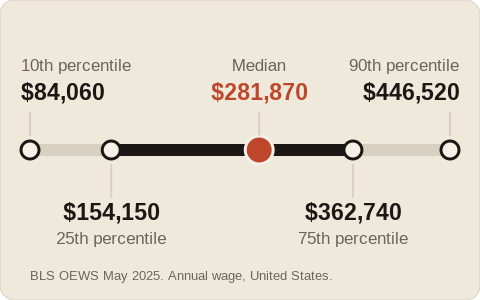
| Measure | Annual wage |
|---|---|
| 10th percentile | $84,060 |
| 25th percentile | $154,150 |
| Median (50th) | $281,870 |
| Mean (average) | $269,940 |
| 75th percentile | $362,740 |
| 90th percentile | $446,520 |
Source: U.S. Bureau of Labor Statistics, Occupational Employment and Wage Statistics (OEWS), May 2025, Psychiatrists, retrieved 23 to 25 November 2026 from the BLS OEWS May 2025 national, state and metropolitan area files.
Psychiatrist hourly pay
The median hourly wage for psychiatrists is $135.51, as published by BLS for May 2025. That is the hourly view of the same national middle as the $281,870 annual median above, so use it when an employer quotes you a rate and not a salary. Annual pay for a job with part-time or shift work depends on the hours you are given, which no national table can tell you.
| Measure | Per hour |
|---|---|
| 10th percentile | $40.41 |
| 25th percentile | $74.11 |
| Median (BLS hourly figure) | $135.51 |
| 75th percentile | $174.39 |
| 90th percentile | $214.67 |
For psychiatrists the median is the hourly wage BLS publishes. The other rows are our division of the BLS annual percentiles by 2,080 hours, the full-time year BLS uses to turn hourly pay into annual pay.
Psychiatrist salary by state
Where you work changes the number more than most things. The highest median is in California, at $353,500. The lowest published median is in West Virginia, at $63,320, a gap of $290,180 a year between two states. The gap is our subtraction of two BLS state medians. All figures below are the annual median wage in each state for May 2025.
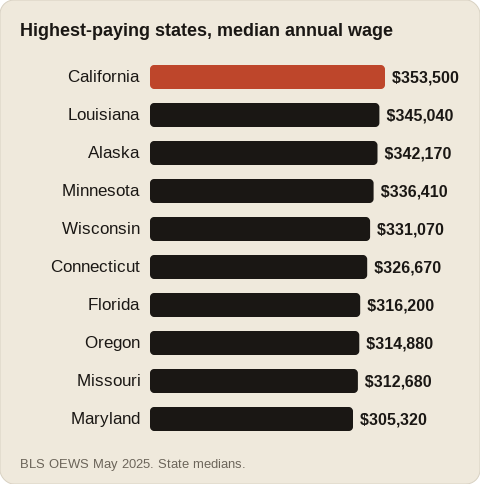
Top-paying states for psychiatrists
| Rank | State | Median wage | vs US median |
|---|---|---|---|
| 1 | California | $353,500 | +$71,630 |
| 2 | Louisiana | $345,040 | +$63,170 |
| 3 | Alaska | $342,170 | +$60,300 |
| 4 | Minnesota | $336,410 | +$54,540 |
| 5 | Wisconsin | $331,070 | +$49,200 |
| 6 | Connecticut | $326,670 | +$44,800 |
| 7 | Florida | $316,200 | +$34,330 |
| 8 | Oregon | $314,880 | +$33,010 |
| 9 | Missouri | $312,680 | +$30,810 |
| 10 | Maryland | $305,320 | +$23,450 |
Psychiatrist salary in all 50 states
| State | Median annual wage |
|---|---|
| California | $353,500 |
| Louisiana | $345,040 |
| Alaska | $342,170 |
| Minnesota | $336,410 |
| Wisconsin | $331,070 |
| Connecticut | $326,670 |
| Florida | $316,200 |
| Oregon | $314,880 |
| Missouri | $312,680 |
| Maryland | $305,320 |
| Washington | $304,920 |
| Vermont | $302,770 |
| Maine | $300,180 |
| Utah | $299,670 |
| Iowa | $295,270 |
| Virginia | $295,010 |
| Michigan | $291,850 |
| Hawaii | $289,990 |
| Rhode Island | $287,610 |
| Indiana | $284,110 |
| Delaware | $279,410 |
| Pennsylvania | $278,970 |
| Kansas | $278,100 |
| Oklahoma | $271,640 |
| Colorado | $266,370 |
| New York | $265,890 |
| Illinois | $258,740 |
| Arizona | $249,720 |
| New Hampshire | $246,140 |
| Ohio | $244,990 |
| Kentucky | $237,770 |
| Georgia | $237,480 |
| South Carolina | $237,250 |
| Texas | $228,460 |
| New Mexico | $227,730 |
| South Dakota | $226,180 |
| Tennessee | $214,880 |
| Mississippi | $213,680 |
| Nevada | $210,030 |
| New Jersey | $194,070 |
| North Carolina | $168,880 |
| Nebraska | $135,180 |
| Arkansas | $124,750 |
| Idaho | $75,470 |
| West Virginia | $63,320 |
| Alabama | Not published by BLS |
| Massachusetts | Not published by BLS |
| Montana | Not published by BLS |
| North Dakota | Not published by BLS |
| Wyoming | Not published by BLS |
BLS does not publish a figure for Alabama, Massachusetts, Montana, North Dakota, Wyoming, usually because there are too few psychiatrists in the survey sample to report one safely.
Top-paying metro areas for psychiatrists
| Metro area | Median wage | Employed |
|---|---|---|
| Springfield, IL | $413,890 | 40 |
| Burlington-South Burlington, VT | $409,950 | 50 |
| Gainesville, FL | $404,240 | n/a |
| Miami-Fort Lauderdale-West Palm Beach, FL | $403,430 | 720 |
| Ocala, FL | $396,200 | 40 |
| New Haven, CT | $381,890 | 140 |
| Los Angeles-Long Beach-Anaheim, CA | $370,510 | 1,610 |
| Riverside-San Bernardino-Ontario, CA | $364,530 | 490 |
| Des Moines-West Des Moines, IA | $358,020 | 50 |
| San Jose-Sunnyvale-Santa Clara, CA | $353,500 | 250 |
BLS publishes the psychiatrist median for 100 metro areas; the national median is $281,870. 5 of these ten count fewer than 100 psychiatrists or have no published headcount, so treat them as rough. In 3 more metro areas BLS shows the median only as $239,200 or more, so they cannot be ranked here. Source: U.S. Bureau of Labor Statistics, OEWS May 2025, metropolitan area estimates.
Compare psychiatrist pay
Put two states side by side, or set psychiatrists next to another job. Every figure is from BLS OEWS May 2025.
| Measure | California | West Virginia |
|---|---|---|
| Median annual wage | $353,500 | $63,320 |
| Median hourly wage | $169.95 | $30.44 |
| 10th percentile | $113,990 | $63,320 |
| 25th percentile | $173,990 | $63,320 |
| 75th percentile | $414,640 | $334,250 |
| 90th percentile | $496,230 | $465,770 |
| Employed, May 2025 | 5,420 | 90 |
The California median is $290,180 a year higher. That difference is our subtraction of two BLS state medians. n/a means this page has only the BLS median for that state so far, or BLS released no figure for it. Source: BLS OEWS May 2025, Psychiatrists.
Starting pay for psychiatrists
BLS does not publish pay by years of experience, so nobody can honestly quote an official entry-level psychiatrist salary. What the data gives is the bottom of the market. One in ten psychiatrists earns $84,060 or less, and one in four earns $154,150 or less. Read those as the low end of the national range, not as what a new graduate will be offered, because older workers sit in the bottom tenth too.
Why psychiatry is a growth specialty
Most physician jobs are projected to grow about as fast as the average, 4 percent from 2025 to 2035. Psychiatrists are projected to grow 7 percent, from 30,000 jobs to 32,100. BLS gives the reason in one line: growing demand for psychiatric care and better access to mental health services.
The pay is high and wide. The middle half of psychiatrists earn between $154,150 and $362,740, and the median of $281,870 is $33,310 above the median neurologist, even though both specialties deal with the brain. BLS does not say what drives the gap, so treat it as a fact about the two markets rather than a rule.
Psychiatrist or nurse practitioner
BLS lists nurse practitioners among the occupations with duties similar to physicians, with a master's degree as the entry point. Nurse practitioners as a whole have a median of $132,300, which is $149,570 below psychiatrists. BLS does not publish a separate figure for nurse practitioners who work in mental health.
The training gap is the real trade. A psychiatrist adds 4 years of medical school and a residency on top of the bachelor's degree before the state license. If you are weighing the two, set those extra years against the pay difference above.
Where psychiatrists earn the most
Of the 45 states with a published median, California is highest at $353,500, followed by Louisiana at $345,040. Idaho and West Virginia show the lowest figures, $75,470 and $63,320, which sit far under the national median; BLS does not say why, and figures for small groups of workers swing more than large ones.
The best-paid metro areas are Springfield, IL ($413,890, about 40 psychiatrists), Burlington-South Burlington, VT ($409,950, about 50 psychiatrists), Gainesville, FL ($404,240, head count not published) and Miami-Fort Lauderdale-West Palm Beach, FL ($403,430, about 720 psychiatrists). A metro median based on a few dozen psychiatrists is an estimate, so the bigger markets give a steadier read.
Related jobs
- Neurologist salary and career path: The other brain specialty, treating disorders such as epilepsy and Alzheimer's disease rather than mental illness.
- Pediatrician salary and career path: Another physician specialty on the same BLS page, caring for patients from infancy to young adulthood.
- Physician Assistant salary and career path: Examines, diagnoses and treats patients under a physician, on a master's degree instead of medical school.
What psychiatrists do
Psychiatrists are the primary mental health physicians. They diagnose mental illnesses and treat them with a mix of personal counseling (psychotherapy), psychoanalysis, hospitalization and medication.
In psychotherapy the psychiatrist helps a patient change behavioral patterns and look at past experiences. Psychoanalysis is the long-term form of that counseling. Because psychiatrists are physicians, they can also prescribe medications that correct the chemical imbalances behind some mental illnesses.
Duties BLS lists
- Take the patient's medical history and do a physical exam
- Diagnose mental illnesses
- Treat patients with psychotherapy and, for some, long-term psychoanalysis
- Prescribe medication where a chemical imbalance drives the illness
- Arrange hospitalization when a patient needs it
- Order tests and consultations from other physicians or staff, and review the results
- Design a treatment plan and keep charts updated with findings and treatments
- Answer the questions patients have about their health and well-being
A typical day
Psychotherapy and psychoanalysis are both forms of counseling, so a good part of the work is conversation. A psychiatrist sees patients for counseling sessions, reviews how a medication is working, updates the chart and adjusts the plan, and works with nurses and other physicians on patients who are in hospital. Like other physicians, many work long shifts and some are on call, which can mean handling a patient concern by phone or going in to see someone.
Where they work
- BLS counted about 30,000 psychiatrist jobs in 2025, out of 862,800 for all physicians and surgeons.
- Physicians work in clinical settings, such as physicians' offices and hospitals, including academic hospitals tied to residency programs, and in nonclinical settings such as government agencies, nonprofit organizations and insurance companies. BLS does not break these settings down for psychiatrists.
- Group practice and healthcare organizations let physicians coordinate patient care, but give them less independence than a solo practice.
- Most physicians work full time and some work more than 40 hours a week, with irregular hours, overnight shifts or call. These schedule facts are for physicians and surgeons as a whole.
Source: U.S. Bureau of Labor Statistics, Occupational Outlook Handbook, Physicians and Surgeons, read 25 November 2026. BLS counted about 30,000 jobs in 2025 and projects 7% growth from 2025 to 2035, against 4 percent for all physicians and surgeons.
How to become a psychiatrist: the career path
Typical entry-level education, according to BLS: doctoral or professional degree. A psychiatrist first earns a bachelor's degree, then spends 4 years in medical school, then enters residency; BLS puts residency at 3 to 9 years across all specialties and does not give a separate length for psychiatry. Each step below comes from the BLS Occupational Outlook Handbook, and the last step is the pay.
- 1Study
Bachelor's degree
No set major is required, though future medical students usually take biology, physical science or other health-related subjects. Medical schools also weigh leadership, personality and activities outside class.
- 2Prepare
MCAT and medical school admission
Applications need transcripts, Medical College Admission Test (MCAT) scores and letters of recommendation, and most schools interview candidates in front of an admissions committee. BLS calls medical schools highly competitive.
- 3Study
M.D. or D.O. degree, 4 years
The early years are classroom and lab work, with psychology and medical ethics among the courses BLS names next to anatomy and pharmacology. Later years are supervised clerkships in areas such as internal medicine, pediatrics and surgery.
- 4Train
Psychiatry residency
Nearly every graduate goes on to a residency in the chosen specialty, usually in a hospital or clinic. BLS gives 3 to 9 years for residency across specialties, plus 1 to 3 years of fellowship for anyone who subspecializes.
- 5License
State medical license
Every state licenses physicians. You need a degree from an accredited medical school, completed residency training and passing scores on standardized national exams. Your state medical board sets the details.
- 6Certify
Board certification in psychiatry (optional)
Not required to practice, but BLS says it may widen job options. It takes a finished residency and a passing score on a specialty exam from a medical certifying board.
- 7Pay
Median $281,870 a year
BLS median annual wage for psychiatrists. The lowest-paid tenth earn $84,060 or less and the highest-paid tenth earn $446,520 or more.
Steps 1 to 6 for psychiatrists: U.S. Bureau of Labor Statistics, Occupational Outlook Handbook, Physicians and Surgeons, "How to Become One", read 25 November 2026. Pay step: U.S. Bureau of Labor Statistics, OEWS May 2025.
Psychiatrist skills and certifications
These come from the CVBooster psychiatrist resume guide, which lists what employers look for on a psychiatrist CV. Put the ones you really have near the top of your CV, in the words the job ad uses.
Core skills
People skills
Licenses and certifications
- Psychiatry Certification, American Board of Psychiatry and Neurology
- Child and Adolescent Psychiatry Subspecialty Certification, American Board of Psychiatry and Neurology
- Addiction Psychiatry Subspecialty Certification, American Board of Psychiatry and Neurology
- Consultation-Liaison Psychiatry Subspecialty Certification, American Board of Psychiatry and Neurology
- Geriatric Psychiatry Subspecialty Certification, American Board of Psychiatry and Neurology
More guides
Psychiatrist salary questions
How much does a psychiatrist make a year?
The BLS median for psychiatrists is $281,870 a year, with a mean of $269,940. The lowest tenth earn $84,060 or less and the top tenth $446,520 or more. All figures are BLS OEWS estimates for May 2025.
How much do psychiatrists make an hour?
The median hourly wage is $135.51. BLS says many physicians work long shifts with irregular hours or call, so the hourly figure is a way to compare jobs, not a promise of how a job is paid. BLS does not publish call pay.
How many years does it take to become a psychiatrist?
Count a bachelor's degree, then 4 years of medical school, then residency. BLS says residency lasts 3 to 9 years depending on the specialty but does not single out psychiatry. A fellowship of 1 to 3 years comes on top for a subspecialty.
Can psychiatrists prescribe medication?
Yes. Psychiatrists are physicians, and BLS says they may prescribe medications to correct chemical imbalances that cause some mental illnesses. They also treat patients with psychotherapy, psychoanalysis and, when needed, hospitalization.
Which state pays psychiatrists the most?
California has the highest published state median at $353,500, then Louisiana at $345,040 and Alaska at $342,170. BLS published a median for 45 states; the table above lists them all.
Is there demand for psychiatrists?
BLS projects psychiatrist jobs to rise by 2,100, or 7 percent, between 2025 and 2035, faster than the 4 percent for physicians overall. It ties the growth to more demand for psychiatric care and better access to mental health services.
Sources and method
- Pay: U.S. Bureau of Labor Statistics, Occupational Employment and Wage Statistics (OEWS), May 2025, Psychiatrists (SOC 29-1223), national, state and metro area estimates, retrieved 23 to 25 November 2026 from the BLS OEWS May 2025 national, state and metropolitan area files. Wages are before tax. BLS defines what its wage figure includes and leaves out in the OEWS technical notes.
- The job, the route in and the outlook: U.S. Bureau of Labor Statistics, Occupational Outlook Handbook, Physicians and Surgeons, read 25 November 2026.
- Skills and certifications: the CVBooster psychiatrist resume guide.
- Where we subtract or divide two BLS figures on this psychiatrist page, the page says so. The pay check is an estimate between the published BLS percentiles for psychiatrists and says so. Nothing else here is estimated.
Psychiatrist CV example

The CVBooster psychiatrist resume guide has a finished example, three written summaries, before and after bullets and answers to the questions people ask.
Build your psychiatrist CV
Create my CV