Psychiatrist Resume Examples: free ATS score and gap list
Write a Psychiatrist Resume That Names Your Setting and Patient Population
By Mustafa Tarabya, founder of CVBooster · Published · Updated
A psychiatrist resume guide with outpatient, inpatient and consultation examples, prescribing keywords, licensure placement and sample bullets that read as clinical.
Sample resumes for a psychiatrist
The same psychiatrist content laid out in three CVBooster templates, so you can see what the finished document looks like before you write a word.

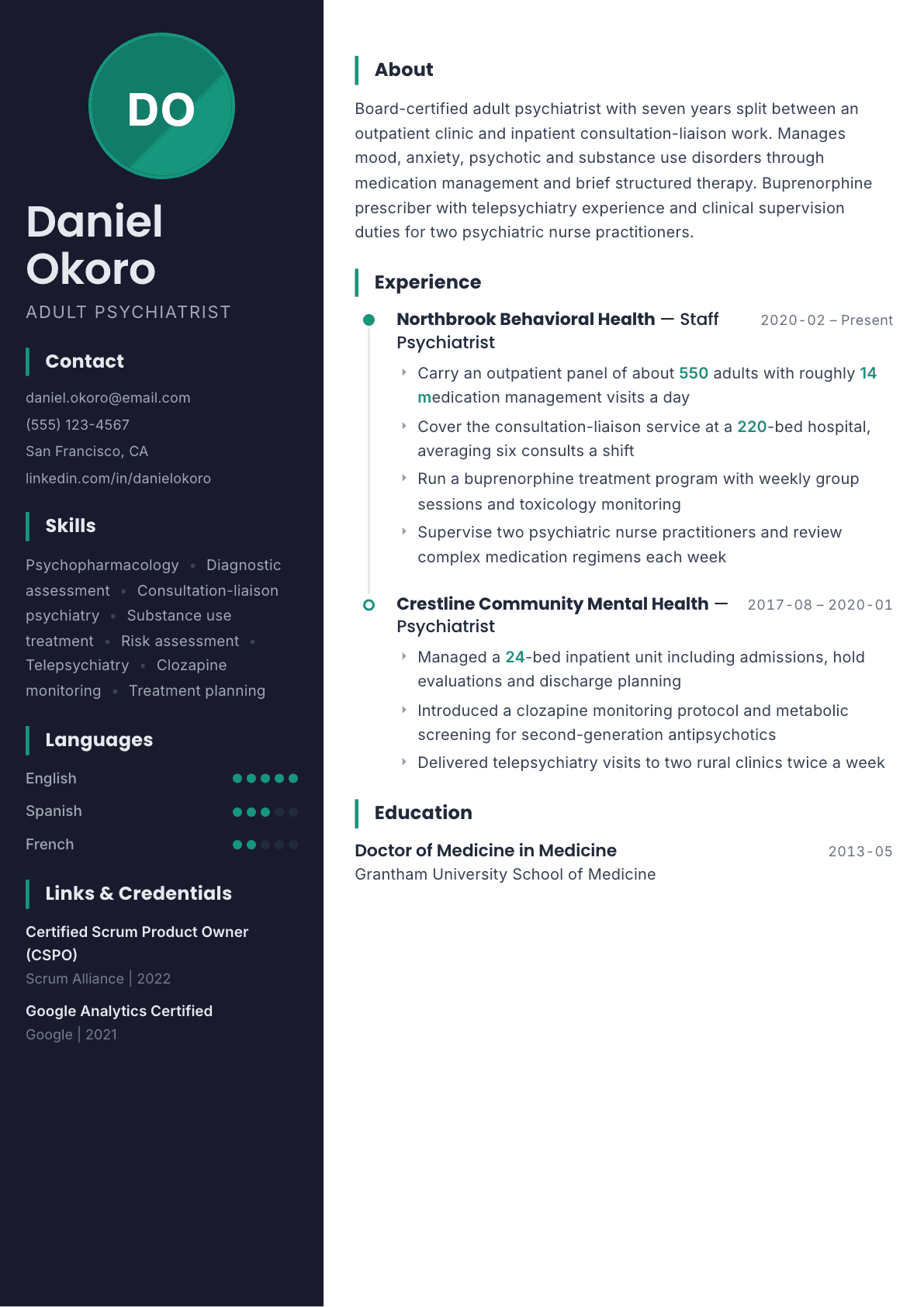
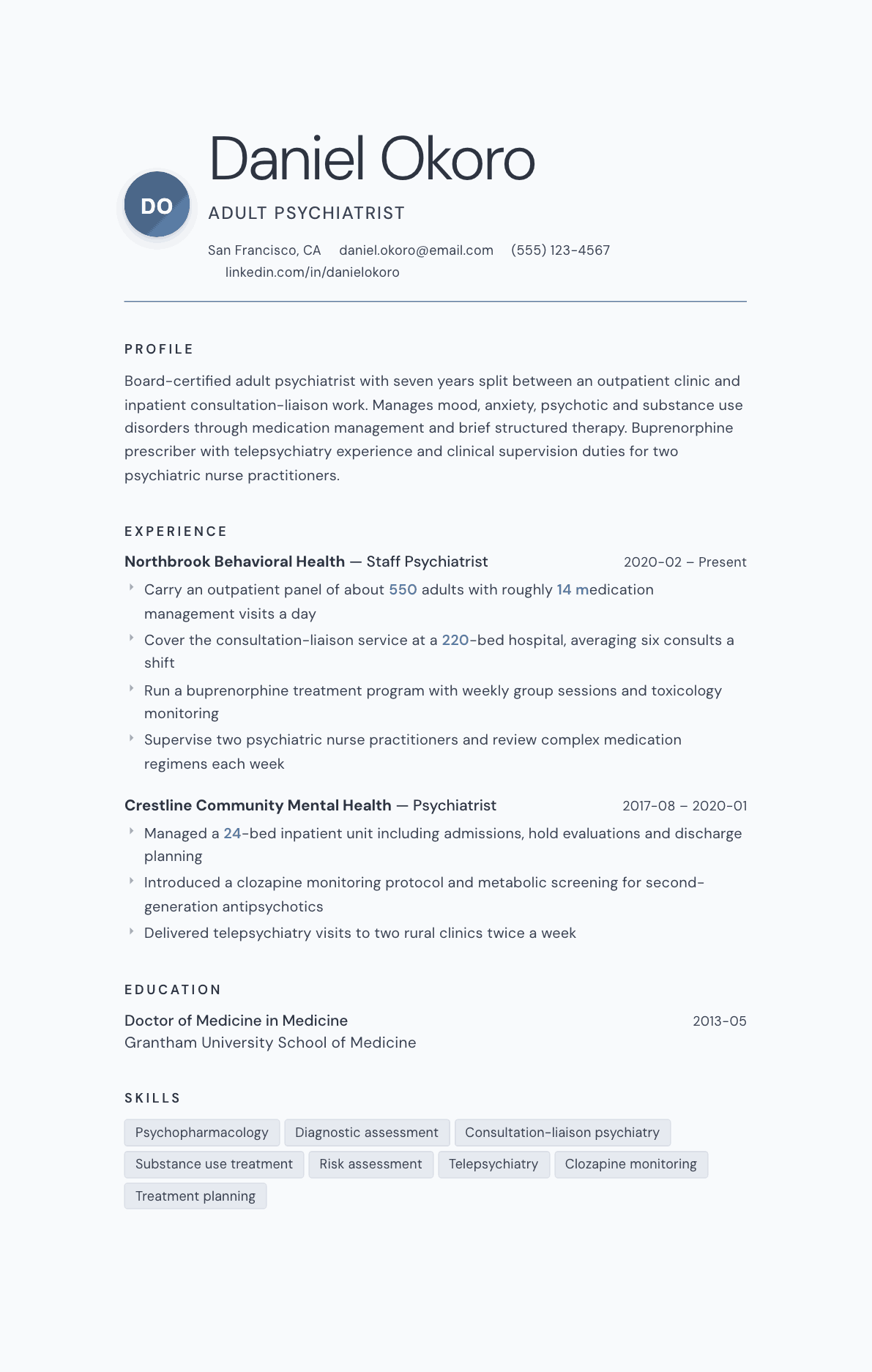
Example Psychiatrist summary
Board-certified adult psychiatrist with seven years across outpatient clinic and hospital consultation-liaison practice, carrying a panel of about 550 adults and roughly 14 medication visits a day. Runs a buprenorphine treatment program, covers a 220-bed hospital consult service, and supervises two psychiatric nurse practitioners. Comfortable with telepsychiatry and looking for an outpatient role with a strong substance use treatment program.
Skills to list on a Psychiatrist resume
- Psychiatric diagnostic evaluation
- Psychopharmacology
- Mood disorder management
- Psychotic disorder management
- Anxiety and trauma treatment
- Substance use disorder treatment
- Buprenorphine prescribing
- Consultation-liaison psychiatry
- Suicide risk assessment
- Involuntary hold evaluation
- Telepsychiatry
- Clozapine and lithium monitoring
- Brief supportive therapy
- Interdisciplinary treatment planning
What actually gets this resume read
- Say up front which setting you practice in: outpatient clinic, inpatient unit, consultation-liaison, emergency or telepsychiatry.
- Name the patient population by age and acuity, since child, adult, geriatric and forensic hiring pools barely overlap.
- List medication management volume and panel size so a clinic can judge whether you match their schedule.
- Put licensure, controlled substance registration and buprenorphine prescribing together in a credentials block near the top.
- Show therapy modalities you actually deliver rather than listing every modality you have read about.
- Include supervision of nurse practitioners, physician assistants or residents, because groups often hire for that coverage.
How to write a psychiatrist resume
Psychiatry hiring is sorted by setting and population before anything else. An outpatient clinic, a locked inpatient unit, a hospital consultation service, an emergency psychiatric assessment center, a correctional facility and a telepsychiatry group are six different jobs, and a candidate strong in one may be no use in another. The first two lines of a psychiatrist resume have to settle which one you are.
The second question is prescribing scope and caseload. How many patients are on your panel, how many medication visits you carry in a day, whether you manage clozapine, long-acting injectables and buprenorphine, and whether you supervise nurse practitioners or physician assistants who extend that panel.
This guide covers setting and population declaration, how to write caseload without turning patients into inventory, where licensure and prescribing registrations belong, supervision and program work, and the questions psychiatrists ask when moving between hospital employment, community mental health and private or telepsychiatry practice.
Format: setting first, credentials block, two pages
Reverse chronological, two pages, plain layout. Under the header put a credentials block with board certification and any subspecialty certification, state medical licenses with expiration, controlled substance registration, and buprenorphine prescribing status if you have it. Behavioral health credentialing is slow, and a complete block shortens it.
If you hold licenses in several states for telepsychiatry, list them all. Multi-state licensure is a hiring advantage for any group with a virtual service line, and it is the sort of detail candidates leave off because it feels administrative.
- Header: name and degree, city and state, phone, email.
- Credentials: board certification, subspecialty certification, all state licenses, prescribing registrations.
- Then summary, practice history, residency and fellowship, education, skills, supervision and committee roles.
Summary: setting, population, caseload, and prescribing scope
Name the setting or settings you work in, the age band and acuity of the population, the caseload you carry, and the prescribing scope that distinguishes you. Four lines. A clinic director reading twenty applications is looking for the one candidate whose current week resembles the week they need covered.
If you are changing settings, say so and name the transferable part. An inpatient psychiatrist moving to outpatient work should point at complex medication management and rapid stabilization rather than hoping a clinic manager works out the connection.
Experience: caseload, visit structure, and the acuity you carry
Open each position with the organization type, the size of the service and the population. A twenty-four bed inpatient unit, a community mental health center with a severe and persistent mental illness caseload, and a hospital consultation service each imply a different clinical day.
Then the caseload picture: panel size, medication management visits a day, appointment lengths, and the share of new evaluations against follow-up. On an inpatient unit, give the bed count, daily census, admissions and average length of stay instead. On a consultation service, give consults a shift and the referring services you covered.
Add the acuity work that makes the job hard: involuntary hold evaluations, capacity assessments, agitation management, seclusion and restraint review, and coordination with courts or child protective services. Those duties are common in the postings and rare on the resumes.
- Organization type, service size, population age band and acuity.
- Panel size and medication visits a day, or census and admissions for inpatient work.
- Evaluation length and follow-up interval, since these define throughput.
- Risk work: hold evaluations, capacity assessments, crisis and safety planning.
Prescribing scope, supervision and program work
Prescribing scope is a real differentiator. Clozapine management with its monitoring requirements, long-acting injectable programs, lithium and metabolic monitoring, stimulant prescribing under state monitoring rules, and buprenorphine treatment for opioid use disorder are all things a clinic screens for by name.
Supervision is often the reason a psychiatrist position exists. Groups build teams of nurse practitioners and physician assistants around one psychiatrist, so say how many clinicians you supervised, how the case review ran, and whether you carried collaborative practice agreements.
Program work belongs here too: an integrated behavioral health model with primary care, a measurement-based care rollout using standardized rating scales, a transitions clinic after discharge, or a substance use treatment program you started.
Therapy, keywords and what to leave out
List only the therapy modalities you actually deliver in your current schedule and say how often. Naming eight modalities on a resume when your day is fifteen-minute medication visits reads as padding, and any interviewer will test it.
Psychiatric postings repeat a narrow set of terms: diagnostic evaluation, medication management, psychopharmacology, risk assessment, treatment planning, interdisciplinary team, crisis intervention, telepsychiatry, substance use disorder. Mirror them once in the skills list and once in a bullet where they are demonstrated.
Psychiatrist resume summary examples
New from residency
Psychiatry board eligible, completing residency with outpatient continuity panel of about 120 adults, inpatient rotations on a 24-bed unit and a year of consultation-liaison service. Trained in buprenorphine prescribing and brief cognitive behavioral techniques. Seeking an outpatient position with team-based care and supervision from senior psychiatrists.
Seven years in practice
Board-certified adult psychiatrist carrying an outpatient panel of about 550 adults at roughly 14 medication visits a day while covering a hospital consultation service. Runs a buprenorphine treatment program with group sessions and toxicology monitoring, and supervises two psychiatric nurse practitioners.
Medical director of behavioral health
Psychiatrist and behavioral health medical director with seventeen years across inpatient, outpatient and consultation settings, accountable for clinical quality, prescribing standards and staffing across three clinics and a 30-bed unit. Built the integrated primary care model and supervises nine advanced practice clinicians.
Work experience bullets: before and after
Before: Provided medication management for adult patients.
After: Carried an outpatient panel of about 550 adults at roughly 14 medication management visits a day, with 60-minute new evaluations and 20-minute follow-up appointments.
Panel size, daily visits and appointment lengths let a clinic director map you onto their template schedule.
Before: Treated patients with substance use problems.
After: Ran a buprenorphine treatment program for 90 patients with weekly group sessions, toxicology monitoring and a same-week induction pathway from the emergency department.
The patient count, the program structure and the referral pathway show a service you built rather than a diagnosis you treated.
Before: Supervised nurse practitioners.
After: Supervised two psychiatric nurse practitioners under collaborative agreements, reviewing complex regimens weekly and running a monthly case conference on treatment-resistant presentations.
Naming the agreements and the review rhythm shows the supervision was structured, which is what a group needs to document.
Before: Worked on the consultation service.
After: Covered the consultation-liaison service at a 220-bed hospital, averaging six consults a shift for delirium, capacity assessment, withdrawal management and post-overdose evaluation.
Consult volume plus the referral reasons describes the actual clinical range rather than a service name.
Before: Improved monitoring of antipsychotic medications.
After: Introduced a clozapine monitoring protocol and quarterly metabolic screening for patients on second-generation antipsychotics, raising completed screening across the clinic caseload.
A specific protocol with a monitoring interval and a measured result is defensible in an interview.
Hard skills
- Psychiatric diagnostic evaluation
- Psychopharmacology and complex regimen management
- Mood and psychotic disorder treatment
- Anxiety and trauma-related disorder treatment
- Substance use disorder treatment
- Buprenorphine and naltrexone prescribing
- Clozapine, lithium and metabolic monitoring
- Long-acting injectable programs
- Suicide and violence risk assessment
- Capacity and involuntary hold evaluation
- Consultation-liaison psychiatry
- Telepsychiatry delivery
- Measurement-based care with rating scales
Soft skills
- Therapeutic alliance with reluctant patients
- De-escalation in agitated situations
- Family and caregiver communication
- Interdisciplinary team leadership
- Documentation that withstands review
- Supervision and case consultation
Certifications worth listing
- Psychiatry Certification (American Board of Psychiatry and Neurology)
- Child and Adolescent Psychiatry Subspecialty Certification (American Board of Psychiatry and Neurology)
- Addiction Psychiatry Subspecialty Certification (American Board of Psychiatry and Neurology)
- Consultation-Liaison Psychiatry Subspecialty Certification (American Board of Psychiatry and Neurology)
- Geriatric Psychiatry Subspecialty Certification (American Board of Psychiatry and Neurology)
Mistakes that cost psychiatrist candidates the interview
- Failing to name the setting and population, leaving a clinic director unable to place you at all.
- Listing every therapy modality you have studied when your current schedule is medication management.
- Leaving caseload and visit volume off the page, which is the first thing a hiring manager will ask about.
- Omitting additional state licenses that would qualify you for a telepsychiatry service line.
- Skipping risk work such as hold evaluations and capacity assessments, which most postings explicitly require.
- Describing supervision without the number of clinicians or the review structure that made it real.
Psychiatrist resume questions
How do I describe caseload without sounding like a factory?
Pair the numbers with the clinical structure. Saying you carry a panel of five hundred adults with hour-long evaluations and twenty-minute follow-ups shows both capacity and how you protect quality, which is what a thoughtful clinic director wants to see.
Should I list buprenorphine prescribing on a psychiatrist resume?
Yes, in the credentials block and again as a bullet with the size and structure of the program you ran. Many behavioral health organizations are trying to expand opioid use disorder treatment and screen resumes specifically for prescribers who already do it.
How do I write a psychiatrist resume for telepsychiatry roles?
List every active state license, the platform and documentation system you used, your video visit volume, and how you handled emergencies and hold evaluations at a distance. Remote employers care most about coverage breadth and your safety protocol for a patient in crisis.
Do subspecialty certifications matter if I practice generally?
They still help, because they signal depth and they widen the range of positions you can be credentialed for. List them in the credentials block, then keep your experience bullets aimed at the general work you actually want to keep doing.
What should a psychiatrist include about outcomes?
Use what your setting measures: rating scale improvement under measurement-based care, readmission after discharge, retention in a substance use program, no-show rates, or time from referral to first appointment. Name the measure, the change and what you did to cause it.