Academic Coach Resume Examples: the lines they read
Write an Academic Coach Resume Colleges and Schools Notice
By Mustafa Tarabya, founder of CVBooster · Published · Updated
Academic coach resume examples with caseload and retention evidence, executive function language, coaching keywords and a full writing guide.
Sample resumes for a academic coach
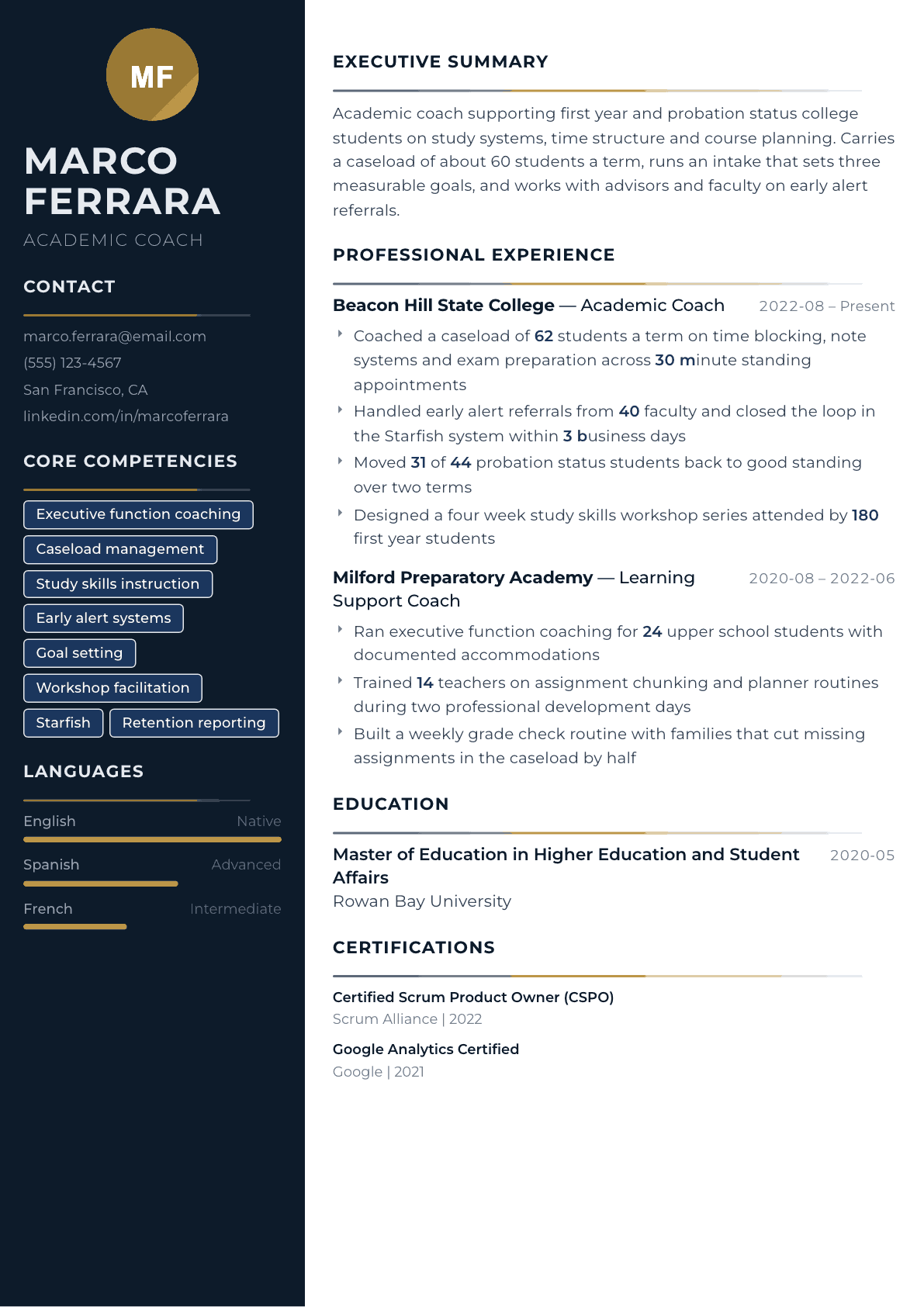
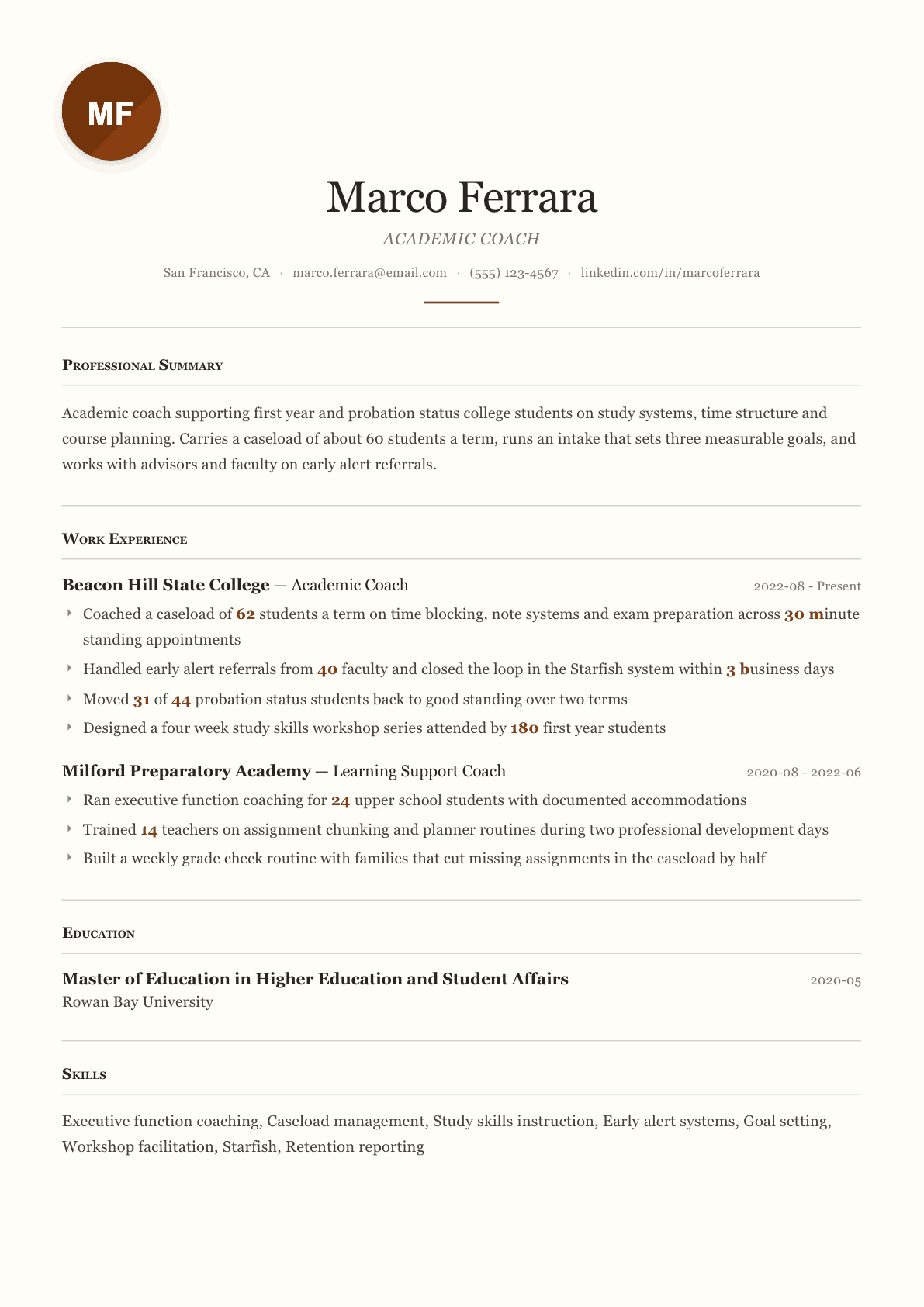
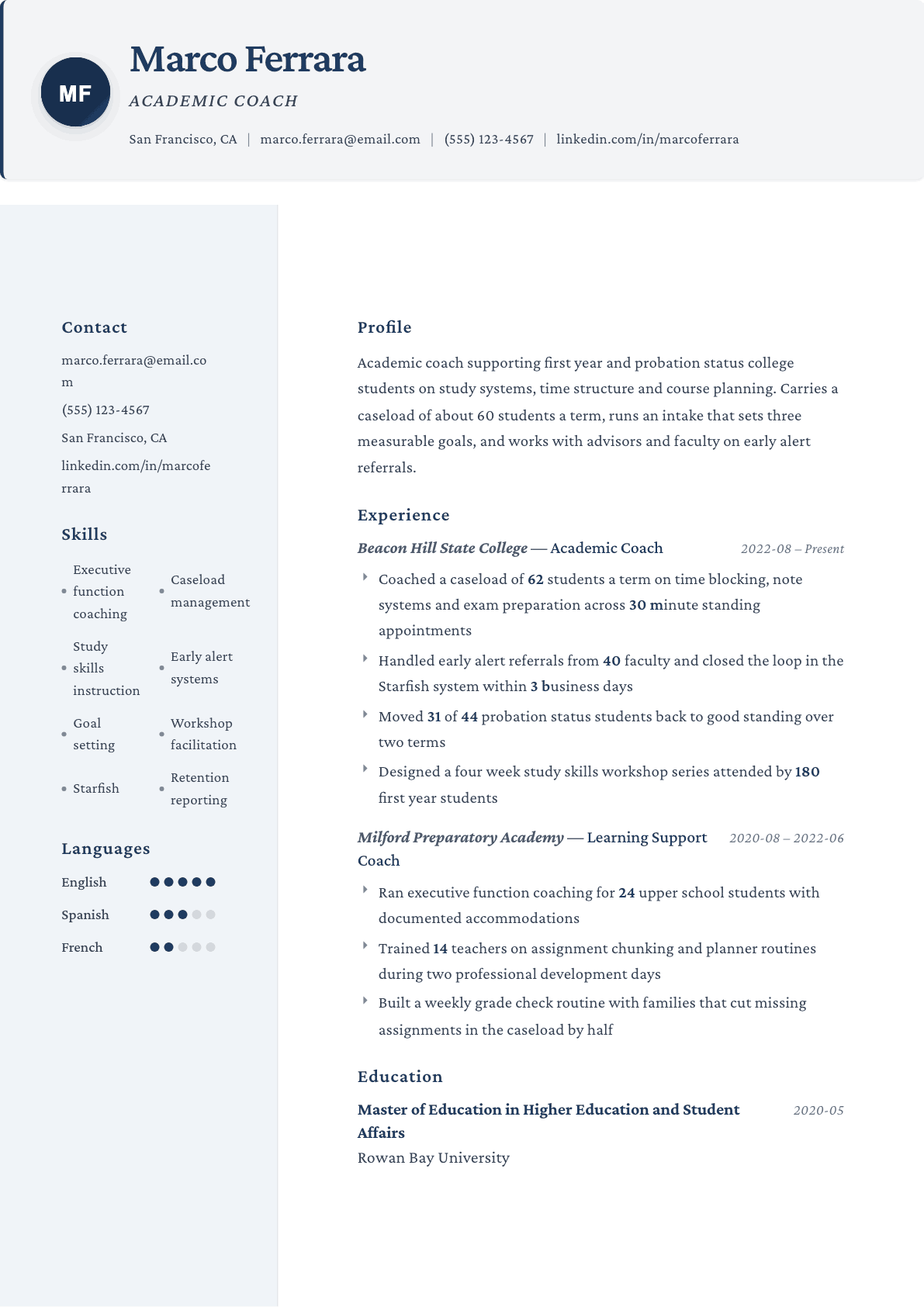
The same academic coach content laid out in three CVBooster templates, so you can see what the finished document looks like before you write a word.
Example Academic Coach summary
Academic coach with four years in a college student success center working with first year, probation status and returning adult students. Runs an intake that sets three goals, meets students on a standing weekly schedule, and documents every contact for the retention report. Experienced with early alert referrals from faculty and with designing study skills workshops that fill.
Skills to list on a Academic Coach resume
- Academic coaching
- Executive function support
- Study skills instruction
- Caseload management
- Goal setting
- Motivational interviewing
- Early alert response
- Workshop facilitation
- Retention initiatives
- Student referral
- Case notes
- Time management instruction
- Data reporting
What actually gets this resume read
- Give your caseload size, appointment length and term structure, because that is how supervisors compare candidates.
- Separate coaching from advising in your bullets, since one owns habits and skills and the other owns course registration.
- Name the case management or early alert platform you worked in, such as Starfish, EAB Navigate or Slate.
- Show retention or standing outcomes with the population, for example probation students who returned to good standing.
- Add the workshops you designed with attendance numbers, because outreach is half of a coaching job.
- Use executive function language such as task initiation, planning and self monitoring when the posting uses it.
How to write a academic coach resume
Academic coach postings sit in student success centers, TRIO and other federally funded support offices, private schools, and independent practices serving students with attention and executive function challenges. The director reading your resume has one anxiety above all others: a coach who talks with students pleasantly for a semester and produces nothing the office can report at the end of it.
So the resume has to prove two habits. You run a structured process, and you document it in whatever system the institution uses. Caseload size, appointment structure, referral handling and case notes are the load bearing details. Warmth is assumed and is not evidence.
This guide covers how to describe a coaching caseload, the difference between coaching and advising in writing, three summaries across career stages, before and after bullets, and the questions coaches ask when they move between K-12, higher education and private practice.
Format: one page early, two pages once you have run programs
Reverse chronological. Higher education hiring committees read fast and then discuss, so put a short summary at the top that names the population you serve, the caseload size and the systems you work in. That paragraph is the one quoted in the committee meeting.
A second page is justified once you have designed workshop series, supervised peer coaches, or presented at a regional conference. Add a short section for presentations and program design rather than stretching your job bullets.
- Sections: summary, experience, program and workshop design, education, skills, professional development.
- Name the student populations by the language the office uses: first year, first generation, probation status, student athletes, transfer, returning adult.
- Keep counseling licensure claims off the page unless you hold one, since coaching and clinical counseling are separate scopes.
Show the caseload and the appointment structure
Give the numbers that define the work: students on your caseload per term, appointment length, whether appointments are standing or drop in, and the required contact cadence. A supervisor comparing candidates is estimating how much of her office load you can absorb, and she cannot do that from a job title.
Add how students reach you. Self referral, faculty early alert, a mandatory condition of probation, or an automatic assignment for a cohort produce very different conversations, and coaches who have handled mandatory referrals are valued because that population is the hardest to keep.
Separate coaching from advising, and say so
Advising owns degree requirements, registration, course substitutions and graduation checks. Coaching owns habits: planning, task initiation, note systems, reading strategy, exam preparation, self monitoring and follow through. Committees are wary of candidates who blur the two, because it usually means the person did neither well.
If your job included both, split the bullets. One block for the coaching work with its caseload and outcomes, one block for the advising duties with the degree audits and registration volume. The clarity itself signals that you understand the office structure you are applying to join.
- Use executive function vocabulary when the posting does: task initiation, working memory support, planning, prioritization, self monitoring.
- Name the coaching model or training you follow if it is a real one, such as motivational interviewing or appreciative advising.
- Say what a first appointment produces, for example three written goals and a weekly plan the student keeps.
Systems, notes and the reporting the office owes
Name the platform. Starfish, EAB Navigate, Slate, Banner, Colleague and Canvas each appear in postings by name, and a candidate who has already worked in the institution stack starts weeks ahead. Say what you did inside it: closed referral loops, logged appointment summaries, ran no show follow up, pulled caseload reports.
Retention offices live on reporting. If you produced a term report, contributed to a grant report, or tracked persistence for a cohort, put that on the page. It tells a director you understand that the office has to justify its own budget every year.
Outcomes you can defend
The credible outcomes are standing restored for probation students, term to term persistence for a cohort, appointment attendance rates, workshop attendance, and referral closure time. Write them with the denominator: how many students out of how many, over which terms.
Avoid grade point average claims unless the office actually measured them and you can say who measured. A committee that runs its own data will ask, and a number you cannot source damages an otherwise strong file.
Academic Coach resume summary examples
New to coaching
Recent higher education graduate with two years as a peer coach and supplemental instruction leader, supporting first year students on note systems, time blocking and exam preparation. Trained in motivational interviewing basics and comfortable documenting every contact. Seeking a full time student success coach role in a first year experience office.
Four years in
Academic coach carrying about sixty students a term across first year and probation status caseloads. Opens with an intake that sets three measurable goals, holds standing thirty minute appointments, and closes faculty early alert referrals inside three business days. Designs and fills a study skills workshop series each fall.
Coaching program lead
Student success coaching lead supervising four coaches and a peer coaching team. Owns the intake protocol, the case note standard and the term retention report the office submits to the provost. Built the probation intervention pathway now used across three colleges within the university.
Work experience bullets: before and after
Before: Met with students to help them succeed academically.
After: Coached a caseload of 62 students a term on time blocking, note systems and exam preparation through standing 30 minute appointments.
Caseload, topics and appointment structure let a director estimate your capacity, which the original sentence cannot.
Before: Worked with faculty referrals.
After: Handled early alert referrals from 40 faculty and closed each loop in the case management system within 3 business days.
The referral volume and the closure standard show the operational discipline the office is actually buying.
Before: Helped students on academic probation.
After: Moved 31 of 44 probation status students back to good standing across two terms using a required weekly check in and a written recovery plan.
A numerator, a denominator and the intervention itself make the outcome checkable and repeatable.
Before: Ran workshops on study skills.
After: Designed a four week study skills workshop series attended by 180 first year students and rebuilt the weakest session after reviewing attendance drop off.
Attendance plus the revision loop shows program ownership rather than a one time presentation.
Before: Kept records of student meetings.
After: Logged every appointment in the case management platform with goals, actions and next steps, producing the caseload summary used in the term retention report.
It connects note taking to the report the office must submit, which is why documentation matters to the supervisor.
Hard skills
- Caseload management
- Intake and goal setting protocols
- Executive function strategy instruction
- Study and note taking systems
- Early alert referral response
- Case note documentation
- Retention and persistence reporting
- Workshop design and facilitation
- Motivational interviewing techniques
- Student information system navigation
- Probation intervention planning
- Peer coach supervision
Soft skills
- Nonjudgmental questioning
- Accountability without lecturing
- Boundary setting
- Cross office collaboration
- Follow through on small commitments
- Cultural humility
Certifications worth listing
- Associate Certified Coach (International Coaching Federation)
- Board Certified Coach (Center for Credentialing and Education)
- Certified Tutor, Levels 1 to 3 (College Reading and Learning Association)
Mistakes that cost academic coach candidates the interview
- Describing conversations rather than a process, so the reader cannot tell what happens in a first appointment.
- Leaving out caseload size, which is the number every supervisor uses to compare two otherwise similar candidates.
- Blurring coaching with academic advising, which makes a committee suspect you did not own either set of duties.
- Implying clinical counseling work without a license, a boundary that student affairs offices take very seriously.
- Skipping the case management platform by name, when institutions hire partly to avoid retraining someone on it.
- Quoting outcome numbers no one measured, since the office running its own data will ask for the source in the interview.
Academic Coach resume questions
What is the difference between an academic coach and an academic advisor?
An advisor owns degree requirements, registration and graduation checks. A coach owns habits and skills: planning, task initiation, study systems and follow through. Many jobs mix them, so split your bullets by function and let the committee see that you know which duty belongs where.
Do I need a coaching certification for this job?
Most higher education postings do not require one, and a relevant graduate degree carries more weight. A credential from a recognized coaching body helps in private practice and in schools that market the service, so add it if you hold it and never invent an issuer.
How do I show results when students choose whether to come back?
Use attendance and persistence measures alongside outcomes. Appointment attendance rates, returning students per term, referral closure time and standing restored for probation students all reflect your work directly, and every one of them survives a follow up question.
Can I move from classroom teaching into academic coaching?
Yes, and teachers move into these roles often. Lead with the individual work rather than whole class instruction: intervention plans, executive function support for students with accommodations, family check in routines and any advisory or homeroom caseload you carried across a year.
How long should an academic coach resume be?
One page while your history is teaching or peer coaching. Two pages once you have designed workshop series, supervised staff or presented regionally, with a separate section for program design and presentations so the committee can find that work quickly.