School Counselor Resume Examples: the lines they read
A School Counselor Resume, Also for Guidance Counselor Posts
By Mustafa Tarabya, founder of CVBooster · Published · Updated
School and guidance counselor resume examples: a full sample, caseload, group and crisis bullets, summaries for every level and a writing guide with program data.
Sample resumes for a school counselor
The same school counselor content laid out in three CVBooster templates, so you can see what the finished document looks like before you write a word.
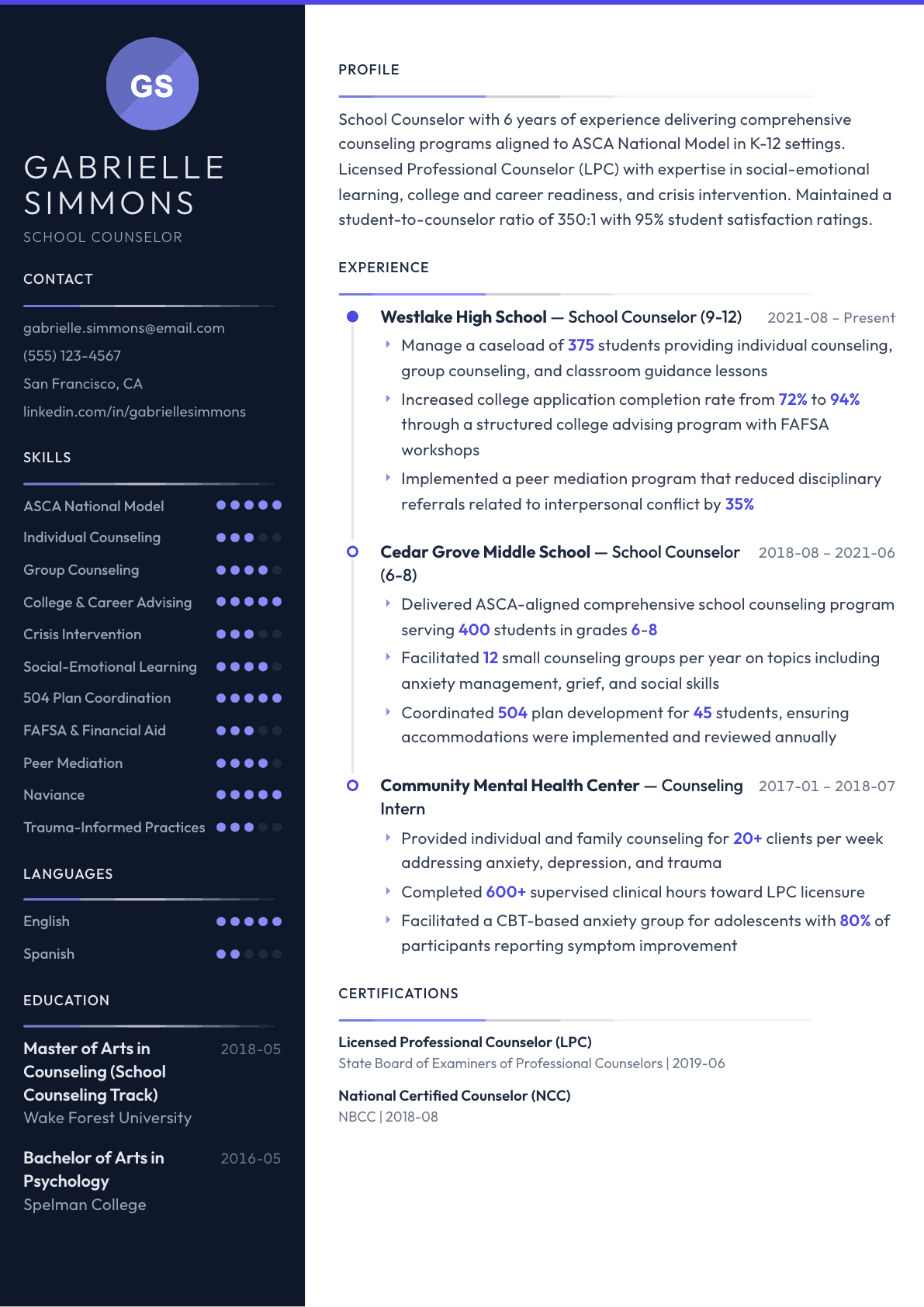
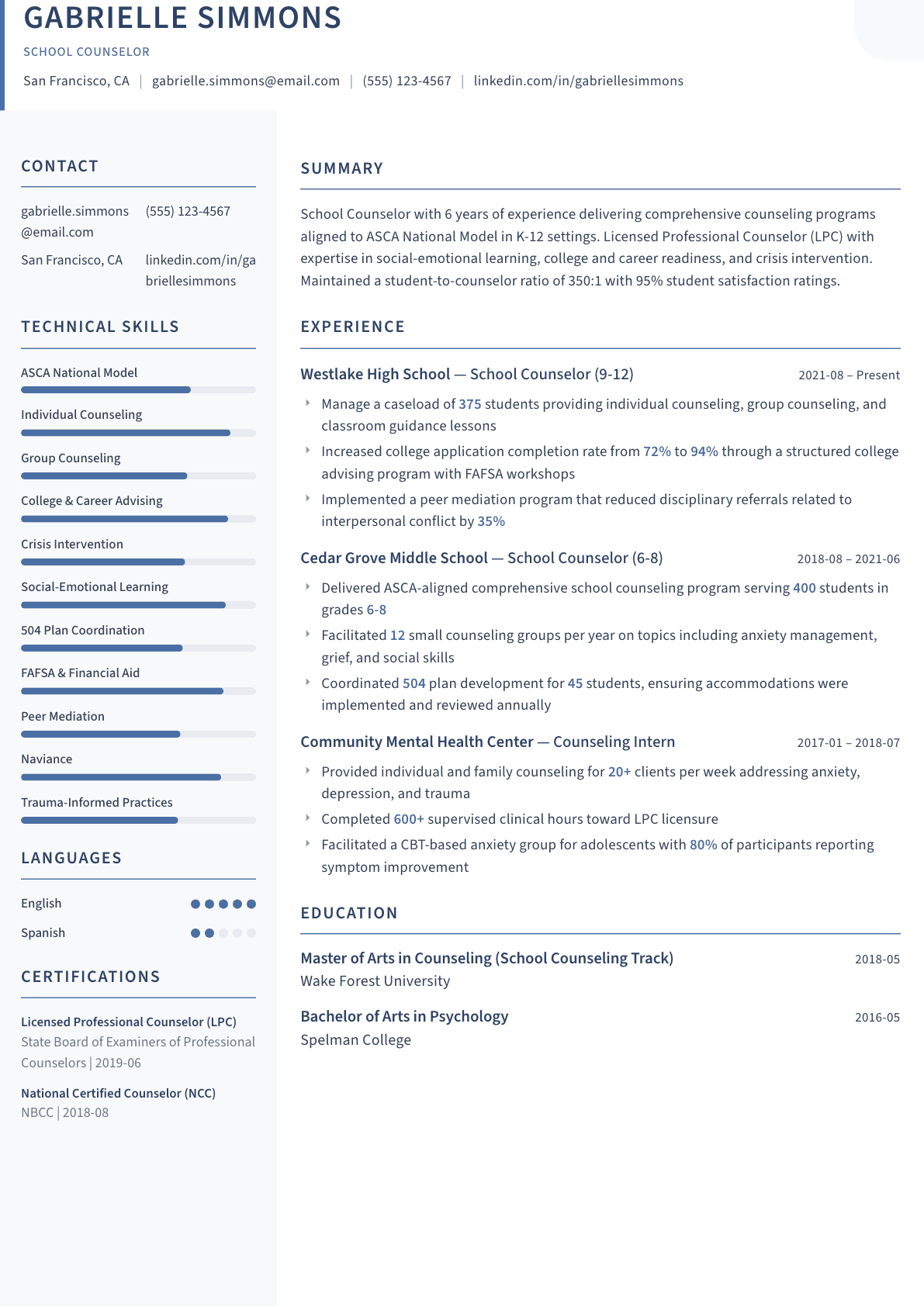
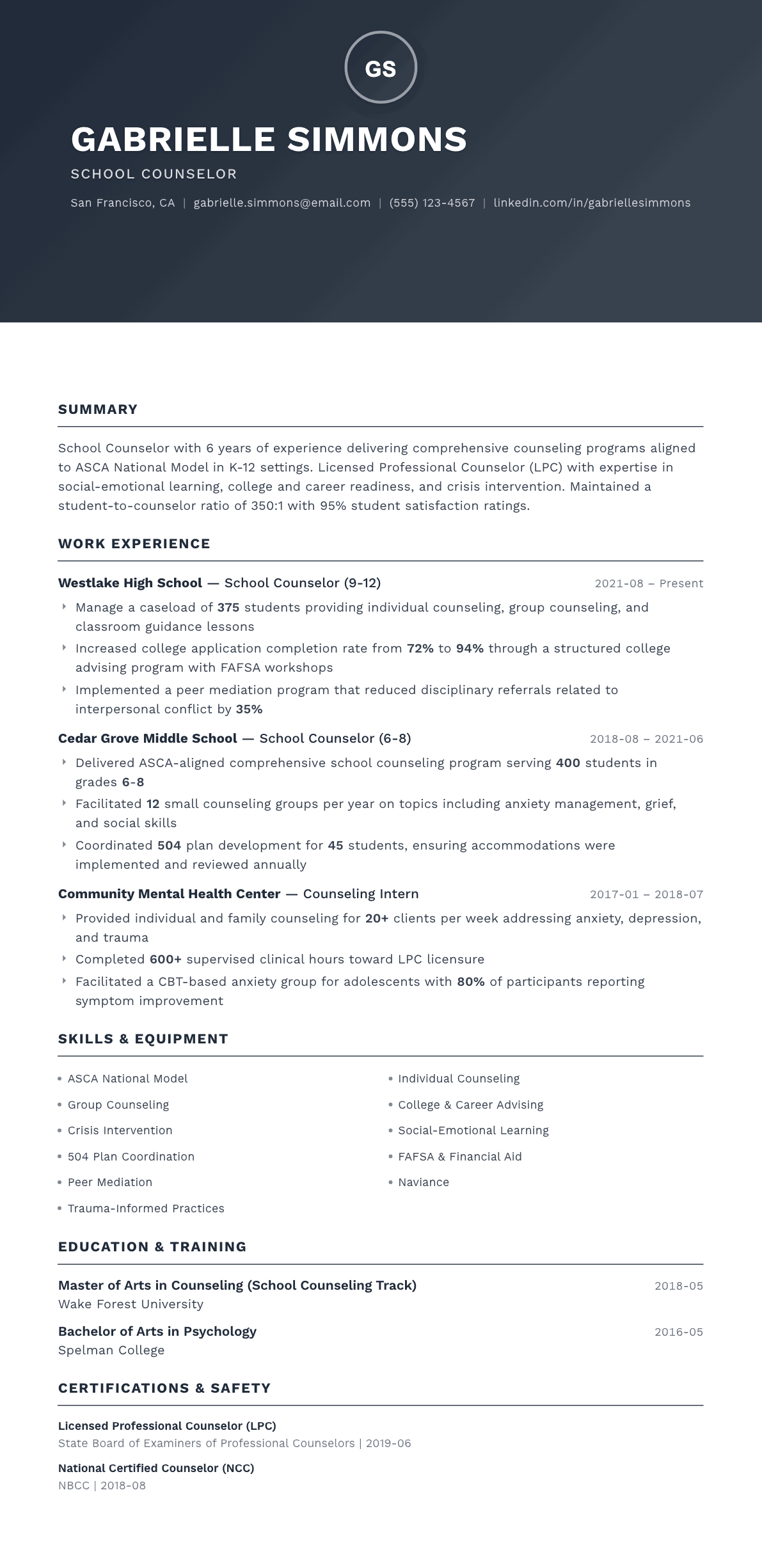
Example School Counselor summary
Licensed Professional Counselor and School Counselor with 6 years of experience delivering ASCA-aligned comprehensive counseling programs. Expert in college advising, social-emotional learning, and crisis intervention. Increased college application completion from 72% to 94% while maintaining 95% student satisfaction.
Skills to list on a School Counselor resume
- ASCA National Model
- Individual Counseling
- Group Counseling
- Crisis Intervention
- College & Career Readiness
- Social-Emotional Learning
- 504 Plan Coordination
- Suicide Risk Assessment
- Trauma-Informed Practices
- Naviance / Scoir
- FAFSA Advising
- Peer Mediation
- Data-Driven Program Evaluation
- Parent & Teacher Consultation
What actually gets this resume read
- Reference the ASCA National Model and its components: foundation, delivery, management, accountability.
- Highlight counseling modalities: individual, small group, classroom guidance, crisis response.
- Quantify program outcomes: college acceptance rates, FAFSA completion, referral reductions.
- Include licensure: LPC, NCC, state school counseling certification prominently.
- Describe special populations served: at-risk youth, LGBTQ+ students, English learners.
- Mention college advising tools: Naviance, Common App, Scoir, FAFSA, scholarship databases.
How to write a school counselor resume
School counselor postings are written by people who have watched the role be misunderstood for years, so they screen hard for one thing: does this candidate run a counseling program, or does she do whatever lands on her desk. A resume built around a comprehensive program, with curriculum, small groups, individual counseling and data attached to each, signals the first. A resume that lists scheduling, testing coordination and lunch duty signals the second.
The second screen is licensure and level. A school counseling license or certification is issued by the state education agency and is separate from a clinical counseling license, and elementary, middle and high school counseling are different jobs with different weightings. Career and college advising dominates a high school role; social skills, transitions and family contact dominate an elementary one.
If you are writing a resume for a guidance counselor post, the older title many districts and private schools still use, everything here applies. This guide covers the file a district student services office expects, how to write caseload, groups, crisis work and college advising, three summaries across levels, and the questions counselors ask when they move between school levels or in from clinical practice.
Format: two pages, with license and level stated up front
Use a two-page reverse-chronological resume. Put your state school counseling license under the header with the grade range it covers, and add any clinical license separately, since districts read the two differently and a clinical credential does not substitute for the school one.
Name the level you are applying for in your target title. A counselor whose resume says only school counselor, with a mix of elementary and high school experience and no signal about which she wants, gets passed over for candidates whose files match the opening exactly.
- Header: name, city and state, phone, email, state school counseling license with grade range, and any clinical license.
- Order: summary, licensure, school counseling experience, program results, clinical or internship experience, education, training.
- A new counselor leads with the practicum and internship, including hours completed and the levels served.
Summary: level, caseload, program components, one result
Open with the level and the caseload, because caseload size is the number every counselor and every director compares. Then name the components of the program you deliver: classroom lessons, small groups, individual counseling, crisis response, and college and career planning.
Close with one measurable result the program produced. Counselors are often reluctant to quantify their work, but a director reading fifty applications needs a reason to keep yours, and a specific outcome such as a rise in completed post-secondary plans or a drop in a referral category gives her one.
Experience: write the program, not the duties
Structure each position around the delivery components rather than a list of tasks. Classroom instruction: how many lessons a year, at which grade levels, on what topics, and how you measured what students learned. Small groups: how many groups a year, the topics, the group size, the session count, and how students were identified.
Individual counseling and crisis work need care. Give volume and type without any detail that could identify a student. Say how you handled risk assessment, mandatory reporting, safety planning, and the referral relationships you maintained with community mental health providers, because a director wants to know you can hold a crisis and hand it off correctly.
Then the planning half of the role: the advisory or planning framework you use, transition programs between buildings, attendance and multi-tiered support team membership, section 504 coordination, and the family outreach that makes any of it work. Where scheduling and testing duties took your time, name them briefly and honestly, since every counselor carries some and pretending otherwise reads as naive.
College, career and post-secondary planning
For secondary roles this section can stand alone. Financial aid application nights and completion support, college application and recommendation letter volume, scholarship advising, career interest inventories, work-based learning placements, military and apprenticeship pathways, and dual enrollment coordination all belong here.
Use the numbers your district already tracks: completed post-secondary plans, financial aid application completion, dual enrollment participation, and the share of seniors who met with you individually. Those are the metrics a high school principal is asked about, so a counselor who arrives already speaking in them is unusual and memorable.
Data and the program model
Comprehensive school counseling models ask counselors to show participation data, mindsets and behaviors data, and outcome data. A resume that presents results in that structure demonstrates fluency with the model without having to name-drop it in every line: how many students received the intervention, what changed in their reported skills or behavior, and what moved in attendance, discipline or achievement afterward.
Keep the claims proportionate. A small group of eight students that improved attendance is a real, defensible result. A school-wide achievement gain attributed to counseling will invite skepticism from an interview panel that knows how many other factors are in play.
Guidance counselor resume sample: the older title, the same file
Guidance counselor is the older name for the same job, and many districts and private schools still use it in postings. The American School Counselor Association uses school counselor, so put the posting's exact title in your header and summary and keep the profession's current name in the body. The file itself does not change.
The sample below is for a middle school counselor applying to a high school guidance counselor opening. The person and schools are invented; keep the order and put your own caseload, groups and results in place of these.
- Header and summary: Renata Okafor, M.Ed., state-certified school counselor (grades K to 12). Five years at a middle school with a caseload of 410 students in grades 6 to 8, running classroom lessons, small groups and transition planning to ninth grade.
- School Counselor, Brookfield Middle School, five years. Delivered a monthly classroom lesson to every grade and ran six small groups a semester on attendance, organization and peer conflict.
- Built the eighth grade transition program with the feeder high school: course selection meetings, a shadow day and a family evening.
- Coordinated suicide risk screenings with the district protocol and referrals to community providers, documented in the student information system.
- Earlier: Counseling Intern, Lakeview High School, one year, college application workshops and individual planning meetings with juniors.
School Counselor resume summary examples
Newly licensed
Licensed school counselor for kindergarten through grade twelve with a 700-hour internship split between a middle school of 620 students and an elementary building. Delivered 30 classroom lessons, co-facilitated four small groups on anxiety and friendship skills, and supported the transition program for incoming sixth graders.
Six years at one level
High school counselor carrying an alphabetical caseload of 340 students across four grade levels, responsible for individual planning, scheduling, and college and career advising. Raised financial aid application completion among seniors from 61% to 88% over three years through grade-level workshops and one-to-one sessions.
Lead counselor
Lead school counselor coordinating a department of five in a high school of 1,700, owning the calendar, the curriculum scope and sequence, and the crisis response protocol. Rebuilt the individual planning conference so every student meets with a counselor about a post-secondary plan each year.
Work experience bullets: before and after
Before: Provided counseling services to students on my caseload.
After: Carried a caseload of 340 students, meeting individually with each senior at least twice a year on post-secondary planning while holding open referral slots for short-term individual counseling.
Caseload size plus a stated contact standard shows a program with structure rather than reactive availability.
Before: Ran small groups for students who needed support.
After: Facilitated 12 small groups a year of six to eight students on anxiety management, grief, social skills and academic organization, with students identified through teacher referral and attendance data.
Group count, size, topics and the referral pathway describe a designed part of the program.
Before: Taught classroom guidance lessons.
After: Delivered 45 classroom lessons a year across grades nine through twelve on course planning, digital wellbeing and career exploration, using a pre and post check to see which objectives students had retained.
Volume, grade span, topics and a measure of learning turn lessons into curriculum delivery.
Before: Helped students apply to college.
After: Ran three financial aid completion nights and 40 senior workshops, wrote 90 recommendation letters a year, and lifted completed post-secondary plans on file from 74% to 96% of the graduating class.
The activities and the resulting completion rate connect effort to a number a principal already reports.
Before: Responded to student crises as needed.
After: Conducted risk assessments and safety planning under the district protocol, coordinated re-entry meetings after hospitalization, and maintained referral relationships with four community mental health providers.
Naming the protocol steps and the external referral network shows crisis work handled correctly, not heroically.
Hard skills
- Comprehensive school counseling program design
- Individual student planning conferences
- Small group counseling facilitation
- Classroom counseling curriculum delivery
- Risk assessment and safety planning
- Section 504 plan coordination
- Multi-tiered systems of support
- College and career readiness advising
- Financial aid application support
- Student information and college planning platforms
- Attendance and discipline data analysis
- Crisis response and re-entry protocols
- Community referral coordination
Soft skills
- Active listening
- Boundaries and confidentiality judgment
- Difficult conversations with families
- Collaboration with teachers
- Composure in crisis
- Advocacy for students
Certifications worth listing
- National Certified School Counselor (NCSC) (National Board for Certified Counselors)
- National Certified Counselor (NCC) (National Board for Certified Counselors)
- Licensed Professional Counselor (LPC) (State counseling licensure board)
- Youth Mental Health First Aid (National Council for Mental Wellbeing)
- Applied Suicide Intervention Skills Training (ASIST) (LivingWorks)
- Trauma-Focused Cognitive Behavioral Therapy training (Medical University of South Carolina)
Mistakes that cost school counselor candidates the interview
- Listing clerical duties such as scheduling and test coordination as the main content of the role, which suggests no program of your own.
- Leaving the caseload size off, when it is the first comparison a student services director makes between candidates.
- Including identifying details from a case, which is a confidentiality failure a panel will notice immediately.
- Applying to an elementary and a high school opening with one file, when the two roles weight the work differently.
- Presenting a clinical license as if it qualifies you for a school position that requires a state school counseling credential.
- Claiming credit for school-wide achievement results that a counseling program alone could not have produced.
School Counselor resume questions
What caseload number should I put on my resume?
Give the actual number of students assigned to you, and note how the caseload was divided, whether alphabetically, by grade level or by academy. If your building shared students across counselors, say so, because a director comparing candidates wants a like-for-like figure.
How do I write about counseling work without breaking confidentiality?
Report volume, topic and process rather than cases. The number of groups, the topics addressed, the protocol you followed and the referrals you coordinated are all safe. Anything that could identify a student, including unusual circumstances, does not belong on a resume.
Can I move from clinical counseling into a school position?
Only with the state school counseling credential, which most states require regardless of clinical licensure. Once you hold it, lead with your internship in a school and translate clinical experience into the school context: group facilitation, risk assessment, family engagement and referral coordination.
Is a guidance counselor resume different from a school counselor resume?
No. It is the same job under an older title, and the same file works for both. Use the posting's exact title in the header and summary so a parser matches it, then show the program: caseload, classroom lessons, groups, crisis protocol and, for high school, college and career planning with participation and outcome data.
How do I switch from elementary to high school counseling?
Rewrite the summary and the top bullets around the secondary work: transition planning, course selection, career exploration and any post-secondary advising you have done. Then add evidence you have been building toward it, such as training in college advising or work with older students outside school.