Career Counselor Resume Examples: the lines they read
Write a Career Counselor Resume That Shows Real Placement Outcomes
By Mustafa Tarabya, founder of CVBooster · Published · Updated
Career counselor resume example with caseload language, assessment tools, employer relations bullets, keyword list and a full writing guide.
Sample resumes for a career counselor
The same career counselor content laid out in three CVBooster templates, so you can see what the finished document looks like before you write a word.
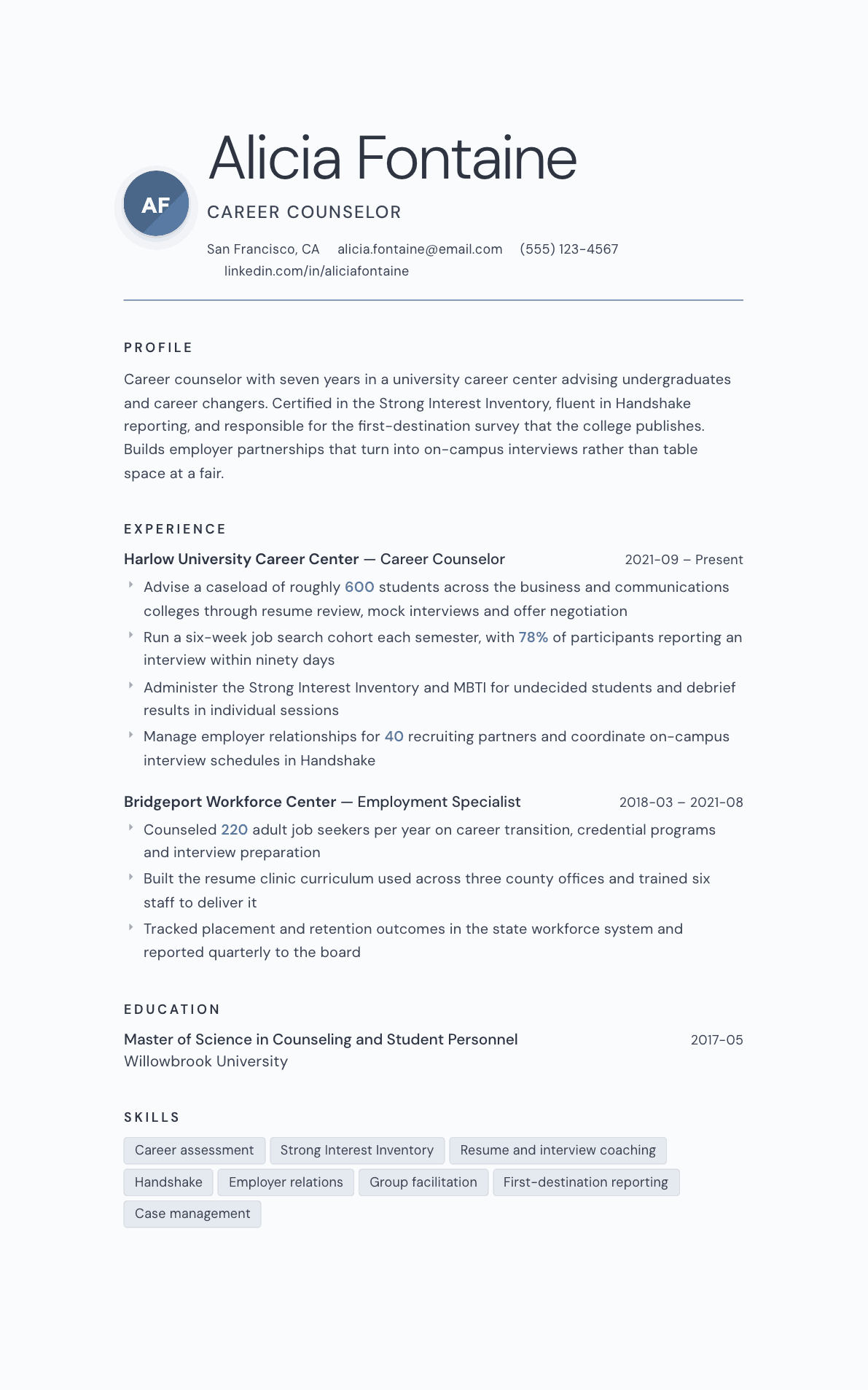
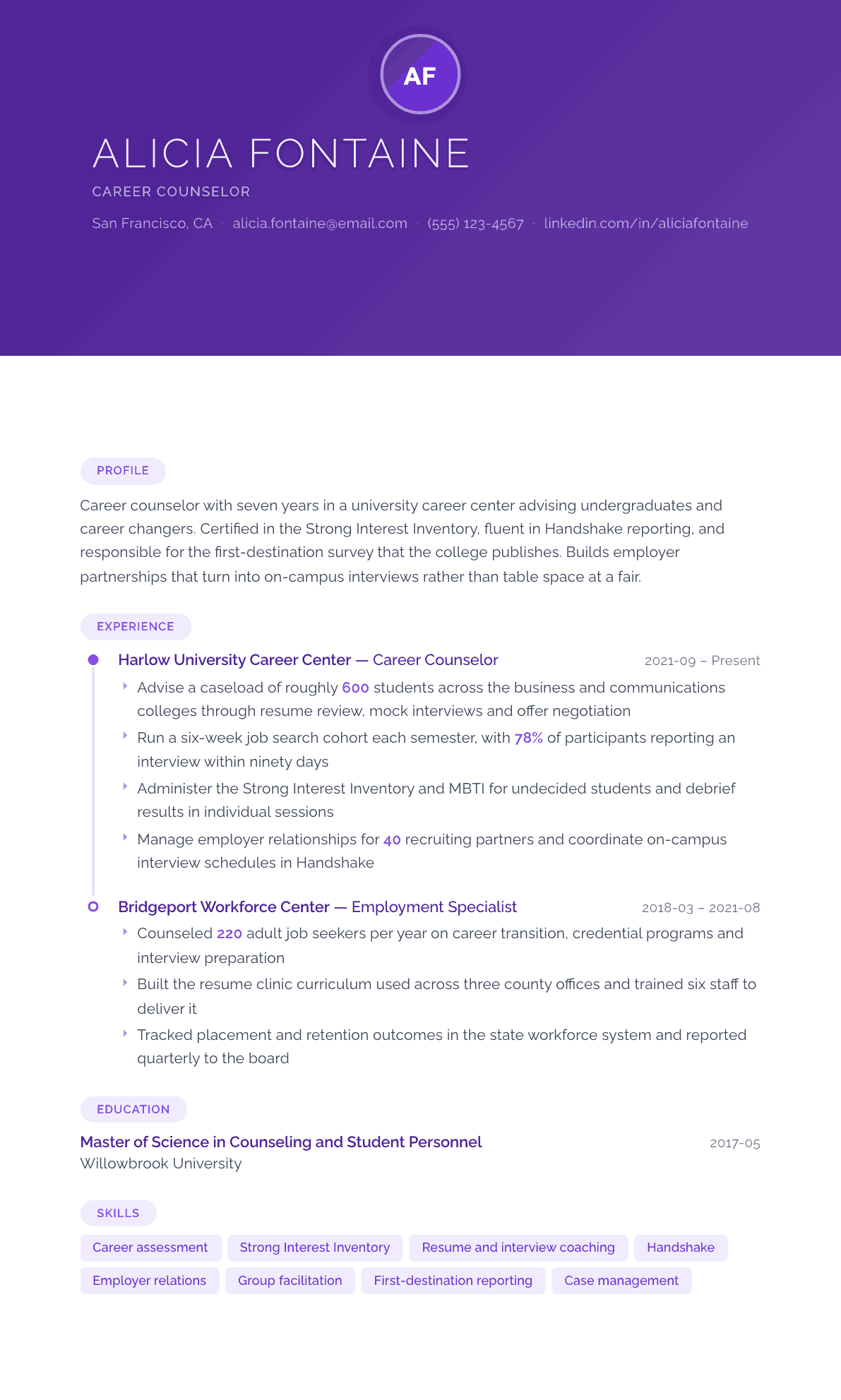
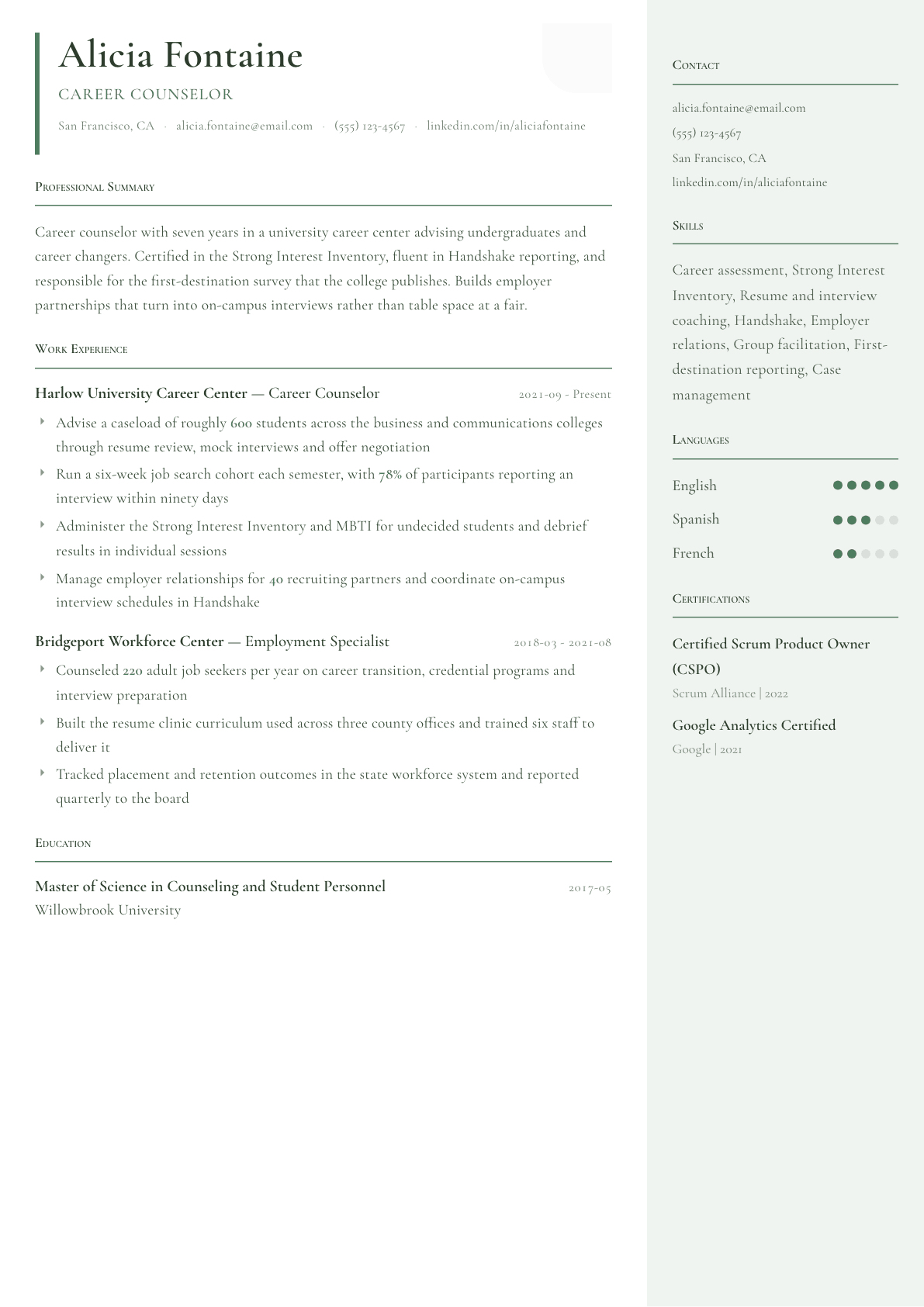
Example Career Counselor summary
Career counselor with seven years across a university career center and a county workforce office. Advises a caseload of roughly six hundred students on job search strategy, administers the Strong Interest Inventory, and manages forty employer recruiting partnerships in Handshake. Designed a job search cohort where most participants landed an interview within three months. Seeking an associate director role in career services.
Skills to list on a Career Counselor resume
- Career counseling
- Career assessment administration
- Strong Interest Inventory
- Myers-Briggs Type Indicator
- Resume and cover letter review
- Mock interviewing
- Job search coaching
- Employer relations
- Handshake
- Symplicity
- Workshop facilitation
- First-destination survey reporting
- Internship program development
- Case notes and documentation
- Labor market research
What actually gets this resume read
- Give your caseload size and the population you served, because advising first-year undecided students is a different job from coaching graduate career changers.
- Name the assessments you are qualified to administer and who certified you, since Strong Interest Inventory and MBTI qualifications are screened for by name.
- Report outcomes you can defend: interview rates from a cohort you ran, placement figures from a system of record, employer partners you signed.
- Show the platform side of the job, because career centers now run on Handshake or Symplicity and hiring managers look for that line.
- Include employer relations work separately from student advising, as many postings split the role between counseling and partnership development.
- If you write curriculum or run workshops, say how many sessions and how many attendees, so facilitation reads as scale rather than a side duty.
How to write a career counselor resume
Career counselors write resumes for a living and still struggle with their own, usually for the same reason: the work is relational and the resume rewards the countable. A career center director reading your file wants to know your caseload, the assessments you are qualified to administer, the employers you brought to campus, and whether the students you advised ended up somewhere.
The second thing she is checking is platform. Career services runs on a recruiting system now, and a counselor who has never pulled a first-destination report or scheduled an on-campus interview round inside one has a gap that shows up in week two. Name the platform, name the reports, name the cycle.
This guide walks through the section order career services searches expect, how to write outcomes you can defend, three summaries from a new counselor to a center leader, before-and-after bullets, and the questions counselors ask about their own documents.
Format: one page early, two once you own programs
Keep it to one page for the first few years and move to two once you run programs, supervise staff or hold employer relationships. Reverse chronological, single column, no icons. Higher education hiring runs through applicant tracking systems that mangle graphics, and career services committees notice the irony immediately when a counselor sends a file that would fail their own advice.
Add a short credentials line near the top with your degree, your counseling licensure if you hold one, and the assessments you are qualified to administer. Those three items decide which searches you clear.
- Header: name, city and state, phone, professional email, and a portfolio or scheduling link if you use one.
- Sections in this order: summary, credentials and assessments, experience, education, presentations and professional service.
- Describe each setting: four-year university center, community college, graduate school career office, or workforce agency.
Summary: population, caseload, method, outcome
Say who you advise before you say how you advise them. Undergraduate undecided students, graduate business students, alumni career changers and dislocated adult workers require different theory and different pacing, and directors hire for the population they need covered.
Then give the caseload and one method you are known for: appreciative advising, narrative career construction, a structured job search cohort, or assessment-driven exploration. Close with an outcome. A summary that ends on a number is a summary that gets read twice.
Experience: advising, programming and employer relations are three jobs
Most career counselor postings blend individual advising, group programming and employer or alumni engagement. Split your bullets so a reader can see all three. If you only ever did one, say so clearly rather than implying breadth you will be asked about in the interview.
For advising, give the caseload, the appointment volume per term and the topics: resume and cover letter review, mock interviewing, offer evaluation, graduate school applications, major exploration. For programming, give the format, the number of sessions and attendance. For employer relations, give the number of partners and what the relationship produced, such as interview schedules, site visits or funded internships.
Outcomes need a source. A cohort interview rate, a first-destination response rate you raised, a placement figure from a state workforce system or an internship count from your recruiting platform are all defensible. Vague claims about student success are not, and an experienced director will ask where the number came from.
Assessments and credentials: name the qualification, not the interest
List only the instruments you are actually qualified to administer and interpret, with the qualification level where it applies. The Strong Interest Inventory, the Myers-Briggs Type Indicator, the Clifton Strengths assessment and the Self-Directed Search all have their own training paths, and postings frequently require one by name.
Do the same with counseling credentials. A licensed professional counselor designation, a national certified counselor credential, or a global career development facilitator certificate each open different doors. If you are mid-training, say the hours completed and the expected date rather than leaving the line blank.
- Group assessments together so a screener finds them in one glance.
- Note supervision experience if you have supervised graduate interns or practicum students.
- List conference presentations, because career services values visible professional contribution.
Keywords career services postings repeat
The recurring language is predictable: career advising, career development theory, employer relations, internship development, experiential learning, first-destination outcomes, job search strategy, labor market information, student engagement. Mirror the phrasing the posting uses rather than a synonym you prefer.
Include the platform names too. Handshake, Symplicity, Twelve Twenty, Interstride and the scheduling tools that sit around them appear directly in postings, and a counselor who has administered rather than merely used one should say which.
Career Counselor resume summary examples
New counselor
Career counselor with a masters in counseling and two years advising undergraduates on resumes, internship searches and major exploration. Trained in the Strong Interest Inventory and comfortable running drop-in review hours. Built the first-year exploration workshop now offered every fall in the residence halls.
Seven years in
Career counselor advising a caseload of 600 business and communications students on job search strategy, interviewing and offer negotiation. Administers the Strong Interest Inventory, manages 40 employer recruiting partnerships in Handshake, and runs a semester job search cohort where 78% of participants land an interview.
Associate director
Associate director of career services leading a team of five counselors, the employer relations function and the first-destination survey. Raised survey response above the state reporting threshold, launched an alumni mentoring program, and rebuilt the center around a college-embedded advising model.
Work experience bullets: before and after
Before: Met with students to discuss career options.
After: Advised a caseload of 600 undergraduates through roughly 480 appointments a year on resume review, mock interviewing, major exploration and offer negotiation.
Caseload, appointment volume and the actual topics replace a sentence that describes every counselor alive.
Before: Ran career workshops for students.
After: Designed and delivered a six-week job search cohort each semester, with 78% of participants reporting an interview within ninety days of finishing.
A defined format with a tracked outcome shows program design rather than one-off event delivery.
Before: Worked with employers.
After: Managed 40 recruiting partnerships and coordinated on-campus interview schedules in Handshake, adding nine new employers to the spring rotation.
Naming the partner count, the platform and the growth turns a relationship claim into a business result.
Before: Used career assessments with students.
After: Administered and interpreted the Strong Interest Inventory and MBTI for undecided students, debriefing results in individual sessions and a follow-up exploration plan.
Qualified administration and the follow-up structure show competence rather than familiarity with a tool.
Before: Helped track graduate outcomes.
After: Managed the first-destination survey for the graduating class, raising response above the reporting standard through faculty outreach and a targeted follow-up sequence.
The specific deliverable and how you moved the response rate demonstrate ownership of a reported metric.
Hard skills
- Career development theory
- Career assessment administration
- Strong Interest Inventory
- Myers-Briggs Type Indicator
- Resume and cover letter review
- Mock interviewing
- Job search strategy coaching
- Employer relations
- Internship program development
- Handshake
- Symplicity
- First-destination outcome reporting
- Labor market information analysis
- Workshop and curriculum design
Soft skills
- Active listening
- Motivational questioning
- Group facilitation
- Relationship building with employers
- Case documentation
- Cultural humility in advising
Certifications worth listing
- Global Career Development Facilitator (GCDF) (Center for Credentialing and Education)
- Certified Career Services Provider (CCSP) (National Career Development Association)
- National Certified Counselor (NCC) (National Board for Certified Counselors)
- Strong Interest Inventory Certification (The Myers-Briggs Company)
Mistakes that cost career counselor candidates the interview
- Writing about caring deeply about student success without a single caseload figure, appointment count or tracked outcome.
- Listing assessments you have taken rather than assessments you are qualified to administer and interpret.
- Leaving out the recruiting platform, which is the operational core of a modern career center and appears in most postings.
- Merging advising, programming and employer relations into one paragraph so the reader cannot see which you have actually run.
- Quoting satisfaction or placement figures with no system of record behind them, which invites an uncomfortable interview question.
- Sending a heavily designed resume to a career services search, where the reviewers screen resumes professionally every day.
Career Counselor resume questions
Do I need a counseling license to work in a college career center?
Usually not. Most higher education career postings ask for a masters in counseling, student affairs or a related field. Licensure matters when the role includes clinical work or sits inside a combined counseling and career center.
How do I show outcomes without access to institutional data?
Use what you can source yourself: attendance across a program you ran, interview rates reported by a cohort you tracked, employers you added to the recruiting rotation, or internships posted through your platform. Attribute each to its source.
Is a career coaching certificate worth adding?
Add it if the issuing body is recognized in the field and the training was substantive. Career centers value the facilitator and provider credentials from national bodies more than short online certificates with no assessment component.
How do I move from workforce development into higher education?
Translate the vocabulary. Case management becomes caseload advising, employer engagement stays the same, and placement tracking maps onto first-destination reporting. Then add one line showing you understand the academic calendar and student developmental stages.
Should the resume mention specific student populations?
Yes, when you have real depth with them. First-generation students, international students, student veterans, athletes and graduate students each carry distinct search patterns, and many postings are written to fill exactly one of those gaps.