Instructional Coach Resume Examples: what gets the call
Craft an Instructional Coach Resume Principals Take Seriously
By Mustafa Tarabya, founder of CVBooster · Published · Updated
Instructional coach resume examples with coaching cycle bullets, teacher growth evidence, district keywords and a complete writing guide.
Sample resumes for a instructional coach
The same instructional coach content laid out in three CVBooster templates, so you can see what the finished document looks like before you write a word.
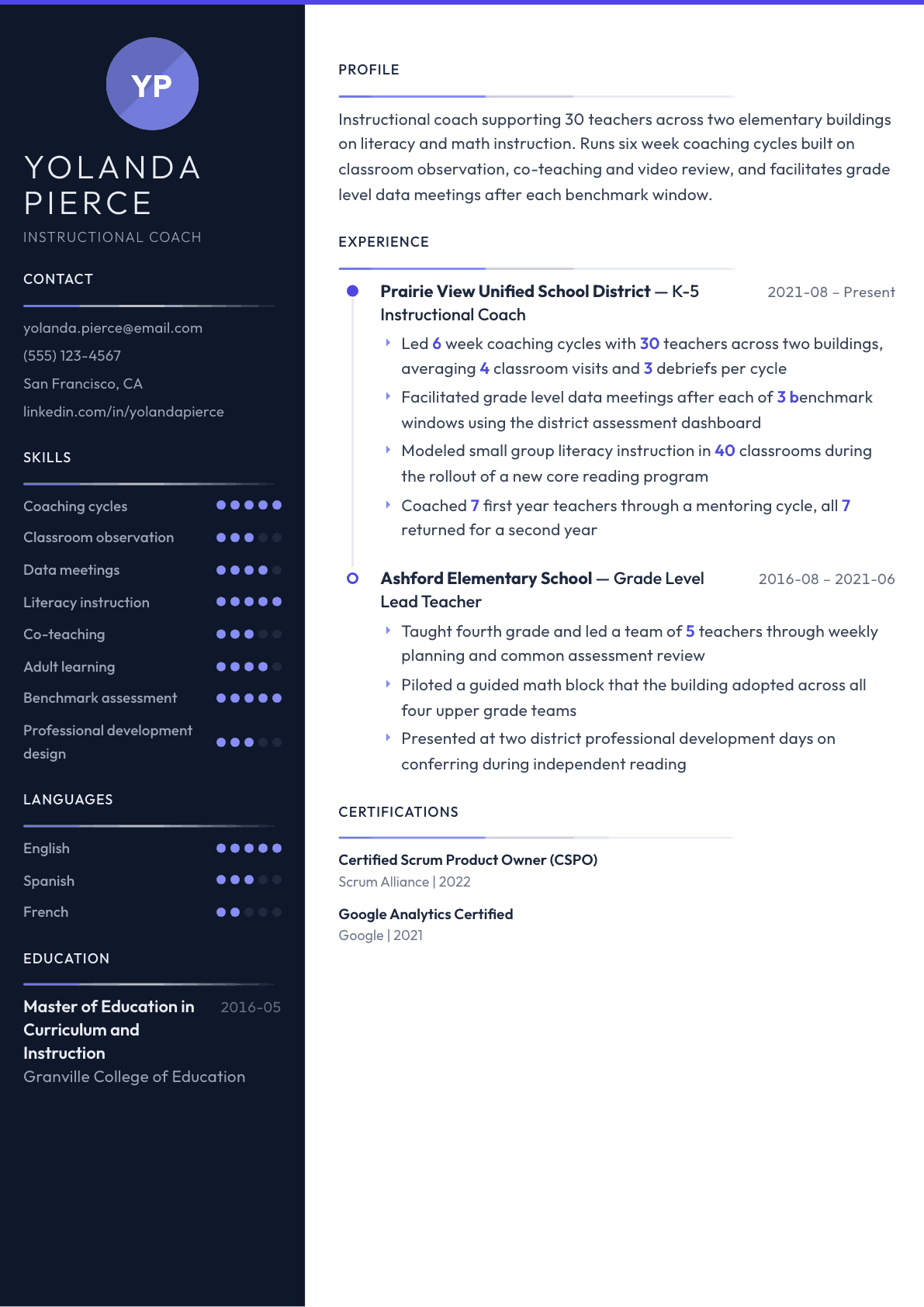
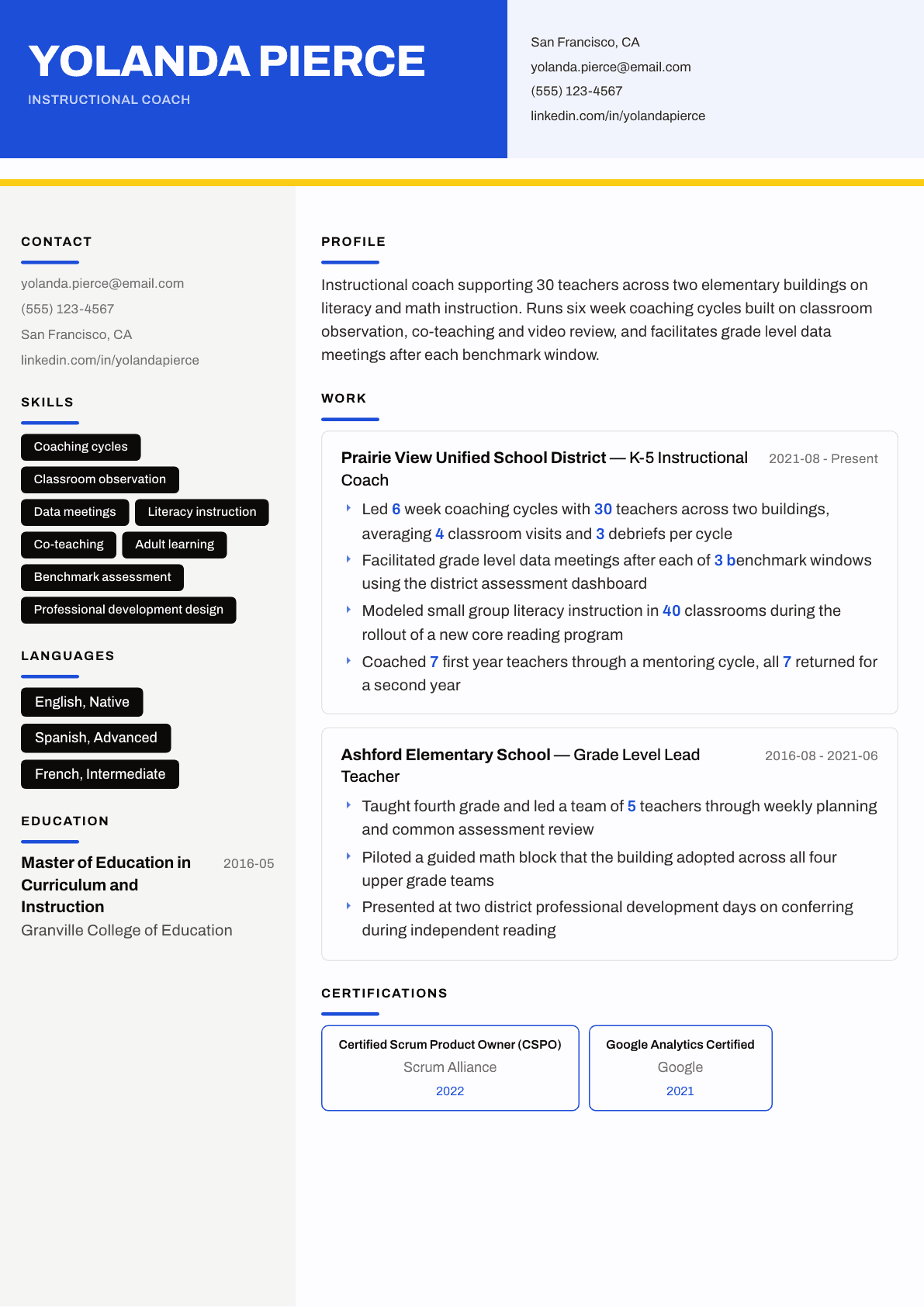
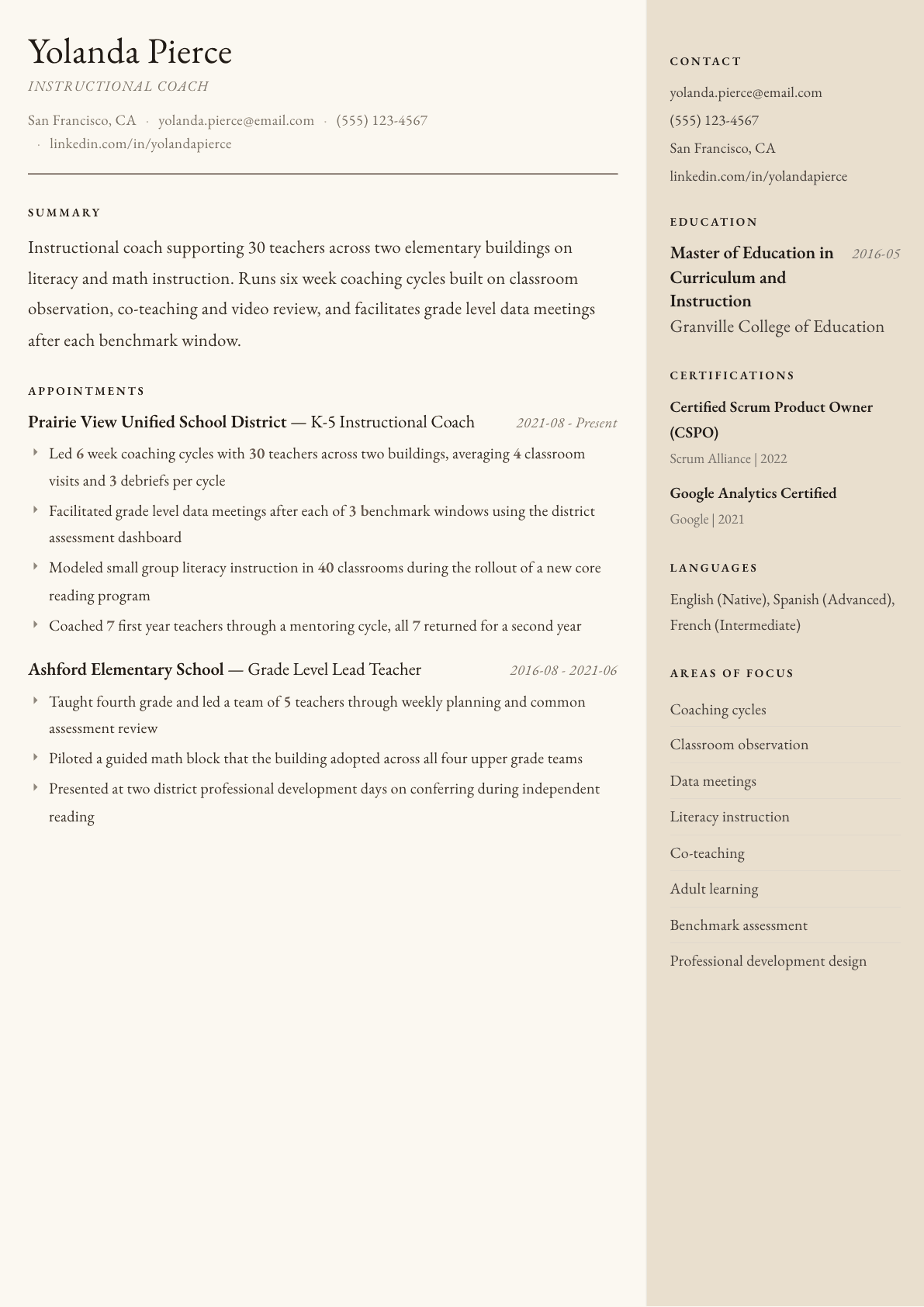
Example Instructional Coach summary
Instructional coach with three years supporting elementary teachers on literacy and math after nine years in the classroom. Runs six week coaching cycles built on observation, modeling and video debriefs, and leads grade level data meetings after every benchmark window. Led a core reading rollout across two buildings and mentored first year teachers through their induction year.
Skills to list on a Instructional Coach resume
- Coaching cycles
- Classroom observation
- Instructional feedback
- Co-teaching
- Lesson modeling
- Data analysis
- Professional learning communities
- Adult learning theory
- Curriculum rollout
- Benchmark assessment
- Mentoring new teachers
- Professional development facilitation
- Literacy instruction
- Guided math
What actually gets this resume read
- Keep your own classroom teaching record on the resume, because teachers will not accept a coach who never taught.
- Describe your coaching model by name and length, whether it is a six week cycle, student centered coaching or a lab classroom.
- Count what you coached: teachers served, buildings covered, observations, debriefs and modeled lessons per cycle.
- Name the curriculum and assessment systems you supported, since a district hires for its own adopted materials.
- Show teacher outcomes rather than student scores alone, such as retention of new teachers or adoption of a practice.
- Include the professional development you designed and delivered with audience size and the topic you were asked to lead.
How to write a instructional coach resume
Instructional coach openings are usually filled by a committee that includes a principal, a curriculum director and at least one teacher. The teacher on that committee is the toughest reader. She wants to know whether you taught long enough and well enough that a colleague would open her door to you, and whether you will show up in classrooms or live in a district office running meetings.
The principal is asking something else: will this person move instruction in my building without becoming an evaluator? Coaching sits deliberately outside the evaluation system, and a resume that reads like an assistant principal file creates doubt in both directions.
What follows is how to present your own teaching record, how to describe a coaching model with real counts, three summaries from a first coaching year to a district lead, five rewritten bullets, and the questions teachers ask when they step out of the classroom into coaching.
Keep your teaching record visible and specific
Coaching credibility is built on classroom years. Write the grade levels, the subjects, the course titles and the buildings, and keep at least two lines of teaching accomplishments under each teaching entry rather than collapsing a decade into one line.
Include the leadership steps that came before coaching: grade level lead, department chair, mentor teacher, curriculum writer, pilot classroom, or presenter at a district professional development day. Committees read those as evidence that colleagues already accepted your influence without a title.
- Name the curriculum you taught, because a district hires against the materials it has adopted.
- List the assessments you used and led data conversations around, from a benchmark tool to common unit assessments.
- Say whether you coached while still teaching, which many districts run as a half time model.
Describe your coaching model with counts, not adjectives
Coaching is a defined practice, and the committee wants to know yours. Say the cycle length, what happens inside it, and how many teachers you carry at once. A six week cycle with a goal setting conversation, four classroom visits, three debriefs and a closing reflection is a model. Building relationships and supporting teachers is not.
Add the modes you use: modeling a lesson, co-teaching, observing with a focused tool, video review, planning side by side, and lab classrooms where several teachers watch a colleague. Districts often name a preferred approach in the posting, and matching that language without misrepresenting your practice is worth the time.
Show impact on teachers, not only on test scores
Student data belongs on the page, but it is shared with everyone in the building and no committee credits it to a coach alone. Teacher level outcomes are yours: practices adopted across a team, new teachers retained through induction, a strategy that spread from a pilot classroom to a grade level, participation in voluntary coaching that grew term over term.
Voluntary uptake is a particularly strong measure. If teachers who were not required to work with you asked for a cycle, say how many, because the committee knows what that means about your reputation in a hallway.
- Count cycles run, teachers served, buildings covered, observations, debriefs and modeled lessons.
- Say what changed in practice, for example a conferring routine adopted by every teacher on a team.
- Track new teacher retention through induction when you mentored, since it is a budget line districts watch.
Data meetings and adult learning
Most coaching jobs include facilitating professional learning communities and data meetings after each assessment window. Write the cadence, the number of teams, the protocol you use and what the meeting produces: a reteach plan, a small group roster, or a revised common assessment item.
Adult learning is a real skill and committees test for it. Say how you handle a teacher who declines coaching, how you keep confidentiality separate from the evaluation process, and how you design professional development that adults choose to attend. One sentence about the non evaluative boundary reassures both the principal and the teacher reading the file.
Credentials and professional learning
A teaching license in the relevant grade band is the baseline, and many districts prefer a masters degree in curriculum, literacy or educational leadership. Reading specialist endorsements, teacher leader endorsements and National Board certification all strengthen a coaching file because they are verifiable and hard to earn.
List coaching specific professional learning with the provider: cognitive coaching training, a district coaching academy, a literacy institute, or a Reading Recovery or similar structured program if you completed one. Keep anything you cannot document off the page.
Instructional Coach resume summary examples
First coaching year
Elementary teacher of eight years moving into instructional coaching after two years as a grade level lead and mentor teacher. Piloted a guided math block adopted by four teams, and presented at two district professional development days on conferring during independent reading. Trained in the district coaching cycle model.
Three years coaching
Instructional coach supporting thirty teachers across two elementary buildings on literacy and math. Runs six week cycles built on observation, modeling and video debriefs, and facilitates grade level data meetings after every benchmark window. Led a core reading rollout and mentored seven first year teachers through induction.
District coaching lead
District instructional coaching lead supervising six building coaches across secondary schools. Owns the coaching cycle standard, the observation tool and the coach onboarding academy. Facilitates monthly coach learning sessions and reports on cycle counts and teacher participation to the assistant superintendent each quarter.
Work experience bullets: before and after
Before: Coached teachers to improve their instruction.
After: Led 6 week coaching cycles with 30 teachers across two buildings, averaging 4 classroom visits and 3 debriefs per cycle.
The model, the volume and the visit counts show a practice the committee can picture running in its own schools.
Before: Helped with data.
After: Facilitated grade level data meetings after each of 3 benchmark windows, closing every meeting with a small group roster and a reteach plan.
It names the cadence and the artifact the meeting produces, which is the difference between a meeting and a decision.
Before: Supported the new reading curriculum.
After: Modeled small group literacy instruction in 40 classrooms during the first year of a new core reading program, then co-taught follow up lessons on request.
Classroom counts prove the coach was in rooms rather than presenting slides about the rollout.
Before: Mentored new teachers.
After: Coached 7 first year teachers through a full induction cycle of biweekly planning sessions and monthly observations, and all 7 returned for a second year.
Retention across an induction cohort is a district budget concern, so the outcome lands with the people hiring.
Before: Ran professional development sessions.
After: Designed and delivered a three part professional learning series on formative assessment for 60 teachers, revising the third session after reviewing exit feedback.
Audience size plus a revision based on feedback demonstrates adult learning skill rather than a slide deck.
Hard skills
- Coaching cycle design
- Classroom observation tools
- Lesson modeling and co-teaching
- Video based debriefs
- Professional learning community facilitation
- Benchmark and formative data analysis
- Curriculum implementation support
- Professional development design
- New teacher induction
- Literacy instruction methods
- Guided math and small group structures
- Adult learning principles
Soft skills
- Building trust with reluctant colleagues
- Nonjudgmental feedback
- Confidentiality
- Facilitation under disagreement
- Listening before advising
- Persistence over a full cycle
Certifications worth listing
- National Board Certification (National Board for Professional Teaching Standards)
- Reading Specialist Endorsement (State department of education)
- Teacher Leader Endorsement (State department of education)
Mistakes that cost instructional coach candidates the interview
- Compressing a decade of teaching into one line, which removes the credibility a coaching hire depends on.
- Writing about supporting teachers without a cycle length, a teacher count or a single classroom visit number.
- Framing the role as evaluative, which alarms the teacher on the committee and misreads the position boundary.
- Claiming student score growth as personal impact when every adult in the building touched the same students.
- Ignoring the district adopted curriculum by name, when materials alignment is often the reason the job exists.
- Filling the page with meetings attended instead of what the meetings produced for classrooms the next week.
Instructional Coach resume questions
How many years of teaching do I need before coaching?
Most districts look for at least five strong classroom years, and committees weigh the leadership steps you took inside them. Mentoring, department chair work, curriculum writing and presenting at district sessions matter as much as the raw count of years.
Is an instructional coach part of teacher evaluation?
In most districts coaching is deliberately non evaluative, and observations you conduct stay between you and the teacher. Say so on your resume in one clause, because it tells the committee you understand the boundary that makes teachers willing to work with a coach.
What numbers belong on an instructional coach resume?
Teachers served, buildings covered, cycles completed, classroom visits and debriefs per cycle, lessons modeled, professional development audience size, and new teacher retention. These describe your work directly rather than crediting you with schoolwide test results.
How do I write about coaching a teacher who did not want a coach?
Describe the approach, not the person. Explain how you opened with a request the teacher chose, kept the first cycle narrow, and let results in her own classroom carry the argument. Committees ask this question in interviews, so having the answer already written helps.
Should an instructional coach resume be one page or two?
Two pages is normal, because the file must carry both a full teaching record and a coaching record. Keep the teaching entries tight, give the coaching role the most space, and add a short section for professional development you designed and delivered.