Academic Advisor Resume Examples: the lines they read
Guide Your Career With an Academic Advisor Resume That Shines
By Mustafa Tarabya, founder of CVBooster · Published · Updated
Build an academic advisor resume highlighting student retention, degree planning, and advising caseload management with measurable outcomes.
Sample resumes for a academic advisor
The same academic advisor content laid out in three CVBooster templates, so you can see what the finished document looks like before you write a word.
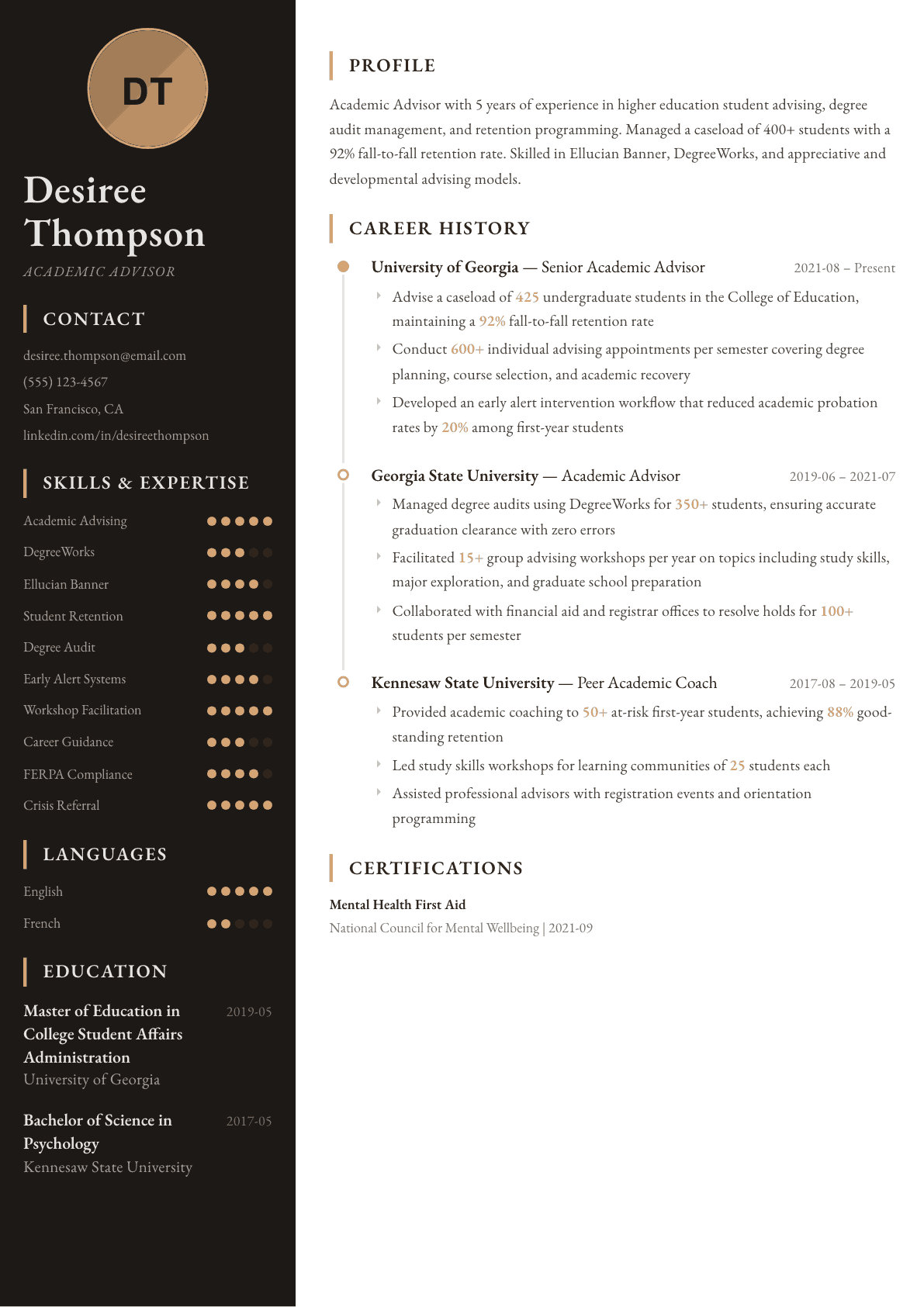
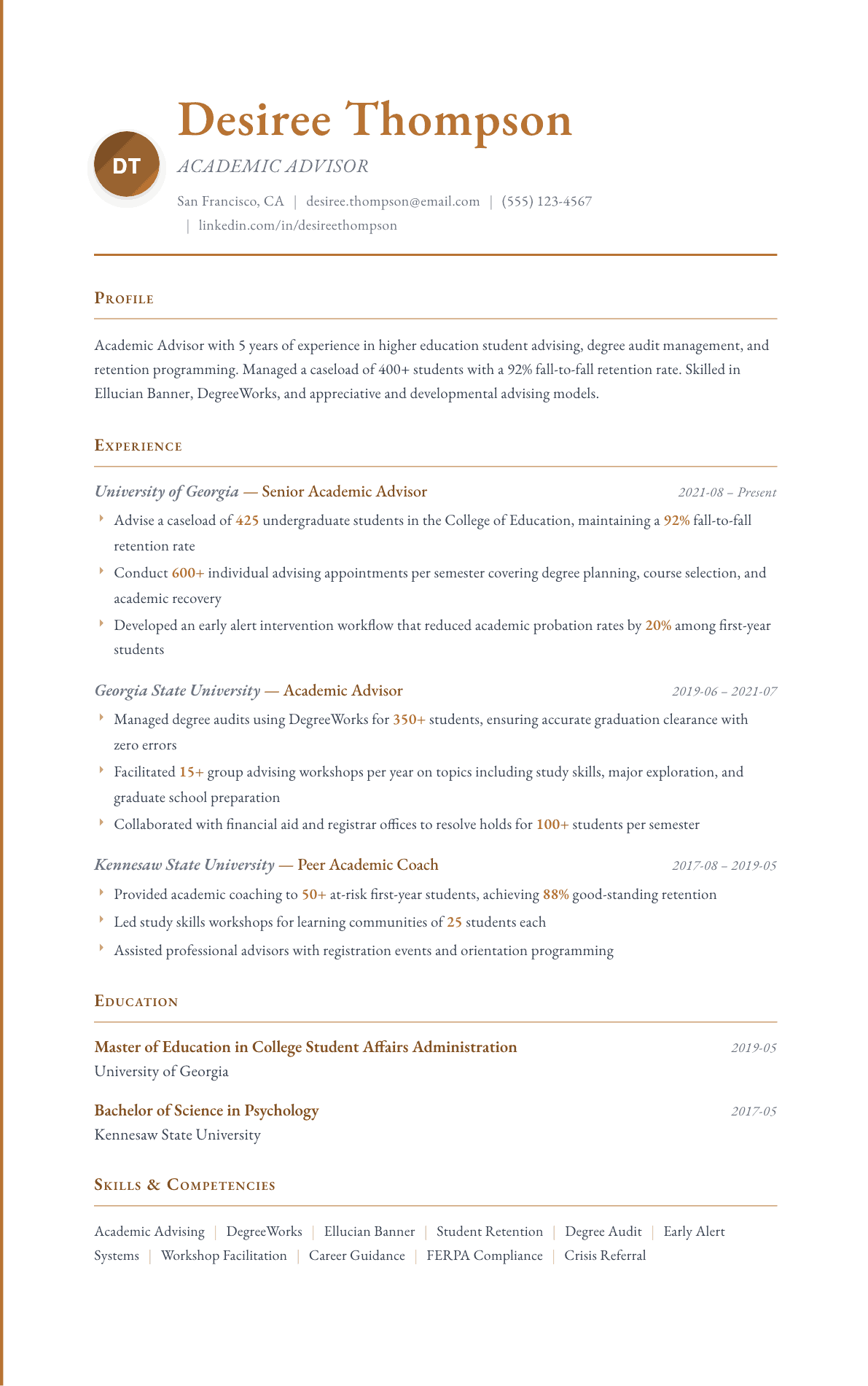
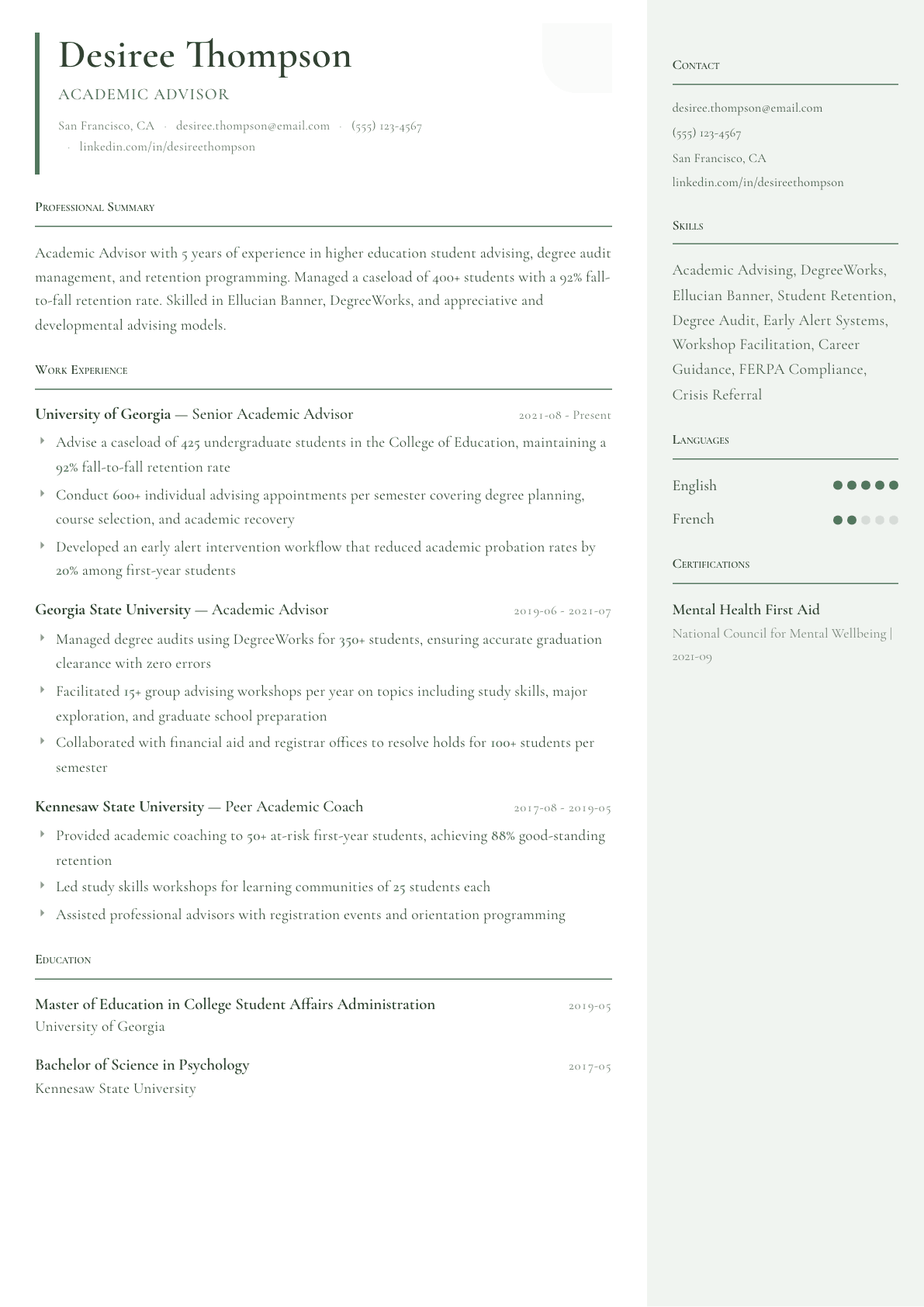
Example Academic Advisor summary
Academic Advisor supporting a caseload of 425 undergraduates in a college of education, holding fall-to-fall retention at 92%. Runs 600+ advising appointments a semester and built an early alert workflow that cut first-year probation rates by 20%. Daily work in DegreeWorks and Ellucian Banner.
Skills to list on a Academic Advisor resume
- Academic Advising
- DegreeWorks
- Ellucian Banner
- Student Retention Strategies
- Degree Audit Management
- Early Alert Systems
- Appreciative Advising
- Workshop Facilitation
- Career Guidance
- FERPA Compliance
- Crisis Intervention & Referral
- Transfer Credit Evaluation
- Orientation Programming
- Data Analysis & Reporting
What actually gets this resume read
- Highlight caseload size and retention metrics: retention rates, graduation rates, GPA improvements.
- Include advising technology: DegreeWorks, Banner, PeopleSoft, Starfish, Navigate.
- Reference advising models: proactive, intrusive, appreciative, developmental.
- Quantify outreach: appointments per semester, workshops facilitated, students served.
- Mention NACADA involvement, certifications, or professional development.
- Describe populations served: first-generation, at-risk, transfer, pre-professional, undeclared.
How to write a academic advisor resume
An academic advisor resume is read inside a student success office that is measured on retention. The director hiring you wants to know the size of the caseload you have carried, the population you carried it for, and whether you can run a degree audit without escalating it. Human resources, meanwhile, is checking the degree requirement, because most four-year institutions ask for a master's for anything above an entry advising title.
Advising is also a systems job, and this surprises candidates coming from teaching or student affairs. Half the day is spent inside a student information system and a degree audit tool, documenting contacts in a case management platform so the next advisor and the registrar can see what was said. A resume that never names those systems reads as though the writer has advised informally rather than professionally.
This guide covers the sections a student success director reads in order, how to describe a caseload honestly, the retention language that carries weight, and the questions advisors ask when they move between community college, four-year and graduate advising.
Format: one to two pages, education visible, systems named early
Reverse chronological, one page for under five years and two after that. Higher education search committees often read as a group and score against a posted rubric, so make each required qualification easy to find rather than clever. If the posting asks for a master's degree and experience with a particular student information system, both should be visible without scrolling.
Keep a short technology line near the top rather than burying it at the bottom. Naming Banner, Colleague, PeopleSoft, DegreeWorks, Starfish or Navigate in the first third of the page saves the reader from guessing and matches the exact terms the posting uses.
- Header: name, city and state, phone, professional email, and an institutional or professional profile link if you have one.
- Section order: summary, advising experience, technology, education, professional development and service.
- New advisors coming from graduate assistantships put education first and label the assistantship as advising experience with the caseload.
Summary: caseload, population, and the outcome you own
Say how many students you advise, who they are, and what you are accountable for. Undeclared first-year students, transfer students, student athletes, adult learners and pre-health students are all different jobs, and a director hiring for a first-year experience program is scanning for that word. A summary that offers dedication to student success describes the whole applicant pool.
Attach one measurable outcome you personally influenced: a persistence or fall-to-fall retention figure for your caseload, a probation recovery rate, or the growth of a workshop series you built. One concrete number carries more weight than three adjectives.
Experience: the caseload, the model, and what you did with the data
Lead each role with the shape of the caseload: the number of assigned students, the college or program, the population, and the appointment volume across a term. An advisor who writes 380 assigned undeclared and pre-business students, roughly 700 appointments per academic year, has answered the first three interview questions in one line.
Then show the advising practice rather than the tasks. Name the model you work in, whether proactive, appreciative or developmental, and show it in action: an early alert flag that you followed up within a set window, a midterm grade campaign, a registration hold outreach that pulled students back before the census date. Directors hire advisors who chase students, not advisors who wait for appointments.
Include the degree work itself, because it is the part new advisors underestimate. Degree audits and exception processing, transfer credit evaluation and articulation, graduation checks, course substitution paperwork, prerequisite overrides, and the registrar relationships that make those move. Add committee and orientation work last.
Compliance and boundaries a search committee checks
Advisors handle protected education records every day, so name your familiarity with the Family Educational Rights and Privacy Act and how it shapes what you release to parents and third parties. Add any training you hold in mental health referral, Title IX responsible employee reporting, or behavioral intervention team participation.
Show that you know where advising stops. The strongest resumes describe warm referrals to counseling, disability services, financial aid and the care team rather than claiming to counsel students through crises. That distinction reads as professional maturity to anyone who has managed an advising unit.
Professional development and the terms the posting reuses
Membership and involvement in the National Academic Advising Association carries real weight in this field, particularly conference presentations, regional service or an advising certificate. List presentations with the venue and the topic rather than as a single line.
Mirror the language of the posting once in the summary and once inside a bullet: retention, persistence, degree completion, holistic advising, caseload management, early alert, academic probation, student success. Use the terms where they are true and skip the rest, because a director reading the interview notes will ask you to describe each one.
Academic Advisor resume summary examples
New to professional advising
Master of Education graduate with two years as a graduate advising assistant supporting 120 first-year students through orientation, registration and probation outreach. Trained in Banner and DegreeWorks, experienced with early alert follow-up, and seeking a first-year advising role in a student success center.
Five years in
Academic advisor with five years supporting a caseload of 400 undeclared and pre-business students, holding roughly 750 appointments a year. Raised fall-to-fall persistence on the caseload from 78% to 86% with a proactive outreach cycle, and built a probation recovery workshop now used college-wide.
Lead advisor
Lead academic advisor with ten years in a community college transfer center, supervising six advisors and owning articulation agreements with four state universities. Redesigned the transfer advising workflow in Navigate, cut degree audit errors, and increased transfer application completion by 19% in two years.
Work experience bullets: before and after
Before: Advised students on course selection and degree requirements.
After: Advised a caseload of 400 undeclared and pre-business students on course selection, degree pathways and major exploration, holding roughly 750 individual appointments across fall, spring and summer terms.
Caseload size, population and appointment volume let a director compare you against the load in her own office.
Before: Used early alert software to help struggling students.
After: Cleared early alert flags in Starfish within two business days, contacting flagged students by phone and text, and documented every outreach so faculty could see the follow-up on their own dashboards.
The named system, the response window and the documentation habit show a repeatable practice rather than good intentions.
Before: Helped improve student retention.
After: Ran a registration hold campaign each November, reaching 210 students with unregistered spring schedules and recovering 168 of them before the census date.
A retention claim only lands when the reader can see the campaign, the population and the recovery count.
Before: Ran workshops for students on academic probation.
After: Designed and facilitated a four-session academic recovery workshop for students on probation, covering study planning, self-assessment and campus resources, with 62% of participants returning to good standing within one term.
The structure, the content and the outcome turn a workshop line into evidence that you can build a program.
Before: Familiar with FERPA and student privacy.
After: Handled parent and third party inquiries under the Family Educational Rights and Privacy Act, confirming written release on file before disclosing any record and training two new advisors on the same process.
Compliance is believable when it appears as a practice you follow and teach, not as an acronym in a list.
Hard skills
- Caseload management
- Degree audit and exception processing
- DegreeWorks
- Ellucian Banner and Colleague
- PeopleSoft Campus Solutions
- Starfish and EAB Navigate
- Transfer credit and articulation review
- Early alert response
- Academic probation and recovery planning
- Registration and schedule building
- FERPA compliance
- Orientation programming
- Retention and persistence reporting
- Workshop facilitation
Soft skills
- Proactive outreach
- Listening without solving too early
- Referral judgment
- Boundary setting with families
- Cross-office collaboration
- Documentation discipline
Certifications worth listing
- Mental Health First Aid (National Council for Mental Wellbeing)
- Certified Educational Planner (American Institute of Certified Educational Planners)
Mistakes that cost academic advisor candidates the interview
- Leaving out caseload size, which is the single number a student success director uses to gauge whether you can carry her office's load.
- Writing about a passion for helping students without naming the population you actually served.
- Skipping the student information system and degree audit tool, so the reader assumes a long training period.
- Claiming counseling work rather than referral, which reads as a boundary problem to anyone who has supervised advisors.
- Listing retention as a skill with no campaign, cohort or figure attached anywhere in the experience section.
- Burying a master's degree on page two when the posting lists it as a minimum qualification.
Academic Advisor resume questions
Do I need a master's degree to be an academic advisor?
Most four-year institutions require one for professional advising titles, often in counseling, higher education, student affairs or a related field. Community colleges and some entry advising roles accept a bachelor's with relevant experience, so read the minimum qualifications line before you rule a posting out.
How do I show retention results if my office does not track them by advisor?
Use the outcomes you can evidence at cohort or campaign level: students recovered from probation, holds cleared before census, workshop participation, or persistence for a program you supported. Say clearly that the figure is for the cohort or campaign rather than implying you owned it alone.
Can I move into academic advising from classroom teaching?
Yes, and it is a common path. Lead with the advising-shaped work you already do: course planning conversations, referrals, family communication and record keeping. Then close the systems gap by naming any student information system you have used and taking an advising certificate before you apply.
Should I list NACADA membership on my resume?
Yes, and go further than membership if you can. Regional conference presentations, committee service or an advising certificate signal that you follow the field rather than only holding the job, and search committees in higher education notice that distinction quickly.
How do I write a resume for advising a specific population?
Name the population in the summary and again in the first bullet of your most recent role, then lead with the practices that population requires. Advising student athletes centers on eligibility certification, while advising adult learners centers on prior learning credit and evening scheduling.