How to Use a Resume Example Without Copying It
By Mustafa Tarabya, founder of CVBooster · Published · Updated
12 min read
Take three things from a resume example: the order of the sections, the grammatical shape of a bullet, and how much text fits on a page. Take nothing else. The numbers, the phrasing and the achievements belong to a person who does not exist, and copying them is how a good example produces a bad resume.
That split is the whole of the advice, and it holds for every example you will find, whether it came from a builder's template gallery, a careers service handout, or a friend who got the job. What follows is why the split falls where it does, and what each half looks like in practice.
What are you actually looking for in an example?
It helps to be honest about the search. Almost nobody types "example resume" wanting to study document design. They want a finished thing they can put their own name on, because writing a resume from an empty page is genuinely hard and a completed one looks like it has already solved the hard part.
It has not. What an example has solved is the part you were going to get right anyway, which is where the sections go and what a page looks like when it is full. The part you find hard, which is deciding what is worth saying about your own work, cannot be solved by a document about someone else. That is not a moral point. It is structural: the example contains no information about you, so anything you take from it that looks like information about a candidate is information about a fiction.
Which means the useful question is not "is this a good resume?" but "what in this resume is transferable?" Those have different answers, and the transferable part is smaller than it looks.
What can you safely take from an example?
Four things, and they are all structural.
- The section order. Whether skills sit above or below experience, whether education comes before or after work history, whether there is a summary at all. This varies by field and by seniority, and seeing three examples from your own field settles it faster than any rule can. The underlying logic is in the resume format guide.
- The grammatical shape of a bullet. Strong bullets have a recognisable structure: an action verb, an object, a scale or a context, and an outcome. You can lift that structure wholesale, because a sentence pattern is not a claim.
- Density. This is the most underrated thing an example teaches, and it is invisible in written advice. How many bullets per job, how long each one runs, how much white space sits between sections, at what point a page stops looking full and starts looking crammed. You calibrate that by looking, not by reading a number.
- Vocabulary register, in the narrow sense of which words are ordinary in your field. A clinical resume, a warehouse resume and a design resume each have a working vocabulary, and an example shows you the level of technicality a reader expects. Not the sentences. The words.
Notice what these have in common. Every one of them is a container. None of them is content. You can pour anything into a container without lying about it.
What will hurt you if you copy it?
Three things, in descending order of how much damage they do.
The numbers, first and worst. Every impressive figure in an example was invented by whoever wrote the example, usually to demonstrate that a bullet can carry a number. "Reduced processing time by 34%" is not a fact about anybody. Copy it and you have made a specific, checkable claim about your own work that is not true, which is a problem that lies dormant through the whole application and detonates in the interview, when someone asks how you measured it.
The phrasing, second. A well-turned sentence in an example is not neutral material. It is the writer's voice, and a resume assembled from three different writers' voices reads as assembled. More practically, popular examples are copied by thousands of people, and a reviewer who has read four hundred applications this year has met "spearheaded cross-functional initiatives to drive operational excellence" before. It does not read as strong. It reads as familiar.
The achievements, third and most quietly. This is the one that catches careful people. You read a bullet about redesigning an onboarding process, recognise that you also did something adjacent, and write it up at the example's scale rather than yours. Nothing in the resulting line is a lie exactly. It is just half a size too big, and it commits you to defending a version of your job that you did not have.
Tip: If a bullet in your draft would need you to say "well, roughly" in an interview, it came from an example rather than from your work. Rewrite it at the size it actually was. A smaller true number is more persuasive than a larger vague one, because you can talk about it for five minutes.
How do you copy the shape of a bullet without the content?
Here is the mechanism, worked all the way through on a single line. The example bullet below is invented, as are all three candidates using it.
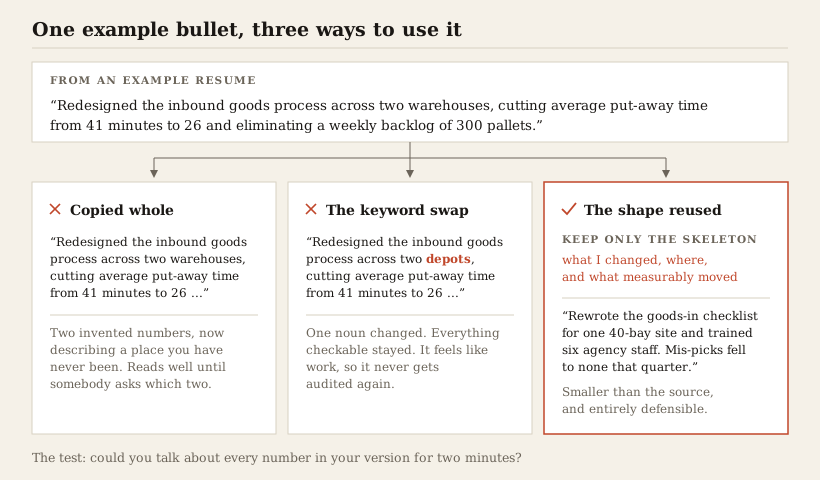
Source bullet, from an example resume for an operations coordinator: "Redesigned the inbound goods process across two warehouses, cutting average put-away time from 41 minutes to 26 and eliminating a weekly backlog of 300 pallets."
Use one: copied whole
The candidate pastes the line in unchanged, because they also worked in a warehouse and the sentence is better than anything they had written.
What has gone wrong is not subtle, but it is worth stating precisely: the resume now contains two numbers, a pallet count and a warehouse count, that describe a place the candidate has never been. The line will read well right up until an interviewer asks which two warehouses, and then it will be the only thing anyone remembers about the conversation.
Use two: the keyword swap
More common, and more dangerous because it feels like work. The candidate keeps the sentence and substitutes their own nouns: "Redesigned the inbound goods process across two depots, cutting average put-away time from 41 minutes to 26 and eliminating a weekly backlog of 300 pallets."
Warehouses became depots. Everything checkable stayed. This is the worst of both, because the candidate now believes they have written an original line and will not audit it again. It is also the failure mode that automated rewriting produces most reliably: asked to make a bullet impressive without being given facts, a tool will keep the impressive part and change the wrapper.
Use three: the shape reused
The candidate throws away every word and keeps only the skeleton, which is: what I changed, where, and what measurably moved.
Then they fill it from their own week. "Rewrote the goods-in checklist for a single 40-bay site after two mis-picks in a month, and trained six agency staff on it. Mis-picks fell to none over the following quarter."
It is a smaller claim than the source. One site instead of two, six people instead of a process redesign, a quarter instead of a permanent fix. It is also entirely true, entirely defensible, and specific in a way the source bullet is not, because it contains a real reason the work happened. The example did its job: it taught the grammar. It contributed no content, which is correct, because it had none to contribute.
Why does copied phrasing read as copied?
Not because a reader recognises the source. Almost nobody does. It reads as copied because of a mismatch inside your own document.
A resume is a small text and its voice is very exposed. You wrote your education section, your skills list and your header yourself, in your own register. If two bullets in the middle arrive in a more polished, more corporate register than everything around them, the seam is visible even to a reader who could not tell you what changed. What they notice is that the document is uneven, and the conclusion they draw is not that you copied. It is that the strong lines are the exception.
The same effect works in your favour. A resume written throughout in your own plain register, with modest true numbers, reads as consistent, and consistency is read as candour. That is worth more than any individual sentence you could borrow.
What about the layout and the section order?
Take these freely. They are conventions rather than claims, and following a convention is the whole point of a convention.
One caution. Examples are produced to be looked at, frequently as a thumbnail in a gallery, and that selects hard for visual interest. Sidebars, two columns, icons in place of labels, a coloured header band, a skills section drawn as filled circles. Those choices make an example legible at 200 pixels wide and they are the same choices that cause a document to be extracted in the wrong order by software. The mechanism, and which parts of it are real rather than folklore, is in the modern resume.
So separate the two things an example's layout is showing you. The section order is information. The visual treatment is a shop window.
How many examples should you look at?
Three from your own field, and they should disagree with each other.
One example is a template, and you will copy it. Three examples that make different choices force you to notice where the choices are, which is the thing you actually needed to learn. If all three put skills above experience, that is a convention in your field and you should follow it. If one does and two do not, it is a preference and you can decide.
A fourth is worth finding for a different reason: an example from a level above yours. Not to copy, but to see what the bullets do differently. Senior bullets tend to describe decisions and consequences where junior bullets describe tasks and volumes. Seeing that gap tells you what your own next line of evidence needs to be, which is more useful than anything on the page you are currently writing.
Where do examples come from, and does it matter?
It matters more than the polish suggests. Most resume examples on the internet are marketing artefacts. They are written by a content team for a fictional candidate, to demonstrate a template and to rank for a search. They have never been submitted to an employer, never been read by a recruiter, and never resulted in a hire. That does not make them bad, and a well-made example is genuinely instructive about structure. It does mean that the phrase "this resume got someone hired at a top company" is a claim you have no way to check, and you should treat it as decoration rather than evidence.
There is one category of example worth more than the rest, and it is free: a resume from someone who currently does the job you are applying for, shown to you privately. It has survived a real screen at a real employer in your actual market. Ask two people. The worst that happens is that they say no.
Even then, the split holds. Take their structure and their vocabulary. Do not take their numbers, because those are theirs, and do not take their career, because the reason their resume works is that it is about them.
A short procedure that works
- Collect three examples from your field, from different sources, and put them side by side.
- Write down only what they agree on: section order, roughly how many bullets per role, whether there is a summary. That is your skeleton.
- Close the examples. Actually close them.
- Write your own content into the skeleton from memory and from your own records: what you did, at what scale, and what changed because of it.
- Reopen one example and compare grammar only. Are your bullets starting with verbs? Are they one line each? Is anything a paragraph pretending to be a bullet? Fix the grammar, not the content.
- Run the interview test on every number: could you talk about this for two minutes? If not, it is not yours yet.
Step three is the one that does the work. Almost every bad outcome in this article comes from having the example visible while writing your own content, because the sentence in front of you is always easier to adapt than a sentence you have not written yet.
What to do next
Open your draft and read only the bullets that you like the most. Those are the ones most likely to have arrived from somewhere else, because a line you wrote yourself about your own Tuesday rarely feels impressive to you. For each one, ask whether you could name the week it happened. If you cannot, rewrite it from the skeleton up.
Then check the rest of the document against something other than an example. The resume review is a six-pass read that catches what side-by-side comparison cannot, and which skills to put on a resume covers the section where copied content does the most quiet damage, because a skills list borrowed from an example is a list of things you have implicitly claimed to be able to do. Some fields ignore the general format entirely, and the film industry resume samples show a credits layout no general example would teach you.
Related articles
- Hard Skills for a Resume: How to List Them
- How Long Should a Resume Be? The Honest Answer
- Resume Skills Section: Layout and Placement
- Soft Skills for a Resume: Communication Examples and More
More articles
- Resume Fonts: 10 That Print Clean and the Sizes to Use
- Career Goals on a Resume: Examples & How to Write Them
- Resume Format Guide: Dates, Layout, Color and File Type
Looking for a worked example for your job title? Browse the resume examples by job title.