Assistant Store Manager Resume Examples: free ATS score
Write an Assistant Store Manager Resume That Earns the Keys
By Mustafa Tarabya, founder of CVBooster · Published · Updated
Assistant store manager resume examples, sample bullets, shrink and payroll keywords, and a writing guide for retail promotion interviews.
Sample resumes for a assistant store manager
The same assistant store manager content laid out in three CVBooster templates, so you can see what the finished document looks like before you write a word.
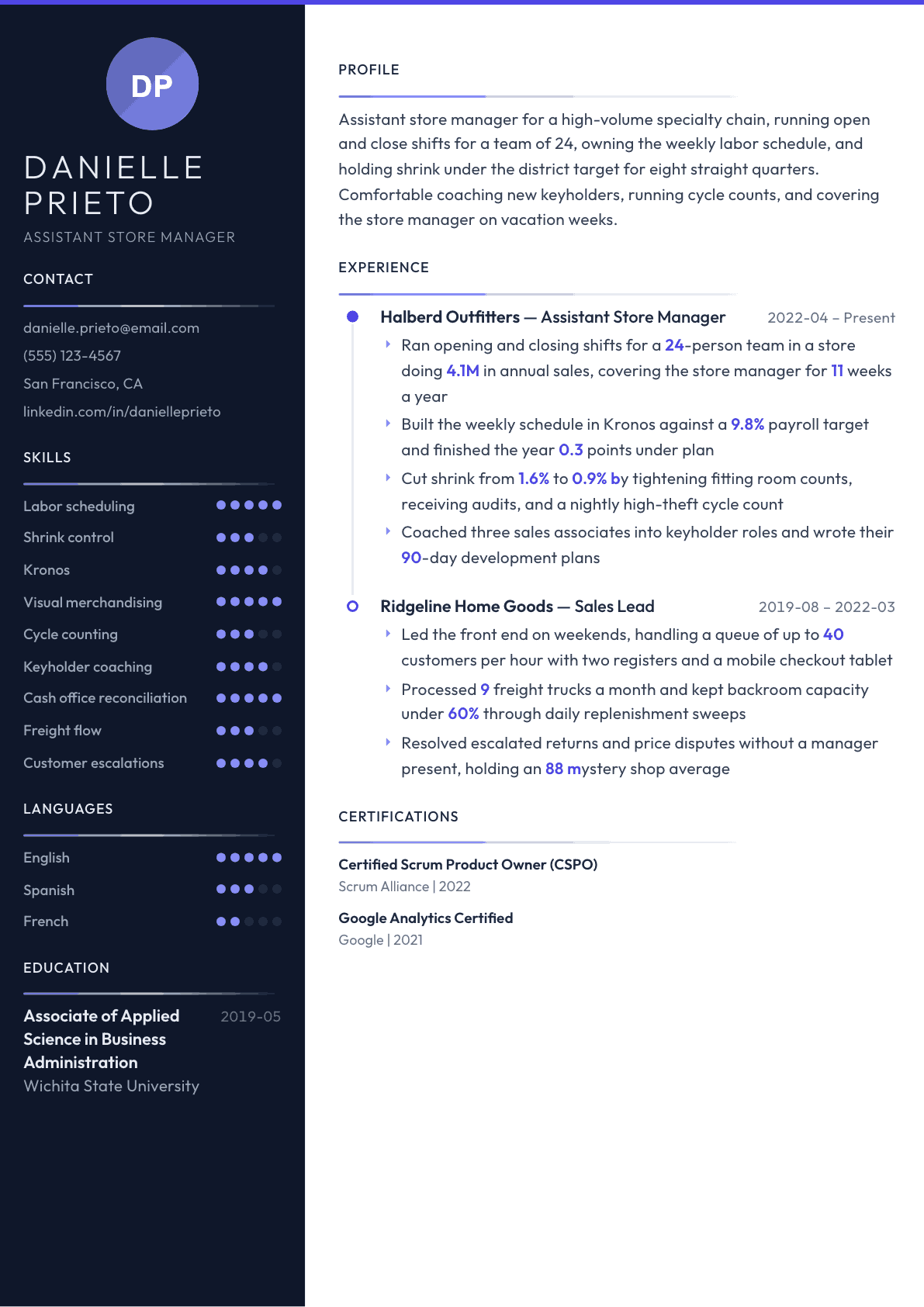
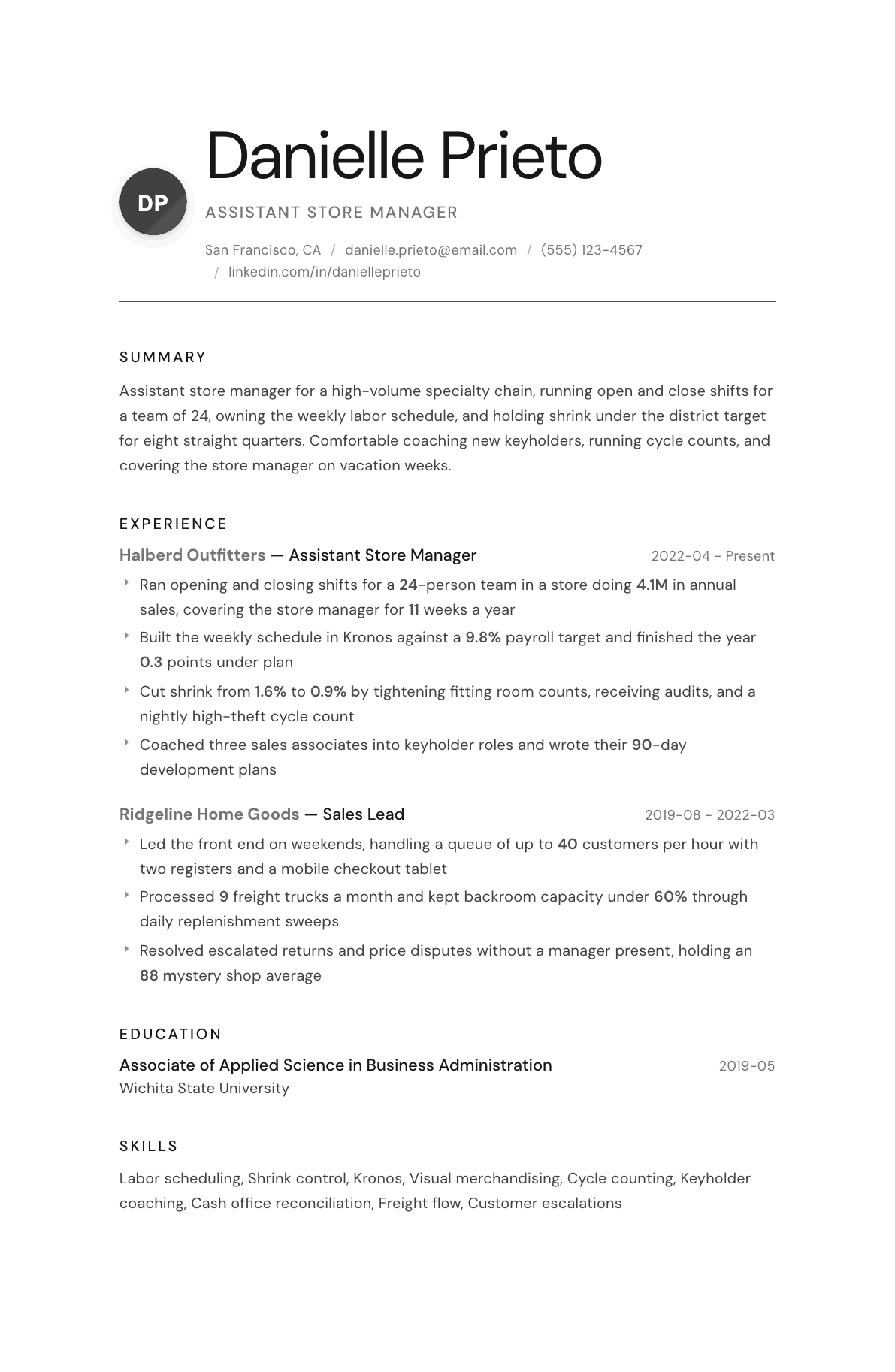
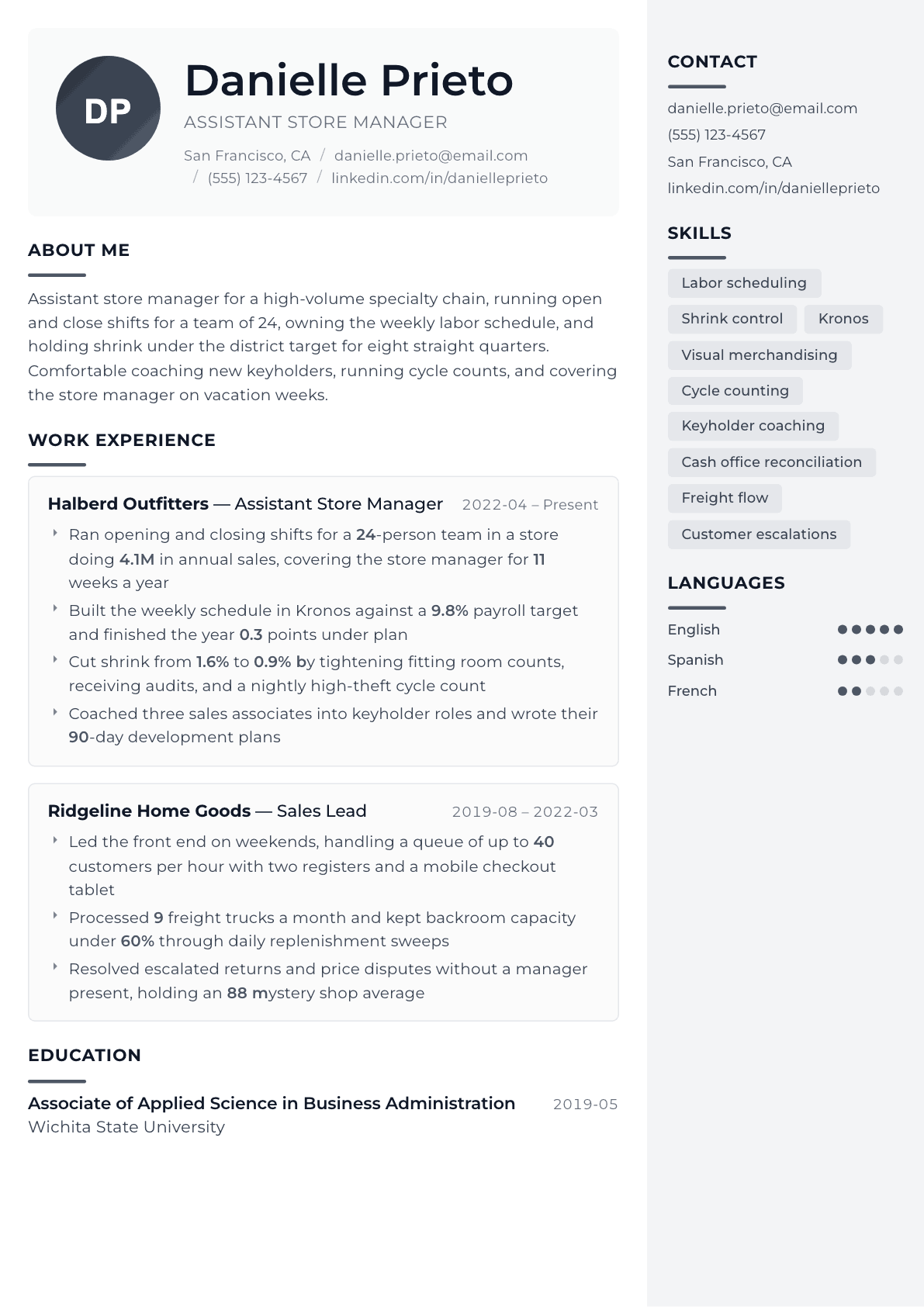
Example Assistant Store Manager summary
Assistant store manager with five years in specialty retail, supervising a team of 24 in a store doing 4.1M a year. Owns the labor schedule against a 9.8% payroll target, runs the cash office, and has held shrink under 1% for two years. Promoted three associates to keyholder and covers the store manager on every vacation week.
Skills to list on a Assistant Store Manager resume
- Labor scheduling
- Payroll management
- Shrink reduction
- Inventory control
- Cycle counting
- Visual merchandising
- Point of sale systems
- Cash handling
- Team coaching
- Performance reviews
- Loss prevention awareness
- Customer escalation handling
- Freight and replenishment
- Opening and closing procedures
- Store audits
What actually gets this resume read
- State the store volume, the headcount you supervised, and whether you carried keys and alarm codes.
- Show the pieces of the profit and loss statement you actually owned, usually payroll hours, shrink, and supply spend.
- Name the scheduling and point of sale systems by name so the recruiter can match them to the posting.
- Give one line on how often you ran the store alone, because that is what separates a lead from an assistant manager.
- Quantify the people you developed: associates promoted, keyholders trained, turnover you pulled down.
- Keep the freight and truck detail short unless you are applying to a warehouse-heavy format.
How to write a assistant store manager resume
An assistant store manager resume is judged against one question: can this person run the building when the store manager is not in it? Everything else on the page is context. The district manager or store manager reading it wants the store volume, the headcount, the parts of the profit and loss statement you touched, and proof that you have carried keys, alarm codes, and a bank deposit without supervision.
The common failure is a resume that reads like a senior sales associate with a longer title. Bullets about greeting customers, folding tables, and helping with inventory describe hourly work. A promotion decision turns on payroll hours, shrink, staffing, and whether the people you coached are still employed.
This guide covers section order, how to size your scope in a single line, three summary examples for a first-time assistant manager through a multi-unit candidate, before and after bullets, and the questions retail leaders ask when they sit down to rewrite their resume.
Format: one page, scope line first, keys and coverage visible
Reverse chronological, one page until you have run more than one store. Retail hiring moves fast and a district manager often reads on a phone between visits, so the first third of the page has to carry the scope. Skip photos, skip skill bars, and keep the experience section in a single column so a chain applicant tracking system parses the dates cleanly.
Give every job a scope line before the bullets: format, annual volume, headcount, and hours of operation if the store is open long. A reader who sees a store doing four million a year with a team of two dozen already knows how to weigh the bullets underneath.
- Header: name, city and state, phone, email, and availability for open and close if you have it.
- Section order: summary, experience, education, skills, then certifications if you hold any.
- Add a short line naming the systems you used for scheduling, point of sale, and inventory.
Summary: volume, team size, and what you own without the manager there
Three lines. Name the format and category, the annual volume, how many people report to you, and the one metric you were personally accountable for. Then state plainly how much of the year you run the store alone, because that is the sentence a hiring store manager reads twice.
If you are stepping up from a keyholder or sales lead role, say so and name the manager duties you already perform. A lead who writes the schedule, counts the safe, and covers vacations is an assistant manager who has not been paid for it yet, and the summary is where you make that argument.
Experience: payroll, shrink, people, in that order
Retail leadership is measured on a short list, so write to it. Payroll hours against plan, shrink against the district target, sales to budget, and staffing stability are the four lines a district manager checks before an interview. Each of your recent jobs should carry at least two of them.
People bullets are the tiebreaker. Naming the associates you promoted, the keyholders you certified, and the turnover you brought down proves you build a bench instead of only covering shifts. Add one operational bullet that shows control: a receiving audit you tightened, a cash office variance you closed, a reset you staged overnight.
Cut the bullets that any associate could write. Greeting customers, maintaining a clean sales floor, and assisting with merchandise are the price of admission and they crowd out the sentences that get you interviewed.
Skills and systems: name the software, not the adjectives
Chains filter on tools. Write the scheduling platform, the point of sale, the inventory or task application, and the learning system you administered. Add the operational vocabulary the posting uses: cycle counts, planogram compliance, markdown execution, cash office reconciliation, freight flow.
Leave leadership adjectives out of the list. Dependable and motivated are claims; a bullet showing you certified three keyholders is evidence, and it lives in the experience section where a reader will believe it.
Education, credentials, and the gaps retail resumes usually have
A degree is optional in most store leadership hiring, so keep education to two lines and move on. If you completed a company management training program, name it and the length, because chains recognize each other's pipelines. Food safety or alcohol service certifications matter when the format sells either one.
Seasonal gaps and short assignments are normal in retail and hiding them looks worse than explaining them. Use month and year dates, and if you covered multiple stores during a remodel or a district vacancy, put that in a bullet rather than creating a separate job entry.
Assistant Store Manager resume summary examples
Moving up from sales lead
Sales lead with three years in specialty retail, already writing the weekly schedule, counting the safe, and covering both open and close for a 16 person team. Certified two new keyholders and held fitting room counts that cut shrink through the last inventory. Ready for an assistant store manager assignment.
Four years as assistant manager
Assistant store manager in a store doing 4.1M a year with 24 employees. Owns the labor schedule against a 9.8% payroll target, finished last year 0.3 points under plan, and brought shrink from 1.6% to 0.9% across two inventories. Runs the store solo for roughly 11 weeks a year.
Ready for store manager
Assistant store manager with seven years across two formats, including 18 months as interim manager of a flagship doing 8M. Promoted five associates into keyholder and supervisor roles, held turnover under half the district average, and led two full remodels without losing a trading day.
Work experience bullets: before and after
Before: Helped manage the store and supervised employees.
After: Supervised a 24 person team in a store doing 4.1M annually, running open and close shifts and covering the store manager for 11 weeks a year.
Volume, headcount, and solo coverage answer the only question the reader has about your scope.
Before: Made the employee schedule every week.
After: Built the weekly schedule in Kronos for 24 employees against a 9.8% payroll target and closed the year 0.3 points under plan.
Naming the system and the target turns a task into a number the district manager already tracks.
Before: Worked on reducing theft and inventory loss.
After: Cut shrink from 1.6% to 0.9% over two inventories by tightening fitting room counts, auditing every receiving door delivery, and adding a nightly high-theft cycle count.
The before and after figures plus the three specific controls show you understand where loss comes from.
Before: Trained new employees on store procedures.
After: Coached three sales associates into keyholder roles, wrote their 90 day development plans, and certified each on cash office and alarm procedures.
Promotions and certifications are evidence of a bench, which is what separates a manager from a shift coverer.
Before: Handled customer complaints when they came up.
After: Resolved escalated returns and price disputes without a manager on site and held an 88 average across quarterly mystery shops.
Autonomy plus a scored result makes the claim verifiable instead of assumed.
Hard skills
- Labor scheduling and payroll control
- Shrink reduction
- Cycle counting and physical inventory
- Cash office reconciliation
- Point of sale administration
- Freight flow and replenishment
- Planogram and floor set execution
- Markdown and promotion execution
- Store opening and closing procedures
- Performance documentation
- Interviewing and onboarding
- Operational audit compliance
Soft skills
- Coaching under pressure
- Delegation across a shift
- Conflict resolution
- Decision making without escalation
- Peer communication with the manager
- Consistency in policy enforcement
Certifications worth listing
- RISE Up Retail Industry Fundamentals (National Retail Federation Foundation)
- RISE Up Business of Retail: Operations and Profit (National Retail Federation Foundation)
- Certified Manager (CM) (Institute of Certified Professional Managers)
- ServSafe Food Handler (National Restaurant Association)
Mistakes that cost assistant store manager candidates the interview
- Writing associate duties under a manager title, so the reader cannot tell what changed when you were promoted.
- Leaving out store volume and headcount, which forces a district manager to guess whether you ran a kiosk or a flagship.
- Claiming leadership qualities in a skills list instead of proving them with a promotion or a certification you delivered.
- Ignoring payroll and shrink entirely, the two lines every retail leader is measured against at the end of a quarter.
- Padding to two pages with every seasonal job, when only the last three roles carry weight for a store leadership hire.
- Using a two column template with icons that chain applicant tracking systems read out of order and drop the dates from.
Assistant Store Manager resume questions
How do I show I am ready to be an assistant store manager without the title?
Write the manager work you already do in your current role: schedule writing, safe counts, opening and closing alone, coaching new hires, and vacation coverage. Put a line in the summary saying you are targeting the assistant manager step and name that coverage explicitly.
Should I include store sales figures on my resume?
Yes, in a scope line rather than as a claim of personal credit. Annual volume, headcount, and format tell the reader how large the operation was. If your employer treats revenue as confidential, use a band such as mid seven figures instead of an exact number.
How long should an assistant store manager resume be?
One page while you are running a single store. Move to two only when you have multiple stores, a district project, or more than a decade of leadership that a hiring manager would lose by cutting. Anything beyond two pages will not be read in a store back office.
What if my shrink or payroll numbers were bad?
Use direction and context rather than a flattering snapshot. Improving shrink from a very high starting point is a stronger story than a low number you inherited. If a result went the wrong way, leave it out and use a control you built instead, such as a receiving audit or a cash variance process.
Do I need a degree to move into retail store leadership?
Usually not. Most chains promote on operating results and coverage record, and many list a degree as preferred rather than required. Keep education to two lines, then use the space for payroll ownership, shrink results, and the associates you have promoted.