Small Business Owner Resume Examples: what gets the call
A Small Business Owner Resume That Reads Like Real Management
By Mustafa Tarabya, founder of CVBooster · Published · Updated
A business owner resume example and a guide to writing a resume as the owner of a small business: the business line, transferable skills, sample bullets and keywords.
Sample resumes for a small business owner
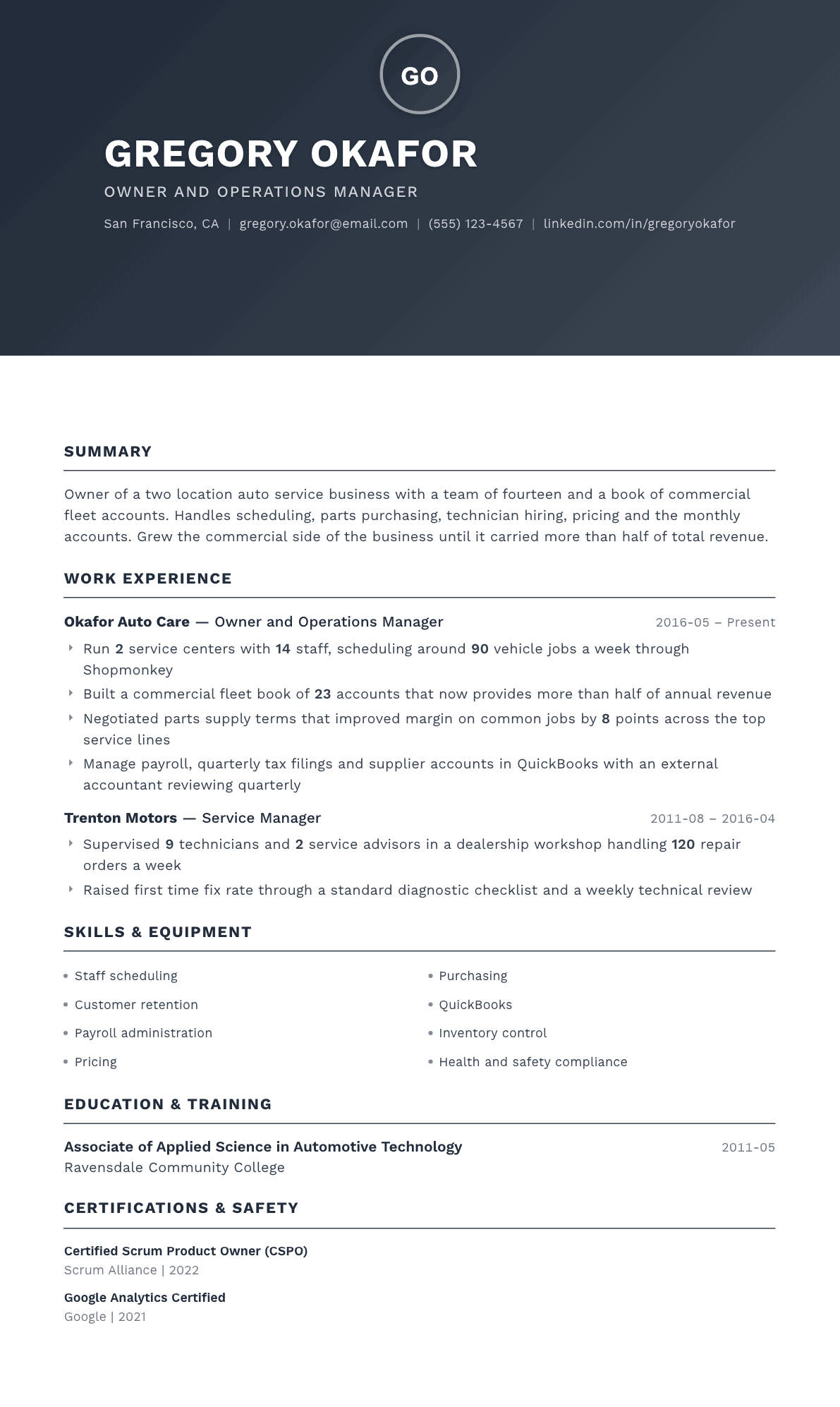
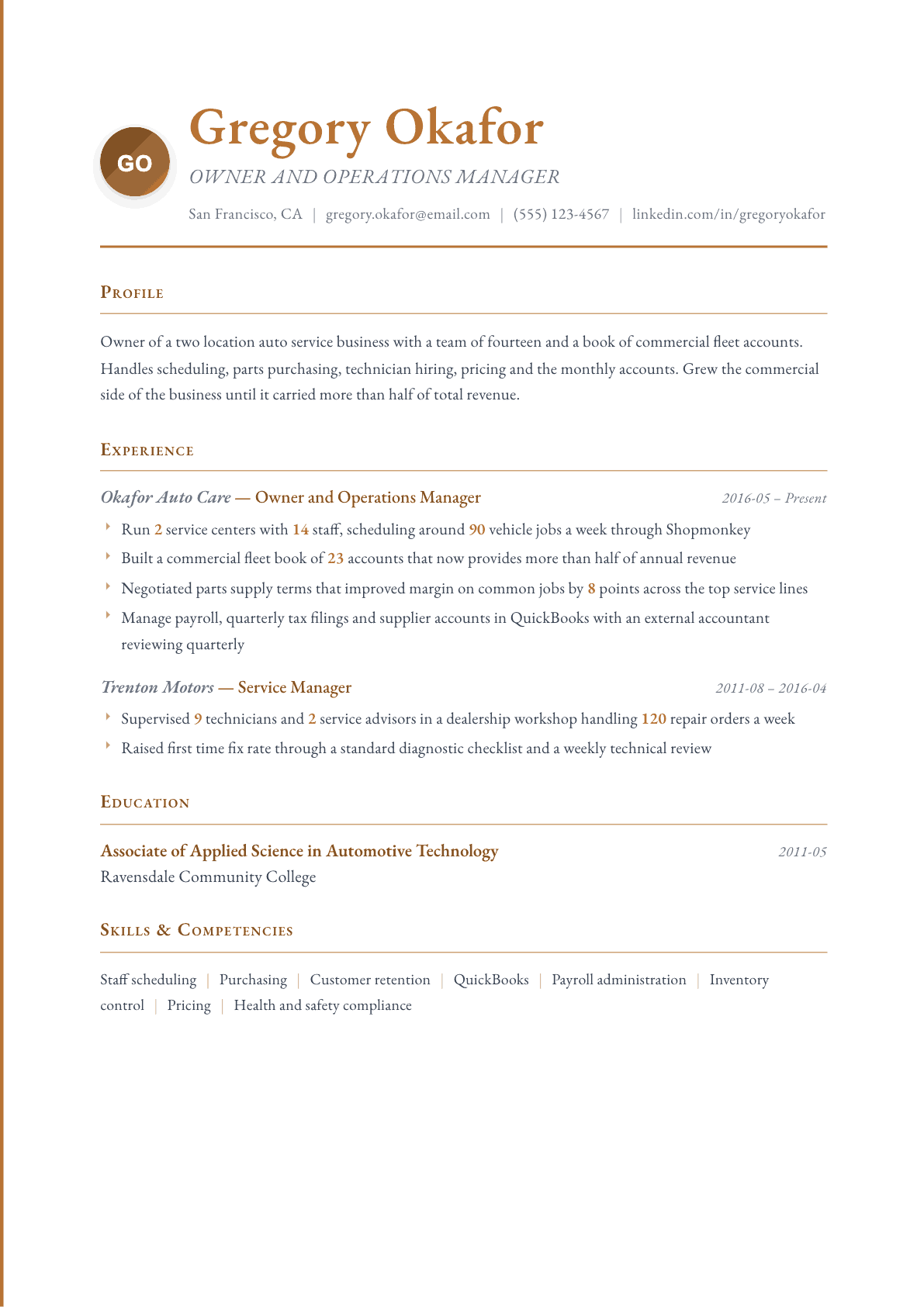
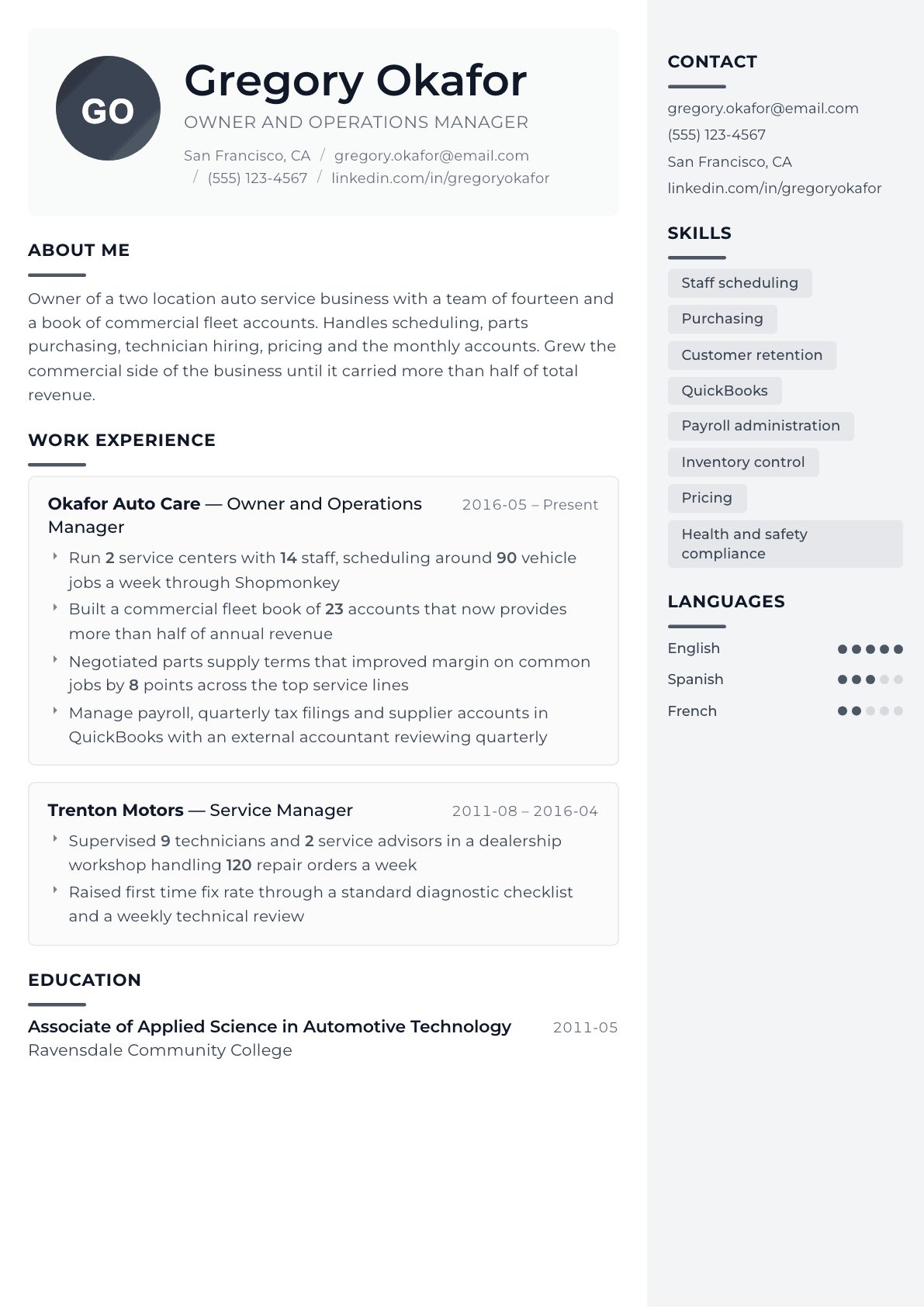
The same small business owner content laid out in three CVBooster templates, so you can see what the finished document looks like before you write a word.
Example Small Business Owner summary
Small business owner running two auto service centers with fourteen staff and a commercial fleet book of more than twenty accounts. Handles hiring, scheduling, parts purchasing, pricing and the monthly accounts, and improved margin on core service lines through renegotiated supply terms. Ten years of workshop management before that. Ready to bring the same operating discipline to a multi site service management role.
Skills to list on a Small Business Owner resume
- Small business management
- Profit and loss ownership
- Staff scheduling
- Hiring and training
- Inventory control
- Purchasing and supplier management
- Customer retention
- Pricing and quoting
- Payroll administration
- QuickBooks
- Point of sale systems
- Cash handling and reconciliation
- Local marketing
- Regulatory compliance
What actually gets this resume read
- Give the business a size line covering staff, locations and rough annual revenue so the reader can judge the scope.
- Use a job title that describes the function you performed rather than the word owner on its own.
- Show the systems you ran the business on, because employers screen for accounting, scheduling and point of sale tools.
- Include the compliance work you handled, such as payroll filings, licensing, insurance renewals and safety records.
- Describe a full week of your work, since owners cover selling, hiring and bookkeeping in a way employees rarely do.
- Add references from suppliers or commercial customers when you have no former manager who can speak for you.
How to write a small business owner resume
Someone who has run a small business for years has done more management than most applicants with a management title, and yet the resume often reads thinner. The reason is that owners describe their business rather than their work. A reader learns that you had a shop, a workshop or a salon, and learns almost nothing about the scheduling, purchasing, hiring, pricing and compliance you handled every week to keep it open.
Hiring managers also carry a quiet question about owners: will this person accept a boss, a rota and a policy manual? You answer that by describing your work in the vocabulary of the role you want. An owner who writes about staff scheduling, stock control, supplier terms and cash reconciliation is speaking the language of an operations or store management posting, and reads as a peer rather than as an outsider.
This guide covers how to size the business on the page, which functions to lead with for different target roles, how to handle references when you had no manager, and the questions owners ask when they return to employment after years of self employment.
Format: a business line, then the functions you owned
Write the business as a normal job entry with a title, dates and a one line description underneath. That description carries the scale: staff numbers, locations, opening hours, customer volume and rough annual turnover as a band. Scale is what lets a reader compare you against the store or site they are hiring for.
Give yourself a functional title. Owner and operations manager, owner and store manager, or proprietor and workshop supervisor all keep the ownership honest while giving an applicant tracking system a title that matches the posting. Then group your bullets by function so a screener can find the parts they care about without reading everything.
- Business line: staff, sites, weekly volume, turnover band, years trading.
- Function groups: people, operations, purchasing, finance, customers, compliance.
- Systems: accounting, scheduling, point of sale, booking and inventory tools by name.
People: the management evidence employers look for hardest
Staff work is the strongest transferable evidence an owner has, and it is the part most often left off. Say how many people you hired, how you recruited them, how you built the rota, how you handled training and probation, and what you did when performance slipped. Employers hiring supervisors want proof you have had the difficult conversation, not just that you had staff.
Include the administrative side of employment. Payroll runs, contracts, holiday tracking, sick cover and statutory filings are exactly the tasks a supervisor role includes, and an owner has usually done all of them without an HR department to lean on.
- Headcount hired, trained and supervised, split by function if useful.
- Rota and cover planning across opening hours or shifts.
- Payroll, contracts, holiday and absence administration.
Money and stock: run the business on numbers, then say so
Owners often manage margin instinctively and then fail to write it down. Put the numbers back in. Gross margin by service or product line, cost of goods after a supplier renegotiation, average transaction value, stock turns, and the effect of a price change are all things a store or operations manager is measured on, and you were measured on them by the bank balance.
Name the tools you did this in. QuickBooks, Xero, Square, Shopify, Lightspeed, Shopmonkey and similar systems appear directly in job postings, and an owner who names the platform reads as somebody who can be dropped into an existing system rather than trained from scratch.
If you handled compliance, list it: licensing, insurance renewals, food safety records, health and safety assessments, waste handling, tax filings. This is unglamorous work that a hiring manager knows is a genuine risk when it is done badly.
Aiming the resume at the role you actually want
The same business supports several different resumes. Applying for a store manager job means leading with staffing, stock, till reconciliation and customer service standards. Applying for a purchasing role means leading with supplier negotiation, terms, order volumes and inventory turns. Applying for a sales role means leading with the accounts you won and the quoting you did.
Trim what does not serve the target. An owner has done everything, and a page that includes everything makes the reader hunt for the relevant part. Two functions in depth beat six functions in one line each.
- Operations roles: scheduling, process, quality, site coverage, supplier reliability.
- Retail roles: sales per week, stock control, shrinkage, till and banking, merchandising.
- Commercial roles: accounts won, quoting, pricing, contract terms, retention.
Business owner resume example: the top third of the page
A resume for the owner of a business has one job in its top third: tell a hiring manager what kind of business it was, how big, and which functions you ran yourself. Employers reading a business owner resume example are checking whether you can work inside a structure again, so give them the size and the systems before anything else.
Below is how that top third reads on a resume for the owner of a small business. The business line carries the facts, the summary aims at the job you want, and the first experience bullets show people and money.
- Business line: Owner, Harbor Street Bakery, eight years. Retail bakery and wholesale to 14 cafes, 9 staff, two locations.
- Summary: Owner operator moving into a retail operations manager role, with eight years running hiring, scheduling, purchasing and the books for a two-site food business.
- First bullet: Hired, trained and scheduled a team of 9, with four staff staying five years or more.
- Second bullet: Ran purchasing and stock for both sites, renegotiating flour and dairy contracts each year.
- Third bullet: Kept the books in QuickBooks and worked with an outside accountant on quarterly taxes and year end.
Small Business Owner resume summary examples
Three years trading
Owner of a mobile coffee business trading six days a week at markets and corporate sites, with two part time staff. Handles stock purchasing, pitch bookings, food hygiene records and daily banking, and grew from one location to four regular pitches. Seeking a supervisor role in hospitality operations.
Ten years, one site
Owner and manager of a nine person auto workshop handling around ninety jobs a week, running scheduling, parts purchasing, quoting and payroll. Built a commercial account book that now carries more than half of revenue and improved margin on core jobs through renegotiated supply terms. Targeting a service manager position.
Multi site owner
Owner of a two site retail and service business with fourteen staff and a turnover in the low millions, trading for nine years. Owns hiring, rotas, purchasing, pricing, compliance and the monthly accounts, working with an external accountant on quarterly review. Ready for a multi site operations management role in an established group.
Work experience bullets: before and after
Before: Ran my own shop.
After: Ran a two site auto service business with fourteen staff, scheduling around ninety vehicle jobs a week through Shopmonkey and covering both sites across a six day trading week.
The rewrite adds sites, headcount, weekly volume and the system, which together let a reader size the operation.
Before: Did the hiring and staff management.
After: Recruited and trained fourteen staff across technician and front desk roles, built the weekly rota around six day opening, and managed two underperforming hires through a documented improvement process.
It shows recruitment, scheduling and the difficult end of people management rather than the word management alone.
Before: Handled ordering from suppliers.
After: Negotiated parts supply terms with four main distributors, moved high volume items onto account pricing and improved margin on the top service lines by eight points.
Supplier work becomes commercial evidence when the negotiation, the change and the margin effect appear together.
Before: Kept the books and did the taxes.
After: Managed payroll, supplier accounts and quarterly tax filings in QuickBooks, reconciling daily takings and working with an external accountant on quarterly reviews.
Naming the system, the cadence and the external review makes the finance work verifiable rather than assumed.
Before: Grew the customer base.
After: Built a commercial fleet book of 23 accounts through direct outreach to local operators, growing it until it carried more than half of annual revenue.
The strong version names the channel, the account count and the share of revenue the new business represents.
Hard skills
- Profit and loss management
- Staff scheduling and rota planning
- Hiring and training
- Inventory and stock control
- Purchasing and supplier negotiation
- Pricing and quoting
- Payroll administration
- Cash handling and reconciliation
- QuickBooks and point of sale systems
- Regulatory and licensing compliance
- Health and safety records
- Local marketing and customer retention
Soft skills
- Customer service under pressure
- Practical problem solving
- Reliability and follow through
- Difficult conversations with staff
- Time management across competing tasks
Certifications worth listing
- QuickBooks Certified ProAdvisor (Intuit)
Mistakes that cost small business owner candidates the interview
- Describing the business and never describing the work, which leaves the reader without evidence of management.
- Using only the word owner as a title so no posting keyword ever matches the entry.
- Skipping headcount, sites and weekly volume, which are the numbers a hiring manager compares you against.
- Leaving out named software when postings screen on accounting, booking and point of sale systems directly.
- Writing every function at equal length instead of leading with the two the target role is about.
- Failing to explain why you are returning to employment, which leaves an obvious question unanswered.
Small Business Owner resume questions
What job title should a small business owner put on a resume?
Pair ownership with the function, such as owner and operations manager or proprietor and store manager. That keeps the entry truthful while matching the words a recruiter and an applicant tracking system are searching for.
Who do I give as a reference if I never had a manager?
Use suppliers, commercial customers, your accountant, or a landlord you dealt with for years. They can speak to reliability, payment behavior and how you handled problems, which is what a reference call is really testing.
How do I write a resume as the owner of a business?
Open with a business line: name, type, years, staff and locations. Write a summary aimed at the job you want, not at running a business. Then group experience by function, such as people, money and stock, and customers, with a number in each bullet. Say plainly whether the business is open, sold or closed.
How do I show revenue without publishing my accounts?
Use a turnover band rather than an exact figure, and add the trend across trading years. A reader needs the scale and the direction to judge the role, and a band gives both without exposing anything you would rather keep private.
Will an employer think I am overqualified or hard to manage?
Address it in the summary by naming the role you want and what draws you to it, such as scale, stability or a specific function. Then keep your bullets in the employer vocabulary so the page reads as a peer applying, not an outsider.
Related resume examples
- Operations Manager Resume example
- General Manager Resume example
- Entrepreneur Resume example
- Business Consultant Resume example
- Management Trainee Resume example
- Assistant Manager Resume example