CPA Resume Examples: what a hiring manager reads first
CPA Resume With Public Accountant Resume Examples
By Mustafa Tarabya, founder of CVBooster · Published · Updated
CPA resume example plus public accounting resume examples for audit staff, tax senior and audit manager, with license line, engagements and keywords.
Sample resumes for a cpa
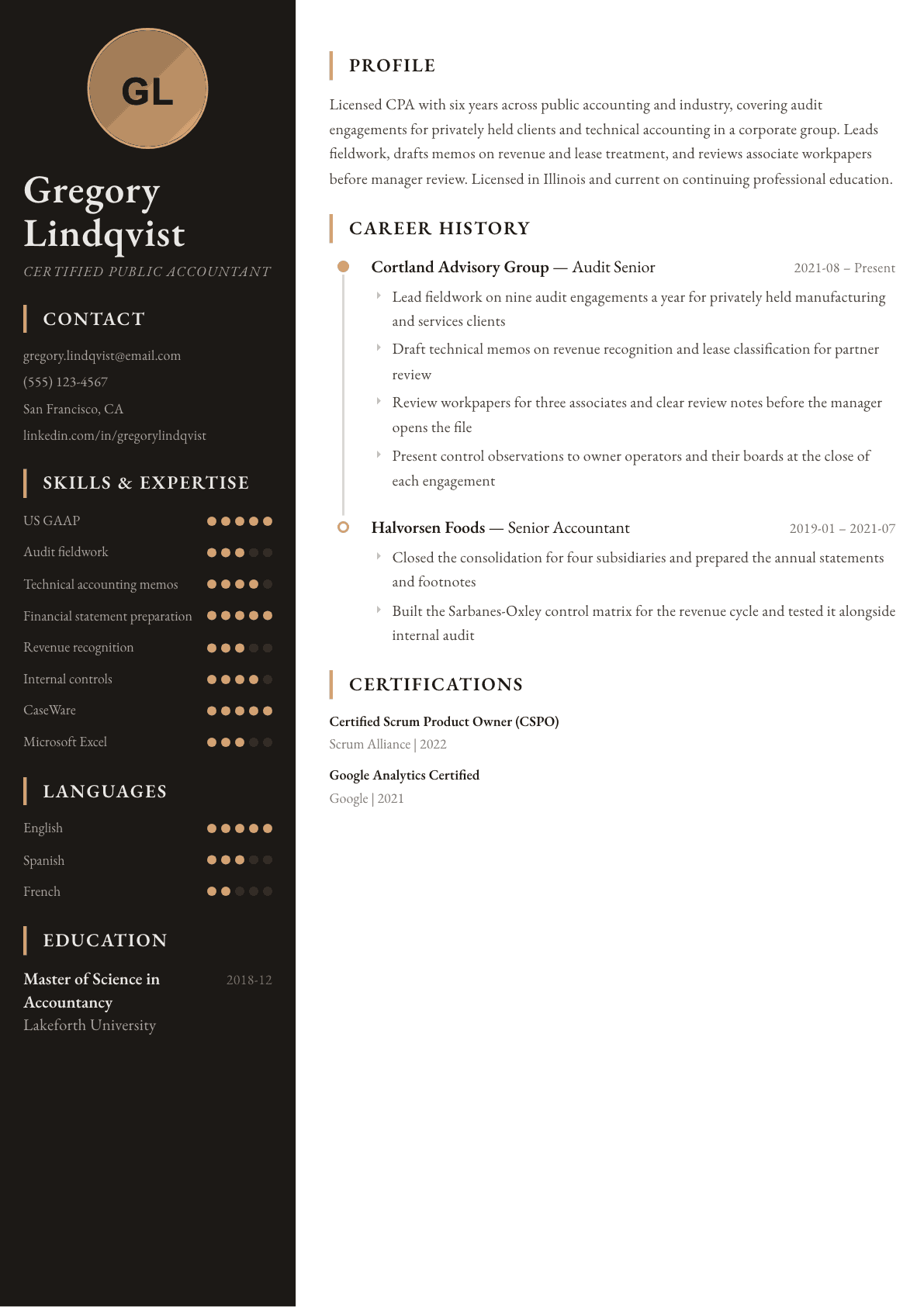
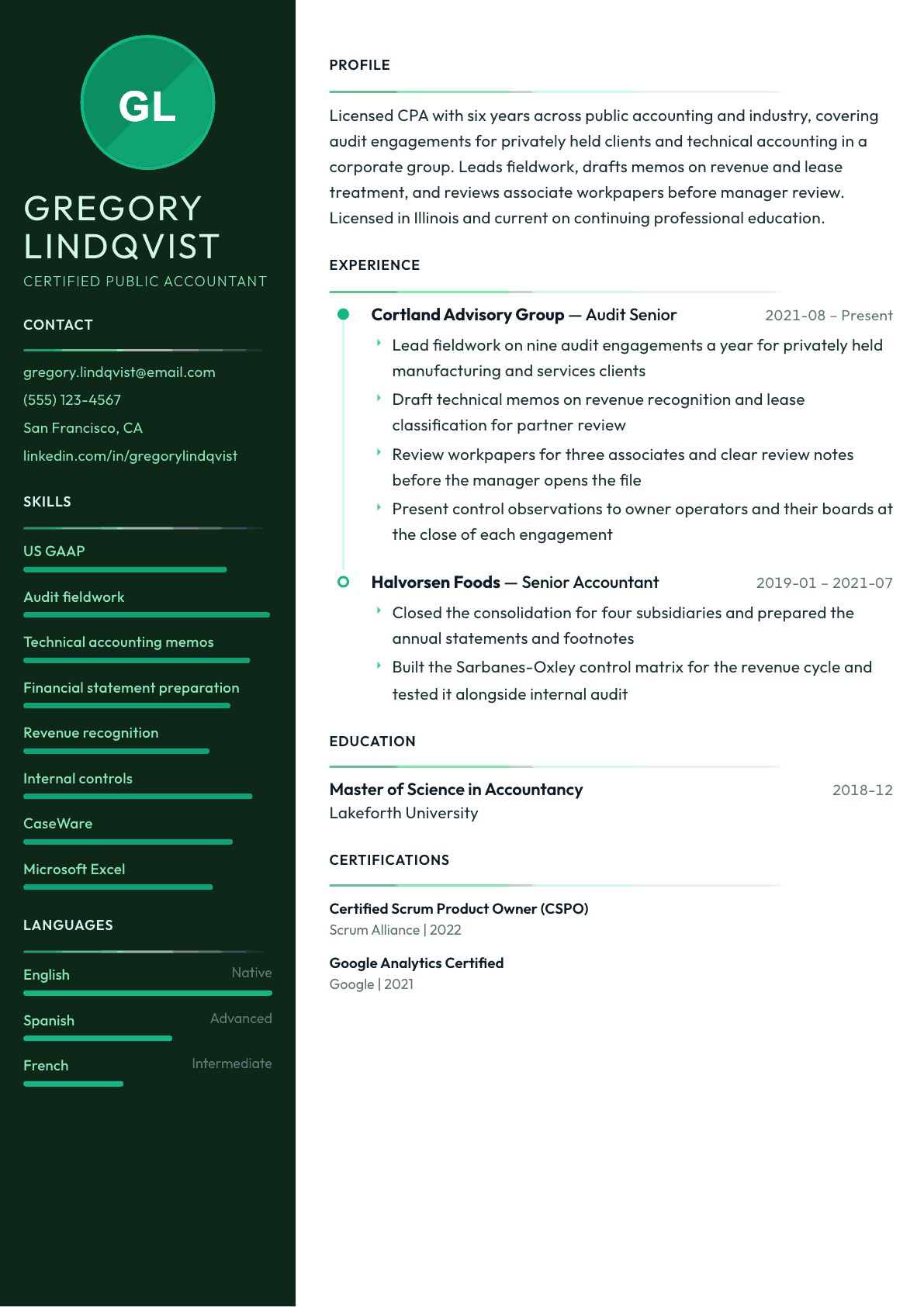
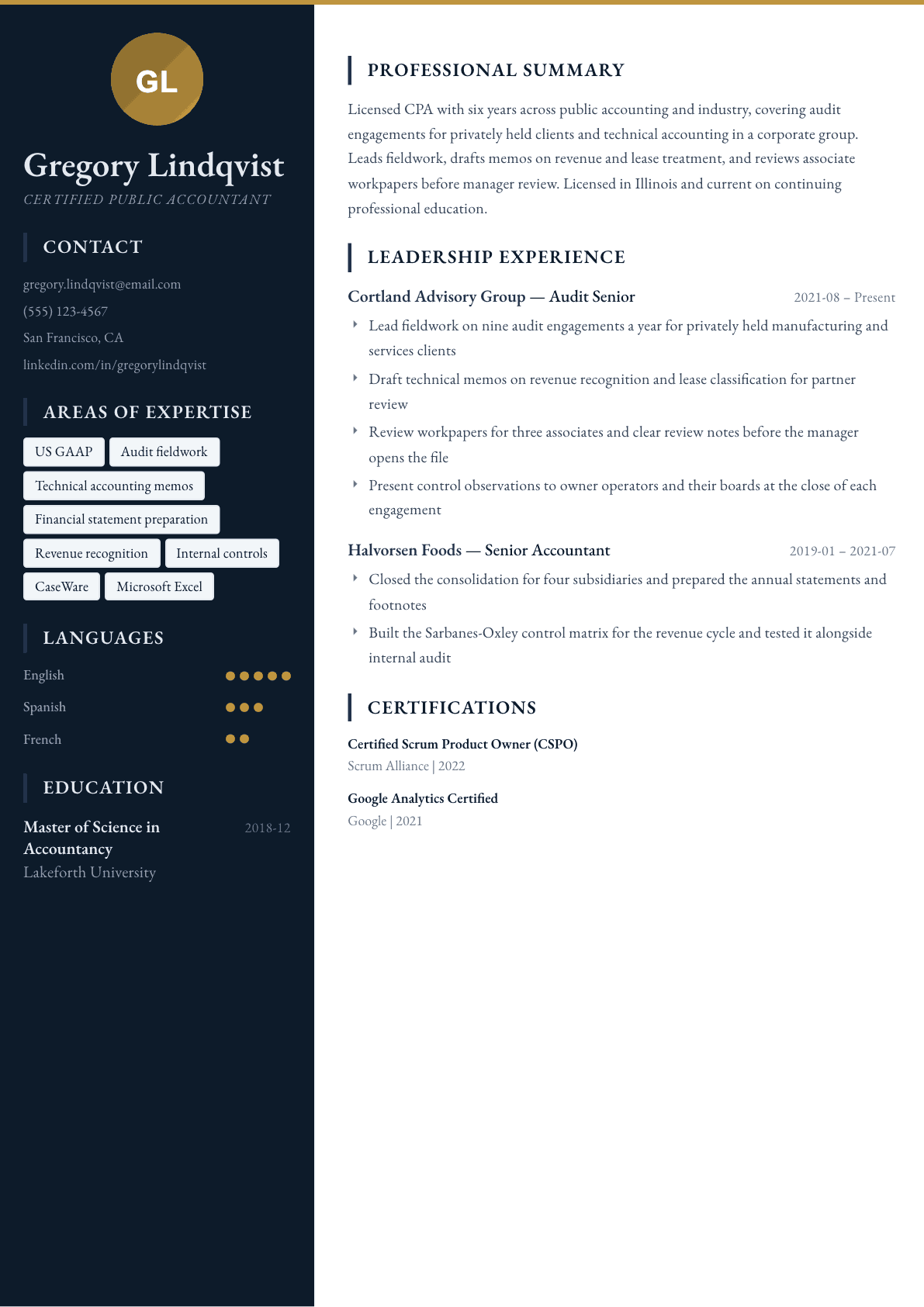
The same cpa content laid out in three CVBooster templates, so you can see what the finished document looks like before you write a word.
Example CPA summary
Licensed CPA with six years across public accounting and industry. Leads fieldwork on nine private company audits a year, drafts technical memos on revenue and lease treatment, and reviews associate workpapers before manager review. Previously closed a four subsidiary consolidation and built the revenue cycle control matrix. Licensed in Illinois and seeking a technical accounting manager role.
Skills to list on a CPA resume
- US GAAP
- Financial statement preparation
- Audit planning and fieldwork
- Revenue recognition (ASC 606)
- Lease accounting (ASC 842)
- Technical accounting research
- Internal controls (SOX)
- Consolidations
- Income tax provision (ASC 740)
- Workpaper review
- CaseWare
- Microsoft Excel
- Client presentation
- Engagement budgeting
What actually gets this resume read
- Put CPA after your name in the header and name the state board that issued your license.
- Add a credentials line with license status, jurisdiction and any reciprocal licenses you hold elsewhere.
- Distinguish public accounting from industry, since firms and corporate teams weigh the same years differently.
- Quantify engagements: client count, client size, industries covered and the role you held on each team.
- Name the technical standards you have applied by their reference, because that is how technical screens work.
- List continuing professional education only when a course matches the posting, not the whole transcript.
How to write a cpa resume
A CPA resume carries a credential that already answers several questions, so the page has a different job than a general accounting resume. Nobody needs convincing that you understand debits and credits. What a partner or a corporate hiring manager wants to establish is which technical areas you have applied, at what client or entity size, and whether you can write and defend a position rather than only apply one.
The license also needs handling with care. State board, active status, and any reciprocal license belong in the top inch of the page, because firms and public companies have hard requirements about who can sign, review or represent. A resume that leaves the reader searching for the jurisdiction gets set aside.
This guide covers where the license goes, public accountant resume examples from staff to manager, how to write engagement and technical work so it reads as depth rather than a list of standards, and how to position a move between public accounting and industry without losing what the other side values.
Put the license where it cannot be missed
Write CPA after your name in the header. Then add a short credentials line under the contact details giving the issuing state board, active status, and any other jurisdiction where you hold a license or a practice privilege. If you are licensed in more than one state, list all of them, because that flexibility is a hiring advantage for firms serving clients across state lines.
Keep continuing professional education out of the main body unless a course is directly relevant to the posting, such as a specialized standard or an industry certification track. A transcript of hours takes space that engagement detail deserves.
- Header: name followed by CPA, city and state, phone, email.
- Credentials line: issuing state board, license status, additional jurisdictions.
- Sections: summary, technical expertise, experience, education, then any additional credentials.
Summary: track, technical areas and the size of what you touched
State the track first, because public accounting and industry are read as different careers. Then name the technical areas you own and the client or entity profile: privately held manufacturing clients, a public filer, a group with foreign subsidiaries, or nonprofit and single audit work.
One line of technical specificity is worth a paragraph of general competence. Naming revenue recognition for milestone contracts, lease classification, business combination purchase accounting or the income tax provision tells a reviewer exactly which conversations you can hold on day one.
Engagements: role on the team, client profile, and outcome
For public accounting experience, each role needs the number of engagements you carry in a year, the client industries and sizes, and where you sat on the team. Leading fieldwork, reviewing associate workpapers, drafting memos for partner review and presenting to an owner or an audit committee are four different levels of responsibility, so name yours.
Add the parts of engagement management that firms weigh: budget and realization, scheduling staff, clearing review notes before the manager opens the file, and turning around client requests. Technical ability is assumed of a CPA. Running an engagement without slippage is what earns a promotion.
For industry experience, replace engagement counts with entity structure, close ownership, reporting deliverables and the audit relationship from the client side. A CPA in industry is hired to be the person who can answer the auditor rather than the person who asks.
Technical writing: memos, positions and research
The skill that distinguishes a CPA on paper is written technical judgment. Say which memos you have drafted, what question each answered, and who reviewed or relied on them. A memo supporting a revenue recognition conclusion on a new contract type, or a lease transition position, is concrete evidence of research ability.
Mention the research tools you use and how a position gets supported: reading the standard, checking implementation guidance, and documenting the conclusion so it survives review. Employers hiring a CPA for a technical seat are buying that documentation habit.
Positioning a move between public accounting and industry
Moving from a firm into industry means translating engagements into operating work: audits become close cycles, client deliverables become internal reporting, and workpaper review becomes staff review. Rewrite the bullets in that language rather than expecting the reader to make the leap.
Moving from industry back into a firm means restoring engagement vocabulary: scope, risk assessment, testing, review notes and client management. Keep the industry depth as a differentiator, because a firm serving that sector values someone who has lived inside its accounting.
Public accountant resume examples: staff, senior and manager
A public accountant resume is read by a firm recruiter and then a manager or partner, and both look for the same things in the same order: license or exam status, service line, client industries and sizes, and your level on the engagement team. The four public accountant resume examples below are invented. Keep the order and replace every detail with your own firm, clients and numbers.
Notice how each level changes the bullets. Staff accountants write the areas they tested and the workpapers they prepared. Seniors write the engagements they ran in the field and the staff they reviewed. Managers write the portfolio, the budget, the client relationship and the people they develop. A CPA accountant resume that writes manager work in staff language undersells the license.
- Audit staff, CPA exam candidate: Audit Associate, a regional CPA firm, two years. Tests cash, receivables, inventory and revenue on eight audits a year for manufacturing and nonprofit clients; prepares workpapers in CaseWare for senior review; passed three of four CPA exam sections, last section scheduled.
- Tax senior, CPA: Tax Senior, a mid sized public accounting firm, four years. Prepares and reviews partnership, S corporation and individual returns for about 60 clients, drafts the tax provision for two private equity backed companies, and trains three staff each busy season.
- Audit manager, CPA: Audit Manager, a national CPA firm, eight years. Manages a portfolio of eleven audit and review engagements for privately held companies with revenue from 20 to 300 million dollars, owns budgets and billing, presents findings to owners and audit committees, and leads the office staff training program.
- Small firm generalist, CPA: Staff Accountant, a five person local CPA practice, three years. Prepares compilations and reviews for about 30 small business clients, individual and business tax returns each season, monthly bookkeeping cleanups and payroll filings, and is the first contact for clients who walk in with a shoebox of receipts.
- Every sample keeps a credentials line under the name: CPA with the issuing state board and status, or the exam sections passed and the date of the next one for candidates.
CPA resume summary examples
Newly licensed
Newly licensed CPA with two busy seasons as an audit associate on privately held manufacturing and distribution clients. Tested revenue, inventory and payroll cycles, prepared workpapers for senior review, and drafted the first draft of financial statements and footnotes. Seeking an audit senior track.
Audit senior
CPA with six years across public accounting and industry, leading fieldwork on nine private company audits a year and reviewing workpapers for three associates. Drafts technical memos on revenue recognition and lease classification for partner review, and presents control observations to owner operators.
Technical accounting lead
CPA and technical accounting lead for a group with foreign subsidiaries, owning the accounting position library, the income tax provision review and the annual statements. Resolved the transition to a new lease standard across a property portfolio and manages the external audit as the client side owner.
Work experience bullets: before and after
Before: Performed audit procedures for various clients.
After: Led fieldwork on nine annual audits a year for privately held manufacturing and services clients, owning risk assessment through to the draft statements.
Engagement count, client profile and the span of the work show the level you actually operate at.
Before: Familiar with ASC 606.
After: Drafted the revenue recognition memo for a new milestone contract type under ASC 606 and carried the position through partner review and the audit file.
A written deliverable that survived review proves technical judgment where a familiarity claim proves nothing.
Before: Reviewed work of junior staff.
After: Reviewed workpapers for three associates each engagement and cleared review notes before the file reached the manager, keeping engagements inside budget.
Review volume plus the budget outcome shows engagement management, not only technical checking.
Before: Prepared financial statements.
After: Prepared the consolidated statements and footnotes for four subsidiaries, including the segment and related party disclosures reviewed by the audit team.
Naming the entity count and the specific disclosures makes the reporting work verifiable.
Before: Worked on internal controls.
After: Built the Sarbanes-Oxley control matrix for the revenue cycle, walked each control with the process owner, and tested design alongside internal audit.
The cycle covered and the testing partner turn a vague controls claim into a documented project.
Hard skills
- US GAAP application and research
- Audit planning and risk assessment
- Fieldwork execution and workpaper review
- Financial statement and footnote preparation
- Revenue recognition under ASC 606
- Lease accounting under ASC 842
- Income tax provision under ASC 740
- Consolidations and foreign currency translation
- Internal control design and testing
- Technical accounting memo drafting
- CaseWare
- Microsoft Excel
Soft skills
- Defending a technical position
- Client and auditor communication
- Engagement budget discipline
- Coaching associates through review notes
- Professional skepticism
Certifications worth listing
- Certified Public Accountant (CPA) (State Boards of Accountancy)
- Certified Internal Auditor (CIA) (Institute of Internal Auditors)
- Certified Fraud Examiner (CFE) (Association of Certified Fraud Examiners)
- Chartered Global Management Accountant (CGMA) (American Institute of Certified Public Accountants)
- Enrolled Agent (EA) (Internal Revenue Service)
Mistakes that cost cpa candidates the interview
- Hiding the licensing state, which matters to firms and filers with hard requirements about who may sign or review.
- Listing standards as a competency block without a single memo, transaction or conclusion attached to any of them.
- Describing engagements without client size or industry, so a partner cannot judge the complexity you have handled.
- Pasting continuing education hours into the body where engagement detail should be.
- Keeping firm vocabulary when applying to industry, so a controller has to translate the resume herself.
- Treating the credential as the whole argument, when hiring decisions turn on what you did with it.
CPA resume questions
Where exactly should CPA appear on the resume?
After your name in the header, then again in a credentials line with the issuing state board and active status. Repeating it once is useful because tracking systems and human readers scan different parts of the page.
Should I list my CPA license number?
It is not required and most candidates leave it off. State, status and any additional jurisdictions give an employer everything needed to verify you through the public board register during the offer stage.
How do I present public accounting years to an industry employer?
Translate the work into the reader language: audits become close cycles you now understand from both sides, and client deliverables become reporting packages. Keep the technical depth but describe it as capability you bring in house.
Is an inactive CPA license worth including?
Yes, marked clearly as inactive with the state. It still evidences that you passed the exam and met the experience requirement, and many employers will accept an inactive license for roles that do not require signing authority.
How do I write a public accounting resume before I am a licensed CPA?
Write CPA candidate or the sections passed in the credentials line, with the date of the next exam, and keep the structure of a CPA resume: service line, clients, engagement role and areas tested. Keep it to one page early in your career. Firms hire candidates every season and expect the license to follow.
Related resume examples
- Accountant Resume example
- Auditor Resume example
- Tax Manager Resume example
- Financial Controller Resume example
- Accounting Manager Resume example
- Audit Manager Resume example