Accounting Manager Resume Examples: the lines they read
Accounting Manager Resume and a CV Sample for Accounting Roles
By Mustafa Tarabya, founder of CVBooster · Published · Updated
Accounting manager resume example and a CV sample for accounting roles, built on close ownership, team size, audit results and recruiter keywords.
Sample resumes for a accounting manager
The same accounting manager content laid out in three CVBooster templates, so you can see what the finished document looks like before you write a word.
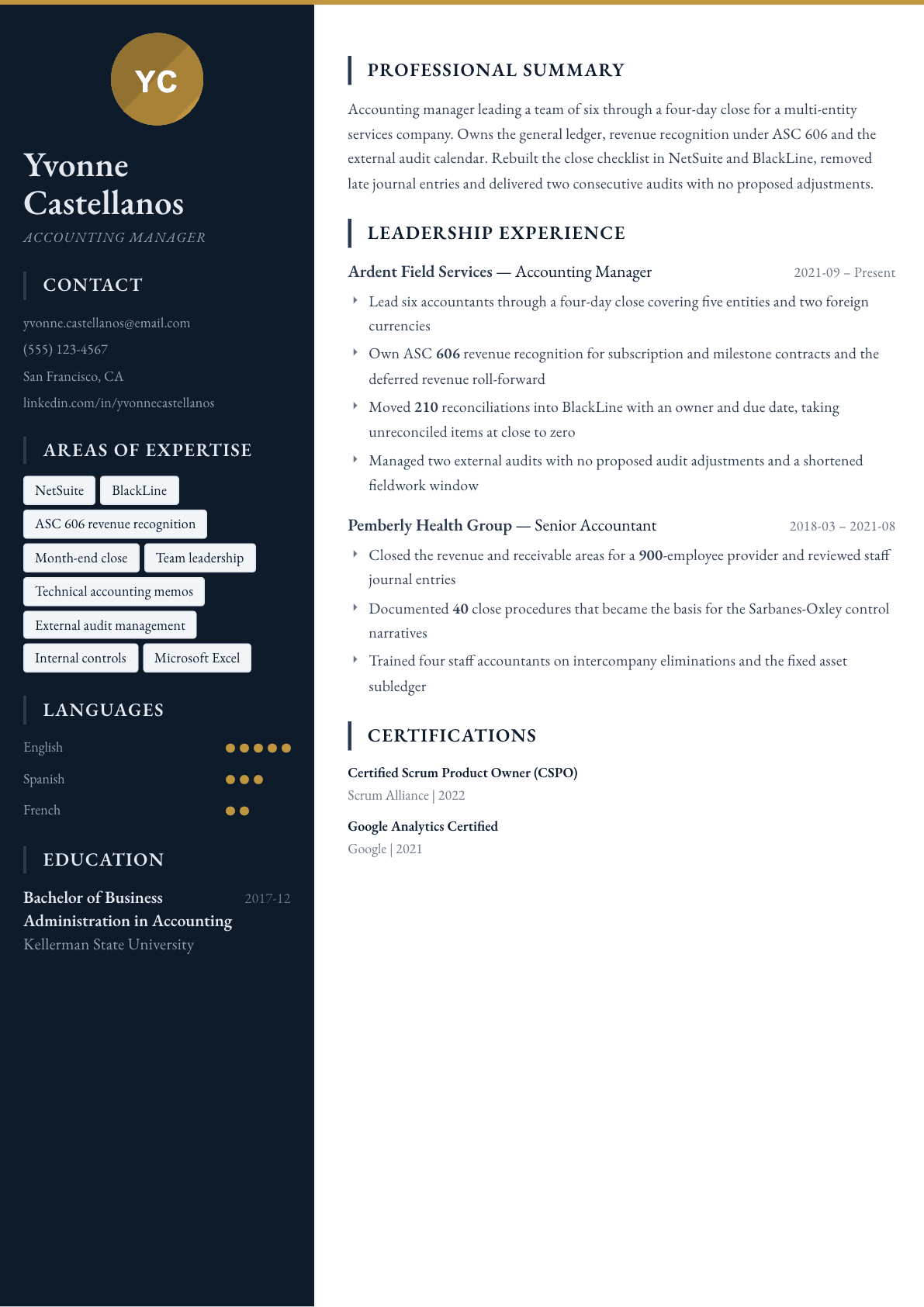
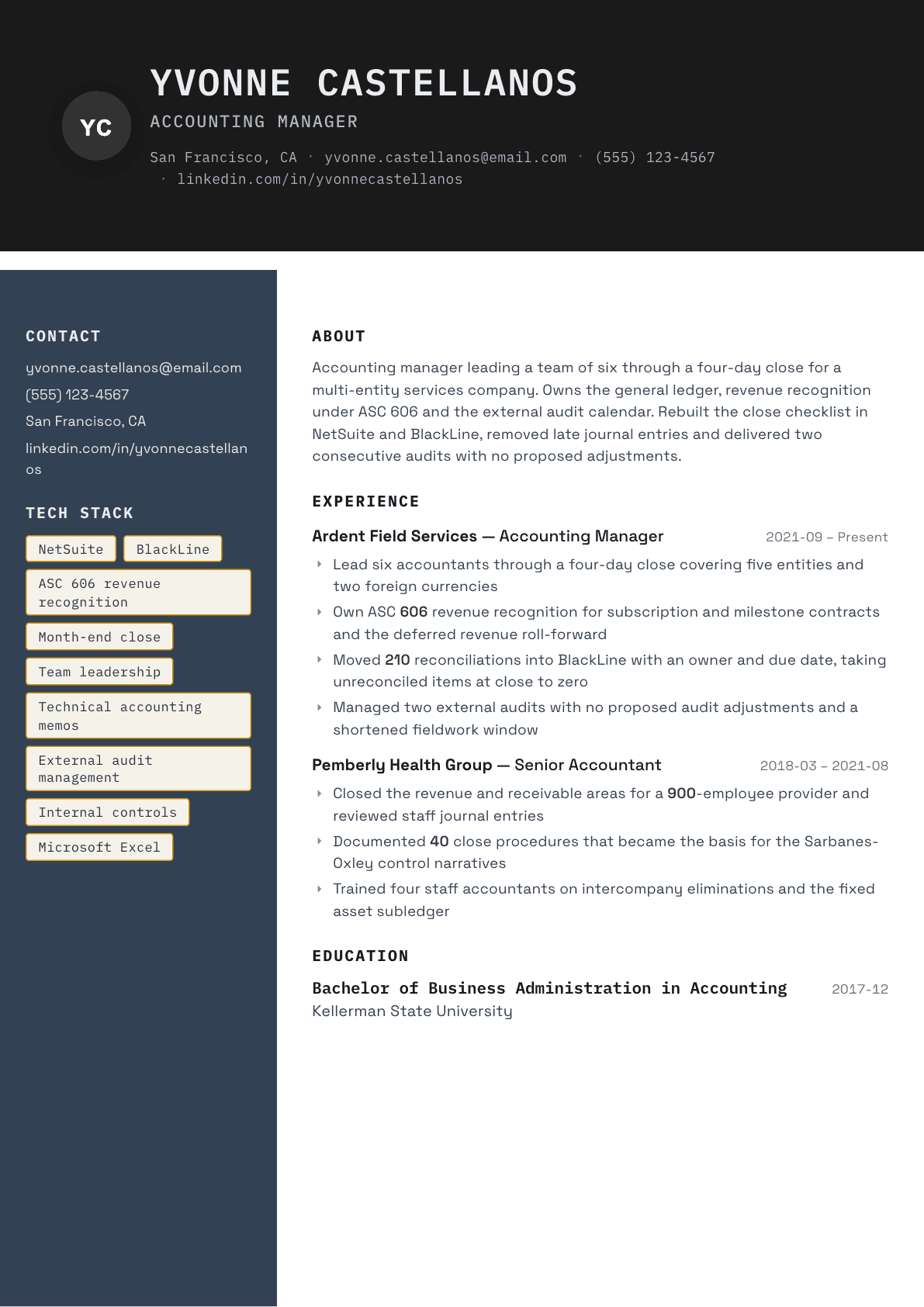
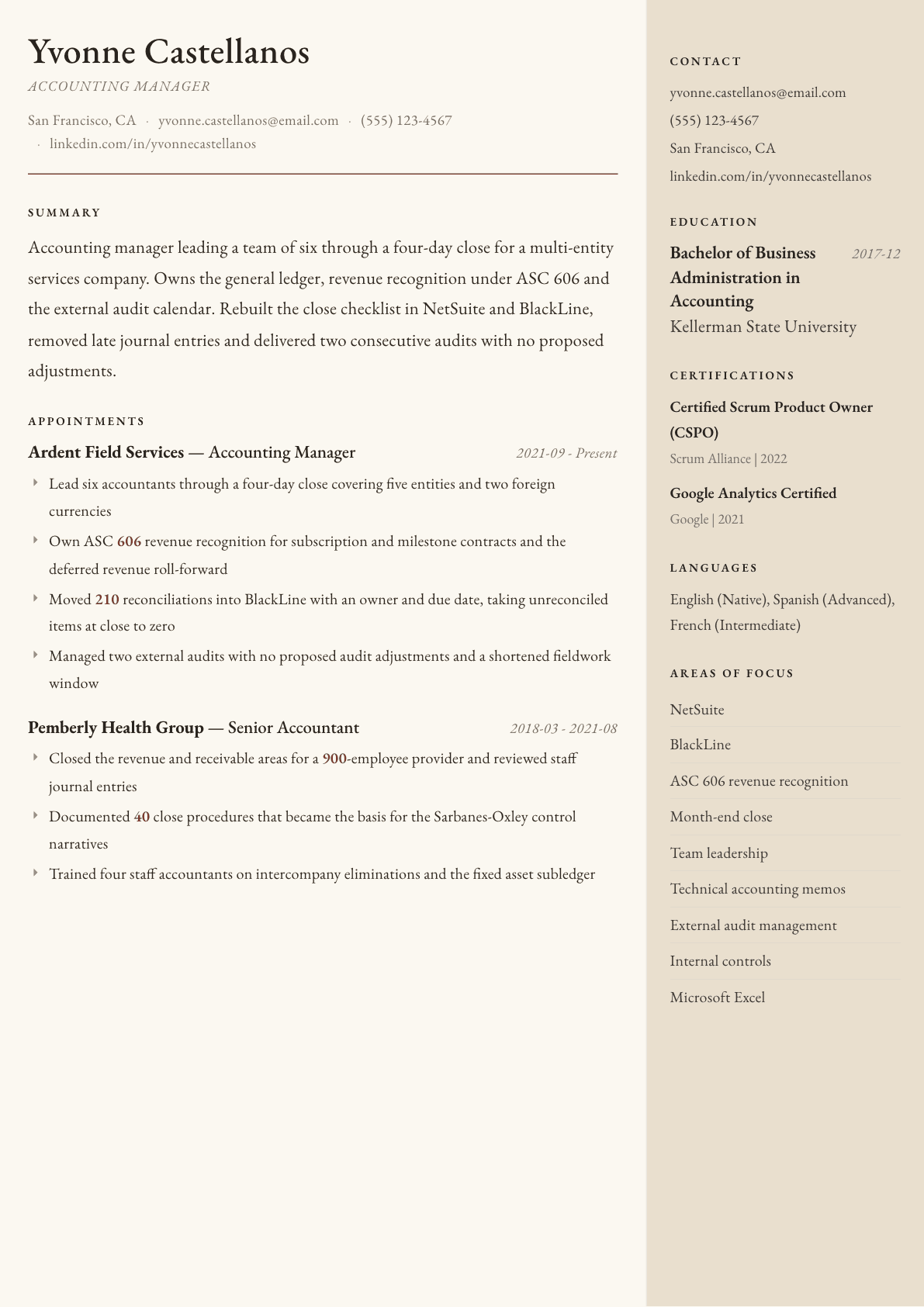
Example Accounting Manager summary
Accounting manager with four years leading a six-person team through a four-day close across five entities. Owns ASC 606 revenue recognition, consolidations and the external audit calendar, and administers reconciliations in BlackLine. Moved the close from a spreadsheet checklist to a controlled workflow and delivered two audits with no proposed adjustments. Looking for a controller track in a growing services business.
Skills to list on a Accounting Manager resume
- Month-end close management
- Revenue recognition (ASC 606)
- Consolidations
- Intercompany accounting
- Technical accounting memos
- Internal controls (SOX)
- External audit management
- Team leadership
- NetSuite
- BlackLine
- US GAAP
- Financial reporting
- Process improvement
- Fixed asset accounting
- Lease accounting (ASC 842)
What actually gets this resume read
- State your team size and the close length, because those two numbers define the job for a finance leader.
- Name the technical areas you own, such as revenue recognition, leases or stock compensation, with the standard.
- Show audit outcomes: adjustment counts, fieldwork length or the control remediation you personally led.
- Describe the close tooling you administer, not only the ERP, since reconciliation platforms are a hiring signal.
- Include the process you rebuilt and what it saved in days, review hours or rework after the first pass.
- Mention how many entities and currencies you consolidate, as that complexity separates similar job titles.
How to write a accounting manager resume
An accounting manager resume is read by a controller or a finance director who is trying to answer two questions at once: can this person run a close without me in the room, and can they hold a team together while doing it. The technical bar is assumed at this level. What gets tested on the page is scope and reliability.
Scope is measured in specific units: entities, currencies, team size, close days, reconciliation counts and the technical areas you personally own. Reliability is measured in audit outcomes, restatements avoided, deadlines held through a system change. Most accounting manager resumes describe responsibilities and skip both, which is why so many strong candidates read as interchangeable.
This guide sets out the section order finance leaders expect, what to write about revenue recognition and controls without drifting into theory, how to show that you have managed people rather than just reviewed their work, and a complete CV sample for accounting roles if you are applying in the UK or anywhere the document is called a CV.
Format and section order for a management-level file
Two pages is normal here, and one page is often a mistake because it forces you to cut the scope details that make the case. Keep a single column, keep dates on the right, and give the current role the most space with earlier roles compressed as you go back.
Order the page as header, summary, core competencies, experience, systems, education and certifications. Core competencies at this level is not a skills dump: it is eight to twelve phrases that match the technical areas the posting names, such as consolidations, revenue recognition, lease accounting and internal controls.
- Header: name, credentials such as CPA or CMA, city and state, phone, email.
- Summary: team size, close length, entity and currency count, the technical areas you own.
- Experience: one scope line per employer, then bullets that separate ownership from oversight.
Summary: the four numbers that define the job
Lead with team size, close length, entity count and the standards you own. A line such as accounting manager leading six accountants through a four-day close for five entities in two currencies, owning ASC 606 revenue recognition tells a finance director more than a paragraph of adjectives.
Add one reliability fact: audits delivered without adjustments, a remediated control deficiency, a close that held through an ERP cutover. That is the sentence that gets you into the interview, because it answers the second question the reader is carrying.
Experience: separate what you own from what you review
Give each employer a scope line before the bullets: industry, revenue size in words, entity structure, headcount reporting to you. Then write bullets that make a clear distinction between the areas you close yourself and the areas you review after a staff accountant prepares them. Managers who blur that line get caught in technical interviews.
Technical bullets should name the standard and the transaction, not just the standard. Owning ASC 606 for subscription and milestone contracts including the deferred revenue roll-forward is a real claim. Familiar with ASC 606 is not. The same applies to lease accounting, stock compensation, business combinations and the income tax provision.
People bullets belong here too. Hiring, onboarding, performance reviews, cross-training between payables and the general ledger, and how long your team has stayed. Retention is a signal a finance director cares about because turnover in accounting costs a close cycle every time.
Controls, audit and the systems you administer
Write the audit relationship as a process you manage: the schedule you set, the prepared by client list you own, the fieldwork window, the number of proposed adjustments. If you have remediated a deficiency or built control documentation for a Sarbanes-Oxley program, describe the cycle covered and who tested it.
For systems, distinguish between the ERP you close in and the tools you administer. Administering reconciliation software, setting up the close checklist with owners and due dates, or configuring approval workflows is manager work. Simply using the ERP is staff work, and the page should show the difference.
Keywords that carry weight in accounting management postings
Recurring terms across these postings include month-end close, consolidations, intercompany accounting, revenue recognition, technical accounting memos, internal controls, external audit management, financial reporting and team leadership. Place each in the competencies block and let at least half of them reappear inside a bullet with a number attached, so the human reader sees substance behind the match.
Example of an accounting CV: one complete page, then a second
In the UK, Ireland and most of Europe the same document is called a CV, and the finance director reading it checks the same things: your qualification status, the size and complexity of the ledgers you run, and whether your close and audit history is clean. A CV for accounting usually opens with a short profile and a qualifications line, because chartered and part qualified status is the first filter on most finance roles there.
The sample below is invented. Keep the order and replace every detail with your own. For a junior accounting role, cut the management lines and lead with your qualification progress and the reconciliations you own.
For an example of an accounting CV below manager level, keep the same order and change the weight: the qualifications line shows exams passed and the next sitting, and the experience bullets show the journals, reconciliations and reports you own rather than a team. The second example at the end of the list is a part qualified assistant accountant applying in the UK.
- Header and profile: Priya Desai, Accounting Manager. Chartered accountant leading a team of five through a five day month end close for a group of six companies in three currencies, with two clean external audits and a finance system migration behind her.
- Qualifications: chartered accountant status, with the professional body named in full and the date you qualified kept in your records; part qualified candidates list the exams passed and the next sitting.
- Experience: Accounting Manager, a professional services group. Owns the general ledger, intercompany reconciliations and the audit file; reviews all balance sheet reconciliations each month; manages two accountants and three assistants.
- Systems: the ledger and consolidation tools you use every week, such as Sage, Xero, NetSuite or SAP, plus advanced Excel.
- Education: degree, university and any accounting exemptions it gave you.
- Second example, profile: Tom Fletcher, Assistant Accountant. Part qualified ACCA accountant with three years in a manufacturing business, preparing month end journals, accruals and balance sheet reconciliations, and the management accounts pack for the finance manager.
- Second example, experience: Assistant Accountant, a food manufacturer. Prepares the fixed asset register and the VAT return workings; reconciles the bank and supplier statements weekly; supports the external auditors with the year end file.
- Second example, qualifications and systems: ACCA with the exams passed and the next sitting named; Sage 200 and advanced Excel, including lookups and pivot tables.
Accounting Manager resume summary examples
New to the title
Senior accountant promoted to accounting manager, leading two staff accountants through a six-day close for two entities. Owns the general ledger, fixed assets and the audit preparation list, and reviews all staff journal entries. Rewrote the close checklist and moved the close forward by two days.
Four years managing
Accounting manager leading six accountants through a four-day close across five entities and two currencies. Owns ASC 606 revenue recognition for subscription and milestone contracts, consolidations and the external audit calendar. Moved 210 reconciliations into a controlled workflow and delivered two audits with no proposed adjustments.
Managing managers
Accounting manager with nine years of leadership across a group of eleven, including two supervisors covering the general ledger and the transaction teams. Owns technical accounting memos, lease accounting under ASC 842 and control documentation. Held a four-day close through an ERP cutover without a restated period.
Work experience bullets: before and after
Before: Managed the month-end close process.
After: Led six accountants through a four-day close covering five entities and two currencies, with every reconciliation signed off before the reporting deadline.
Team size, close length and entity count convert a generic claim into the scope a finance director is buying.
Before: Responsible for revenue recognition.
After: Owned ASC 606 revenue recognition for subscription and milestone contracts, including the deferred revenue roll-forward and the memo supporting each new contract type.
Naming the contract types and the deliverables shows depth that the standard reference alone cannot.
Before: Worked with external auditors.
After: Managed two external audits end to end, owning the prepared by client list and closing fieldwork with no proposed audit adjustments.
The outcome and the artifact you owned make the audit relationship measurable rather than assumed.
Before: Improved accounting processes.
After: Moved 210 reconciliations from spreadsheets into a platform with named owners and due dates, taking unreconciled items at close to zero.
A count, a mechanism and an end state show process work that survived contact with a real close.
Before: Supervised and trained accounting staff.
After: Hired and onboarded four accountants, cross-trained the team across payables and the general ledger, and kept the group intact through two close cycles of system change.
Hiring, cross-training and retention are the management facts a finance director actually weighs.
Hard skills
- Month-end close management
- Consolidations and eliminations
- Revenue recognition under ASC 606
- Lease accounting under ASC 842
- Technical accounting memos
- Internal control documentation
- External audit management
- Financial statement preparation
- NetSuite
- Reconciliation platforms
- Multi-currency accounting
- US GAAP
Soft skills
- Delegating a close area cleanly
- Coaching through review notes
- Hiring and onboarding accountants
- Explaining accounting to operators
- Holding a deadline under pressure
Certifications worth listing
- Certified Public Accountant (CPA) (State Boards of Accountancy)
- Certified Management Accountant (CMA) (Institute of Management Accountants)
- Chartered Global Management Accountant (CGMA) (American Institute of Certified Public Accountants)
- Certified Internal Auditor (CIA) (Institute of Internal Auditors)
Mistakes that cost accounting manager candidates the interview
- Writing a duty list that any accounting manager could claim, with no team size, entity count or close length.
- Saying familiar with a standard rather than naming the transactions you applied it to and the memos you wrote.
- Leaving out audit outcomes, which is the single fastest way for a finance director to judge reliability.
- Compressing to one page and cutting the scope details that justify a management salary.
- Describing people management as supervised staff without hiring, cross-training or retention evidence.
- Listing the ERP as a skill without saying which parts of it you configure rather than simply use.
Accounting Manager resume questions
How long should an accounting manager resume be?
Two pages is normal and expected. Give the current role the most detail, compress each earlier role as you go back, and reduce anything more than a decade old to a single line with the title and employer.
Do I need a CPA to be hired as an accounting manager?
Many postings prefer it and some require it, particularly where technical accounting or audit interaction is heavy. Without one, lead harder on close ownership, consolidations and audit outcomes, and consider the CMA as an alternative credential.
How long should an accounting CV be in the UK?
Two pages at most, and one page is fine for a trainee or an assistant accountant. Lead with a short profile and your qualification status, give the current role the most detail, and leave out a photo, date of birth and references, which UK employers do not expect on the page.
What should a CV sample for accounting include?
A short profile, your qualification status with the professional body named, then experience with the ledgers you own, the close timetable, the team you manage and your audit results. Add the systems you use every week and your education. Describe company size in words rather than figures, with the number of entities and currencies.
What if I manage a team but have no direct reports on paper?
Say so precisely: led a team of four with review responsibility but no formal reporting line. Overstating direct reports gets caught in reference checks, and an accurate description of functional leadership still counts for the role.
Related resume examples
- Controller Resume example
- Accountant Resume example
- Financial Controller Resume example
- Senior Accountant Resume example
- CPA Resume example
- Payroll Manager Resume example